Minimum Wage in the Philippines: The Complete 2026 Guide
This guide breaks down the Philippines’ minimum wage system for 2026, covering the regionalized daily wage structure across all 17 regions, the current rates in Metro Manila (NCR) and key provinces, mandatory employer contributions to SSS, PhilHealth, and Pag-IBIG, compliance requirements under Philippine labour law, penalties for underpayment including double indemnity, 13th month pay and other mandatory benefits, and how minimum wage compares to living costs across major Philippine cities.

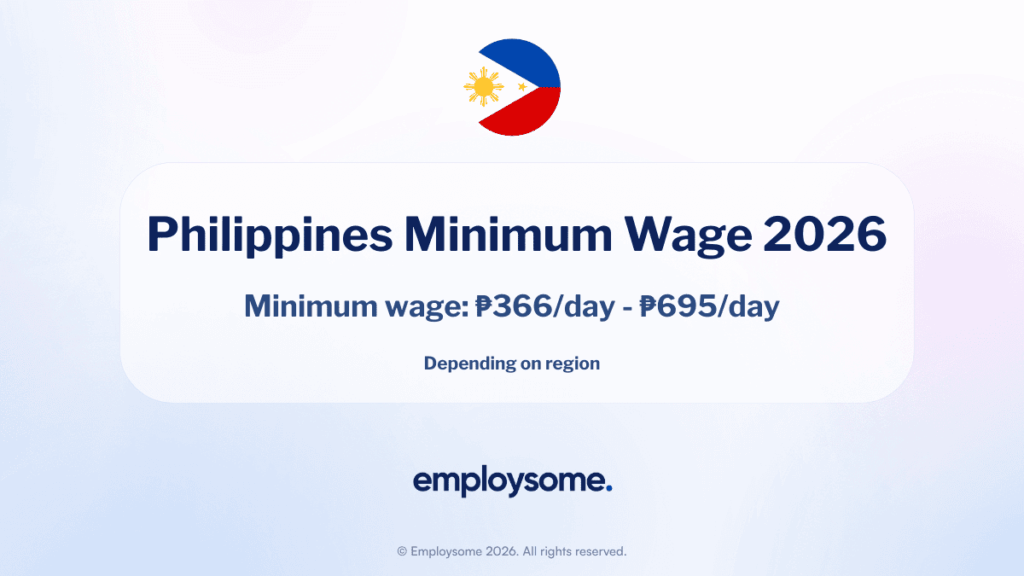
Table of Contents
- Current Rates by Region
- How Minimum Wage in the Philippines Is Calculated
- Employer Statutory Contributions in the Philippines
- Legal Framework Governing Minimum Wage in the Philippines
- Employer Obligations Under Philippine Law
- Penalties for Violating Minimum Wage in the Philippines
- Minimum Wage Philippines vs. Cost of Living
- 2026-2027 Outlook
- Final Takeaway

How Minimum Wage in the Philippines Is Regulated
Unlike most countries that set a single national minimum wage, the Philippines operates a regionalized wage-setting system established by Republic Act No. 6727 (the Wage Rationalization Act of 1989). Under this system, minimum wages are determined independently for each of the country’s 17 administrative regions, reflecting local economic conditions, cost of living, and employment levels.
Each region has its own Regional Tripartite Wages and Productivity Board (RTWPB), a tripartite body composed of representatives from the government, employers, and workers’ groups. The RTWPBs operate under the oversight of the National Wages and Productivity Commission (NWPC), which is attached to the Department of Labor and Employment (DOLE).
Each RTWPB evaluates:
- Consumer price index and inflation trends in the region
- Cost of living and poverty thresholds
- Local labour market conditions and employment levels
- The capacity of businesses, particularly small and medium enterprises, to absorb wage increases
- Productivity and competitiveness of the regional economy
Based on its assessment, the RTWPB issues a Wage Order that sets the minimum daily wage for the region, typically differentiated by sector (non-agriculture, agriculture, retail/service) and by establishment size. There is no fixed annual schedule for wage adjustments. New Wage Orders can be issued at any time, though the NWPC guidelines state that no new Wage Order may be issued within 12 months of the previous one, unless a supervening condition (such as a natural disaster or economic emergency) is declared.
Enforcement of minimum wage in the Philippines is handled by DOLE through routine and complaint-based labour inspections. In 2024, DOLE inspected over 30,000 establishments and issued thousands of compliance orders and wage restitution directives.
Philippines Minimum Wage 2026: Current Rates by Region
As of early 2026, the National Capital Region (NCR / Metro Manila) has the highest minimum wage in the Philippines at ₱695 per day for non-agricultural workers in establishments with more than 15 employees, following a ₱50 increase under Wage Order No. NCR-26, which took effect on 18 July 2025.
The following table summarizes the current daily minimum wage rates across key regions (non-agriculture, larger establishments):
|
Region |
Daily Rate (Non-Agri) |
Notes |
|
NCR (Metro Manila) |
₱695 |
Wage Order NCR-26 (Jul 2025) |
|
CAR (Cordillera) |
₱505 |
Wage Order CAR-24 (Dec 2025) |
|
Region III (Central Luzon) |
₱510-₱570 |
Varies by province/sector |
|
Region IV-A (CALABARZON) |
₱485-₱600 |
Varies by zone |
|
Region IV-B (MIMAROPA) |
₱455 |
Unified rate from Jan 2026 |
|
Region VI (Western Visayas) |
₱520-₱550 |
Post-Nov 2025 adjustment |
|
Region VII (Central Visayas) |
₱468-₱533 |
Varies by area/sector |
|
Region X (Northern Mindanao) |
₱485-₱500 |
Tranche 2 from May 2026 |
|
Region XI (Davao) |
₱483-₱537 |
Wage determination in progress |
|
Region XIII (Caraga) |
₱455-₱475 |
Tranche 2 from May 2026 |
|
BARMM |
₱366-₱411 |
Lowest rates nationally |
Rates for agriculture workers, smaller establishments (15 or fewer employees), and retail/service firms are typically ₱30-50 lower per day than the non-agriculture rate for larger establishments. Each region’s Wage Order specifies the exact rates by sector and establishment size.
Several regions are implementing staggered (two-tranche) increases in 2026. Region X (Northern Mindanao) and Region XIII (Caraga) both have second-tranche increases effective in May 2026. Region IX (Zamboanga Peninsula) has a second tranche in June 2026. Employers in these regions must update payroll when each tranche takes effect.
Important: The minimum wage in the Philippines is set as a daily rate, not monthly or hourly. To calculate the approximate monthly equivalent, multiply the daily rate by the number of working days per month (typically 26 for a six-day work week, or 22 for a five-day week). For NCR at ₱695 per day, this yields approximately ₱18,070 per month (26 days) or ₱15,290 per month (22 days).
How Minimum Wage in the Philippines Is Calculated
The minimum wage in the Philippines applies to the basic daily wage for a standard eight-hour workday. Compliance is assessed against the daily rate prescribed by the applicable Wage Order for the employee’s region, sector, and establishment size.
Key calculation principles:
- Overtime: Work beyond eight hours is compensated at 125% of the daily rate on regular days. Higher premiums apply for rest days (130%), special holidays (130%), and regular holidays (200%).
- Night shift differential: A 10% premium applies for work performed between 10:00 PM and 6:00 AM.
- Holiday pay: The Philippines observes approximately 18 regular and special non-working holidays per year. Regular holiday pay is 200% of the daily rate; special non-working holiday pay is 130%.
- 13th month pay: All rank-and-file employees are entitled to 13th month pay, equivalent to one-twelfth (1/12) of the employee’s total basic salary within a calendar year. This must be paid on or before 24 December each year. The first ₱90,000 is tax-exempt.
- Service incentive leave: Employees who have worked at least one year are entitled to a minimum of five days’ paid service incentive leave per year.
- COLA: Some Wage Orders include a Cost of Living Allowance (COLA) as a separate component on top of the basic minimum wage. COLA is mandatory but is not integrated into the basic wage for computing overtime, holiday pay, and other premiums unless the Wage Order specifically states otherwise.
The minimum wage applies to all private sector employees regardless of position, designation, or employment status (regular, probationary, casual, seasonal, or contractual).
Employer Statutory Contributions in the Philippines
Beyond the minimum wage, employers in the Philippines must budget for mandatory statutory contributions to three government agencies. These contributions significantly increase the total cost of employment.
Social Security System (SSS)
The SSS contribution rate increased to 15% of the Monthly Salary Credit (MSC) from January 2025, split between employer (approximately 10%) and employee (approximately 5%). The MSC ceiling is ₱35,000. This means the maximum monthly employer SSS contribution is approximately ₱3,530.
PhilHealth (Philippine Health Insurance Corporation)
PhilHealth premiums are set at 5% of monthly basic salary, shared equally between employer and employee (2.5% each). The income ceiling for PhilHealth contributions is ₱100,000 per month, meaning the maximum monthly employer share is ₱2,500.
Pag-IBIG (Home Development Mutual Fund)
Pag-IBIG contributions are based on the Monthly Fund Salary (MFS), capped at ₱10,000. Both employer and employee contribute 2% each (employees earning ₱1,500 or below contribute only 1%). The maximum monthly contribution is ₱200 per side (₱400 total).
Total Employer Cost
For a minimum wage worker in NCR (₱695/day, approximately ₱18,070/month on a 26-day basis), total employer statutory contributions add approximately ₱2,500-3,000 per month on top of the gross wage, representing a cost premium of roughly 15-17% above the daily wage. When 13th month pay is annualised, the effective employment cost increases by an additional 8.3%.
Collectively, mandatory contributions and benefits increase the true cost of employment in the Philippines by approximately 20-30% above the base salary, depending on the employee’s salary level and the applicable statutory contribution brackets.
Legal Framework Governing Minimum Wage in the Philippines
The principal legislation governing minimum wage in the Philippines includes:
- Republic Act No. 6727 (Wage Rationalization Act of 1989): Established the regionalized minimum wage system and created the RTWPBs and NWPC.
- Presidential Decree No. 442 (Labour Code of the Philippines): Defines the employment relationship, working conditions, hours of work, overtime, holiday pay, and core labour standards.
- Republic Act No. 8188 (1996): Increased penalties for minimum wage violations and imposed the double indemnity rule for underpayment.
- Republic Act No. 10361 (Domestic Workers Act / Batas Kasambahay): Establishes separate minimum wages for domestic workers (kasambahay), not covered by the regional Wage Orders.
- Republic Act No. 9178 (BMBE Act): Exempts registered Barangay Micro Business Enterprises with capitalisation of ₱3 million or less from the minimum wage, though they must pay at least the applicable floor wage.
- Presidential Decree No. 851: Mandates 13th month pay for all rank-and-file employees.
Minimum wage protections cannot be waived by contract. If an employment agreement specifies pay below the applicable Wage Order rate, the legal rate prevails automatically.
Employer Obligations Under Philippine Law
To remain compliant with minimum wage in the Philippines, employers must:
- Pay at least the applicable daily minimum wage for the region, sector, and establishment size, as prescribed by the current Wage Order
- Apply the correct rate category: Rates differ between non-agriculture, agriculture, retail/service, and by establishment size. Employers must classify their establishment correctly under the applicable Wage Order
- Update payroll when tranche increases take effect: Several regions implement staggered increases in 2026. Missing a tranche effective date creates underpayment liability
- Pay 13th month pay on or before 24 December each year, equal to one-twelfth of the employee’s total basic salary earned during the calendar year
- Remit SSS, PhilHealth, and Pag-IBIG contributions monthly, by the prescribed deadlines for each agency
- Withhold income tax (BIR) under the TRAIN Law progressive tax brackets and remit to the Bureau of Internal Revenue
- Maintain payroll records for at least three years, including daily time records, payslips showing all deductions, and evidence of statutory benefit payments
- Submit an Annual Establishment Report on Wages (AERW) to the NWPC/RTWPB as required
For international companies without a legal entity in the Philippines, an Employer of Record (EOR) can handle all of these obligations, including compliant employment contracts, payroll processing, SSS/PhilHealth/Pag-IBIG registration and remittance, BIR withholding, and 13th month pay compliance. The EOR acts as the legal employer in the Philippines, managing the complexity of the regionalized wage system on the client’s behalf. For a detailed comparison of providers, see our Best Employer of Record in the Philippines guide.
Penalties for Violating Minimum Wage in the Philippines
Minimum wage enforcement in the Philippines is handled by DOLE through routine inspections, complaint-driven investigations, and the Single Entry Approach (SEnA) conciliation process.
If an employer pays below the minimum wage in the Philippines, the consequences include:
- Double indemnity: Under Republic Act No. 8188, employers who refuse or fail to pay the prescribed minimum wage must pay the affected employees an amount equal to double the unpaid benefits. This means the employer pays the wage differential plus an equal amount as damages.
- Criminal penalties: Fines of ₱25,000 to ₱100,000 and/or imprisonment of two to four years. Convicted violators are not entitled to the benefits of the Probation Law.
- Compliance orders: DOLE can issue binding compliance orders requiring immediate back-payment of wage arrears and correction of payroll practices.
- Administrative sanctions: Repeated or severe violations can result in additional fines, licence suspensions in regulated industries, and inclusion in DOLE’s non-compliance records.
- Attorney’s fees: In cases of bad faith, employers may be ordered to pay moral and exemplary damages plus attorney’s fees equivalent to 10% of the total monetary award.
DOLE inspected over 30,000 establishments in 2024, benefiting 3.28 million workers through recovered wage differentials and occupational safety and health corrections. Underpayment of minimum wage is one of the most common findings in DOLE inspections.
Minimum Wage Philippines vs. Cost of Living
Because the Philippines uses a regionalized minimum wage system, the relationship between minimum wage and cost of living varies significantly by location. Metro Manila has both the highest minimum wage (₱695/day) and the highest cost of living in the country, while provinces in Mindanao and the Visayas have lower wages but also substantially lower living costs.
For a full-time minimum wage worker in NCR on a six-day work week, gross monthly pay is approximately ₱18,070. After statutory deductions (SSS, PhilHealth, Pag-IBIG), net take-home pay is approximately ₱16,500-17,000 per month. Minimum wage earners are exempt from income tax under the TRAIN Law.
|
City / Area |
Daily Rate |
Est. Monthly Net |
Studio Rent |
Rent ÷ Income |
|
Metro Manila (NCR) |
₱695 |
~₱17,000 |
~₱12,000-15,000 |
~71-88% |
|
Cebu City |
₱533 |
~₱12,500 |
~₱7,000-9,000 |
~56-72% |
|
Davao City |
₱537 |
~₱12,600 |
~₱6,000-8,000 |
~48-63% |
|
Iloilo City |
₱550 |
~₱12,900 |
~₱5,000-7,000 |
~39-54% |
|
Cagayan de Oro |
₱500 |
~₱11,700 |
~₱5,000-7,000 |
~43-60% |
|
Zamboanga City |
₱439 |
~₱10,300 |
~₱4,000-5,500 |
~39-53% |
In Metro Manila, a full-time minimum wage worker would spend 71-88% of their net income on a basic studio apartment alone, making independent living extremely difficult without shared housing or supplementary income. Outside the NCR, particularly in cities like Iloilo, Zamboanga, and Cagayan de Oro, the lower minimum wage is partially offset by significantly lower housing costs, resulting in more manageable rent-to-income ratios of 39-60%.
This highlights the core rationale behind the Philippines’ regionalized minimum wage system: a single national rate would either be too low for Metro Manila or too high for less developed provinces to absorb without significant job losses.
Minimum Wage Philippines 2026-2027 Outlook
Several developments will shape the minimum wage in the Philippines over the coming years:
- Pending national wage increase legislation: House Bill No. 11376, which sought a ₱200 daily increase for all private sector workers nationwide, passed the House in June 2025 but lapsed at the end of the 19th Congress before the House and Senate could reconcile their differing versions (₱200 vs. ₱100 daily increase). The bill must be refiled under the 20th Congress for any national increase to take effect.
- Ongoing regional adjustments: Region XI (Davao) and Region V (Bicol) are scheduled to commence wage determination processes in early 2026, which may result in new Wage Orders later in the year. Multiple regions have second-tranche increases taking effect in May-June 2026.
- Wage distortion corrections: With mandated increases affecting approximately 4.5 million minimum wage earners, companies may face wage distortion, where the gap between salary levels is eliminated or significantly reduced. The NWPC advises employers to correct these distortions proactively.
- Wage structure simplification: Five regions (II, III, CALABARZON, MIMAROPA, and VII) have simplified their wage structures, reducing the number of wage categories. This trend is expected to continue, making compliance easier for employers.
For companies operating in the Philippines, monitoring DOLE announcements and individual RTWPB Wage Orders is essential. The absence of a fixed annual schedule means wage increases can be issued at any time, and payroll systems must be updated promptly when new Wage Orders take effect.
Final Takeaway – Minimum Wage Compliance in the Philippines
The minimum wage in the Philippines operates under a unique regionalized framework that requires employers to navigate 17 different sets of wage rates, each determined by local tripartite boards and varying by sector, establishment size, and sometimes sub-provincial zones. This complexity makes payroll compliance significantly more demanding than in countries with a single national rate.
To remain compliant in 2026 and beyond, employers must correctly identify the applicable Wage Order for their region, sector, and establishment size, and update payroll promptly when new Wage Orders or tranche increases take effect. Statutory contributions to SSS, PhilHealth, and Pag-IBIG must be calculated correctly and remitted on time. 13th month pay, service incentive leave, holiday premiums, and overtime calculations must all be based on the correct daily rate.
Enforcement is active and carries meaningful financial consequences. Double indemnity under RA 8188 means that underpayment can cost employers twice the amount of the original wage differential, on top of potential criminal penalties, fines, and DOLE compliance orders. For international companies hiring in the Philippines, whether directly or through an Employer of Record, minimum wage compliance should be treated as a core element of employment risk management. The regionalized system, combined with multiple mandatory benefits and contribution requirements, makes the Philippines one of the more complex payroll environments in Southeast Asia. Proper wage compliance forms the foundation of lawful hiring, payroll stability, and long-term operational security in the Philippine market.

Written by
Courtney Pocock is a Copywriter & EOR/PEO Researcher at Employsome with 15+ years of experience writing for the HR, corporate, and financial sectors. She has a strong interest in global business expansion and Employer of Record / PEO topics, focusing on news that matters to business owners and decision-makers. Courtney covers industry updates, regulatory changes, and practical guides to help leaders navigate international hiring with confidence.
Our content is created for informational purposes only and is not intended to provide any legal, tax, accounting, or financial advice. Please obtain separate advice from industry-specific professionals who may better understand your business’s needs. Read our Editorial Guidelines for further information on how our content is created.
Other posts
Check out other blog posts