Minimum Wage Morocco Guide: 3,400 MAD/Month in 2026
Morocco’s minimum wage (SMIG) rose 5% to 17.92 MAD per hour in January 2026, or roughly 3,400 MAD per month ($372 USD). The agricultural minimum (SMAG) rises to 97.44 MAD per day from April 2026. This is the final phase of a 20% cumulative increase since 2021, negotiated through tripartite social pacts. This guide covers the SMIG and SMAG rates, who they apply to, employer CNSS costs (~21% on top of salary), the 2025 income tax reform, how overtime and severance are calculated from the minimum wage, the historical increase pattern, how Morocco compares to Tunisia and Egypt for francophone nearshoring, and what EOR clients need to know about Damacom filings and collective agreement compliance.

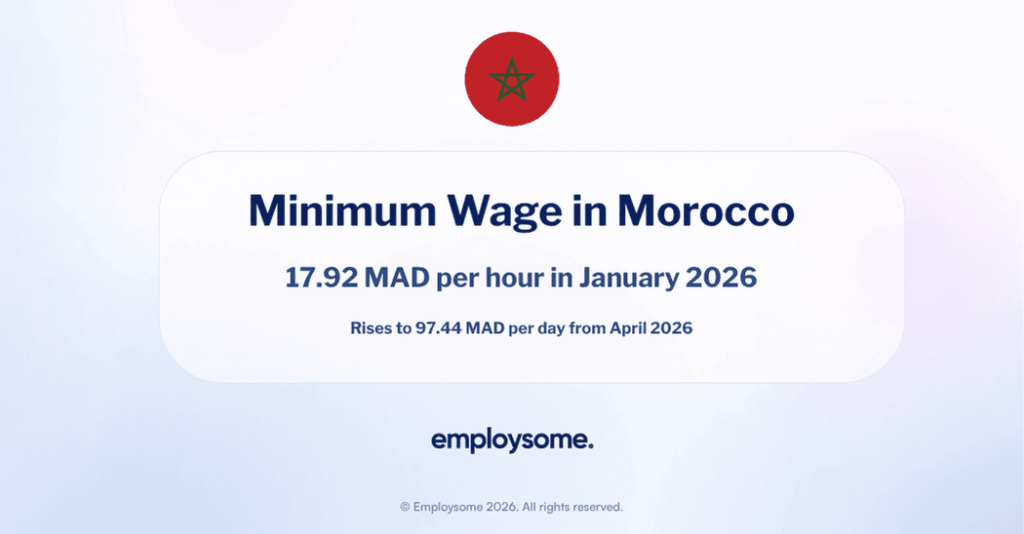
Table of Contents
Morocco has done something unusual in the minimum wage world: it has raised its floor by 20% over five years through a series of negotiated social pacts between the government, employers, and unions. The latest increase, a 5% bump effective January 1, 2026, brings the non-agricultural minimum wage (SMIG) to 17.92 MAD per hour, or roughly 3,400 MAD per month ($372 USD). The agricultural minimum (SMAG) follows in April 2026 at 97.44 MAD per day. These are not arbitrary numbers. They are the second phase of a tripartite agreement signed in April 2024, which itself built on an earlier agreement from 2022.
For international companies, Morocco is increasingly on the radar as a francophone nearshore market with competitive labour costs, strong proximity to Europe (90 minutes from Madrid by plane, same timezone as London), and a growing tech and services sector. Understanding the minimum wage is the starting point for any compensation planning, because it sets the floor for CNSS social security calculations, overtime premiums, severance pay, and the entire payroll cost structure.
This guide covers the current SMIG and SMAG rates, the history of recent increases, who the minimum wage applies to, how employer social security costs stack on top, the income tax brackets, how Morocco compares to Tunisia and other nearshore competitors, and what international companies hiring through an EOR need to know.

Minimum Wage Rates: 2026
|
Rate |
Amount (2026) |
Effective Date |
|
SMIG (hourly) |
17.92 MAD (~$1.80 USD) |
January 1, 2026 |
|
SMIG (monthly, 44-hour week) |
~3,400 MAD (~$372 USD) |
January 1, 2026 |
|
SMIG (monthly, 48-hour week) |
~3,720 MAD (~$407 USD) |
January 1, 2026 |
|
SMAG (daily, agriculture) |
97.44 MAD (~$10.60 USD) |
April 1, 2026 |
|
SMAG (monthly estimate, 26 working days) |
~2,533 MAD (~$277 USD) |
April 1, 2026 |
|
Previous SMIG (2025) |
17.10 MAD/hour; ~3,266 MAD/month |
January 1, 2025 |
|
Previous SMAG (2025) |
93 MAD/day |
April 1, 2025 |
The monthly SMIG calculation is based on 191 hours per month (44 hours x 52 weeks / 12 months). Some sectors operate on a 48-hour week, which produces a higher monthly figure. The SMAG is expressed as a daily rate because agricultural working patterns are seasonal and irregular. Employers should note that both the SMIG and SMAG are gross amounts; net pay is lower after the 6% employee CNSS deduction and any applicable income tax.
The 5% increase in 2026 is the final phase of the April 2024 tripartite agreement. Between 2021 and 2026, the cumulative increase has been 20% for non-agricultural workers and 25% for agricultural workers. This represents a significant real-terms improvement given Morocco’s inflation of roughly 2-4% per year over the same period.
Who the Minimum Wage Applies To
The SMIG applies to all private-sector workers in industry, commerce, services, banking, insurance, hospitality, transport, telecommunications, IT, and the liberal professions (lawyers, accountants, architects, and doctors who employ staff). It covers full-time, part-time, fixed-term, and indefinite-term contracts. It applies equally to Moroccan nationals and foreign workers. Foreign companies operating through subsidiaries, branches, or EOR arrangements must comply with the same SMIG rates as local employers.
The SMAG applies specifically to agricultural workers, including those in livestock, forestry, and agricultural cooperatives. Agro-industrial processing (canning, food processing, packaging) falls under SMIG, not SMAG, because these are classified as industrial rather than agricultural activities.
Domestic workers have a separate minimum wage regime under Morocco’s domestic workers law (Law 19-12), with rates that differ from both SMIG and SMAG. Interns on government-subsidised training contracts (contrats d’insertion) may also have different pay arrangements, though these must still respect minimum wage floors.
Employers cannot negotiate wages below the SMIG or SMAG, even with the employee’s consent. Any employment contract specifying a salary below the applicable minimum is legally void to the extent of the underpayment, and the employer is liable for the difference plus penalties.
Employer Social Security Costs (CNSS)
On top of the gross salary, Moroccan employers must pay social security contributions to the Caisse Nationale de Sécurité Sociale (CNSS). The total employer burden is approximately 21-22% of gross salary, broken down as follows:
|
Contribution |
Employer Rate |
Employee Rate |
|
CNSS Family Allowances |
6.4% |
None |
|
CNSS Pension (short and long term) |
8.98% (capped) |
4.48% (capped) |
|
4.11% |
2.26% |
|
|
Vocational training tax |
1.6% |
None |
|
Total employer burden |
~21.09% |
~6.74% (employee deductions) |
Some CNSS contributions are capped at a salary ceiling of 6,000 MAD/month. The family allowance contribution (6.4%) is not capped and applies to the full salary. For employees earning the minimum wage (~3,400 MAD), all contributions apply to the full amount since it is below the ceiling. For higher earners, the cap limits the pension and some other contributions.
Total employer cost for a minimum-wage worker: approximately 3,400 MAD salary + 718 MAD employer contributions = roughly 4,118 MAD/month ($450 USD). This is the real cost of a minimum-wage employee in Morocco, which is important to factor into outsourcing cost comparisons.
💡 Employsome Insight: The CNSS Declarations Are Monthly and Penalties Are Strict
Employers must declare and pay CNSS contributions through the Damacom online portal before the 10th of the following month. Late payment triggers a 5% penalty for the first month and additional charges thereafter. International companies using an EOR should verify that the EOR is filing CNSS declarations on time and that the correct contribution rates are being applied, particularly after the January 2026 SMIG increase, which changes the base for all contribution calculations.
Income Tax Brackets (2025 Finance Law)
Morocco’s personal income tax (Impôt sur le Revenu, or IR) is progressive and was reformed under the 2025 Finance Law:
|
Annual Taxable Income (MAD) |
Tax Rate |
|
0 – 40,000 |
0% |
|
40,001 – 60,000 |
10% |
|
60,001 – 80,000 |
20% |
|
80,001 – 100,000 |
30% |
|
100,001 – 180,000 |
34% |
|
Over 180,000 |
37% |
A minimum-wage worker earning 3,400 MAD/month has an annual gross income of approximately 40,800 MAD. After the CNSS employee deduction of roughly 6%, taxable income falls to around 38,350 MAD, which is within the 0% bracket. In practice, minimum-wage workers in Morocco pay no income tax. The tax only starts to bite meaningfully at salaries above 5,000 MAD/month.
How the Minimum Wage Affects Overtime, Holidays, and Severance
The SMIG is not just the wage floor. It is the base rate from which several other employment costs are calculated:
Overtime premiums are calculated on the SMIG rate: 25% for daytime hours beyond the standard workweek, and 50% for hours worked at night (9pm to 6am) or on rest days. On public holidays, the premium is 100%. For a minimum-wage worker earning 17.92 MAD/hour, night overtime pays 26.88 MAD/hour and holiday work pays 35.84 MAD/hour.
Holiday pay: Morocco has approximately 13 paid public holidays per year. Workers are entitled to 18 days of paid annual leave after 6 months of service, increasing by 1.5 days per additional 5 years of seniority. Annual leave pay must reflect the employee’s normal earnings including regular allowances.
Severance pay is calculated based on the employee’s average salary over the preceding 52 weeks. The statutory severance is: 96 hours of salary per year for the first 5 years, 144 hours for years 6-10, 192 hours for years 11-15, and 240 hours for years beyond 15. For long-serving minimum-wage workers, this can accumulate to meaningful amounts.
Recent Minimum Wage Increases
|
Year |
SMIG (MAD/hour) |
Change |
|
2021 |
14.81 |
Baseline |
|
2022 |
15.55 |
+5% (Phase 1 of 2022 agreement) |
|
2023 |
16.29 |
+5% (Phase 2 of 2022 agreement) |
|
2025 |
17.10 |
+5% (Phase 1 of 2024 agreement) |
|
2026 |
17.92 |
+4.8% (Phase 2 of 2024 agreement). Cumulative +20% since 2021. |
The pattern is clear: Morocco has committed to steady, negotiated minimum wage increases through tripartite social pacts rather than sporadic political decisions. This gives employers predictability (you know roughly what the minimum will be for the next 2-3 years) and gives workers real purchasing power growth. The 20% cumulative increase since 2021 is substantial and has contributed to improved consumer spending, though it has also raised input costs for labour-intensive industries like textiles and agriculture.
How Morocco Compares
|
Morocco |
Tunisia |
Egypt |
|
|
Minimum wage (monthly, USD) |
~$372 |
~$178 |
~$128 |
|
Average salary (monthly, USD) |
~$1,657 |
~$530 |
~$250-350 |
|
Employer SI costs |
~21% |
~21% |
~18-26% |
|
Primary languages |
French, Arabic, Darija |
French, Arabic |
Arabic, growing English |
|
Timezone (UTC) |
UTC+1 |
UTC+1 |
UTC+2 |
|
Key advantage |
Largest talent pool in francophone Africa, proximity to Europe |
Lower cost, strong French |
Lowest cost, large population |
Morocco is more expensive than Tunisia and Egypt but offers the largest francophone talent pool in Africa, stronger infrastructure, better connectivity to Europe, and a more developed services sector. Casablanca is a genuine regional business hub with a growing fintech, IT, and BPO ecosystem. For companies choosing between these three markets for francophone outsourcing, Morocco is the quality play, Tunisia is the value play, and Egypt is the volume play.
Minimum Wage and EOR Arrangements
When you hire through an Employer of Record (EOR) in Morocco, the EOR is the legal employer and must comply with the SMIG for all applicable roles. The EOR handles CNSS registration, monthly contributions via Damacom, payslip generation (which must explicitly list the hourly SMIG rate), and annual declarations.
The most common compliance issue for EOR clients in Morocco is the interaction between the minimum wage and collective agreements. Several sectors (textiles, construction, banking, insurance) have collective agreements that set wage floors above the SMIG. If your employee works in a sector covered by a collective agreement, the CBA rate applies, not the SMIG. Your EOR should identify the correct agreement and apply the higher rate.
Also note that Morocco requires payslips to be provided for every payment, and the payslip must show the applicable SMIG rate. Labour inspectors check payslips during inspections. Fines for non-compliance are 300 to 500 MAD per employee, doubled for repeat offences.
Hiring in Morocco?
Morocco’s francophone talent pool, proximity to Europe, and growing services sector make it one of the strongest nearshore markets for French-speaking roles. Compare the best EOR providers for Morocco on Employsome. Visit our guide to see provider coverage, pricing, and compliance scores.
Frequently Asked Questions
The SMIG (non-agricultural) is 17.92 MAD per hour or approximately 3,400 MAD per month for a 44-hour work week, effective January 1, 2026. The SMAG (agricultural) is 97.44 MAD per day, effective April 1, 2026.
It is reviewed every 2 to 4 years through tripartite social agreements between the government, employers (CGEM), and trade unions. The current cycle of increases (2024 agreement) completes in 2026. Future increases will depend on the next negotiated agreement.
Yes. The SMIG and SMAG apply equally to Moroccan nationals and foreign workers employed in Morocco, regardless of the employer’s nationality or corporate structure.
Approximately 4,118 MAD/month ($450 USD) including the 3,400 MAD gross salary and roughly 718 MAD in employer CNSS and other contributions (~21%).
Effectively no. After the CNSS employee deduction, a minimum-wage worker’s taxable income falls within the 0% tax bracket. Income tax becomes meaningful only above approximately 5,000 MAD/month gross.
SMIG (Salaire Minimum Interprofessionnel Garanti) applies to industry, commerce, services, and all non-agricultural private-sector work. It is expressed as an hourly rate. SMAG (Salaire Minimum Agricole Garanti) applies to agricultural workers and is expressed as a daily rate. SMAG is lower than SMIG.

Written by
Courtney Pocock is a Copywriter & EOR/PEO Researcher at Employsome with 15+ years of experience writing for the HR, corporate, and financial sectors. She has a strong interest in global business expansion and Employer of Record / PEO topics, focusing on news that matters to business owners and decision-makers. Courtney covers industry updates, regulatory changes, and practical guides to help leaders navigate international hiring with confidence.
Our content is created for informational purposes only and is not intended to provide any legal, tax, accounting, or financial advice. Please obtain separate advice from industry-specific professionals who may better understand your business’s needs. Read our Editorial Guidelines for further information on how our content is created.
Other posts
Review other guides