Minimum Wage in Mexico: The Complete 2026 Guide
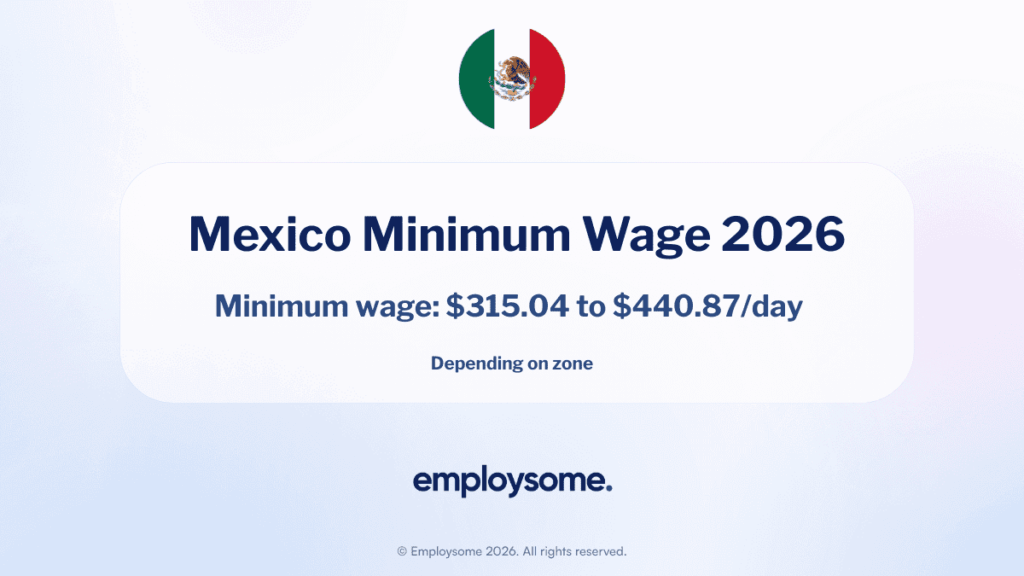
Mexico’s general minimum wage for 2026 is MXN $315.04 per day (approximately USD $17.23), effective 1 January 2026. In the Northern Border Free Zone, the rate is MXN $440.87 per day (approximately USD $24.11). This guide covers both wage zones, the 61 professional minimum wages, mandatory benefits (Aguinaldo, vacation premium, PTU), employer social security contributions (IMSS, INFONAVIT, SAR), penalties for non-compliance, and how minimum wage compares to the cost of living across major Mexican cities.


How Minimum Wage in Mexico Is Regulated
Mexico’s minimum wage is governed by the Federal Labor Law (Ley Federal del Trabajo, LFT) and is set annually by the National Minimum Wage Commission (CONASAMI), a tripartite body composed of representatives from the government, employers, and workers’ unions. Article 570 of the LFT requires CONASAMI to fix the minimum wage each year, with new rates taking effect on 1 January.
CONASAMI considers several factors when setting the annual rate:
- Consumer price inflation and cost-of-living trends
- National economic growth and employment conditions
- Purchasing power of the minimum wage relative to basic consumer baskets
- The presidential policy target of reaching 2.5 basic baskets by the end of the current six-year term
- Technical reports from CONASAMI’s research directorate
For 2026, CONASAMI unanimously approved a 13% increase to the general minimum wage, composed of a 6.5% fixed adjustment plus an Independent Recovery Amount (Monto Independiente de Recuperación, MIR) of MXN $17.01 per day. The Northern Border Free Zone received a separate 5% increase. The decision was announced by President Claudia Sheinbaum on 3 December 2025.
Mexico’s minimum wage is defined as a daily rate. Unlike most European countries, Mexico does not publish an official hourly or monthly minimum wage. Monthly equivalents used in payroll are calculated by multiplying the daily rate by 30 (or 30.4), but the legal reference is always the daily wage.
Enforcement is handled by the Labour and Social Welfare Secretariat (STPS) and local and federal labour boards. The Mexican Social Security Institute (IMSS) also plays an enforcement role because the minimum wage directly affects social security contribution calculations.
💡 Employsome Insight: Mexico Has Had Nine Consecutive Years of Double-Digit Minimum Wage Increases
Since 2018, Mexico’s general minimum wage has risen 256.6%, from MXN $88.36 to MXN $315.04 per day. This is one of the most aggressive minimum wage growth trajectories of any major economy globally. International companies should budget for continued above-inflation increases as both the current and previous administrations have treated minimum wage policy as a core poverty-reduction tool. The era of static minimum wages in Mexico is definitively over.
Minimum Wage Mexico 2026: Current Rates
From 1 January 2026, the statutory minimum wage rates in Mexico are:
|
Category |
2025 Rate |
2026 Rate |
|
General Zone (daily) |
MXN $278.80 |
MXN $315.04 |
|
Northern Border Free Zone (daily) |
MXN $419.88 |
MXN $440.87 |
|
General Zone (monthly est., ×30) |
~MXN $8,364 |
~MXN $9,451 |
|
Border Zone (monthly est., ×30) |
~MXN $12,596 |
~MXN $13,226 |
|
General Zone (hourly est., ÷8hrs) |
~MXN $34.85 |
~MXN $39.38 |
|
Border Zone (hourly est., ÷8hrs) |
~MXN $52.49 |
~MXN $55.11 |
The 13% general zone increase and 5% border zone increase mark the ninth consecutive year of double-digit increases to the general minimum wage. The standard working day in Mexico is 8 hours, and the maximum working week is 48 hours (6 days of 8 hours). Overtime is paid at 200% for the first 9 hours per week and 300% beyond that.
Two-Zone System
Mexico operates a two-zone minimum wage system:
- General Zone: Covers the entire country except the Northern Border Free Zone. The vast majority of Mexican workers fall under this zone.
- Northern Border Free Zone (ZLFN): Covers specific municipalities in Baja California, Sonora, Chihuahua, Coahuila, Nuevo León, and Tamaulipas along the U.S. border. The higher rate reflects stronger economic activity, higher living costs, and competition for talent with U.S. border cities.
The applicable zone is determined by the employer’s registered IMSS work location, not the employee’s physical location or residence. This is a critical compliance point for remote work arrangements.
Professional Minimum Wages
In addition to the general minimum wage, Mexico maintains 61 professional minimum wages for specific skilled trades and occupations, including technicians, operators, and certified trade workers. These rates were increased by approximately 13% for the general zone and 5% for the border zone in 2026, keeping them aligned with the general increase.
💡 Employsome Insight: The Zone Classification Determines Your IMSS Obligations, Not the Employee’s Location
A common compliance error for international companies is applying the wrong zone rate. The applicable minimum wage is based on where the employer is registered with IMSS, not where the employee physically works. If your company is registered in Mexico City (General Zone) but your employee works remotely from Tijuana (ZLFN), the General Zone rate applies. Getting this wrong affects SDI calculations, IMSS contributions, and audit risk.
Mandatory Benefits That Affect Total Compensation
Mexico’s Federal Labor Law requires a set of mandatory benefits that significantly increase the total cost of employment beyond the base daily wage. These are not optional and apply to all formal employees.
Aguinaldo (Christmas Bonus)
All employees must receive a Christmas bonus of at least 15 days’ salary, paid no later than 20 December each year. Employees who have not completed a full year receive a prorated amount. The first 30 days of Aguinaldo are exempt from income tax. This is one of the most closely monitored statutory benefits in Mexico.
Vacation and Vacation Premium
Employees are entitled to paid vacation starting at 12 days after the first year of service, increasing by 2 days for each subsequent year up to year 5, then by 2 days for every 5 years of service thereafter. Employees also receive a vacation premium of at least 25% of their regular salary during vacation days.
Profit Sharing (PTU)
All companies must distribute 10% of annual taxable profits to eligible employees by 30 May each year. Half is distributed equally among all employees; half is distributed based on salary and days worked. PTU applies to all companies except those in their first year of operation. Employees need at least 60 days of service to qualify.
Sunday Premium
Employees who work on Sundays are entitled to a premium of at least 25% on top of their daily wage.
Public Holidays
Mexico has 7 mandatory paid holidays plus additional days established by law. Employees required to work on these holidays receive double pay in addition to their regular daily wage (triple pay total).
💡 Employsome Insight: Aguinaldo, Vacation Premium, and PTU Make Mexico’s True Minimum Wage Significantly Higher Than the Daily Rate Suggests
When you add the mandatory Aguinaldo (15 days), vacation premium (25% of vacation pay), and PTU (10% of profits) to the base daily wage, the effective annual compensation for a minimum wage worker is substantially higher than the daily rate multiplied by 365. International companies that budget only for the daily wage will significantly underestimate their true employment costs in Mexico. Always calculate the Integrated Daily Salary (SDI) to understand the real cost.
Employer Statutory Contributions in Mexico
Mexico has one of the most complex and substantial employer contribution systems in Latin America. Total employer contributions typically range from 30–40% on top of base salary, depending on salary level, industry risk classification, and state payroll tax rates.
IMSS (Social Security)
The Mexican Social Security Institute administers healthcare, disability, maternity, life insurance, retirement pensions, and workplace risk coverage. Employer contributions to IMSS vary by component but total approximately 24–38% of the employee’s base salary, depending on salary level and industry risk classification (Levels I–V). Employee contributions are approximately 2.78%. The contribution base is the Salario Base de Cotización (SBC), which integrates the daily wage plus mandatory benefits.
INFONAVIT (Housing Fund)
Employers must contribute 5% of the employee’s SBC to INFONAVIT, the federal housing fund that provides employees with access to housing loans and subsidies. This is an employer-only contribution.
SAR (Retirement Savings)
Employer retirement contributions go to the AFORE system (individual retirement accounts). The employer retirement contribution rate is being gradually increased under pension reform, reaching approximately 3.15% in 2026 (rising to 10% by 2030). This is an employer-only contribution.
State Payroll Tax (ISN)
Each Mexican state imposes its own payroll tax (Impuesto Sobre Nóminas), typically ranging from 1% to 5% of total payroll. Mexico City charges 3%. This is an employer-only tax that varies by state and must be paid monthly to the relevant state tax authority.
|
Contribution |
Approximate Employer Rate |
|
IMSS (social security, healthcare, disability, maternity, workplace risk) |
~24–38% (varies by risk class and salary) |
|
INFONAVIT (housing fund) |
5% of SBC |
|
SAR (retirement savings) |
~3.15% in 2026 (rising to 10% by 2030) |
|
State payroll tax (ISN) |
1–5% (varies by state) |
|
Total employer add-on (approximate) |
~30–40% above base salary |
💡 Employsome Insight: Mexico’s Employer Costs Are Rising Every Year Due to Pension Reform
The 2020 pension reform introduced a phased increase in employer retirement contributions from 3.15% to 10% by 2030. This means that even if the minimum wage stayed flat, total employer costs would still increase every year through 2030 solely from the SAR contribution schedule. Combined with annual double-digit minimum wage increases, state payroll taxes, and mandatory benefits, total employment costs in Mexico are on a steep upward trajectory that international companies must factor into multi-year budgets.
Legal Framework Governing Minimum Wage
The principal legislation governing Mexico’s minimum wage and employment conditions includes:
- Federal Labor Law (Ley Federal del Trabajo, LFT): The core employment law framework. Articles 90–97 govern the minimum wage. Article 570 mandates annual review by CONASAMI. Article 1004 establishes penalties including fines and imprisonment for paying below minimum wage.
- Social Security Law (Ley del Seguro Social, LSS): Governs IMSS contributions, the SBC calculation, and social security benefits.
- INFONAVIT Law: Establishes the 5% employer housing fund contribution obligation.
- SAR Law: Governs retirement savings contributions and the AFORE system.
- UMA (Unidad de Medida y Actualización): A separate reference unit introduced in 2016 to decouple official fines, thresholds, and caps from the minimum wage. UMA and minimum wage serve different legal purposes and are not interchangeable.
The minimum wage cannot be waived, reduced, or replaced by any contract, agreement, or benefit. It is a constitutional right under Article 123 of the Mexican Constitution and a mandatory legal floor for all formal employment.
Employer Obligations Under Mexican Law
To remain compliant with Mexico’s minimum wage and employment regulations, employers must:
- Pay at least the applicable daily minimum wage (MXN $315.04 general zone or MXN $440.87 ZLFN) for every working day from 1 January 2026
- Apply the correct wage zone based on the employer’s IMSS-registered work location
- Register with IMSS, INFONAVIT, and SAT before hiring any employees, and register each new employee with IMSS within 5 days of their start date
- Calculate and pay the Integrated Daily Salary (SDI) correctly for IMSS contribution purposes, including the integration of Aguinaldo, vacation premium, and other mandatory components
- Pay Aguinaldo (minimum 15 days’ salary) by 20 December each year
- Distribute PTU (10% of taxable profits) to eligible employees by 30 May
- Issue CFDI payroll receipts (electronic payroll invoices) for every payment, as required by SAT
- Pay state payroll tax (ISN) monthly to the relevant state tax authority
- Update payroll systems every January when new minimum wage rates take effect, including recalculating SBC/SDI bases
For international companies without a Mexican legal entity (Sociedad), an Employer of Record (EOR) can handle all of these obligations on your behalf, including IMSS/INFONAVIT/SAT registration, payroll processing, CFDI issuance, SDI calculation, Aguinaldo, vacation premium, PTU distribution, and ongoing minimum wage compliance. The EOR acts as the legal employer in Mexico, assuming full responsibility for Federal Labor Law compliance while you retain day-to-day management of the employee.
For a detailed comparison of providers, see our Best Employer of Record in Mexico guide.
Penalties for Violating Minimum Wage in Mexico
Mexico’s Federal Labor Law takes minimum wage violations seriously. Article 1004 of the LFT establishes that paying below the minimum wage can result in fines and, in extreme cases, imprisonment.
If an employer is found to have underpaid workers or otherwise violated labour regulations, the consequences include:
- Fines: Non-compliance with minimum wage and mandatory benefits can result in fines of up to 5,000 times the daily UMA value. At 2026 UMA levels, this translates to significant financial penalties.
- Back-payment orders: Employers may be required to pay wage arrears retroactively for the full period of underpayment, plus interest.
- IMSS audits and recalculations: Incorrect SBC reporting or underpayment of contributions triggers IMSS audits, retroactive contribution assessments, surcharges, and penalties.
- Labour claims: Employees can file claims with federal or local labour boards. Disputes are generally resolved in favour of the employee under Mexican labour law.
- Criminal liability: Article 1004 of the LFT provides for imprisonment in cases of deliberate and systematic underpayment.
- PTU non-compliance: Failure to distribute profit sharing by the 30 May deadline can result in fines, back-payment orders, and employee claims.
IMSS conducts regular audits and can cross-reference payroll data with tax filings. Misalignment between SDI reported to IMSS and salaries reported to SAT is a common audit trigger.
Minimum Wage Mexico vs. Cost of Living
Mexico applies a two-zone minimum wage with no further regional variation within each zone. The real purchasing power of minimum wage earnings differs significantly across cities, driven by housing costs, food prices, and transport expenses.
For a full-time general zone worker earning MXN $315.04/day (approximately MXN $9,451/month gross), after income tax deductions (minimal at this income level) and employee IMSS contributions (~2.78%), net take-home pay is approximately:
MXN $8,800–$9,100 per month
|
City |
Zone |
Est. Net Pay |
Studio Rent |
Rent ÷ Income |
|
Mexico City |
General |
~MXN $9,000 |
~MXN $8,000–12,000 |
89–133% |
|
Monterrey |
General |
~MXN $9,000 |
~MXN $7,000–10,000 |
78–111% |
|
Guadalajara |
General |
~MXN $9,000 |
~MXN $6,000–9,000 |
67–100% |
|
Tijuana |
ZLFN |
~MXN $12,500 |
~MXN $8,000–12,000 |
64–96% |
|
Querétaro |
General |
~MXN $9,000 |
~MXN $5,000–8,000 |
56–89% |
|
Puebla |
General |
~MXN $9,000 |
~MXN $4,000–6,500 |
44–72% |
|
Mérida |
General |
~MXN $9,000 |
~MXN $5,000–8,000 |
56–89% |
In Mexico City and Monterrey, a general-zone minimum wage worker would need to spend 78–133% of their net income on a studio apartment, making independent living effectively impossible on the minimum wage alone. In border cities like Tijuana, the higher ZLFN rate partially offsets higher costs but rent-to-income ratios remain challenging. Mid-sized cities like Puebla offer more manageable ratios (44–72%), though even there the minimum wage leaves limited room for other essentials.
The presidential target of reaching 2.5 basic consumer baskets by the end of the current six-year term reflects the government’s acknowledgement that despite the dramatic 256% increase since 2018, the minimum wage remains insufficient for a comfortable standard of living in most Mexican cities.
Minimum Wage Mexico 2026–2027 Outlook
Mexico’s minimum wage has followed one of the most dramatic growth trajectories of any major economy:
|
Year |
General (MXN/day) |
Border (MXN/day) |
General Increase |
|
2018 |
$88.36 |
— |
— |
|
2019 |
$102.68 |
$176.72 |
16.2% |
|
2020 |
$123.22 |
$185.56 |
20.0% |
|
2021 |
$141.70 |
$213.39 |
15.0% |
|
2022 |
$172.87 |
$260.34 |
22.0% |
|
2023 |
$207.44 |
$312.41 |
20.0% |
|
2024 |
$248.93 |
$374.89 |
20.0% |
|
2025 |
$278.80 |
$419.88 |
12.0% |
|
2026 |
$315.04 |
$440.87 |
13.0% |
Looking ahead, several developments will shape the 2027 minimum wage:
- 2.5 basic baskets target: President Sheinbaum has committed to reaching 2.5 basic consumer baskets during her six-year term, implying continued above-inflation increases through at least 2030.
- Pension reform contributions: The SAR employer contribution will continue increasing annually toward the 10% target by 2030, adding cumulative cost pressure independent of wage increases.
- Working hours reform: A proposed reduction of the maximum weekly working hours from 48 to 40 has been debated since 2023. If enacted, it would significantly increase effective hourly labour costs without changing the daily wage.
- UMA decoupling: The continued separation of UMA from the minimum wage means that double-digit wage increases no longer trigger cascading increases in government fines and official thresholds, giving the government more political room for aggressive wage policy.
- USMCA labour provisions: The US-Mexico-Canada Agreement includes labour provisions that incentivise Mexico to improve working conditions and wages, providing additional external pressure for continued minimum wage growth.
💡 Employsome Insight: Budget for 10–15% Annual Minimum Wage Increases Through at Least 2030
Based on nine consecutive years of double-digit increases and the current administration’s explicit policy commitment, international companies should model minimum wage increases of 10–15% per year through 2030 when building long-term cost projections for Mexican operations. Combined with the pension reform SAR escalation, state payroll taxes, and mandatory benefits, total employment costs for minimum wage workers will approximately double between 2024 and 2030.
Final Takeaway – Minimum Wage Compliance in Mexico
Mexico’s minimum wage system is structurally unique: a daily rate set across two geographic zones, supplemented by 61 professional minimum wages, and layered with mandatory benefits (Aguinaldo, vacation premium, PTU, Sunday premium) that substantially increase the true cost of employment beyond the headline daily figure.
Compliance requires more than paying the correct daily rate. Employers must correctly calculate the Integrated Daily Salary (SDI) for IMSS purposes, register with IMSS/INFONAVIT/SAT within the required timelines, issue electronic CFDI payroll receipts, distribute PTU by 30 May, pay Aguinaldo by 20 December, apply the correct wage zone based on IMSS registration (not employee location), and update all payroll systems every January when new rates take effect.
Total employer costs in Mexico typically run 30–40% above base salary when all contributions and mandatory benefits are included. This figure is rising every year due to pension reform, double-digit wage increases, and state payroll taxes. The penalty regime is consequential: fines of up to 5,000 times UMA, IMSS audit recalculations with surcharges, back-payment orders, and in extreme cases imprisonment under Article 1004 of the Federal Labor Law.
For international companies hiring in Mexico, whether directly or through an Employer of Record, minimum wage compliance is the foundation of a much larger compliance obligation that includes social security, housing fund contributions, profit sharing, and electronic payroll invoicing. With the minimum wage having risen 256% since 2018 and further double-digit increases expected through 2030, wage compliance in Mexico is not a static obligation but one of the most dynamic and consequential in Latin America.

Written by
Dane Cobain is a Copywriter at Employsome and an accomplished author whose work spans fiction, non-fiction, and professional writing. Over the past decade, he has built a strong track record creating straightforward content for the HR, payroll, and corporate sectors. Dane brings a storyteller’s eye to the evolving world of global employment, with a particular focus on Employer of Record and PEO models. His articles explore industry trends and dedicated Best Of Guides when managing an international workforce.
Our content is created for informational purposes only and is not intended to provide any legal, tax, accounting, or financial advice. Please obtain separate advice from industry-specific professionals who may better understand your business’s needs. Read our Editorial Guidelines for further information on how our content is created.
Other posts
Review other blog posts by Employsome