Minimum Wage in Italy 2026: Why There Isn’t One & CCNL Rate
Italy has no national minimum wage and that is not changing in 2026. Instead, over 992 collective agreements (CCNL) set sector-specific pay floors ranging from roughly €7/hour in hospitality to €14/hour in banking. Coverage is close to 100%, which is why the EU does not force Italy to legislate a statutory rate. But “no minimum wage law” does not mean “no rules.” Italian courts use CCNL rates to enforce the constitutional right to adequate pay, and picking a low-paying “pirate” agreement will not protect you. Add employer INPS contributions of 29-32%, TFR accrual, and the mandatory 13th month salary, and total employer cost in Italy reaches 45-55% above gross. This guide covers every sector’s rates, the failed €9/hour proposal, the north-south gap, and what international employers need to get right.

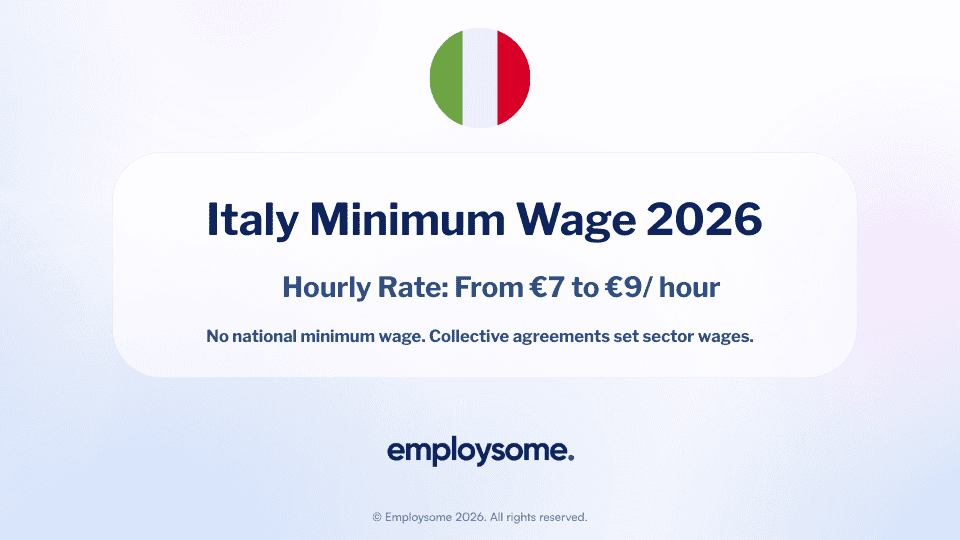
Here is the answer to the question you probably googled: Italy does not have a minimum wage. Not a national one, anyway. There is no single number you can look up, no government-mandated hourly rate, no neat table that says “pay at least this much.” Italy is one of only five EU countries (alongside Denmark, Austria, Finland, and Sweden) that operates without a statutory minimum wage, and that is not going to change in 2026.
What Italy has instead is a system of roughly 992 collective bargaining agreements, called CCNL (Contratti Collettivi Nazionali di Lavoro). These are sector-specific deals negotiated between trade unions and employer associations, and they set minimum pay scales for virtually every industry in the country, from metalworking and construction to banking and hospitality. Coverage is close to 100% of the private-sector workforce, which is why the EU Minimum Wage Directive does not force Italy to introduce a statutory rate. The coverage threshold is 80%, and Italy clears it.
But “no statutory minimum wage” does not mean “no rules.” If you hire someone in Italy and pay them less than what their CCNL says they should earn, you are breaking the law. The Italian Constitution (Article 36) guarantees every worker a wage that is “proportionate to the quantity and quality of work” and “sufficient to ensure a free and dignified existence.” Italian labour courts use the relevant CCNL as the benchmark to enforce this. So while Italy technically has no minimum wage law, it has something that works like one, sector by sector.
This guide explains how the system works in practice, what the actual minimum pay looks like across major sectors, how employer costs stack up (spoiler: they are among the highest in Europe), and what international companies need to get right when hiring in Italy.

How Italy’s CCNL System Works
A CCNL is a national collective labour agreement that covers an entire sector. It is negotiated between the major trade unions (CGIL, CISL, UIL, and others) and the relevant employer association (Confindustria, Confcommercio, Confesercenti, etc.). Each CCNL typically runs for three to four years before it is renegotiated.
The CCNL does not just set a single minimum wage. It establishes an entire pay scale with multiple levels (usually seven or more), based on job classification, seniority, and qualifications. A junior administrative worker in the commerce sector and a senior engineer in metalworking are governed by completely different CCNLs with completely different pay floors.
There are over 992 CCNLs registered with CNEL (the National Economic and Labour Council). Most workers are covered by one of the large, well-known agreements signed by the most representative unions. But there is also a growing problem with so-called “pirate” agreements (contratti pirata), which are CCNLs negotiated by minor or unrepresentative unions that set lower wages and worse conditions. Italian courts have started to push back against these, ruling that wages must meet the standards set by the most representative agreements in the relevant sector, not just any CCNL the employer happens to choose.
💡 Employsome Insight: Picking the Wrong CCNL Can Get You in Serious Trouble
With 992+ registered CCNLs, it might be tempting to choose one with lower wages for your sector. Do not do this. Italian labour courts look at whether the CCNL you applied was signed by the “comparatively most representative” trade unions and employer associations. If you applied a pirate agreement with below-market rates, a court can declare the wages inadequate under Article 36 of the Constitution and order you to pay the difference, plus interest, plus potential damages. Your EOR or legal advisor in Italy should identify the correct CCNL for your industry before you hire anyone.
Minimum Wage Italy by Sector: What the CCNLs Actually Pay
Since there is no single minimum wage number, the best we can do is show what the lowest CCNL pay levels look like across major sectors. These are the minimum monthly gross salaries for the lowest job classification (entry-level) in each sector’s most representative CCNL:
|
Sector (CCNL) |
Lowest Monthly Gross (€) |
Approx. Hourly (€) |
|
Banking (Credito) |
~€2,350 |
~€13.70 |
|
Chemicals & Pharmaceuticals (Chimici-Farmaceutici) |
~€1,697 |
~€9.90 |
|
Construction (Edilizia) |
~€1,696 |
~€9.90 |
|
Metalworking (Metalmeccanici) |
~€1,559 |
~€9.10 |
|
Hotels, Restaurants & Catering (Turismo) |
~€1,293 |
~€7.55 |
|
Local Public Transport |
~€1,238 |
~€7.20 |
|
Waste Collection |
~€1,202 |
~€7.00 |
|
Commerce & Retail (Commercio) |
~€1,200-1,400 |
~€7.00-8.15 |
|
Domestic Workers (Lavoro Domestico) |
Varies (hourly-based) |
~€5.30-8.00+ |
The range is enormous. A banking employee at the lowest classification earns nearly double what a hotel worker earns. And these are the minimums. Most employees earn above their CCNL floor, especially in northern Italy where the labour market is tighter and companies have to compete for talent.
The often-citedwfers to the lower end of the spectrum, primarily in hospitality, retail, and services. In industrial and professional sectors, the floor is closer to €9 to €14 per hour.
The €9/Hour Proposal: Dead for Now
You might have read that Italy was about to introduce a €9/hour statutory minimum wage. A bill to that effect was pushed by opposition parties in 2023 and debated again in 2024. It did not pass. The ruling coalition blocked it, backed by employer groups who argued that a rigid statutory floor would undermine the collective bargaining system, hurt small businesses in the south, and create a one-size-fits-all rate in a country with massive regional economic differences.
The debate is not dead. Unions continue to push for a €9 floor. Some economists have proposed a regional approach, with perhaps €8 in the south and €10 in the north, reflecting the real cost-of-living gap. The EU Minimum Wage Directive (2022/2041) adds pressure, though it does not force Italy to introduce a statutory rate as long as collective bargaining coverage stays above 80%. For 2026, the status quo holds: no national minimum wage, CCNLs remain king.
The North-South Wage Gap
Italy is really two labour markets. The north (Lombardy, Veneto, Emilia-Romagna, Piedmont) has low unemployment, higher salaries, and companies that often pay well above CCNL minimums to attract talent. The south (Campania, Calabria, Sicily, Puglia) has higher unemployment, lower costs of living, and wages that often sit closer to the CCNL floor.
The gap is significant: employers in the south typically pay 15 to 20% less than employers in the north for equivalent roles. This is not because different CCNLs apply (national CCNLs are the same across Italy), but because northern employers add supplementary pay, bonuses, and company-level agreements on top of the national minimum. In the south, the CCNL minimum is often the actual wage.
For international companies, this means your salary benchmarking should be location-specific, not just sector-specific. Offering the CCNL minimum in Milan will get you zero applicants. Offering the CCNL minimum in Bari might be competitive.
Employer Costs: Why Italy Is Expensive Despite “Low” Wages
Italy’s headline wages look moderate by Western European standards, but total employer cost tells a different story. Mandatory employer contributions to INPS (social security), INAIL (workplace injury insurance), and TFR (severance fund) add roughly 35 to 45% on top of gross salary. This is among the highest employer-side burdens in Europe.
|
Cost Component |
Rate / Amount |
|
Gross monthly salary (example: metalworking CCNL, mid-level) |
€2,200 |
|
Employer INPS (pension, unemployment, sickness, maternity) |
~29-32% (~€660) |
|
INAIL (workplace injury/occupational disease) |
~0.3-4% (varies by industry risk) |
|
TFR accrual (~6.91% of annual salary / 13.5) |
~€163/month |
|
13th month salary (tredicesima, mandatory) |
~€183/month (amortised) |
|
14th month salary (quattordicesima, if CCNL requires) |
~€183/month (amortised, not all sectors) |
|
Total monthly employer cost (approx.) |
~€3,200 to €3,500 (~45-55% above gross) |
The TFR (Trattamento di Fine Rapporto) is uniquely Italian. Every employer must accrue approximately 6.91% of annual salary as a deferred severance fund, revalued yearly for inflation, and paid out when the employee leaves, regardless of the reason. It compounds over time and can become a substantial liability for long-serving employees. For a deep dive into how TFR works, including the 2026 Budget Law changes on automatic pension enrolment, see our TFR Italy 2026 guide.
💡 Employsome Insight: The 13th Month Is Not a Bonus. It Is a Legal Obligation.
Every employee in Italy is entitled to a 13th month salary (tredicesima), paid in December. Many CCNLs also require a 14th month (quattordicesima), typically paid in June or July. These are not bonuses and not discretionary. They are mandatory components of total annual compensation. If your budget assumes 12 months of salary, you are underbudgeting by 8 to 17%. International companies setting up in Italy consistently underestimate this.
Employee Income Tax (IRPEF) in 2026
Italy uses a progressive income tax called IRPEF. The 2026 Budget Law reduced the middle bracket rate from 35% to 33%, which gives a small net pay boost to employees earning between €28,000 and €50,000. The current brackets:
|
Annual Taxable Income (€) |
IRPEF Rate (2026) |
|
Up to €28,000 |
23% |
|
€28,001 to €50,000 |
33% (reduced from 35%) |
|
Over €50,000 |
43% |
On top of IRPEF, employees pay regional surcharges (addizionale regionale, 1.2% to 3.3%) and municipal surcharges (addizionale comunale, 0.1% to 0.9%), which vary by location. Combined with INPS employee contributions of 9 to 10%, the total tax and contribution burden on employees is heavy. A metalworking employee earning €30,000 gross takes home approximately €22,000 to €23,000 net, depending on the region.
Tax Breaks for Foreign Workers: The Impatriati Regime
Italy offers one of Europe’s most generous tax incentives for workers relocating to the country. The Regime Impatriati (inbound workers regime), reformed in 2025, exempts 50% of employment income from IRPEF for five years (60% if the worker has at least one minor child). The income cap is €600,000 per year.
To qualify, you need to have been a tax resident outside Italy for at least three years, hold a university degree or be classified as “highly qualified,” and commit to Italian tax residency for at least four years. The regime is attractive but more restrictive than previous versions, which offered up to 90% exemption for workers moving to the south.
For digital nomads, Italy’s DN visa (launched 2024) offers a separate path, and lawmakers are discussing a dedicated tax incentive specifically for digital nomads as part of future budget negotiations. Nothing is enacted yet, but the direction is clear: Italy wants foreign talent.
Working Hours, Overtime, and Leave
|
Rule |
Details |
|
Standard workweek |
40 hours (by law). Many CCNLs set 36-38 hours. |
|
Maximum (including overtime) |
48 hours per week, averaged over 4 months |
|
Overtime cap |
250 hours per year (typical CCNL limit) |
|
Overtime premium |
15-30% surcharge depending on CCNL and hours |
|
Annual leave |
Minimum 4 weeks (20 working days). Many CCNLs give more. |
|
Public holidays |
12 national holidays per year |
|
13th month (tredicesima) |
Mandatory. Paid in December. |
|
14th month (quattordicesima) |
Required by many CCNLs (commerce, hospitality, etc.). Paid June/July. |
|
Sick leave |
First 3 days: employer pays (carenza). Days 4+: INPS pays 50-66% depending on duration. Many CCNLs top up to 100%. |
European Comparison
|
Country |
National Min. Wage? |
Rate (€/hr) |
Employer SI |
13th/14th Month |
TFR / Severance |
|
Italy |
No (CCNL) |
~€7-14 (sector) |
~29-32% |
13th mandatory, 14th common |
TFR ~6.91%/yr |
|
Germany |
Yes |
€12.82 |
~20-21% |
No |
No mandatory |
|
France |
Yes |
€11.88 |
~25-42% |
No (but 10% paid leave bonus) |
No mandatory |
|
Spain |
Yes |
~€8.87 |
~30-32% |
14 payments standard |
20-33 days/yr service |
|
Netherlands |
Yes |
€14.71 |
~18-22% |
No (8% holiday allowance) |
No mandatory |
|
Norway |
No (9 sectors) |
NOK 162-260 |
14.1% |
No |
No mandatory |
|
Sweden |
No (collective) |
~SEK 140-180 |
31.42% |
No |
No mandatory |
Italy sits in a peculiar spot. The headline hourly rates from CCNLs (€7-14) look lower than Germany or the Netherlands, but once you add 29-32% employer social security, TFR accrual, 13th month, and potentially a 14th month, total employer cost per employee is among the highest in Europe. The combination of moderate wages and extreme employer costs is the defining feature of hiring in Italy.
“Pirate” Agreements and the Enforcement Gap
One of the weakest points in Italy’s CCNL system is the proliferation of so-called contratti pirata (pirate agreements). These are CCNLs negotiated by small, unrepresentative unions and employer associations that intentionally set lower wages and worse conditions than the mainstream agreements for the same sector. Employers who adopt pirate agreements can legally claim they are following a “collective agreement” while paying workers significantly less than the established floor.
Italian courts have started to challenge this. The Supreme Court (Corte di Cassazione) has ruled that simply adopting any CCNL is not enough. The wages must be “sufficient” under Article 36 of the Constitution, and the benchmark is the rate set by the most representative unions in the relevant sector. If a pirate agreement sets wages below that benchmark, a court can order the employer to pay the difference.
For international companies, the practical takeaway is simple: apply the CCNL signed by the most representative unions for your sector. Your EOR or labour advisor in Italy should identify this during onboarding. Do not try to save money by picking a lesser agreement. The short-term savings are not worth the legal risk.
Hiring in Italy?
Italy’s CCNL system, TFR obligations, and employer contribution rates of 29-32% make it one of Europe’s most complex payroll markets. Compare the best EOR providers for Italy on Employsome. We score each provider on CCNL compliance, INPS registration, TFR handling, payroll accuracy, and local labour law expertise. Visit our Best EORs in Italy Guide to see the full comparison.
Frequently Asked Questions
Italy has no national minimum wage. Minimum pay is set by sector-specific collective agreements (CCNL), which cover close to 100% of the workforce. Typical minimums range from €7 to €9/hour in hospitality and services, and €9 to €14/hour in industrial and professional sectors. The proposed €9/hour statutory floor has not been enacted.
Italy relies on collective bargaining (CCNLs) to set wages, similar to the Nordic countries. The system covers nearly all workers, and the Italian Constitution (Article 36) guarantees adequate pay, which courts enforce using CCNL rates as the benchmark. The EU Minimum Wage Directive does not require a statutory minimum if collective bargaining coverage exceeds 80%.
A lot. Employer INPS contributions (29-32%), INAIL (0.3-4%), TFR accrual (~6.91%), 13th month salary (mandatory), and potentially 14th month salary bring total employer cost to approximately 45-55% above gross salary. Italy has one of the highest employer-side burdens in Europe. For a full breakdown of TFR, see our TFR Italy 2026 guide [link to /blog/tfr-italy/].
A Contratto Collettivo Nazionale di Lavoro is a national collective labour agreement negotiated between trade unions and employer associations for a specific sector. It sets minimum pay scales, job classifications, working hours, overtime rules, leave entitlements, and other employment conditions. There are over 992 registered CCNLs in Italy.
An employee can take you to the labour court. The court will compare your wages against the CCNL signed by the most representative unions in your sector and can order you to pay the difference plus interest. Adopting a “pirate” agreement with lower rates does not protect you. The Article 36 constitutional guarantee applies regardless.
Yes. An EOR in Italy identifies the correct CCNL for your employee’s role, applies the right pay scale and classification, handles INPS/INAIL contributions, calculates TFR, processes the 13th and 14th month salaries, and manages all payroll reporting. Getting the CCNL wrong is one of the biggest compliance risks in Italy, so the EOR’s local expertise matters more here than in most countries.

Written by
Courtney Pocock is a Copywriter & EOR/PEO Researcher at Employsome with 15+ years of experience writing for the HR, corporate, and financial sectors. She has a strong interest in global business expansion and Employer of Record / PEO topics, focusing on news that matters to business owners and decision-makers. Courtney covers industry updates, regulatory changes, and practical guides to help leaders navigate international hiring with confidence.
Our content is created for informational purposes only and is not intended to provide any legal, tax, accounting, or financial advice. Please obtain separate advice from industry-specific professionals who may better understand your business’s needs. Read our Editorial Guidelines for further information on how our content is created.
Other posts
Review other blog posts