Minimum Wage in the Czech Republic: Complete 2026 Guide
The Czech minimum wage increased to CZK 22,400 per month (CZK 134.40/hour) on 1 January 2026, an 7.7% rise that pushed the minimum to 43.4% of the average wage, the highest ratio in Czech history. This guide covers the automatic valorisation mechanism, the four guaranteed wage groups in the public sector, employer social security and health insurance costs of 33.8%, income tax brackets, the new Unified Monthly Employer Report, and what international companies hiring through an EOR need to know.

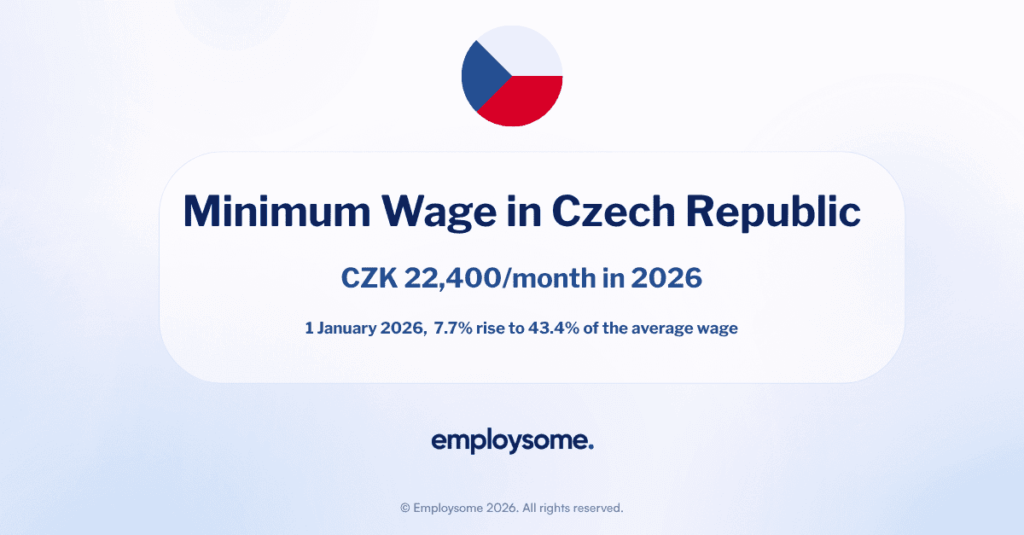
Table of Contents
- Czech Republic Minimum Wage 2026: The Numbers
- How the Automatic Valorisation Mechanism Works
- Minimum Wage History: 2020 to 2026
- Guaranteed Wage Groups (Public Sector Only)
- Total Employer Cost: 33.8% on Top of Gross Salary
- Employee Income Tax (2026)
- Working Hours, Overtime, and Leave
- European Comparison
- Key 2026 Compliance Changes for Employers
- FAQs
The Czech Republic raised its minimum wage to CZK 22,400 per month (CZK 134.40 per hour) on 1 January 2026. That is CZK 1,600 more than 2025 and roughly EUR 924 per month, placing the Czech Republic in the middle of the EU pack but well below Germany (EUR 2,161) and Austria (EUR 2,070). The increase of 7.7% outpaced 2025 inflation of 2.1%, which means workers gained real purchasing power for the first time in several years.
This was not a political decision. Since 2024, the Czech Republic uses an automatic valorisation mechanism written into the Labour Code. The minimum wage is now calculated as the product of the national average gross wage (set by the Finance Ministry) multiplied by a government-approved coefficient. For 2026, the coefficient is 43.4%. The government has committed to raising it to 47% by 2029, which means minimum wage increases are locked in for the next several years.
About 118,000 workers (just over 3% of Czech employees) earn the minimum wage. That sounds low, but the minimum also sets the floor for health insurance contributions, tax bonus eligibility, and pension exemption thresholds. So even if your employees earn well above the minimum, the 2026 increase affects your payroll calculations. This guide covers the rate, the formula behind it, guaranteed wage groups, total employer costs, tax brackets, working hours, and what international companies hiring through an Employer of Record need to get right.

Czech Republic Minimum Wage 2026: The Numbers
|
Metric |
2026 Rate |
|
Monthly minimum wage (gross) |
CZK 22,400 |
|
Hourly minimum wage (40-hour week) |
CZK 134.40 |
|
Monthly minimum wage in EUR (approx.) |
EUR 924 |
|
Annual minimum wage (gross, 12 months) |
CZK 268,800 (~EUR 11,088) |
|
Increase from 2025 |
CZK 1,600 (+7.7%) |
|
Ratio to average wage |
43.4% (highest in Czech history) |
|
Average monthly wage 2026 |
CZK 48,967 (~EUR 2,020) |
|
Workers earning minimum wage |
~118,000 (~3% of employees) |
The hourly rate of CZK 134.40 applies to the standard 40-hour workweek. For a 38.75-hour week, the hourly rate is CZK 138.70; for 37.5 hours, it is CZK 143.30. The Czech minimum wage does not include premiums for overtime, night work, weekend work, or hazardous conditions. Those must be paid separately under the Labour Code.
How the Automatic Valorisation Mechanism Works
Until 2024, the Czech minimum wage was set by government decree, which meant it was subject to political negotiation and often stalled for years. Between 2019 and 2023, the minimum wage went from CZK 13,350 to CZK 17,300, but increases were inconsistent and unpredictable.
The 2024 amendment to the Labour Code changed this. The minimum wage is now calculated using a formula: Minimum Wage = Average Gross Wage x Coefficient. The Finance Ministry publishes the average wage figure by the end of August each year. The government sets the coefficient. For 2026, the average wage is CZK 48,967 and the coefficient is 43.4%, producing a minimum wage of CZK 22,400 (rounded).
The government has set a roadmap to reach 47% by 2029. Assuming average wage growth of roughly 4 to 5% per year, this means the minimum wage could reach approximately CZK 27,000 to 28,000 by 2029. Employers can plan ahead for the first time, which is the whole point of the mechanism.
Minimum Wage History: 2020 to 2026
|
Year |
Monthly (CZK) |
Hourly (CZK) |
YoY Change |
|
2020 |
14,600 |
87.30 |
+9.4% |
|
2021 |
15,200 |
90.50 |
+4.1% |
|
2022 |
16,200 |
96.40 |
+6.6% |
|
2023 |
17,300 |
103.80 |
+6.8% |
|
2024 |
18,900 |
112.50 |
+9.2% |
|
2025 |
20,800 |
124.40 |
+10.1% |
|
2026 |
22,400 |
134.40 |
+7.7% |
The Czech minimum wage has increased by 53% since 2020. However, it remains one of the lower minimum wages in the EU in absolute euro terms, sitting above Bulgaria, Romania, and Hungary but below Poland, Slovakia, and all Western European member states.
Guaranteed Wage Groups (Public Sector Only)
Until 2025, the Czech Republic maintained a system of eight “guaranteed wage groups” that set higher minimum pay floors for more complex or skilled work, applying to both private and public sector employers. In 2025, guaranteed wages were abolished for the private sector. Only four groups now remain, and they apply exclusively to state and public sector employers.
|
Group |
Multiplier |
Monthly Min (CZK) |
Hourly Min (CZK) |
|
1st |
1.0x minimum wage |
CZK 22,400 |
CZK 134.40 |
|
2nd |
1.2x minimum wage |
CZK 26,880 |
CZK 161.30 |
|
3rd |
1.4x minimum wage |
CZK 31,360 |
CZK 188.20 |
|
4th |
1.6x minimum wage |
CZK 35,840 |
CZK 215.00 |
For private sector employers, the only legal floor since 2025 is the national minimum wage of CZK 22,400. In practice, market rates in the Czech Republic are significantly higher. The national average is CZK 48,967, and unemployment sits near 2.7%, so competition for workers, especially in Prague, Brno, and Plzen, pushes actual wages well above the statutory minimum.
💡 Employsome Insight: Private Sector Guaranteed Wage Is Gone
If you are hiring in the Czech Republic through an EOR, you only need to comply with the national minimum wage of CZK 22,400 in the private sector. The eight-tier guaranteed wage system that previously applied to all employers was abolished for private companies in 2025. However, if your employee works in the public sector (e.g., state-funded research or education), the four-tier guaranteed wage system still applies and the floors are higher. Make sure your EOR provider knows the difference.
Total Employer Cost: 33.8% on Top of Gross Salary
Czech employer costs are straightforward compared to countries like Italy or France. There are two mandatory contributions: social security (24.8%) and health insurance (9%). Combined, they add 33.8% on top of gross salary. There is no mandatory 13th month, no severance fund accrual, and no housing levy.
|
Cost Component |
Employer Rate |
Employee Rate |
|
Social security (pension, sickness, unemployment) |
24.8% |
7.1% |
|
Health insurance |
9.0% |
4.5% |
|
Total mandatory contributions |
33.8% |
11.6% |
|
Accident insurance (Kooperativa) |
0.28% to 5.0% (industry-dependent) |
N/A |
Example at minimum wage: An employee earning CZK 22,400 gross costs the employer approximately CZK 29,970 per month (CZK 22,400 + CZK 5,555 social security + CZK 2,016 health insurance). That is roughly EUR 1,236 total monthly employer cost at the minimum wage level.
The social security cap for 2026 is CZK 2,350,416 per year (48 times the average wage). Above this threshold, no further social security contributions are due from either employer or employee. There is no cap on health insurance contributions.
For a full breakdown of how EOR costs work in practice, including what providers charge on top of these statutory contributions, see our separate guide.
Employee Income Tax (2026)
The Czech Republic uses a simple two-bracket progressive income tax:
|
Annual Taxable Income |
Tax Rate |
|
Up to CZK 1,762,812 (CZK 146,901/month) |
15% |
|
Above CZK 1,762,812 |
23% |
Employees also pay 7.1% social security and 4.5% health insurance from their gross salary, bringing the total employee-side deduction to roughly 26 to 27% of gross pay (including income tax at the 15% bracket). A minimum-wage worker earning CZK 22,400 gross takes home approximately CZK 18,800 to 19,200 net, depending on applicable tax credits.
Tax credits include CZK 30,840/year for the basic taxpayer credit, CZK 15,204/year per dependent child (first child), and CZK 24,204/year for the second child onwards. These credits are deducted directly from the tax due, not from taxable income, so they can significantly reduce the effective tax rate for lower-income workers.
Working Hours, Overtime, and Leave
|
Rule |
Details |
|
Standard workweek |
40 hours. Reduced to 38.75 hours for multi-shift work, 37.5 hours for continuous/underground operations. |
|
Maximum overtime |
150 hours/year (can be increased to 416 hours by agreement). Max 8 hours/week averaged over 26 weeks. |
|
Overtime premium |
25% on top of average earnings (or time off in lieu) |
|
Night work premium |
10% of average earnings |
|
Weekend work premium |
10% of average earnings |
|
Annual leave |
Minimum 4 weeks (20 working days). 5 weeks for state/public sector employees. |
|
Public holidays |
13 days per year |
|
Sick leave (employer) |
Employer pays 60% of reduced average earnings for first 14 calendar days. |
|
Sick leave (state) |
Czech Social Security Administration (CSSZ) pays from day 15 onwards, 60 to 72% depending on duration. |
|
Probation period |
Maximum 3 months (6 months for senior managers) |
|
Notice period |
Minimum 2 months for both employer and employee |
Overtime premiums, night work premiums, and weekend premiums are not included in the minimum wage. They must be paid separately on top of the CZK 22,400 base. This is explicitly stated in the Labour Code and is a common compliance issue for international employers unfamiliar with Czech rules.
European Comparison
|
Country |
Monthly Min (EUR) |
Hourly |
Employer SI |
13th Month |
Unemployment |
|
Czech Republic |
~924 |
~5.55 |
33.8% |
No |
~2.7% |
|
Germany |
~2,161 |
12.82 |
~20-21% |
No |
~5.8% |
|
Poland |
~1,112 |
~7.25 |
~20% |
No |
~5.0% |
|
Slovakia |
~816 |
~4.69 |
~35.2% |
No |
~5.7% |
|
Hungary |
~698 |
~4.28 |
~13% |
No |
~4.2% |
|
Austria |
No statutory (CBA) |
~11-14 |
~21% |
Yes (13th+14th) |
~5.3% |
|
Romania |
~826 |
~4.93 |
~2.25% |
No |
~5.5% |
The Czech Republic’s headline minimum wage is low compared to Western Europe but competitive within Central and Eastern Europe. Where it stands out is the combination of low unemployment (2.7%) and moderate employer costs (33.8%), which makes it attractive for companies looking to hire skilled workers in the EU at a lower total cost than Germany or Austria. For international companies evaluating where to hire developers or build operational teams, the Czech Republic is a strong option.
💡 Employsome Insight: Czech Employer Costs Are Predictable, but the Minimum Wage Keeps Rising
The automatic valorisation formula means the minimum wage will keep increasing every January until the 47% target is reached (projected for 2029). For companies budgeting multi-year EOR contracts, factor in annual increases of roughly 5 to 8% for minimum-wage-adjacent roles. The coefficient is published in advance, so there are no surprises, but you need to build escalation into your compensation planning.
Key 2026 Compliance Changes for Employers
Unified Monthly Employer Report (UMER): From 1 January 2026, a new law consolidates roughly 25 separate employer submissions to various government agencies into a single electronic monthly report. Full implementation begins April 2026, with retroactive reports for January to March due between April and June. This reduces paperwork but requires employers (and their payroll outsourcing partners) to update systems.
Sickness insurance threshold for DPP contracts: The threshold for participation in sickness insurance for employees working under a DPP (agreement on performance of work) increased to CZK 12,000 per month. If income exceeds this, it becomes subject to social security contributions.
Remote work flat-rate: The flat-rate allowance for remote work costs (electricity, heating) is CZK 4.70 per hour in 2026, slightly reduced from CZK 4.80 in 2025.
Employee registration deadline: From 1 July 2026, employers must register new employees with the Czech Social Security Administration before the employee starts work (previously, employers had eight days). For non-foreign workers, a partial registration is permitted before start, with full details due within eight days.
EU Blue Card salary threshold: The minimum salary for EU Blue Card applications in the Czech Republic increased to CZK 77,245 per month (1.5 times the forecast average wage). This applies to all new high-skill residence route applications from 1 January 2026.
Hiring in the Czech Republic?
The Czech Republic’s 2.7% unemployment rate, predictable minimum wage trajectory, and 33.8% employer contribution load make it one of Central Europe’s most competitive hiring markets. But the 2026 changes (UMER reporting, new registration deadlines, rising DPP thresholds) add compliance layers that trip up companies without local expertise. Compare the best EOR providers for the Czech Republic on Employsome. We score each provider on Czech Labour Code compliance, social security and health insurance handling, UMER readiness, and payroll accuracy. Visit our Best EORs in the Czech Republic Guide to see the full comparison.
Frequently Asked Questions
CZK 22,400 per month gross, or CZK 134.40 per hour for a standard 40-hour workweek. This is approximately EUR 924 per month.
Employers pay 33.8% on top of gross salary: 24.8% for social security and 9% for health insurance. An employee earning CZK 22,400 gross costs approximately CZK 29,970 in total monthly employer cost.
No. The Czech Republic does not require a 13th or 14th month salary. Annual compensation is based on 12 monthly payments.
Since 2024, the minimum wage is calculated automatically using a formula: average gross national wage multiplied by a government-set coefficient. For 2026, the coefficient is 43.4%. The government plans to increase it to 47% by 2029.
Guaranteed wage groups (higher minimum floors based on job complexity) were abolished for the private sector in 2025. They now apply only to state and public sector employers, in four groups ranging from 1.0x to 1.6x the minimum wage.
Yes. An EOR with a Czech entity handles employment contracts, payroll, social security and health insurance registration, tax withholding, the new Unified Monthly Employer Report (UMER), and compliance with working time and leave rules.

Written by
Dane Cobain is a Copywriter at Employsome and an accomplished author whose work spans fiction, non-fiction, and professional writing. Over the past decade, he has built a strong track record creating straightforward content for the HR, payroll, and corporate sectors. Dane brings a storyteller’s eye to the evolving world of global employment, with a particular focus on Employer of Record and PEO models. His articles explore industry trends and dedicated Best Of Guides when managing an international workforce.
Our content is created for informational purposes only and is not intended to provide any legal, tax, accounting, or financial advice. Please obtain separate advice from industry-specific professionals who may better understand your business’ needs. Read our Editorial Guidelines for further information on how our content is created.
Other posts
Review other blog posts