Minimum Wage in Colombia: The Complete 2026 Guide
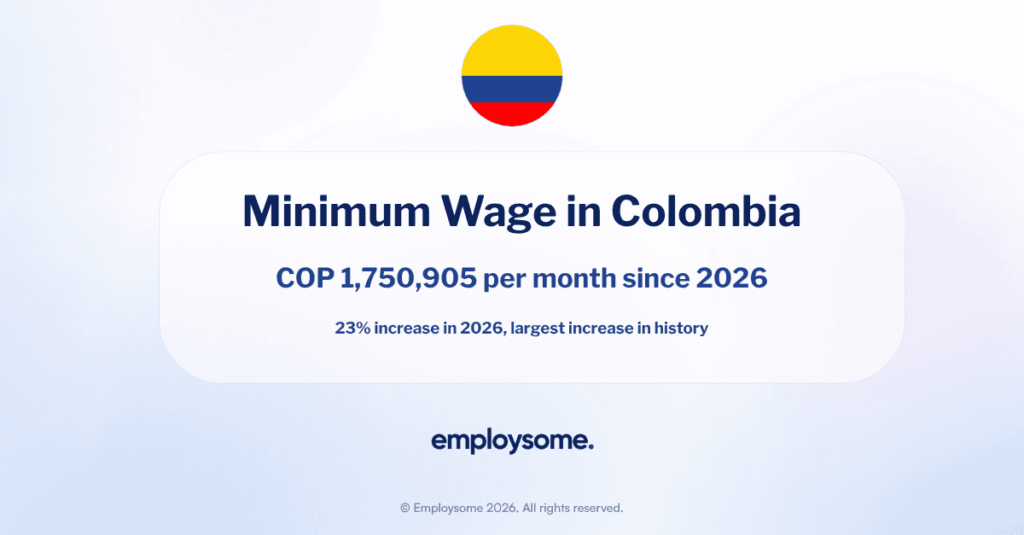
Colombia’s 2026 minimum wage jumped 23% to COP 1,750,905 per month, the largest increase in modern history. Combined with a transport subsidy of COP 249,095, the effective floor is COP 2,000,000 (~$550 USD). This guide covers the full breakdown: employer contributions, overtime rates, the workweek reduction to 42 hours from July 2026, income tax, mandatory benefits, and how Colombia compares across Latin America.

Colombia’s minimum wage is not just a salary floor. It is the reference point for nearly every calculation in the Colombian employment system. Social security contributions, severance (cesantias), the 13th-month bonus (prima de servicios), overtime rates, visa income thresholds, and even government fines are all expressed as multiples of the SMMLV (salario minimo mensual legal vigente). When the minimum wage moves, everything moves with it.
As of 1 January 2026, the gross minimum wage is COP 1,750,905 per month. On top of that, employees earning up to two minimum wages receive a mandatory transport subsidy (auxilio de transporte) of COP 249,095, bringing the effective minimum monthly compensation to COP 2,000,000 (~$550 USD). This represents a 23% increase over 2025, the largest single adjustment in modern Colombian history, and was imposed by presidential decree after negotiations between the government, unions, and employer associations broke down.
For companies hiring in Colombia, whether through a local entity or an Employer of Record, the headline number is only the starting point. Employer contributions, mandatory benefits, and the upcoming workweek reduction push the real cost significantly higher. This guide breaks down all of it.
Hiring in Colombia?
If you are looking to hire employees in Colombia without setting up a local entity, an Employer of Record handles payroll, social security, cesantias, prima, and compliance on your behalf. See our Best Employer of Record in Colombia ranking for pricing, entity ownership, and compliance depth.

The 2026 Minimum Wage and What It Actually Costs
The gross minimum wage of COP 1,750,905 is what the employee sees on their contract. The total cost to the employer is substantially higher once mandatory contributions and benefits are factored in.
Monthly employer contributions on minimum wage:
|
Contribution |
Employer Rate |
Monthly Amount (COP) |
|
Health (EPS) |
8.5% |
148,827 |
|
Pension |
12% |
210,109 |
|
Occupational risk (ARL) |
0.522% to 6.96% (risk-dependent) |
~9,140 (minimum risk) |
|
SENA |
2% |
35,018 |
|
ICBF |
3% |
52,527 |
|
Caja de Compensacion |
4% |
70,036 |
|
Total employer contributions |
~30% |
~525,657 |
On top of monthly contributions, employers must provision for annual mandatory benefits: prima de servicios (one month’s salary paid in two instalments in June and December), cesantias (one month’s salary deposited annually by 14 February), interest on cesantias (12% of the cesantias balance, paid by 31 January), vacation (15 working days paid leave per year, equivalent to half a month’s salary), and dotacion (work uniforms/clothing for employees earning up to two minimum wages, provided three times per year).
When all mandatory contributions and annual provisions are annualised and included, the total employer cost for a minimum-wage employee in Colombia is approximately 35 to 40% above gross salary. For a COP 1,750,905 salary, that means the real monthly cost is roughly COP 2,400,000 to 2,450,000. For a detailed breakdown of how these costs compare across salary levels and industries, see our average salary in Colombia guide.
💡 Employsome Insight: The 23% Increase Hits More Than Minimum Wage Workers
The SMMLV is baked into everything. When it jumped 23%, it recalibrated social security ceilings, pension contribution bases, cesantias calculations, overtime values, and visa income thresholds across the board. Companies with employees earning two to three times the minimum also felt the ripple because their statutory benefit calculations shifted. If your EOR has not proactively updated all contract terms and payroll calculations for 2026, that is a compliance gap you need to close immediately.
Working Hours, Overtime, and the 42-Hour Reform
Colombia is in the middle of a phased reduction of the maximum workweek under Ley 2101 of 2021. The timeline is as follows: 48 hours until July 2023, 47 hours from July 2023, 46 hours from July 2024, 44 hours from July 2025, and 42 hours from 15 July 2026.
The reduction to 42 hours from July 2026 is the final step. It applies to all employees without any reduction in salary. Employers must adjust hourly wage calculations accordingly, which means the effective hourly rate for minimum-wage workers increases even without a nominal wage change.
Overtime is capped at 2 hours per day and 12 hours per week. Daytime overtime (6 a.m. to 7 p.m. as of December 2025) is paid at 125% of the standard hourly rate. Nighttime overtime (7 p.m. to 6 a.m.) is paid at 175%. Sunday and holiday work carries a surcharge that is increasing progressively: 80% as of July 2025, rising to 90% from July 2026 and 100% from July 2027.
For companies hiring developers, support staff, or other roles where overtime is common, the combined effect of the workweek reduction and the increasing Sunday surcharge makes total labour cost planning for H2 2026 materially different from H1.
Employee Income Tax
Colombia uses a progressive income tax system measured in UVT (Unidad de Valor Tributario). For 2026, 1 UVT = COP 49,799. Minimum wage earners fall below the taxable threshold and pay no income tax. The brackets for employment income are:
|
Annual Income (UVT) |
Annual Income (COP approx) |
Tax Rate |
|
0 to 1,090 UVT |
Up to ~COP 54.3 million |
0% |
|
1,090 to 1,700 UVT |
~COP 54.3m to 84.7m |
19% |
|
1,700 to 4,100 UVT |
~COP 84.7m to 204.2m |
28% |
|
4,100 to 8,670 UVT |
~COP 204.2m to 431.8m |
33% |
|
8,670 to 18,970 UVT |
~COP 431.8m to 944.7m |
35% |
|
18,970 to 31,000 UVT |
~COP 944.7m to 1,543.8m |
37% |
|
Over 31,000 UVT |
Over ~COP 1,543.8m |
39% |
A minimum-wage worker earning COP 1,750,905/month (COP 21 million/year) is well below the 1,090 UVT threshold and pays zero income tax. A professional earning COP 5,000,000/month crosses into the 19% bracket partway through the year. Colombia’s tax burden on lower earners is light by regional standards, which makes the gross salary a closer approximation to take-home pay than in markets like Brazil or Argentina.
How Colombia Compares in Latin America
|
Country |
Min Wage (USD/mo) |
Employer SI |
Workweek |
Severance |
Key 2026 Change |
|
Colombia |
~$550 (incl. transport) |
~30% |
42 hrs (from July) |
Cesantias + prima |
23% wage hike, 42-hr week |
|
Mexico |
~$480 |
~25 to 30% |
48 hrs |
3 months + 20 days/yr |
Profit sharing reform |
|
Brazil |
~$270 |
~30 to 40% |
44 hrs |
FGTS + 40% penalty |
Labour code review pending |
|
Chile |
~$530 |
~5% |
40 hrs |
1 month/yr (capped 11) |
40-hr workweek in effect |
|
Argentina |
~$200 (official rate) |
~25 to 30% |
48 hrs |
1 month/yr |
Currency instability |
|
Peru |
~$280 |
~9 to 11% |
48 hrs |
CTS deposits |
Minimum wage review |
Colombia’s minimum wage is now the second highest in the region after Chile when the transport subsidy is included. But Chile’s employer social insurance burden is just ~5%, compared to Colombia’s ~30%. This makes Colombia’s total employment cost significantly higher than the headline salary suggests. For companies comparing nearshoring destinations across Latin America, the best countries to hire developers index covers how talent quality and total cost compare beyond just the minimum wage.
What This Means for EOR Arrangements
If you are hiring through an Employer of Record in Colombia, the EOR handles all mandatory contributions (EPS, pension, ARL, SENA, ICBF, Caja de Compensacion), calculates and pays the prima de servicios, deposits cesantias and interest, manages the workweek transition to 42 hours from July 2026, and adjusts overtime and surcharge calculations accordingly.
The 23% minimum wage increase means every payroll parameter has shifted. Confirm with your EOR that all 2026 statutory calculations have been updated, including visa income thresholds if you are sponsoring work permits. Providers that are still running 2025 parameters are out of compliance.
Frequently Asked Questions
The gross minimum wage is COP 1,750,905 per month. Employees earning up to two minimum wages also receive a transport subsidy of COP 249,095, bringing the effective minimum to COP 2,000,000 (~$550 USD).
Total employer cost is approximately 35 to 40% above gross salary when mandatory contributions (health, pension, ARL, parafiscals) and annual benefits (prima, cesantias, vacation) are included. For a minimum-wage employee, expect a total monthly cost of roughly COP 2,400,000 to 2,450,000.
From 15 July 2026. The current maximum is 44 hours (since July 2025). The reduction applies to all employees with no salary reduction.
No. The income tax exemption threshold is 1,090 UVT (~COP 54.3 million/year). A minimum-wage earner at COP 21 million/year is well below this threshold.
The 23% increase was imposed by presidential decree after tripartite negotiations failed. It was a politically driven decision by President Petro, significantly above the 2025 inflation rate of approximately 5.3%.

Written by
Courtney Pocock is a Copywriter & EOR/PEO Researcher at Employsome with 15+ years of experience writing for the HR, corporate, and financial sectors. She has a strong interest in global business expansion and Employer of Record / PEO topics, focusing on news that matters to business owners and decision-makers. Courtney covers industry updates, regulatory changes, and practical guides to help leaders navigate international hiring with confidence.
Our content is created for informational purposes only and is not intended to provide any legal, tax, accounting, or financial advice. Please obtain separate advice from industry-specific professionals who may better understand your business’s needs. Read our Editorial Guidelines for further information on how our content is created.
Other posts
Along with our standard maps we offer highly customizable maps.