How Employer of Record Is Changing the Hiring Market
Employer of Record services are reshaping the hiring market by turning global employment into on-demand infrastructure. From faster contract generation to lower HR overhead and new competition around employer cost, EOR platforms like Deel and Rippling are changing how companies expand internationally – and what comes next for the category.


Table of Contents
- Hire First, Set Up Later
- Employer Cost as the Deciding Factor
- EORs Turned Global Hiring Into Employee Work
- EOR Platforms Are Replacing Standalone HRIS Tools
- Global Hiring No Longer Requires Large Internal HR Teams
- Fast Contracts Win Global Talent
- Coverage Numbers Are No Longer Enough - Infrastructure Matters
- The New Default: Hiring Without Borders
A company with twenty employees can now hire in Germany, Brazil, or the Netherlands almost as easily as it can hire domestically. Ten years ago, this sentence would have seemed absurd.
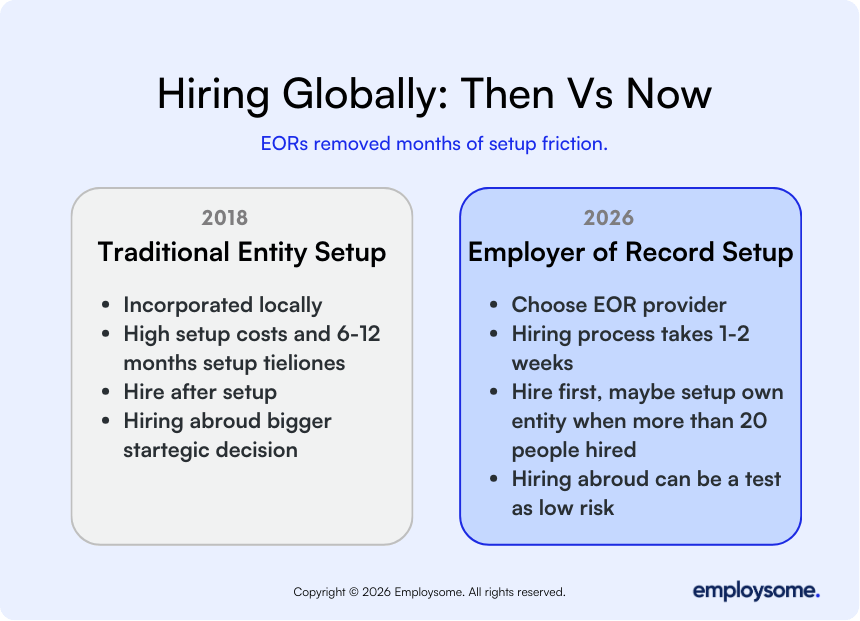
Not long ago, hiring internationally required the same playbook every multinational followed: open a subsidiary, register locally, retain lawyers, set up payroll, and accept that the process would take six to twelve months. Global hiring was slow by design, and only companies with significant scale could justify the overhead.
Employer of Record (EOR) services changed that. Over the past decade, EOR providers turned employment into a service layer – infrastructure companies can access without building everything themselves.
The growth of the category reflects how structural the shift has become. The global EOR market is projected to expand from $5.0 billion in 2026 to nearly $19.8 billion by 2036, representing a 14.8% CAGR, as adoption accelerates and EOR converges with broader workforce management services.
Global hiring is no longer an enterprise-only capability. It has become an operational default.

Hire First, Set Up Later
For decades, hiring abroad meant incorporating abroad. That order has flipped.
Many companies now hire their first employee internationally through an EOR, test the market, build traction, and only incorporate later – if they ever do. International expansion has become modular rather than binary.
CloudWay, a Norwegian technology consultancy, partnered with Safeguard Global’s Employer of Record service to hire technical talent internationally without establishing local entities in each market. By using Safeguard Global’s EOR infrastructure, CloudWay was able to onboard employees in countries like the UK and Finland while payroll, benefits, and compliance were handled locally – turning what once required a multi-quarter expansion process into a straightforward operational decision.
The hiring market changed because the sequence changed: companies no longer need infrastructure before they can employ.
Employer Cost as the Deciding Factor
EORs removed one of the biggest historical blockers: legal setup.
But they replaced it with a different constraint: employer cost.
Countries with high taxes or heavy employment regulation are no longer automatically excluded because companies fear permanent establishment risk. With an EOR, the bigger question becomes whether the fully loaded employment cost makes sense. Once compliance and entity setup are handled externally, geography becomes less about legal barriers and more about economics.
This has reshaped global hiring patterns.
South Africa is a good example. In recent years, it has become an increasingly popular destination for international hiring – not because it is easier legally, but because employer costs remain relatively competitive compared to Western Europe. Employer social contributions in South Africa are typically far lighter than in many EU markets, and fully loaded employment costs are often meaningfully lower for the same salary level. With an EOR handling payroll and compliance, companies can hire quickly without building infrastructure, making the cost-to-talent ratio especially attractive.
The contrast is clear in countries like France. While EORs have made compliant employment feasible, the employer burden remains among the highest in Europe. Employer social contributions can add roughly 40% to 50%+ on top of gross salary in many cases, meaning the true cost of employing someone can be dramatically higher than the headline wage.
Italy shows a similar dynamic. Employer contributions often sit in the range of 30% to 40%+ of salary, and employment protections can increase the complexity and cost of termination. The question is no longer whether a company can hire in Italy through an EOR. It is whether the total cost of employment is sustainable compared to alternatives.
A comparable pattern plays out in Latin America. Countries like Mexico or Colombia have seen growing international hiring demand because fully loaded employer costs are often lower than in the US or Western Europe, while talent supply remains strong. In many cases, the employer burden may sit closer to the 20% to 30% range rather than the 50%+ levels seen in parts of Europe. EOR infrastructure removes the compliance friction, leaving cost competitiveness as the deciding factor.
Global hiring now competes on total employer cost, not just compliance possibility.
EORs Turned Global Hiring Into Employee Work – Not Contractor Work
One of the most under-appreciated ways EORs changed the hiring market is that they shifted international work from contractor arrangements to real employment.
Before EORs became mainstream, many cross-border hires were structured as freelance contracts by default. Not because companies preferred it, but because employing someone properly in another country required entity setup, local payroll registration, and months of legal overhead. Independent contractors were often the only practical option.
EORs flipped that model.
By making compliant employment accessible without incorporation, EOR providers enabled companies to hire internationally as employees from day one. That change matters not only for employers, but for workers.
Many professionals who previously would have been asked to invoice as independent contractors are now open to being employed through an EOR because it comes with real security: stable monthly payroll, statutory benefits, health coverage where applicable, pension contributions, paid leave entitlements, and clearer protections under local labor law. In many countries, employment status also determines access to mortgages, visas, unemployment insurance, and basic financial stability.
In markets with strong labor rights, the difference between contractor status and employment is not cosmetic – it fundamentally changes the employee experience.
In that sense, EORs did more than accelerate global hiring. They formalized it. They turned cross-border work from a patchwork of contractor workarounds into legitimate employment at scale.
Global hiring didn’t just become easier. It became more employable.

EOR Platforms Are Replacing Standalone HRIS Tools for Many Teams
EORs didn’t just change hiring – they changed the HR tech stack.
Historically, companies bought an HRIS first, then layered payroll and compliance underneath. The HRIS was the core system of record, and everything else plugged into it.
Increasingly, that order is reversing.
Modern EOR platforms are bundling HRIS functionality directly into the employment layer, and for many teams, it is simply “good enough.” Providers like Deel, Rippling, and Remote now include built-in tooling for onboarding, document management, leave tracking, org charts, employee self-service, and basic people administration – all inside the same platform that runs contracts and payroll.
Deel is a particularly clear example. By offering HRIS features at little or no incremental cost alongside its global hiring product, Deel has effectively made lightweight HRIS functionality a bundled default rather than a separate category purchase. For companies managing a few dozen international employees, paying again for a standalone HRIS often feels redundant.
This creates a structural challenge for traditional HRIS vendors. Competing against a dedicated HRIS product is one thing. Competing against an EOR platform that provides global employment infrastructure and includes core HR workflows for free is another.
💡 Employsome Insight: We increasingly see companies consolidating around the EOR platform as the system of record – not because it is the most sophisticated HRIS available, but because the marginal value of running a second system is often too small to justify the added cost and complexity.
In practice, EOR platforms are not just providers of compliance. They are becoming the default HR layer for globally distributed teams.
Global Hiring No Longer Requires Building a Large Internal HR Function
Another quiet shift is organizational.
In the past, hiring across multiple countries required building internal HR infrastructure country by country: local payroll specialists, compliance managers, benefits administrators, external counsel, and often local advisors just to navigate basic employment workflows.
EORs externalize much of that operational burden.
Many modern providers do not simply process payroll. They handle the full employment lifecycle: onboarding, compliant contract issuance, local registrations, statutory benefits, tax filings, and ongoing payroll execution. They support terminations and offboarding, often with in-country legal expertise built in. Some also manage work permits and visa processes, removing yet another layer of complexity for companies hiring internationally.
For startups and mid-sized businesses, this changes the internal HR equation completely. Global hiring no longer requires building a parallel HR organization just to operate across jurisdictions. Much of the administrative and compliance-heavy work sits with the EOR provider.
The result is that HR teams are increasingly freed from infrastructure and pushed toward higher-order challenges: culture, engagement, performance management, and building cohesion across distributed teams. As global hiring becomes easier operationally, the harder problem shifts from compliance to company-building.
Global expansion becomes lighter – but managing a global workforce becomes the new frontier.
Fast Contracts Win Global Talent
Speed is one of the most immediate shifts EORs introduced.
Entity setup stretches across quarters. EOR onboarding happens in weeks. That difference matters in competitive talent markets, where hiring delays are often the difference between landing a candidate or losing them.
In many cases, the company that can send the compliant employment contract first wins the candidate. Global hiring has become a race of execution: the faster an employer can move from “yes” to a signed agreement, the less likely they are to lose talent to another offer.
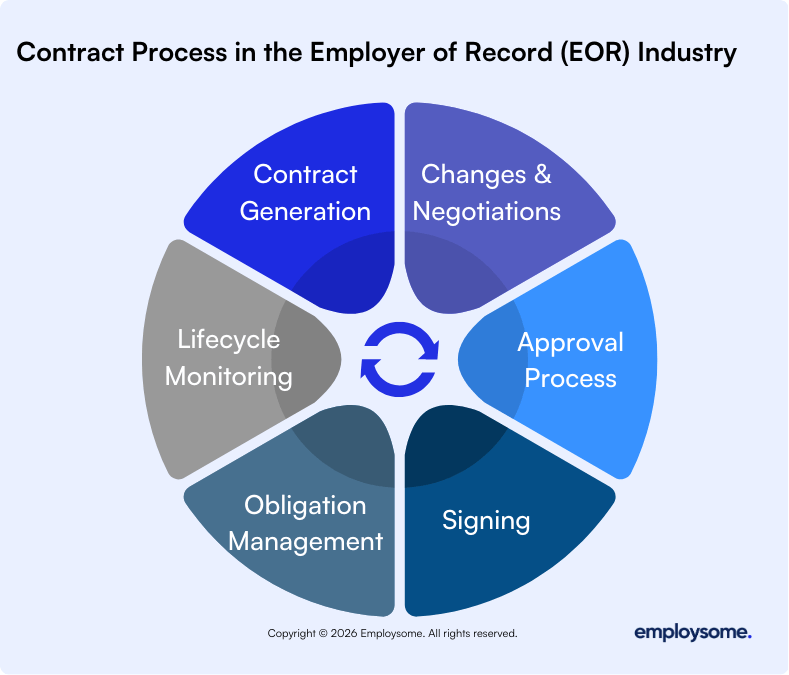
This is where technology has become decisive. Providers like Deel, Remote, and Boundless increasingly offer automated contract generation and onboarding workflows, allowing companies to issue locally compliant employment agreements almost immediately. In that environment, EORs are no longer the reason hiring slows down – they are often the reason it can move fast at all.
For smaller or more manually operated EORs, this is a growing challenge. In some cases, drafting an employment contract can still take a week, introducing delays that feel unacceptable in modern hiring cycles. The difference between a platform-driven EOR and a service-heavy one is increasingly measured in days, not features.
High-growth companies are now able to expand distributed teams across multiple jurisdictions in the time it once took to hire a single international employee.
💡 Employsome Insight: The EOR value proposition is increasingly not “global coverage,” but compressed hiring timelines. Hiring internationally is no longer next year’s project – it’s this month’s workflow.
The EOR Market Is Shifting From Coverage to Real Infrastructure
The EOR category expanded quickly, and much of that growth was driven by a simple promise: hire anywhere.
Today, many providers advertise coverage across 100 or even 150 countries. But in practice, much of that footprint is often built through in-country partners rather than owned legal infrastructure. The ability to onboard an employee in a jurisdiction is not always the same as having real operational depth there.
Entity coverage is frequently the real coverage – and it is not always displayed transparently.
For buyers, this creates a meaningful gap. Two providers may claim the same number of countries, but the underlying model can be completely different: one may operate through owned entities with local teams and benefits infrastructure, while another relies primarily on third-party partners with varying levels of consistency and accountability.
As the market matures, coverage alone is becoming table stakes. Evaluation is shifting toward execution quality: entity ownership, local responsiveness, compliance depth, and reliability when complex scenarios arise.
At Employsome, this is exactly what we focus on in our country-level scoring and provider analysis – separating marketing coverage from real infrastructure on the ground.
This dynamic is also reshaping what comes next for the industry.
The next phase of the EOR market will be defined by consolidation and deeper local control. As global platforms like Deel, Rippling, and Remote expand, many are moving beyond partner-based networks toward acquiring or building stronger country-specific infrastructure.
A good example of this trend is Payoneer’s acquisition of Boundless – a move that signals how larger global platforms are consolidating EOR capabilities and local expertise into broader HR and payments ecosystems, combining scale, technology, and country-level operational depth.
Larger players increasingly want to offer both: the consistency of a global platform and the depth of local expertise. The result is a hybrid model – global technology layered on top of real local employment foundations.
In many ways, the market is converging toward fewer, bigger providers that combine three advantages at once: strong product, broad international coverage, and genuine operational depth in the countries that matter.
For buyers, this raises expectations. The future leaders in the EOR space will not be defined by how many countries appear on a coverage map, but by how well they execute on the ground – with real entities, real expertise, and real accountability.
The category is shifting from fragmented partner networks toward integrated global infrastructure.
The New Default: Hiring Without Borders
Employer of Record services have already changed the hiring market structurally.
They made global employment faster, more accessible, and more scalable. They enabled remote work to become operationally real. And they shifted employment from something companies must build locally into something companies can access as infrastructure.
For a growing number of companies, the question is no longer “Should we hire internationally?” but simply: where is the best person for this role?
Geography has become a secondary constraint.
But as global hiring becomes easier, choosing the right infrastructure becomes harder. The EOR market is crowded, coverage claims are inconsistent, and execution quality varies significantly beneath the surface. Employsome exists to bring transparency to the space by helping companies compare providers based on real country-level infrastructure, compliance depth, and operational reliability – not just marketing coverage numbers.

Written by
Courtney Pocock is a Copywriter & EOR/PEO Researcher at Employsome with 15+ years of experience writing for the HR, corporate, and financial sectors. She has a strong interest in global business expansion and Employer of Record / PEO topics, focusing on news that matters to business owners and decision-makers. Courtney covers industry updates, regulatory changes, and practical guides to help leaders navigate international hiring with confidence.
Our content is created for informational purposes only and is not intended to provide any legal, tax, accounting, or financial advice. Please obtain separate advice from industry-specific professionals who may better understand your business’s needs. Read our Editorial Guidelines for further information on how our content is created
Other posts
View additional blog posts