Germany Work Permit: The Complete 2026 Guide
Germany’s work permit system has undergone its most significant reform in decades. Under the Skilled Immigration Act, salary thresholds have been lowered, the EU Blue Card has been expanded, and entirely new pathways like the Opportunity Card and Recognition Partnership now allow professionals to enter the country more flexibly than ever before. This 2026 guide breaks down every major work permit Germany offers, including eligibility criteria, salary thresholds, employer obligations, permanent residency timelines, and how companies can hire compliantly through an Employer of Record if they do not yet have a German entity.

Table of Contents
- How the German Work Permit System Works
- 1. Work Visa for Qualified Professionals (Sections 18a & 18b)
- 2. EU Blue Card Germany: The Premium Route
- 3. Visa for Professionally Experienced Workers
- 4. Recognition Partnership Visa
- 5.Job Seeker Visa and Opportunity Card
- Self-Employment and Freelance Residence Permits
- Employer of Record in Germany
- Path to Permanent Residency
- Final Assessment
Germany is not experimenting with immigration reform. It is restructuring its labour market access model around economic necessity.
Germany’s work permit system has been reshaped in response to sustained labour shortages across engineering, IT, healthcare, logistics, and advanced manufacturing. Germany has reported around 700,000 registered job vacancies in recent labour market reports, underscoring the structural demand for international talent. Against this backdrop, the German government has modernised the Germany work permit framework to make it easier for qualified professionals to obtain a work permit Germany and enter the labour market.
The reforms introduced under the Skilled Immigration Act (Fachkräfteeinwanderungsgesetz), implemented in stages through 2024 and 2025, lowered EU Blue Card salary thresholds, expanded eligibility criteria, created new pathways for experienced professionals, and digitised large parts of the application process. As a result, securing a working visa Germany in 2026 is more transparent, more flexible, and more closely aligned with real labour market demand than in previous years.
For professionals considering relocation and for companies hiring into Germany, the 2026 work permit Germany framework is significantly more accessible than it was five years ago. But it remains structured, rule-based, and compliance-intensive.
This guide explains how Germany’s work permit system works, what visa categories are available, how the Arbeitserlaubnis is granted, what salary thresholds apply, how the approval process functions in practice, and how temporary residence transitions into permanent settlement. It also examines the employer side of the equation including wage compliance, social contribution obligations, and when an Employer of Record structure becomes strategically relevant.

How the German Work Permit System Actually Works
Germany no longer operates a standalone “work permit” system in the traditional sense. Instead, employment authorisation is embedded within a residence title (Aufenthaltstitel). When a non-EU national is granted residence for employment purposes, the right to work “the Arbeitserlaubnis” is included within that residence permit.
The process typically unfolds in two stages. First, the applicant applies for a national visa (Type D) at a German embassy or consulate abroad. This visa allows entry into Germany for employment purposes and is usually valid for up to twelve months. Once in Germany, the individual applies at the local Foreigners’ Authority (Ausländerbehörde) for a longer-term residence permit, which may be valid for up to four years and is renewable.
Certain nationals (including citizens of the United States, Canada, Australia, Japan, Israel, New Zealand, and South Korea) may enter Germany visa-free and apply for the residence permit after arrival. However, employment generally cannot begin until the residence permit explicitly authorises it.
In most cases, the Federal Employment Agency (Bundesagentur für Arbeit) must approve the employment of a foreign national. This approval is not symbolic. Authorities verify that salary, working hours, and employment conditions are comparable to those offered to domestic employees in similar roles. Employers must submit a formal “Declaration of Employment” as part of this review.
This is where many misunderstand the system. Entry into Germany does not automatically grant the right to work. The Arbeitserlaubnis is only valid once included in the residence permit, and employers must verify that authorisation before employment begins.
💡 Employsome Employment Insight: Immigration Approval Is Only One Layer of Compliance
Germany’s system integrates immigration and labour market protection. Salary alignment, contract structure, and social contribution registration are reviewed before work begins. Employers who treat visa approval as the end of the process often underestimate payroll and social security obligations.
The Major Work Permit Categories in Germany (2026)
Germany offers multiple employment-based residence pathways. Each is grounded in a distinct economic logic and legal basis within the Residence Act (Aufenthaltsgesetz).
Below is a structural overview before we analyse each route in depth.
|
Visa Category |
Who It’s For |
2026 Salary Threshold |
Permanent Residency Timeline |
|---|---|---|---|
|
EU Blue Card |
Highly qualified professionals |
€45,300 / €41,042 shortage |
21–27 months |
|
Skilled Worker Visa |
Recognised academic or vocational professionals |
Market-aligned salary |
3–5 years |
|
Experienced Professional Visa |
Vocational + 2 years’ experience |
€45,630 |
3–5 years |
|
IT Specialist (No Degree) |
3+ years IT experience |
€45,934.20 |
3–5 years |
|
Recognition Partnership |
Work + recognition in parallel |
Market-aligned salary |
Standard timeline |
|
Job Seeker / Opportunity Card |
Qualified job seekers |
None initially |
Transition required |
|
Self-Employment / Freelancer |
Independent professionals |
Business viability |
After 3–5 years |
1. Work Visa for Qualified Professionals (Sections 18a & 18b)
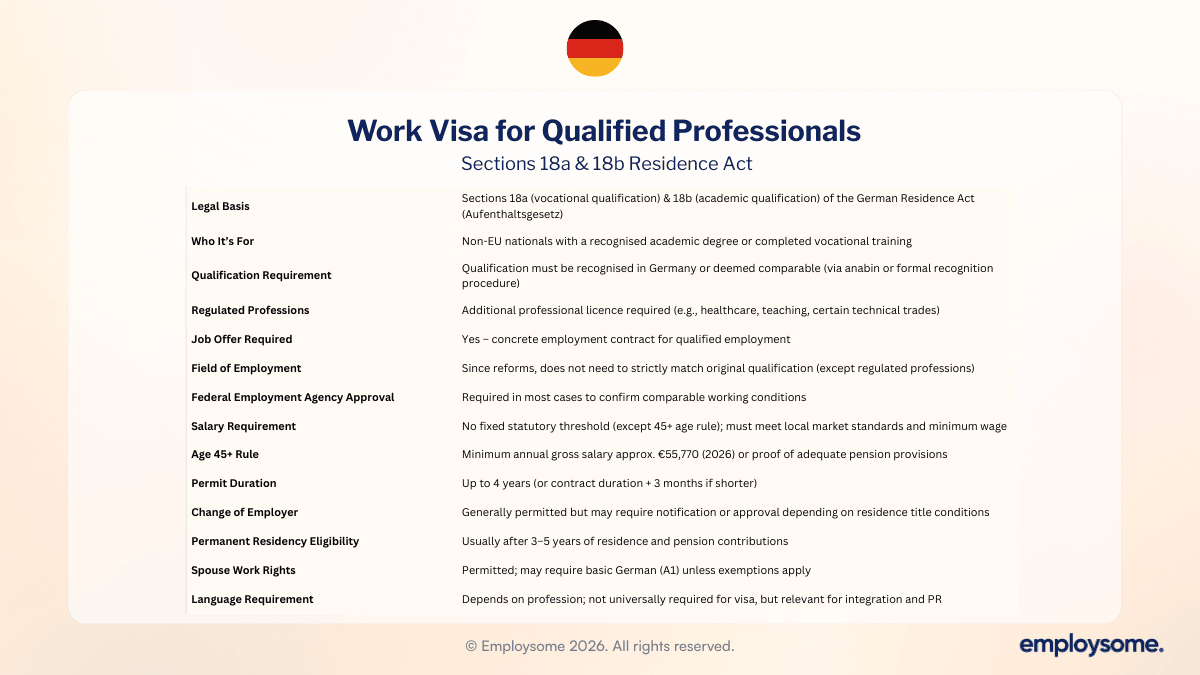
This is the most widely used route for foreign professionals relocating to Germany. It applies to individuals holding either a recognised university degree or a completed vocational training qualification.
Eligibility requires formal recognition of the qualification. Academic degrees can be checked through the anabin database, while vocational training must be assessed for comparability. Regulated professions (such as nursing or certain technical trades) require a professional licence.
A concrete job offer is mandatory. The role must be classified as qualified employment, meaning it typically requires advanced training or academic education. Auxiliary or unskilled positions do not qualify under this route.
If the applicant is over 45 and entering Germany for the first time for employment, the salary must meet a higher threshold (approximately €55,770 in 2026) or adequate pension provisions must be demonstrated.
Residence permits are issued for up to four years. After holding employment-based residence for three years, applicants may qualify for permanent residency, provided language proficiency and pension contribution requirements are met.
One of the most important reforms under the Skilled Immigration Act removed the previous restriction tying workers strictly to jobs that directly matched their formal qualification. Skilled professionals can now pursue employment outside their precise academic field, except in regulated professions.
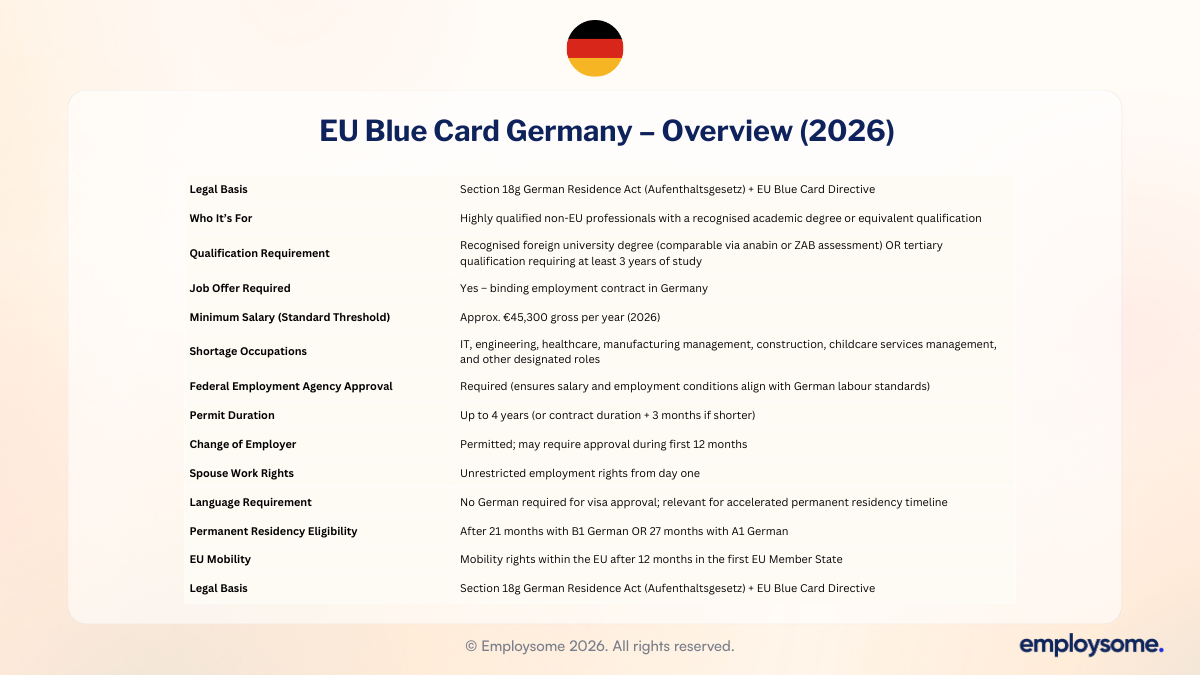
2. EU Blue Card Germany: The Premium Route
The EU Blue Card remains Germany’s most advantageous work permit category.
It is designed for highly qualified professionals earning above defined salary thresholds. In 2026, the standard annual gross salary requirement is approximately €45,300. For shortage occupations – including IT, engineering, healthcare, construction management, childcare services management, and other professional roles – the reduced threshold is approximately €41,042.
Unlike the general skilled worker route, the Blue Card offers accelerated permanent residency. Applicants can qualify for a settlement permit after 21 months with B1 German language proficiency, or after 27 months with A1-level skills.
Spouses of Blue Card holders enjoy unrestricted work rights from day one. Family reunification requirements are simplified compared to other residence categories.
Recent reforms also expanded eligibility for IT specialists without formal academic degrees. Applicants with at least three years of relevant IT experience within the last seven years can qualify if their salary meets the higher threshold of approximately €45,934.20 annually.
From a strategic perspective, the EU Blue Card is Germany’s most competitive migration product.
💡 Employsome Employment Insight: Salary Benchmarking Matters Beyond Thresholds
Employers often assume meeting the minimum Blue Card salary is sufficient. In practice, the Federal Employment Agency assesses whether compensation reflects local labour market standards. Offering exactly the minimum can slow approval in competitive regions such as Munich or Frankfurt. Strategic salary positioning strengthens both approval predictability and retention outcomes.
3. Visa for Professionally Experienced Workers
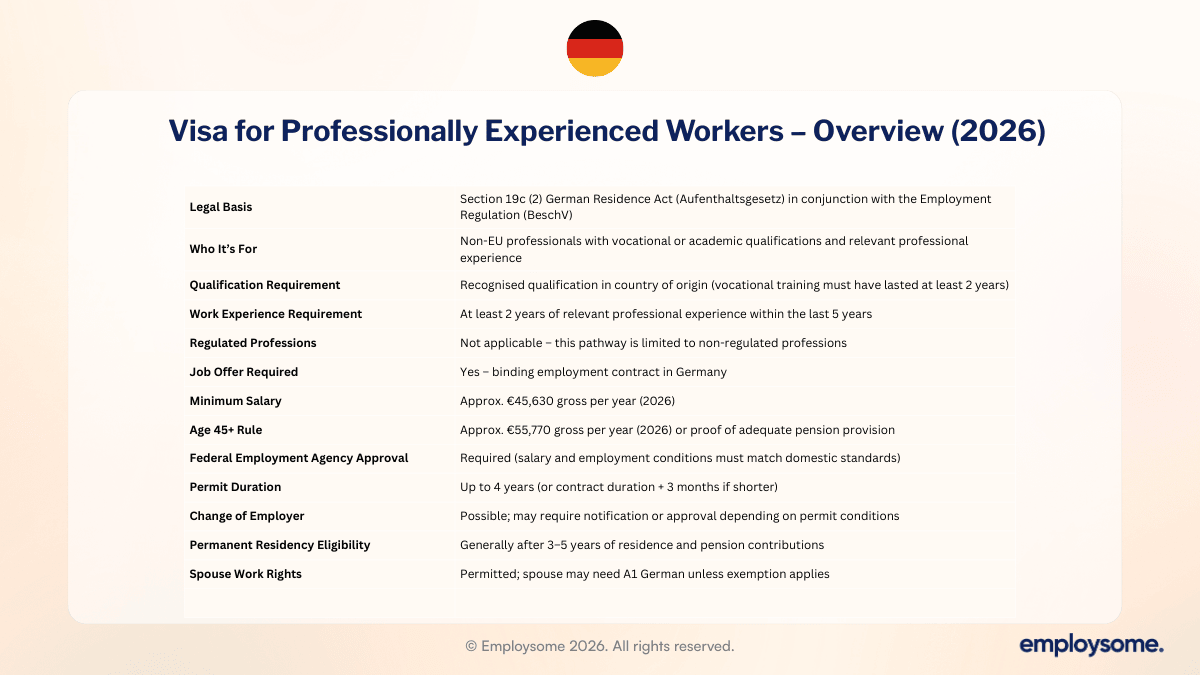
This newer pathway addresses workers who hold vocational training and professional experience but not necessarily university degrees.
Eligibility requires a vocational or academic qualification recognised in the country of origin, at least two years of relevant professional experience within the last five years, and a binding job offer with a minimum annual salary of approximately €45,630. For workers over 45, higher thresholds apply.
If employment falls under a collective agreement and salary conditions are governed by it, the statutory salary minimum may not apply.
This category is limited to non-regulated professions. It broadens access to Germany’s labour market for experienced technical and vocational professionals.
4. Recognition Partnership Visa
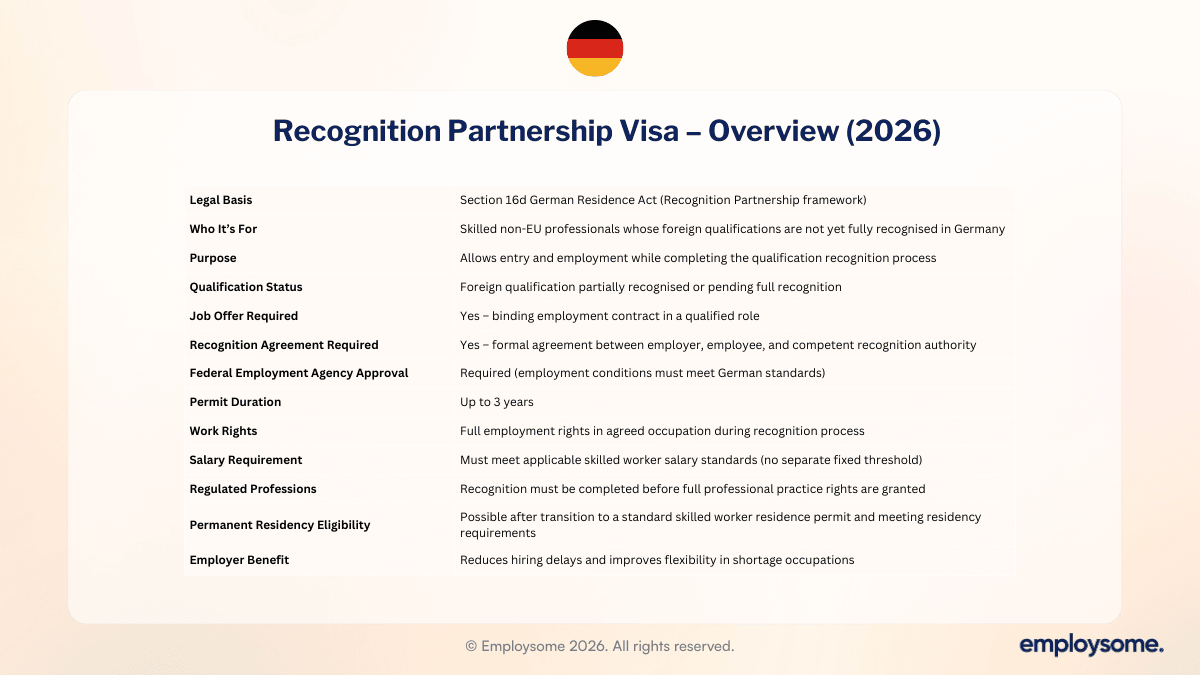
One of the most innovative reforms introduced in recent years is the recognition partnership pathway. It addresses a persistent bottleneck: the lengthy qualification recognition process.
Under this framework, professionals whose credentials are not yet fully recognised can enter Germany, begin employment, and complete recognition simultaneously. The residence permit can last up to three years.
This pathway requires formal agreement between employer, employee, and the competent recognition authority, ensuring that the recognition process proceeds during employment.
From an employer perspective, this reduces onboarding delays and improves hiring flexibility in shortage sectors.
5. Job Seeker Visa and Opportunity Card
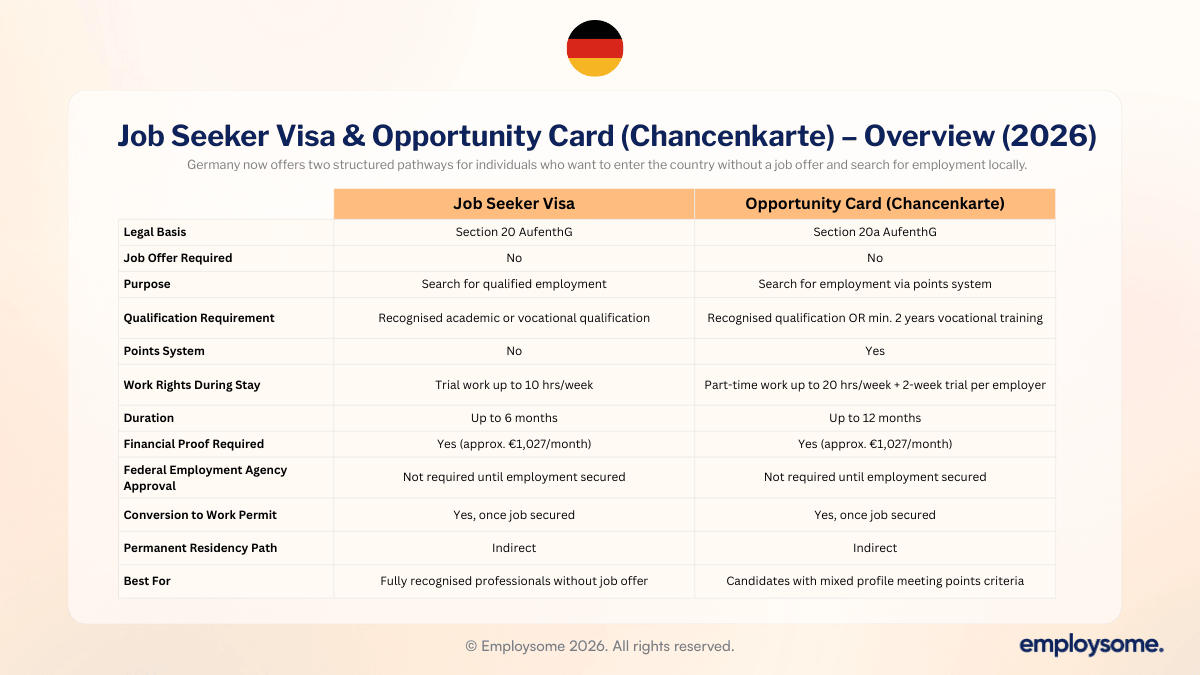
Germany offers structured entry pathways for qualified professionals who do not yet have a job offer.
The traditional job seeker visa allows entry for up to 18 months. Applicants must hold recognised qualifications. During this period, full employment is permitted, even if unrelated to qualifications.
The newer Opportunity Card (Chancenkarte) uses a points-based system evaluating qualifications, work experience, language proficiency, and financial sustainability. It allows entry for up to twelve months to search for employment. Limited part-time work is permitted during the search period.
Once suitable employment is secured, applicants transition into a standard employment residence permit.
Self-Employment and Freelance Residence Permits
Germany does not offer a digital nomad visa but provides structured pathways for independent professionals.
The self-employment visa is available to entrepreneurs establishing businesses that demonstrate economic interest or regional benefit. Applicants must submit a viable business plan and proof of financial resources.
The freelance visa applies to independent professionals such as consultants, creatives, journalists, and certain IT contractors. Applicants must demonstrate secured contracts or realistic income projections and register for German taxation.
Both routes require full compliance with German health insurance and social security obligations where applicable.
Salary Thresholds and Labour Cost Realities (2026)
Salary thresholds are adjusted annually based on pension insurance contribution ceilings. The 2026 benchmarks are summarised below:
|
Minimum Annual Salary (2026) |
|
|---|---|
|
EU Blue Card (Standard) |
€45,300 |
|
EU Blue Card (Shortage) |
€41,042 |
|
IT Specialist (No Degree) |
€45,934.20 |
|
Experienced Worker Visa |
€45,630 |
|
Age 45+ Requirement |
€55,770 |
However, base salary is only part of the equation.
Employers must also account for social security contributions, which typically represent approximately 20–22% of gross salary on the employer side. This includes pension insurance, health insurance, unemployment insurance, and long-term care insurance.
All employment must comply with the statutory minimum wage. For a full breakdown of current minimum wage rates and sector-specific obligations, see our Germany Minimum Wage guide.
💡 Employsome Employment Insight: Work Permit Germany Approval Is Only the Beginning
Visa approval authorises employment. It does not replace wage compliance, payroll tax registration, or social insurance contributions. For international companies hiring in Germany, understanding total employment cost is essential before extending offers.
Employer of Record in Germany: How It Interacts with the Work Permit Process
For international companies hiring into Germany without an existing legal entity, the work permit Germany process intersects directly with corporate structure. Germany does not allow informal remote employment arrangements. Any individual physically working in Germany must be registered under German payroll, social security, and tax systems from day one. There is no “independent contractor workaround” that avoids this requirement without creating compliance risk.
If a foreign company hires an employee directly without a German entity, it may unintentionally trigger permanent establishment exposure. This can create corporate tax liability, payroll tax registration requirements, and potential back-payment exposure for social contributions.
An Employer of Record (EOR) structure addresses this structural constraint. Under an EOR model, the employee is formally employed through a German legal entity operated by the EOR provider. The foreign company retains operational control over day-to-day responsibilities, but the German entity becomes the legal employer for payroll, tax, and labour law purposes.
However, when it comes to the work permit Germany process, several important nuances apply.
Can an Employer of Record Sponsor a Work Permit in Germany?
In Germany, the key issue is not “visa sponsorship” in the Anglo-American sense. Rather, the German entity that signs the employment contract is the entity assessed by the Federal Employment Agency. That entity must:
-
Offer a compliant employment contract
-
Meet salary threshold requirements
-
Register the employee for social insurance
-
Submit the Declaration of Employment
-
Demonstrate labour market compliance
If the EOR provider operates a properly registered German legal entity, it can act as the employing entity during the residence permit application. In that case, the EOR entity signs the contract, and the employee applies for the relevant residence permit category (e.g., EU Blue Card, Skilled Worker Visa, IT specialist route) based on that contract.
From the immigration authority’s perspective, the EOR is simply the employer.
The foreign company does not appear in the visa process as the legal employer; it appears operationally in the background through a commercial agreement with the EOR.
How the Work Permit Process Works Under an EOR Structure
When hiring through an Employer of Record in Germany, the process typically unfolds as follows:
-
The foreign company agrees commercial terms with the EOR provider.
-
The EOR drafts a German-compliant employment contract that meets salary thresholds and labour standards.
-
The contract is signed between the employee and the German EOR entity.
-
The employee applies for the appropriate residence permit category (EU Blue Card, Skilled Worker Visa, etc.) using that employment contract.
-
The Federal Employment Agency reviews the employment terms.
-
Upon approval, the residence permit is issued, including the Arbeitserlaubnis.
-
The EOR registers the employee for German payroll and social insurance.
From the employee’s perspective, the immigration pathway does not fundamentally change. The same salary thresholds apply. The same recognition requirements apply. The same permanent residency timelines apply. The difference lies in which entity signs the contract.
When an EOR Makes Strategic Sense
An Employer of Record structure is particularly relevant in three situations.
First, when a company is hiring one or two employees in Germany and does not want to establish a GmbH immediately. Forming a German entity involves notarial incorporation, capital deposit requirements, managing directors, accounting registration, and ongoing compliance costs.
Second, when a company is testing market viability. Hiring through an EOR allows entry into the German labour market without committing to long-term entity infrastructure.
Third, when speed matters. Entity formation can take several weeks. An established EOR entity already exists and can issue compliant employment contracts immediately.
Important Limitation: Salary and Visa Criteria Still Apply
Using an Employer of Record does not lower salary thresholds, relax qualification recognition requirements, or bypass Federal Employment Agency approval. The work permit Germany criteria remain identical.
An EU Blue Card still requires meeting the annual gross salary threshold. A Skilled Worker Visa still requires recognised qualifications. An IT specialist without a degree must still meet experience and salary benchmarks.
The EOR structure solves corporate presence and payroll compliance issues. It does not alter immigration eligibility criteria.
💡 Employsome Employment Insight: EOR Solves Entity Risk, Not Immigration Eligibility
Some companies assume that using an Employer of Record simplifies immigration approval. In reality, it simplifies corporate compliance. Immigration approval remains contingent on the same statutory requirements. The EOR removes permanent establishment exposure and payroll risk — it does not change visa law.
Transitioning from EOR to Local Entity
If a company later establishes its own German subsidiary, the employment contract can be transferred from the EOR entity to the new German entity. In most cases, this does not require a new visa application, provided the role, salary, and employment conditions remain materially consistent. However, notification to the Foreigners’ Authority may be required.
This flexibility makes the EOR route particularly attractive for staged market entry.
For a detailed breakdown of structures, pricing, and compliance considerations, see our dedicated Employer of Record Germany guide.
Path to Permanent Residency
Germany provides a clear statutory pathway from temporary work permit to permanent settlement (Niederlassungserlaubnis).
Standard skilled workers typically qualify after three years of residence and pension contributions. EU Blue Card holders qualify after 21–27 months, depending on language proficiency.
Permanent residency requires proof of income stability, pension contributions, basic German language skills, adequate housing, and a clean criminal record.
After five years of permanent residence, applicants may qualify for long-term EU residence status.
Final Assessment: Work Permit Germany in 2026
Germany’s work permit framework in 2026 is structured, economically aligned, and strategically rational. It rewards recognised qualifications, labour market alignment, and salary compliance. The EU Blue Card remains the fastest route to permanent residency. Skilled Worker and Experienced Professional visas provide stability. Recognition partnerships increase flexibility. Employer of Record structures enable compliant hiring without entity formation.
Germany does not offer shortcuts. It offers predictability backed by strong labour protections and clear settlement pathways. For professionals and employers prepared to align with its regulatory framework, it remains one of Europe’s most stable long-term migration destinations.

Written by
Dane Cobain is a Copywriter at Employsome and an accomplished author whose work spans fiction, non-fiction, and professional writing. Over the past decade, he has built a strong track record creating straightforward content for the HR, payroll, and corporate sectors. Dane brings a storyteller’s eye to the evolving world of global employment, with a particular focus on Employer of Record and PEO models. His articles explore industry trends and dedicated Best Of Guides when managing an international workforce.
Our content is created for informational purposes only and is not intended to provide any legal, tax, accounting, or financial advice. Please obtain separate advice from industry-specific professionals who may better understand your business’s needs. Read our Editorial Guidelines for further information on how our content is created.
Other posts
Check out other similar blog posts