Employment Rights Act 2025: What’s Changing in 2026
The Employment Rights Act 2025 received Royal Assent on 18 December 2025 and represents the most significant overhaul of UK employment law in over a generation. It introduces 28 major reforms phased across 2026 and 2027, including reducing the unfair dismissal qualifying period from 2 years to 6 months (January 2027), removing the cap on unfair dismissal compensation, restricting fire and rehire, creating the Fair Work Agency, introducing guaranteed hours for zero-hours workers, expanding day-one rights for paternity and parental leave, and strengthening protections against sexual harassment. This guide covers every key change, the full implementation timeline, and what employers need to do now to prepare.

Table of Contents
- Implementation Timeline at a Glance
- Unfair Dismissal: The Biggest Change
- Fire and Rehire Restrictions
- Zero-Hours and Low-Hours Contract Reforms
- Statutory Sick Pay Reforms
- Sexual Harassment: Strengthened Duties
- The Fair Work Agency
- Collective Redundancy Changes
- Trade Union Reforms
- Flexible Working
- Employment Tribunal Time Limits
- What This Means for International Employers
- FAQs
The Employment Rights Act 2025 received Royal Assent on 18 December 2025, becoming the most significant piece of UK employment legislation in decades. Originally introduced as the Employment Rights Bill in October 2024, the Act introduces 28 major reforms across unfair dismissal, zero-hours contracts, fire and rehire, family leave, sexual harassment, trade union rights, and enforcement.
The Employment Rights Act 2025 does not take effect all at once. Implementation is phased across 2026 and 2027, with many provisions still subject to government consultation and secondary legislation. This means employers have time to prepare, but the window is narrowing. Some changes took effect immediately on Royal Assent, others landed in February and April 2026, and the most impactful reforms arrive in October 2026 and January 2027.
For international companies hiring in the UK through an Employer of Record, these changes directly affect employment contracts, probation structures, termination risk, and ongoing compliance obligations. Understanding the Employment Rights Act 2025 is essential for any company employing UK staff.

Implementation Timeline at a Glance
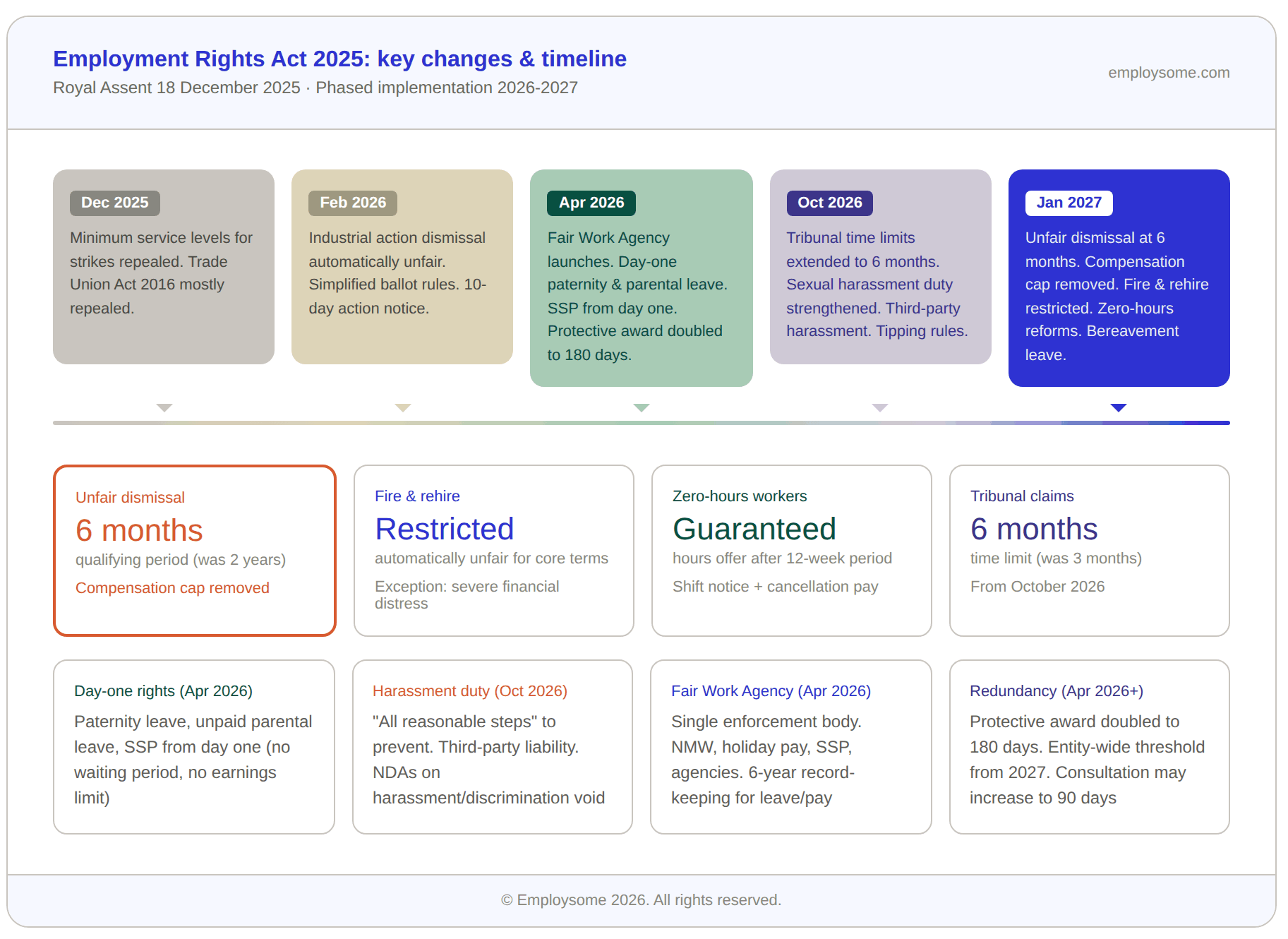
The Employment Rights Act 2025 rolls out in four main phases:
18 December 2025 (Royal Assent) Repeal of the Strikes (Minimum Service Levels) Act 2023. Repeal of most provisions of the Trade Union Act 2016.
February 2026 Dismissal for taking part in industrial action became automatically unfair (no 12-week limit). Simplified requirements for trade union ballot and action notices. Reduced notice period for industrial action (down to 10 days). Ballot mandate validity extended to 12 months.
April 2026 Establishment of the Fair Work Agency. Paternity leave becomes a day-one right. Unpaid parental leave becomes a day-one right. Statutory Sick Pay payable from day one of illness (removing the 3-day waiting period). SSP lower earnings limit removed. Collective redundancy protective award doubled from 90 to 180 days. Simplified trade union recognition process. Electronic and workplace balloting enabled (where employer and union agree). Employers must keep records of annual leave and holiday pay (retained for 6 years). Gender pay gap and menopause action plans introduced on a voluntary basis.
October 2026 Fire and rehire restrictions take effect (automatically unfair for restricted variations to core terms). Extended Employment Tribunal time limits from 3 months to 6 months. Duty on employers to take “all reasonable steps” to prevent sexual harassment (strengthened from “reasonable steps”). Third-party harassment liability reinstated. Strengthened trade union rights (workplace access, facilities, equality representatives). Tipping and gratuities protections strengthened. Updated Code of Practice on trade union recognition.
January 2027 Unfair dismissal qualifying period reduced from 2 years to 6 months. Statutory cap on unfair dismissal compensation removed. Zero-hours and low-hours contract reforms (guaranteed hours offers, shift notice, cancellation pay). Flexible working reforms (employers must show refusal is reasonable). Bereavement leave including pregnancy loss before 24 weeks. Enhanced dismissal protections for pregnant workers and new mothers. Collective redundancy threshold changes (entity-wide, not per establishment). Mandatory gender pay gap and menopause action plans. NDA restrictions on harassment and discrimination disclosures. Regulation of umbrella companies.
Unfair Dismissal: The Biggest Change
The Employment Rights Act 2025 makes two fundamental changes to unfair dismissal that will affect every UK employer.
First, the qualifying period drops from 2 years to 6 months, effective from 1 January 2027. This means employees hired from the end of June 2026 onwards will gain unfair dismissal protection from January 2027. The original plan was to make unfair dismissal a day-one right, but this was dropped following House of Lords resistance. Six months is the compromise.
Second, the statutory cap on unfair dismissal compensation is removed entirely. Currently, the compensatory award is capped at the lower of 52 weeks’ pay or £115,115 (2025/26). Under the Employment Rights Act 2025, there will be no cap. This means unlimited compensation awards are possible, particularly for senior employees and high earners. Combined with the shorter qualifying period, this dramatically increases the financial risk of getting terminations wrong.
For a full breakdown of current UK notice periods, statutory redundancy pay calculations, and how severance works in practice, see our severance pay UK guide.
💡 Employsome Insight: The removal of the compensation cap is the change that should concern employers most. A poorly handled dismissal of a senior employee could now result in an award far exceeding the current cap. Employers should review their termination processes, documentation standards, and settlement agreement practices before January 2027.
Fire and Rehire Restrictions
The Employment Rights Act 2025 makes it automatically unfair to dismiss an employee for refusing to agree to changes to certain core contractual terms, including pay, hours, and location. This is the “fire and rehire” provision, taking effect from 1 January 2027 (originally expected October 2026).
There is a narrow exception where the employer can demonstrate genuine severe financial difficulty with no alternative. But the threshold is high, and the burden of proof falls on the employer.
An updated Code of Practice on dismissal and re-engagement will be published in 2027. Employers planning contractual changes should assume that fire and rehire is effectively off the table for core terms unless the business faces existential financial threat.
Zero-Hours and Low-Hours Contract Reforms
The Employment Rights Act 2025 introduces significant new rights for workers on zero-hours or low-hours contracts, expected to take effect in 2027.
Employers must make a guaranteed hours offer to qualifying workers after each reference period (expected to be 12 weeks) if their actual hours exceed the minimum specified in their contract. Workers have the right to accept or decline the offer. Workers gain the right to reasonable notice of shifts and fair compensation for short-notice cancellations. Protections are extended to agency workers, with aligned rights and anti-avoidance provisions. New Employment Tribunal remedies will apply for breach of these duties.
These changes will be particularly significant for hospitality, retail, logistics, healthcare, and gig economy employers.
Family Leave and Day-One Rights
From 6 April 2026, several family-related rights become day-one entitlements under the Employment Rights Act 2025.
Paternity leave becomes a day-one right (currently requires 26 weeks of service). Unpaid parental leave becomes a day-one right (currently requires 1 year of service). The restriction on taking paternity leave after shared parental leave is removed. Eligible fathers and partners can take up to 52 weeks of unpaid bereaved partner’s paternity leave if the mother or primary adopter dies.
In 2027, the Employment Rights Act 2025 will introduce unpaid bereavement leave covering pregnancy loss before 24 weeks (losses after 24 weeks already qualify for maternity and paternity leave). Enhanced protections against dismissal will apply for pregnant workers and for 6 months following return from maternity leave.
Statutory Sick Pay Reforms
rom April 2026, the Employment Rights Act 2025 changes SSP in two important ways. SSP becomes payable from day one of illness, removing the previous 3-day waiting period. The lower earnings limit is removed, meaning all employees qualify regardless of earnings level. SSP is capped at the lower of the flat rate (£118.75/week in 2025/26) or 80% of normal weekly earnings. This change increases employer costs, particularly for businesses with high absence rates.
Sexual Harassment: Strengthened Duties
The Employment Rights Act 2025 significantly strengthens the employer duty to prevent sexual harassment in the workplace.
From October 2026, employers must take “all reasonable steps” to prevent sexual harassment (strengthened from the current “reasonable steps” standard introduced in October 2024). Employers become liable for harassment of their employees by third parties (clients, customers, contractors) unless they have taken all reasonable steps to prevent it. In 2027, the government will specify what steps are regarded as “reasonable” to provide further clarity.
Additionally, new NDA restrictions mean that any agreement preventing a worker from making allegations or disclosures about harassment or discrimination will be void. This covers alleged discriminatory conduct, third-party harassment, and failure to make reasonable adjustments.
The Fair Work Agency
The Employment Rights Act 2025 establishes the Fair Work Agency (FWA), launching on 7 April 2026 with Matthew Taylor as its first chair. The FWA consolidates enforcement of national minimum wage, employment agency rules, gangmaster licensing, holiday pay, and statutory sick pay into a single body.
The FWA will have powers to investigate workplaces, issue penalties, bring tribunal claims on behalf of workers, and share information across enforcement bodies. It is governed by an advisory board with business, trade union, and independent representation.
Employers face new record-keeping duties: annual leave and holiday pay records must be retained for 6 years. Failure to comply may result in fines.
Collective Redundancy Changes
The Employment Rights Act 2025 tightens collective redundancy rules in two important ways.
The maximum protective award for failure to properly consult on redundancies doubles from 90 days’ pay to 180 days’ pay (April 2026). In 2027, the consultation trigger changes: employers will need to consider the total number of redundancies across the entire employing entity, not just individual workplaces. The existing “at one establishment” test is retained alongside a new entity-wide threshold (details to be set in secondary legislation, expected to be based on a percentage or a higher number such as the lower of 10% or 100 employees across the business).
The minimum consultation period for 100+ redundancies may also increase from 45 to 90 days.
Trade Union Reforms
The Employment Rights Act 2025 significantly rebalances the relationship between employers and trade unions.
Changes already in force (February 2026): repeal of minimum service level requirements for strikes, simplified ballot and action notice requirements, reduced industrial action notice period (10 days), extended ballot mandate validity (12 months), dismissal for protected industrial action is automatically unfair for the entire period (no 12-week limit).
From April 2026: simplified recognition process (no need to demonstrate majority support through petitions), simple majority of votes cast is sufficient (40% support requirement removed), electronic and workplace balloting enabled.
From October 2026 and 2027: new workplace access framework, duty on employers to inform workers of their right to join a union, enhanced protections for equality representatives.
Flexible Working
The Employment Rights Act 2025 strengthens the existing right to request flexible working (already a day-one right). From 2027, when employers reject a request, they must state the reasons from the list of 8 acceptable business reasons and explain why the refusal is reasonable. This introduces a reasonableness test that goes beyond the current requirement to simply cite a prescribed reason.
Employment Tribunal Time Limits
From October 2026, the time limit for bringing most Employment Tribunal claims extends from 3 months to 6 months. This applies across unfair dismissal, discrimination, and most other statutory employment claims. For employers, this means longer exposure windows and the need to maintain documentation and evidence for extended periods.
What This Means for International Employers
For companies hiring in the UK through an Employer of Record, the Employment Rights Act 2025 has direct implications. The shorter unfair dismissal qualifying period (6 months from January 2027) means probation structures and early-stage performance management must be tightened. The removal of the compensation cap increases the financial risk of every termination. Fire and rehire restrictions limit options for restructuring. Strengthened harassment duties require proactive compliance. Extended tribunal time limits create longer exposure windows.
UK employers must also ensure compensation structures comply with minimum wage requirements, which changed in April 2026. For the full rate breakdown and employer cost calculations, see our minimum wage UK guide. For a detailed explanation of how working time regulations interact with the new ERA provisions, including maximum hours, rest breaks, and overtime, see our Working Time Regulations 1998 guide.
An EOR with strong UK employment law expertise should already be preparing for these changes by updating contract templates, reviewing probation clauses, and strengthening termination documentation processes. For a broader overview of UK employment compliance, see our Best Employer of Record in the UK guide.
Frequently Asked Questions
Implementation is phased. Some provisions took effect on Royal Assent (December 2025), others in February and April 2026, with major changes arriving in October 2026 and January 2027.
No. The original proposal for day-one protection was dropped. The qualifying period is reduced from 2 years to 6 months from January 2027.
No. The Employment Rights Act 2025 removes the statutory cap entirely. Awards are now unlimited, determined by the tribunal based on actual losses.
From January 2027, dismissing an employee for refusing changes to core contractual terms (pay, hours, location) is automatically unfair, unless the employer faces severe financial difficulty with no alternative.
A new single enforcement body launching April 2026. It consolidates enforcement of minimum wage, holiday pay, SSP, employment agency regulation, and gangmaster licensing. It has investigation and penalty powers.
From 2027, zero-hours and low-hours workers gain the right to guaranteed hours offers (after a 12-week reference period), reasonable shift notice, and compensation for short-notice cancellations.
Paternity leave and unpaid parental leave become day-one rights from April 2026. Bereavement leave for pregnancy loss before 24 weeks is introduced in 2027. Enhanced dismissal protections apply for pregnant workers and new mothers.
Review employment contracts and probation clauses, update termination processes, strengthen anti-harassment policies, audit zero-hours arrangements, prepare for extended tribunal time limits, and ensure record-keeping meets the new 6-year retention requirement for annual leave and holiday pay.

Written by
Courtney Pocock is a Copywriter & EOR/PEO Researcher at Employsome with 15+ years of experience writing for the HR, corporate, and financial sectors. She has a strong interest in global business expansion and Employer of Record / PEO topics, focusing on news that matters to business owners and decision-makers. Courtney covers industry updates, regulatory changes, and practical guides to help leaders navigate international hiring with confidence.
Our content is created for informational purposes only and is not intended to provide any legal, tax, accounting, or financial advice. Please obtain separate advice from industry-specific professionals who may better understand your business’s needs. Read our Editorial Guidelines for further information on how our content is created.
Other posts
Review other blog posts