Employer of Record vs Staffing Agency: What’s the Difference?
An Employer of Record (EOR) and a staffing agency both involve third parties in the hiring process, but they solve fundamentally different problems. An EOR becomes the legal employer of your workforce and handles payroll, taxes, benefits, and compliance. A staffing agency finds and places candidates but does not typically take on legal employment responsibility. Choosing the wrong model can lead to compliance failures, inflated costs, and operational complexity, particularly when hiring internationally. This guide explains how each model works, where they overlap, where they differ, and when to use one, the other, or both.


An Employer of Record (EOR) and a staffing agency both involve third parties in the hiring process, but they solve fundamentally different problems. An Employer of Record becomes the legal employer of your workforce and handles payroll, taxes, benefits, and compliance across international markets. A staffing agency finds and places candidates but does not typically take on long-term legal employment responsibility. Choosing the wrong model can lead to compliance failures, inflated costs, and operational complexity, particularly when hiring across borders.
Understanding the difference between an Employer of Record vs staffing agency is critical for companies expanding internationally. An EOR allows you to hire full-time employees in countries where you have no legal entity, absorbing employment risk and managing everything from tax withholding to compliant terminations. A staffing agency helps you fill roles quickly, especially for temporary, seasonal, or project-based work, but leaves compliance responsibility with you once a worker converts to permanent employment.
The global EOR market reached $5.6 billion in 2025, reflecting a shift away from patchwork staffing arrangements toward dedicated employment infrastructure for distributed teams. At the same time, staffing agencies continue to place over 3 million workers per week in the United States alone, demonstrating that both models serve essential but distinct roles in workforce strategy.
This guide breaks down how each model works, compares costs and compliance risk, and explains when to use an Employer of Record, a staffing agency, or both. For companies already evaluating EOR providers, see our independent comparison of the Best Global Employer of Record providers or explore country-specific guides including Employer of Record in Canada, Employer of Record in the UK, and Employer of Record in Germany.

What Is an Employer of Record?
An Employer of Record is a third-party organisation that legally employs workers on your behalf in countries where you do not have a legal entity. The EOR signs the employment contract, processes payroll, withholds and remits taxes, administers statutory benefits, and ensures compliance with local labour law. You manage the employee’s day-to-day work, performance, and goals. The EOR handles everything that makes that employment legal.
EORs are primarily used for international hiring. Instead of spending weeks or months incorporating a subsidiary in a foreign country, registering with tax authorities, and setting up local payroll infrastructure, you partner with an EOR that already has legal entities in your target markets. The employee works for you in practice but is legally employed by the EOR.
Key EOR responsibilities include employment contract drafting and execution under local law, payroll processing and salary payments in local currency, income tax withholding and statutory social security contributions, mandatory benefits administration (pension, health insurance, leave entitlements), compliance with local labour regulations including working hours, overtime, and termination rules, and ongoing regulatory monitoring as laws change.
The EOR absorbs the legal employment risk. If payroll taxes are filed incorrectly, if a termination violates local law, or if benefits are not administered properly, the liability sits with the EOR, not with your company. This risk transfer is the core value proposition that distinguishes an EOR from every other hiring model.
What Is a Staffing Agency?
A staffing agency (also called a recruitment agency, temp agency, staff agency, or employment agency) specialises in sourcing, screening, and placing candidates into roles at your company. The agency maintains a database of candidates, matches them to your job requirements, and handles the recruitment process on your behalf.
Staffing agencies typically work across three engagement types: temporary placements (the agency employs the worker for a fixed period and assigns them to your company), temp-to-perm arrangements (the worker starts as a temporary employee through the agency with the option to convert to your permanent payroll), and direct placement (the agency recruits the candidate and you hire them directly from the start, paying a one-time placement fee).
For temporary placements, the staffing agency is often the legal employer of the worker during the assignment, handling payroll and basic employment administration. However, once a worker converts to a permanent role, employment responsibility transfers to your company, along with all associated compliance obligations.
Staffing agencies excel at speed and volume. They are particularly effective for filling short-term gaps, scaling teams for seasonal demand, sourcing candidates in competitive talent markets, and providing access to specialised skill pools that are difficult to reach through direct recruitment.
Employer of Record vs Staffing Agency: Key Differences
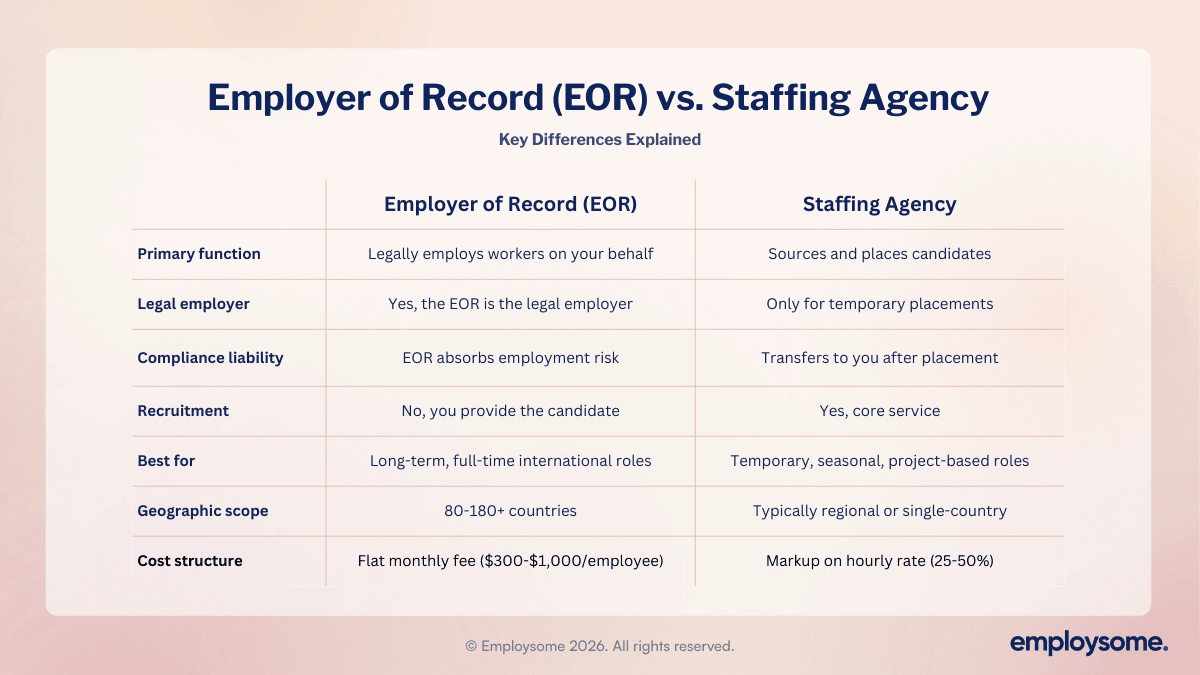
Legal employer status. This is the most important distinction. An EOR is the legal employer of your workers on an ongoing basis. A staffing agency is the legal employer only for temporary placements, and that status ends when the assignment ends or the worker converts to permanent employment.
Compliance liability. An EOR absorbs employment compliance risk across all jurisdictions where it operates, including payroll tax, labour law, benefits, and termination. A staffing agency typically transfers compliance responsibility to you once a worker is permanently placed. For temporary workers, the agency carries some liability, but the scope is narrower.
Geographic scope. EORs are built for international hiring. Most operate through owned legal entities or vetted local partners in 80-180+ countries. Staffing agencies tend to operate regionally or within a single country. Very few staffing agencies can provide compliant employment infrastructure across multiple international jurisdictions.
Recruitment capability. A staffing agency finds candidates. An EOR does not. Most EOR providers assume you have already identified your candidate and need someone to employ them legally. If you need help finding talent, a staffing agency or a specialised recruitment firm is the right tool. Some providers (like Alcor) combine both, but this is the exception.
Employment duration. EORs are designed for long-term, full-time employment. Staffing agencies are designed for temporary, project-based, or seasonal work. Using a staffing agency for long-term permanent employment is often more expensive and creates compliance risk. Using an EOR for a 2-week temporary placement is usually impractical.
Cost structure. EORs charge a flat monthly fee per employee (typically $300-$1,000/month depending on the provider and country) or a percentage of salary. Staffing agencies charge a markup on the worker’s hourly or daily rate, typically 25-50% above the worker’s pay rate. For long-term, full-time roles, EORs are almost always more cost-effective. For short-term, high-volume temporary placements, staffing agencies often provide better value.
Employee experience. With an EOR, the worker feels like a direct employee of your company. They work exclusively for you, use your tools, attend your meetings, and are managed by your team. The EOR is invisible in day-to-day operations. With a staffing agency, the worker may feel more like a contractor or temporary resource, particularly if the engagement is short-term or if the agency remains the primary employer.
When to Use an Employer of Record
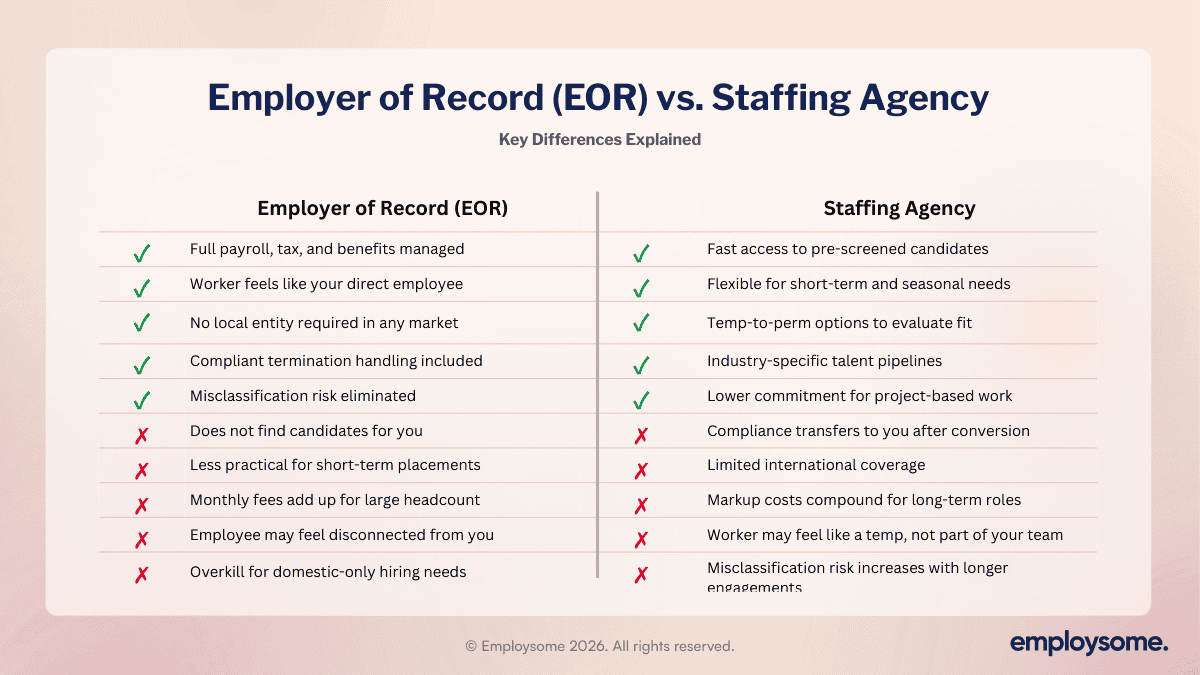
Use an EOR when you want to hire full-time employees in a country where you do not have a legal entity, you need compliant employment infrastructure quickly (days or weeks, not months), you are building a distributed team across multiple countries, you want to test a new market before committing to entity setup, you need someone to absorb employment compliance risk in unfamiliar jurisdictions, or you are hiring for long-term, permanent roles where the employee should feel like part of your team.
EORs are particularly valuable in jurisdictions with complex labour law, high employer payroll burdens, or strict termination protections, where the cost of getting compliance wrong is significant. Countries like France, Germany, Belgium, Brazil, and India are common examples where EOR usage is highest.
When to Use a Staffing Agency
Use a staffing agency when you need to fill temporary or seasonal positions quickly, you need help sourcing candidates in a competitive market, you want temp-to-perm arrangements to evaluate candidates before committing, you need high-volume hiring for a project or event, or you are hiring domestically and do not need international compliance infrastructure.
Staffing agencies are strongest in markets with deep, established temporary labour frameworks, such as the United States, the United Kingdom, the Netherlands, and Japan.
When to Use Both EOR & Staffing Agency
There is no rule that says you must choose one or the other. Many companies use both an EOR and a staffing agency simultaneously.
A common pattern is using a staffing agency to source and recruit candidates in a specific market, then handing the selected candidate to an EOR for compliant long-term employment. This gives you the recruitment expertise of the agency and the compliance infrastructure of the EOR without needing to build either capability in-house.
This approach is particularly effective for international hiring in markets where you have no local recruitment network and no legal entity. The staffing agency solves the talent discovery problem. The EOR solves the legal employment problem.
The Compliance Risk That Most Companies Underestimate
The single biggest risk when choosing between an EOR and a staffing agency is worker misclassification. If you engage a worker through a staffing agency on a temporary basis but the working relationship looks like permanent employment (fixed hours, exclusive work, indefinite duration, integrated into your team), regulators in many countries may reclassify the worker as your employee. This triggers back-payment of social security, taxes, benefits, and penalties.
The EU Platform Work Directive taking effect in 2026 intensifies enforcement across all EU member states. Germany imposes fines up to €10 million with potential personal liability for executives. Spain, France, and the Netherlands have all increased enforcement of misclassification rules in recent years.
An EOR eliminates this risk entirely by making the worker a legal employee from day one with a compliant employment contract, full statutory benefits, and proper tax withholding. A staffing agency reduces the risk for temporary workers under its umbrella, but the protection ends when the assignment converts to permanent employment.
For companies hiring internationally, especially in the EU, using an EOR for any role intended to be long-term is the safest compliance approach. For a comparison of EOR providers across countries, see our Best Global Employer of Record guide, or explore Country-Specific Guides.
Final Takeaway: Employer of Record vs Staffing Agency
The choice between an Employer of Record and a staffing agency comes down to one question: do you need help finding talent, or do you need help employing talent legally?
If you already have a candidate and need compliant international employment, payroll, and benefits, use an EOR. If you need help sourcing candidates for temporary or project-based work, use a staffing agency. If you need both recruitment and compliant employment in a foreign market, use both, or find a provider that combines them.
The worst outcome is using a staffing agency for long-term international employment. The costs compound, the compliance risk accumulates, and the employee experience suffers. The second worst outcome is using an EOR when you have no candidates and no recruitment pipeline, because the EOR cannot solve that problem for you.
Match the model to the problem, and the decision becomes straightforward.

Written by
Courtney Pocock is a Copywriter & EOR/PEO Researcher at Employsome with 15+ years of experience writing for the HR, corporate, and financial sectors. She has a strong interest in global business expansion and Employer of Record / PEO topics, focusing on news that matters to business owners and decision-makers. Courtney covers industry updates, regulatory changes, and practical guides to help leaders navigate international hiring with confidence.
Our content is created for informational purposes only and is not intended to provide any legal, tax, accounting, or financial advice. Please obtain separate advice from industry-specific professionals who may better understand your business’s needs. Read our Editorial Guidelines for further information on how our content is created
Other posts
Along with our standard maps we offer highly customizable maps.