Minimum Wage in China: The Complete 2026 Guide
This guide breaks down China’s minimum wage system for 2026, covering current statutory monthly and hourly rates by province and major city, employer social insurance and housing fund obligations, compliance requirements under Chinese labor law, penalties for underpayment, and how regional minimum wages compare to actual living costs across China’s Tier-1, Tier-2, and inland cities.

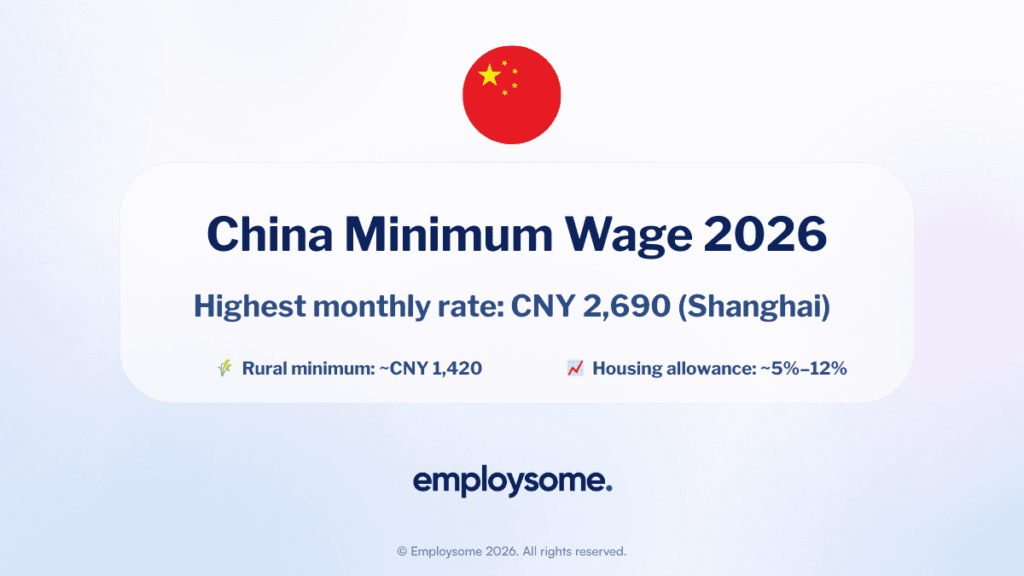
Table of Contents
- How Minimum Wage China Is Regulated
- Major City and Provincial Rates
- How Minimum Wage in China Is Calculated
- Legal Framework Governing Minimum Wage China
- Employer Obligations Under Minimum Wage China Law
- Penalties for Violating Minimum Wage in China
- Minimum Wage China vs. Cost of Living
- Minimum Wage China 2026–2027 Outlook
- Final Takeaway
The minimum wage China system does not operate under a single national rate. Instead, the minimum wage in China is set at provincial and municipal level, meaning wage floors vary significantly between cities such as Shanghai, Beijing, Shenzhen, and Chengdu.
As of 2026, Shanghai maintains the highest monthly minimum wage in China, while other provinces apply lower statutory wage thresholds aligned with regional economic conditions and cost of living.
Understanding minimum wage China rules is essential for compliant hiring, payroll planning, and labour cost benchmarking.
How Minimum Wage China Is Regulated
The minimum wage China framework is based on national labour legislation but implemented at provincial level. The legal foundation stems from the Labour Law of the People’s Republic of China and the Minimum Wage Provisions issued by the Ministry of Labour.
National oversight sits with the Ministry of Human Resources and Social Security (MOHRSS), which supervises provincial wage adjustments and enforcement.
The statutory legal framework governing wage protections can also be reviewed through the National People’s Congress legal database, where China’s labour legislation is published.
There is no unified national minimum wage China figure. Each province sets:
-
A monthly minimum wage for full-time workers
-
An hourly minimum wage for part-time workers
Employers must apply the rate specific to the employee’s registered work location.
Minimum Wage China 2026: City and Provincial Rates
Below are representative minimum wage China rates for 2026, including approximate USD equivalents (1 USD ≈ 7.1 RMB).
Many provinces operate multiple wage tiers depending on district classification. Employers should verify the exact local minimum wage China rate before onboarding employees.
|
City / Region |
Monthly Minimum Wage (RMB) |
Approx. USD |
Hourly Minimum Wage (RMB) |
Approx. USD |
|---|---|---|---|---|
|
Shanghai |
2,690 |
~$379 |
24.0 |
~$3.38 |
|
Beijing |
2,420 |
~$341 |
26.4 |
~$3.72 |
|
Shenzhen |
2,360 |
~$332 |
22.2 |
~$3.13 |
|
Guangzhou |
2,300 |
~$324 |
22.2 |
~$3.13 |
|
Hangzhou |
2,280 |
~$321 |
22.0 |
~$3.10 |
|
Nanjing |
2,280 |
~$321 |
22.0 |
~$3.10 |
|
Chengdu |
2,100 |
~$296 |
22.0 |
~$3.10 |
|
Wuhan |
2,010 |
~$283 |
19.5 |
~$2.75 |
|
Xi’an |
2,160 |
~$305 |
21.0 |
~$2.96 |
How Minimum Wage in China Is Calculated
The minimum wage in China applies separately to monthly and hourly employment structures.
The monthly minimum wage China threshold applies to employees working under the standard working hours system (typically 40 hours per week). Employers must ensure base salary meets or exceeds the applicable local rate.
Minimum wage China figures represent base pay only. Employers must separately contribute to mandatory social insurance and Housing Provident Fund payments.
Housing fund contributions are regulated under the Ministry of Housing and Urban-Rural Development.
Payroll withholding and Individual Income Tax reporting are administered by the State Taxation Administration.
Employees earning minimum wage China rates are still entitled to overtime premiums:
-
150% weekday overtime
-
200% rest days
-
300% statutory public holidays
Employers may not reduce wages below the statutory minimum through internal deductions.
Legal Framework Governing Minimum Wage China
The legal basis for minimum wage China enforcement includes:
-
Labour Contract Law
-
Provincial and municipal wage regulations
Minimum wage protections cannot be waived by agreement. If an employment contract specifies wages below the statutory minimum wage China threshold, the statutory rate prevails.
For foreign employees working in China, wage compliance may intersect with immigration requirements overseen by the National Immigration Administration.
Employer Obligations Under Minimum Wage China Law
To remain compliant with minimum wage China regulations, employers must meet several statutory obligations that extend beyond simply paying base salary. China’s labour framework requires structured payroll, documentation, and social insurance compliance alongside minimum wage payment.
Employers must:
-
Pay at least the applicable minimum wage China rate based on the employee’s registered work location
-
Issue written employment contracts within the legally required timeframe
-
Maintain accurate in-house payroll records and wage documentation
-
Register employees for mandatory social insurance schemes
-
Contribute to the Housing Provident Fund where required
Importantly, minimum wage China obligations apply to base salary only. Employer social insurance contributions and housing fund payments are separate statutory requirements and cannot be used to offset or reduce the minimum wage threshold.
Failure to meet these obligations may expose employers to administrative penalties, wage repayment orders, and labour arbitration claims.

Penalties for Violating Minimum Wage in China
Failure to comply with minimum wage China regulations can trigger administrative, financial, and legal consequences at both the provincial and municipal level. Local human resources and social security bureaus actively investigate wage complaints, and enforcement is not purely theoretical, particularly in Tier 1 cities.
If an employer pays below the applicable minimum wage China threshold, authorities may:
-
Order full repayment of wage arrears to affected employees
-
Impose administrative fines based on the severity and duration of non-compliance
-
Require rectification within a specified deadline
-
Refer cases to labour arbitration or judicial proceedings
-
Increase regulatory scrutiny and conduct follow-up inspections
Under Chinese labour law, employees are entitled to file complaints directly with local labour bureaus or initiate formal labour arbitration proceedings. If underpayment is confirmed, employers may be required not only to repay arrears but also to compensate employees for damages caused by unlawful wage practices.
In cases involving repeated or serious violations, authorities may:
-
Publicly record the employer’s non-compliance
-
Restrict participation in government tenders or procurement processes
-
Increase audit frequency
-
Escalate enforcement actions
Minimum wage violations may also create exposure during termination disputes. If a dismissed employee proves they were underpaid below the minimum wage China level, this can strengthen wrongful termination claims and increase severance liabilities.
For foreign-invested enterprises and multinational companies, wage violations may additionally impact compliance reviews related to tax, immigration, and social insurance filings.
Beyond legal penalties, underpayment of minimum wage China obligations carries reputational risk. Labour disputes in China can escalate quickly through arbitration channels and may attract regulatory attention, particularly in economically developed municipalities.
In practice, compliance with minimum wage China rules is one of the most basic and most closely monitored; elements of employment law enforcement.
Minimum Wage China vs. Cost of Living
Even as statutory wages rise, minimum wages remain well below basic living costs in major cities. For example, 2025/2026 data show that Shanghai’s monthly minimum wage is RMB 2,740, whereas a modest city-center one-bedroom apartment rents for about ¥7,000.
Similarly, Beijing’s minimum wage is RMB 2,540 versus ~¥6,500 rent.
In Shenzhen it’s RMB 2,520 and rent ~¥6,000; Guangzhou RMB 2,500 vs. ~¥5,500; Chengdu RMB 2,330 vs. ~¥4,000; Wuhan RMB 2,400 vs. ~¥3,800.
The table below summarizes these comparisons (note Rent ÷ Wage reflects the percentage of monthly income consumed by rent):
|
City |
Min. Wage (RMB) |
Avg. 1‑BR Rent (RMB) |
Rent ÷ Wage |
|
Shanghai |
2,740 |
7,000 |
~255% |
|
Beijing |
2,540 |
6,500 |
~256% |
|
Shenzhen |
2,520 |
6,000 |
~238% |
|
Guangzhou |
2,500 |
5,500 |
~220% |
|
Chengdu |
2,330 |
4,000 |
~172% |
|
Wuhan |
2,400 |
3,800 |
~158% |
In every case above, rent alone consumes more than 100% of the monthly minimum wage income, illustrating a huge affordability gap. Even beyond housing, other essentials (food, utilities, transportation) further strain a minimum-wage budget. This stark comparison highlights why many workers on minimum pay struggle to meet basic needs, and why living costs must be considered when assessing wage adequacy.
Minimum Wage China 2026–2027 Outlook
The minimum wage in China (2026–2027) is expected to remain decentralized, with adjustments issued at the provincial and municipal level rather than through a unified national minimum wage.
China does not operate under a single nationwide minimum wage system. Instead, each province, autonomous region, and major city sets its own standards based on:
-
Local economic growth
-
Cost of living and inflation levels
-
Employment conditions
-
Regional development strategy
For 2026 and 2027, economically advanced cities such as Beijing, Shanghai, and Shenzhen are likely to implement moderate minimum wage increases due to rising living costs and labor market pressure. In contrast, lower-tier cities and inland provinces may adopt gradual or limited adjustments.
Because minimum wage updates in China are announced provincially through the Ministry of Human Resources and Social Security (MOHRSS) and local Human Resources and Social Security (HRSS) bureaus, employers hiring across multiple regions must actively monitor local government releases.
Failure to track provincial updates can lead to payroll non-compliance, underpayment risks, and potential administrative penalties.
Final Takeaway – Minimum Wage Compliance in China
The minimum wage system in China is decentralized, region-specific, and strictly enforced by local authorities. There is no single national minimum wage. Instead, each province and major city sets its own standards, which are updated periodically based on economic conditions and cost-of-living factors.
To remain compliant in 2026 and beyond, employers must:
-
Verify the correct city- or province-level minimum wage rate
-
Separate base salary from statutory social insurance contributions
-
Ensure overtime pay complies with Chinese labor law thresholds
-
Monitor provincial government announcements for updates
-
Maintain accurate payroll and employment documentation
Minimum wage compliance in China is a core payroll obligation. Employers operating across multiple regions must implement structured monitoring and payroll controls to avoid underpayment risks, penalties, and administrative scrutiny.

Written by
Courtney Pocock is a Copywriter & EOR/PEO Researcher at Employsome with 15+ years of experience writing for the HR, corporate, and financial sectors. She has a strong interest in global business expansion and Employer of Record / PEO topics, focusing on news that matters to business owners and decision-makers. Courtney covers industry updates, regulatory changes, and practical guides to help leaders navigate international hiring with confidence.
Our content is created for informational purposes only and is not intended to provide any legal, tax, accounting, or financial advice. Please obtain separate advice from industry-specific professionals who may better understand your business’s needs. Read our Editorial Guidelines for further information on how our content is created.
Other posts
View other post on minimum wage across the world