Minimum Wage in Canada: The Complete 2026 Guide
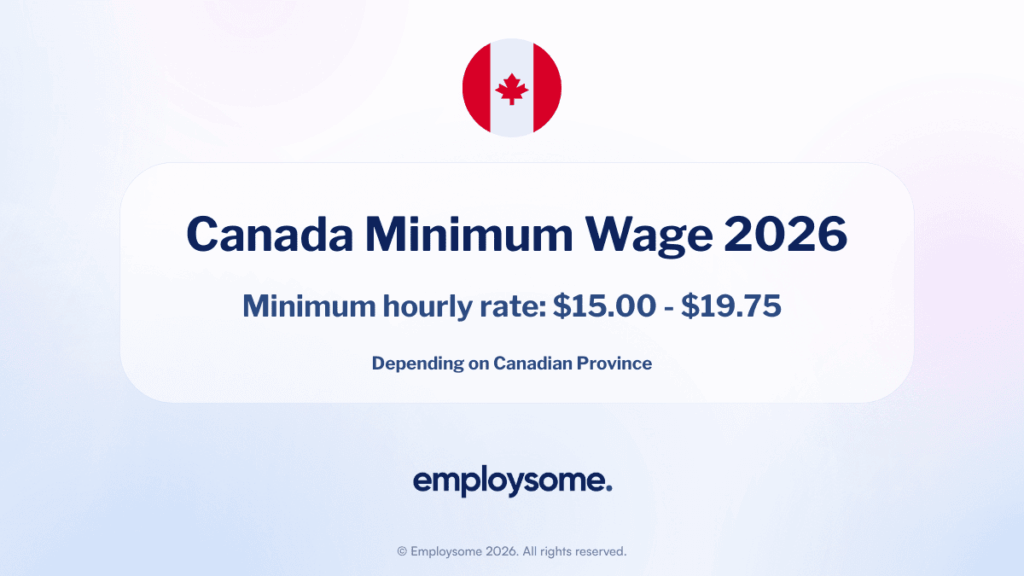
Minimum wage Canada is not a single national number. It is a patchwork of federal, provincial, and territorial rates shaped by regional economies, inflation formulas, and separate labour legislation in each jurisdiction. This guide covers every minimum wage rate across Canada for 2026, employer payroll obligations including CPP and EI contributions, compliance requirements, penalties, cost of living by city, and how an Employer of Record can help international companies hire in Canada compliantly.

Unlike most countries where a single national minimum wage applies to all workers, minimum wage Canada operates under a two-layer system. The federal government sets a minimum wage for federally regulated industries (banking, telecommunications, interprovincial transportation, postal services, and certain Crown corporations), while each of the ten provinces and three territories sets its own rate for all other workers. The higher rate always applies: if a province’s minimum wage exceeds the federal rate, employers in federally regulated industries must pay the provincial rate.
For employers hiring in Canada for the first time, understanding which rate applies, when it changes, and what additional payroll obligations exist on top of the base wage is essential to remaining compliant and avoiding penalties that can exceed C$10,000 per violation.

How Minimum Wage in Canada Is Regulated
Canada’s constitutional structure divides labour law authority between the federal government and the provinces. Under the Constitution Act, the responsibility for enacting and enforcing employment standards, including minimum wage, rests primarily with the ten provinces and three territories. The federal government has authority only over employees in federally regulated industries.
This means there is no single “minimum wage Canada” rate that applies to every worker in the country. Instead, there are 14 separate minimum wage rates: one federal and 13 provincial/territorial. Each jurisdiction sets its own rate through its own employment standards legislation, reviews it on its own schedule, and applies its own indexation formula (or none at all, in the case of Alberta).
The federal minimum wage was reestablished as a distinct rate in December 2021, after having been tied to provincial rates since 1996. Since then, it has been indexed annually to the Consumer Price Index (CPI), with adjustments taking effect on April 1 each year. The formula is straightforward: the current rate is multiplied by one plus the annual CPI change, then rounded to the nearest C$0.05.
Most provinces have adopted similar CPI-based indexation, though the timing, formula, and any additional adjustments vary. Some provinces add a percentage point above inflation (Nova Scotia uses CPI plus 1%), some tie adjustments to provincial CPI rather than the national figure (Yukon uses Whitehorse CPI), and one province, Alberta, has not increased its minimum wage since 2018.
Minimum Wage Canada 2026: Federal Rate
The federal minimum wage in Canada is currently C$17.75 per hour, effective since April 1, 2025. It applies to employees in federally regulated industries, which account for approximately 6% of the Canadian workforce, including workers in banking, telecommunications, interprovincial and international transportation, postal services, and certain Crown corporations.
On April 1, 2026, the federal minimum wage is projected to increase to approximately C$18.10 per hour, based on the 2025 annual CPI of approximately 2.0%. Statistics Canada confirms the CPI figure each January, and Employment and Social Development Canada (ESDC) typically confirms the new rate in late February or March. The adjustment is automatic and does not require new legislation.
At C$18.10 per hour and a standard 40-hour workweek, a full-time federally regulated worker would earn approximately C$37,648 per year before taxes.
There is no training wage, probationary rate, or youth discount under federal rules. Every hour worked must be paid at least the federal minimum wage, including for interns who qualify as employees under the Canada Labour Code.
Quick Reference: Federal Minimum Wage Canada 2026
Current rate (April 2025): C$17.75/hour Projected rate (April 1, 2026): C$18.10/hour Annual full-time gross (40 hrs/week, 52 weeks): ~C$37,648 Applies to: Federally regulated industries (~6% of workforce) Indexation: Annual, CPI-based, effective April 1 Youth/training rate: None (full rate from day one) Rule: If provincial rate is higher, employer must pay the higher rate
Minimum Wage Canada by Province and Territory
The following table shows the current and forthcoming minimum wage rates for every province and territory in Canada. Because each jurisdiction sets its own rate and review schedule, effective dates range from April 1 to October 1 depending on the province.
|
Province / Territory |
Current Rate (C$/hr) |
Next Confirmed Rate |
Effective Date |
Indexation Method |
|
Nunavut |
$19.75 |
TBD |
September 1, 2026 |
Annual review |
|
Yukon |
$17.94 |
~$18.37 (est.) |
April 1, 2026 |
Whitehorse CPI |
|
British Columbia |
$17.85 |
TBD |
June 1, 2026 |
CPI-based, annual |
|
Ontario |
$17.60 |
~$18.00 (est.) |
October 1, 2026 |
CPI-based, annual |
|
Northwest Territories |
$16.95 |
TBD |
September 1, 2026 |
Reviewed biennially |
|
Nova Scotia |
$16.50 |
$16.75 / $17.00 |
April 1, 2026 / October 1, 2026 |
CPI + 1% (two-stage) |
|
Prince Edward Island |
$16.50 |
$17.00 |
April 1, 2026 |
Annual review |
|
Quebec |
$16.10 |
TBD |
May 1, 2026 |
Annual government review |
|
Manitoba |
$16.00 |
TBD |
October 1, 2026 |
CPI-based, annual |
|
Newfoundland and Labrador |
$16.00 |
~$16.32 (est.) |
April 1, 2026 |
CPI-based |
|
New Brunswick |
$15.65 |
~$16.00 (est.) |
April 1, 2026 |
National CPI |
|
Saskatchewan |
$15.25 |
TBD |
October 1, 2026 |
CPI-based |
|
Alberta |
$15.00 |
None announced |
N/A |
No indexation; no increase since 2018 |
Rates marked as estimated (~) are projections based on CPI formulas and will be confirmed by the relevant provincial authority closer to the effective date.
💡 Employsome Insight: Alberta’s Minimum Wage Stagnation
Alberta is a significant outlier in the minimum wage Canada landscape. At C$15.00 per hour, it has the lowest minimum wage of any province and has not seen an increase since June 2018, despite seven years of inflation that has eroded its real value by over 20%.
For employers hiring across multiple provinces, this means identical roles may carry different minimum wage obligations depending on the province of employment. If you are using an Employer of Record to hire in Canada, ensure the EOR applies the correct provincial rate for each employee’s location – not a blanket federal rate.
Special rates and exceptions
Several provinces maintain separate minimum wage rates for specific worker categories:
Ontario has a student rate of C$16.20 per hour (for workers under 18 working 28 hours or less per week), a homeworker rate of C$19.35 per hour, and a liquor server rate equal to the general rate (the previous lower server rate was eliminated in 2022). Alberta has a student rate of C$13.00 per hour for workers under 18. Nova Scotia has a rate for inexperienced workers (first three months of employment) set 20% below the general rate. Quebec maintains a rate for employees who receive tips of C$12.80 per hour. The federal jurisdiction does not permit any age-based, experience-based, or tipped-worker reductions.
Canada vs. Other Countries: How Minimum Wage Compares
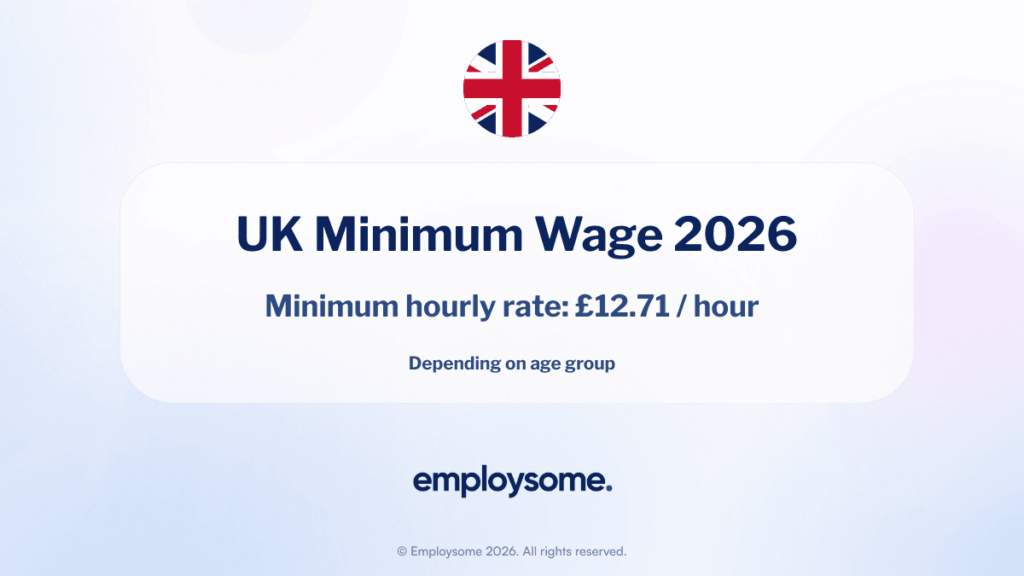
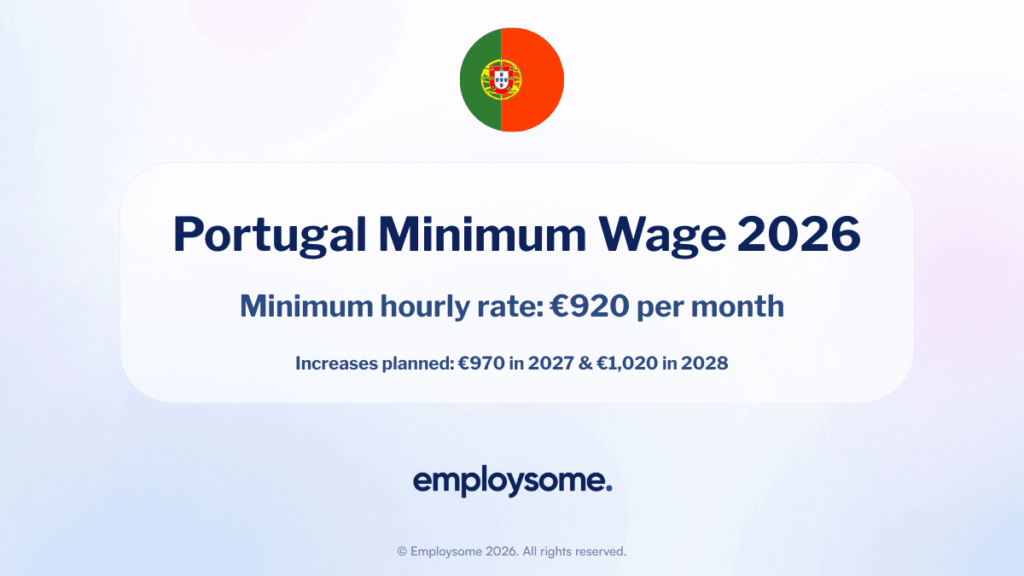
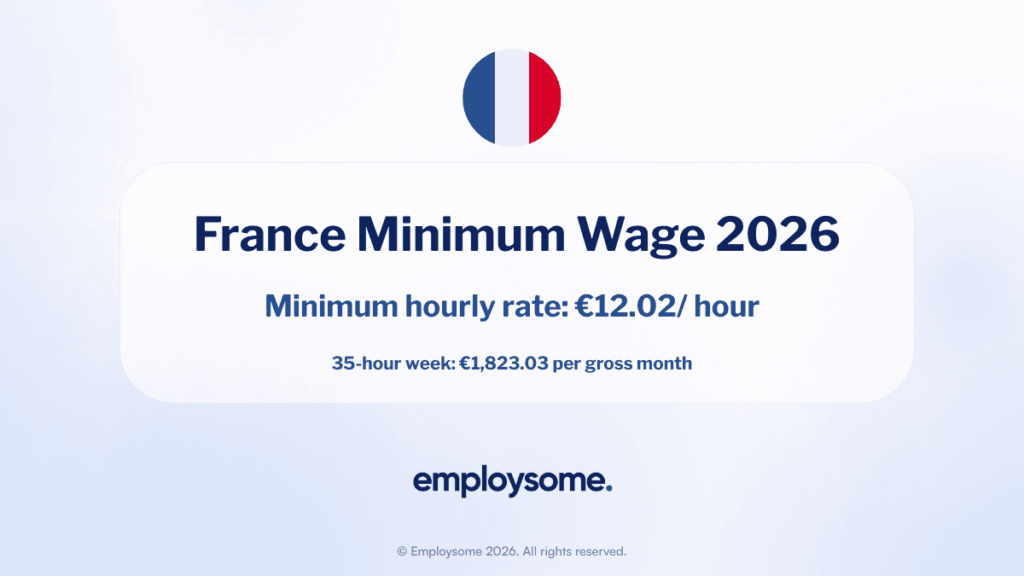
To put minimum wage Canada in a global context, here is how the federal rate and the most common provincial rates compare to minimum wages in other major economies. All figures are converted to approximate USD equivalents using March 2026 exchange rates for comparison purposes.
|
Country |
Minimum Wage (Local Currency) |
Approx. USD Equivalent |
Standard Workweek |
|
Canada (Federal) |
C$17.75/hour (C$18.10 from April 2026) |
~US$13.15 |
40 hours |
|
Canada (Ontario) |
C$17.60/hour |
~US$13.00 |
44 hours (overtime threshold) |
|
Canada (British Columbia) |
C$17.85/hour |
~US$13.20 |
40 hours |
|
Australia |
A$24.10/hour |
~US$15.50 |
38 hours |
|
United Kingdom |
£12.21/hour (from April 2025) |
~US$15.40 |
No statutory maximum |
|
€13.90 per hour |
~US$14.85 |
40 hours |
|
|
€12.02/hour |
~US$12.95 |
35 hours |
|
|
United States (Federal) |
US$7.25/hour |
US$7.25 |
40 hours |
|
United States (California) |
US$16.50/hour |
US$16.50 |
40 hours |
Employer Payroll Costs in Canada: CPP, EI, and Beyond
The minimum wage Canada rate is only part of the total cost of employing someone. On top of the base hourly wage, Canadian employers are required to make several mandatory contributions:
Canada Pension Plan (CPP)
The CPP is a mandatory retirement pension funded by both employer and employee contributions. In 2026, the employer contribution rate is 5.95% on employee earnings between C$3,500 and C$74,600 (the Year’s Maximum Pensionable Earnings, or YMPE). There is also a second tier, CPP2, introduced as part of the CPP enhancement: a 4.00% employer contribution on earnings between C$74,600 and C$85,000 (the YAMPE). For a minimum wage worker earning below the YMPE, the CPP2 tier does not apply, but the base 5.95% does.
Maximum employer CPP contribution in 2026: C$4,646.45 per employee (base CPP + CPP2 combined).
Employment Insurance (EI)
Employers contribute 1.4 times the employee’s EI premium rate of 1.63% on insurable earnings up to C$68,900. This means the employer’s effective EI rate is approximately 2.28% of insurable earnings.
Maximum employer EI premium in 2026: approximately C$1,572.30 per employee.
Vacation Pay
Under most provincial employment standards, employees are entitled to at least 4% of gross earnings as vacation pay (equivalent to two weeks of paid vacation), increasing to 6% after five or six years of employment in most jurisdictions. This is a direct cost on top of the hourly wage.
Workers’ Compensation
Employers must contribute to provincial Workers’ Compensation Boards (WCBs). Rates vary by province and industry classification, typically ranging from 1% to 3% of payroll for low-risk industries, and higher for construction, forestry, or mining.
Other provincial levies
Some provinces impose additional employer payroll levies, such as the Employer Health Tax in Ontario (on payrolls exceeding C$1 million), the Health and Post Secondary Education Tax in Manitoba, and Quebec’s unique contributions to the Quebec Pension Plan (QPP), Quebec Parental Insurance Plan (QPIP), and health services fund.
Total Employer Cost: Minimum Wage Worker in Canada
For a full-time minimum wage employee in Ontario (C$17.60/hour, 40 hours/week):
Gross annual salary: ~C$36,608 Employer CPP (5.95%): ~C$1,970 Employer EI (2.28%): ~C$834 Vacation pay (4%): ~C$1,464 Workers’ compensation (~1.5%): ~C$549 Estimated total employer cost: ~C$41,425/year (~C$19.92/hour)
This represents a payroll burden of approximately 13% to 15% on top of the gross wage, significantly lower than France (40-45%) or Germany (19-22%), but meaningful for businesses employing large numbers of minimum wage workers.
Legal Framework Governing Minimum Wage in Canada
Minimum wage in Canada is governed by separate legislation in each jurisdiction:
At the federal level, Part III of the Canada Labour Code establishes minimum employment standards for federally regulated industries, including minimum wage, hours of work, overtime, vacation, and statutory holidays. The federal minimum wage is set by regulation under section 178 of the Code and adjusted annually by the Governor in Council based on CPI data.
At the provincial level, each province has its own employment standards act. In Ontario, minimum wage is governed by the Employment Standards Act, 2000 (ESA). In British Columbia, it falls under the Employment Standards Act (RSBC 1996). In Quebec, the Act Respecting Labour Standards sets the minimum wage and is administered by the Commission des normes, de l’équité, de la santé et de la sécurité du travail (CNESST).
The key principle across all jurisdictions is that the employee is always entitled to the higher of the federal or provincial rate. A bank employee working in British Columbia, for example, falls under federal jurisdiction but is entitled to BC’s C$17.85/hour if that exceeds the federal C$17.75/hour.
Employer Obligations Under Canadian Law
Employers in Canada must meet several obligations related to minimum wage compliance:
Pay at least the applicable minimum wage rate for every hour worked. This includes regular hours, overtime hours (at the applicable overtime premium), and any time the employee is required to be at the workplace or available for work. No deductions from wages that would bring the effective hourly rate below the minimum wage. This includes deductions for uniforms, tools, cash register shortages, or breakage. Employers cannot pass business costs on to employees in a way that reduces their pay below the statutory minimum.
Maintain accurate payroll records, including hours worked, wages paid, deductions, and vacation pay. Most provinces require employers to retain these records for at least three years. Provide pay stubs or statements of earnings that clearly show the hourly rate, hours worked, deductions, and net pay. Requirements vary by province but all jurisdictions require some form of written earnings statement.
Pay overtime at the prescribed rate. In most provinces, overtime is payable at 1.5 times the regular rate for hours worked beyond 44 hours per week (40 hours in BC; 48 hours in Alberta). The federal overtime threshold is 40 hours per week or 8 hours per day.
Display employment standards information in the workplace, including minimum wage rates and employee rights, in a location visible to all employees.
Compliance Warning: Multi-Province Employers
If you employ workers in more than one province, each employee must be paid at least the minimum wage of the province where they perform their work, not the province where the company is headquartered. Remote workers are generally covered by the employment standards of the province where they are physically located. For companies with distributed teams across Canada, this means potentially managing five, eight, or more different minimum wage rates, each with different effective dates and review schedules. An EOR that operates across all Canadian provinces can manage this complexity and ensure each employee is paid the correct provincial rate.
Penalties for Violating Minimum Wage in Canada
Enforcement mechanisms and penalties vary by jurisdiction, but all provinces and the federal government take minimum wage violations seriously:
Under the Canada Labour Code (federal), employers who fail to pay minimum wage can face administrative monetary penalties of up to C$250,000 per violation, recovery orders for unpaid wages, and potential prosecution for repeat or willful violations. ESDC labour inspectors can conduct investigations with or without a formal complaint.
In Ontario, the ESA allows the Ministry of Labour to issue orders for unpaid wages, with interest. Employers can face fines of up to C$50,000 for a first offence and up to C$100,000 for subsequent offences. Directors and officers can be held personally liable.
In British Columbia, the Employment Standards Branch can issue determinations requiring payment of wages, interest, and penalties. Penalties escalate with repeat violations: C$500 for a first contravention, C$2,500 for a second, and C$10,000 for a third within a three-year period.
In Quebec, employers who fail to comply with minimum wage provisions can face fines of C$600 to C$1,200 for a first offence, doubling for subsequent offences, plus orders to pay back wages.
Across all jurisdictions, employees can file complaints anonymously, and retaliation against employees who file complaints is prohibited and subject to additional penalties.
Compliance Warning: Record-Keeping
The most common minimum wage violations in Canada are not deliberate underpayment but failures in record-keeping, incorrect classification of hours (particularly for overtime), and application of the wrong provincial rate for remote workers. Labour inspectors in all jurisdictions have the authority to audit payroll records and can issue orders for back pay covering up to two years of underpayment (six years in some provinces). The cost of a retroactive order across multiple employees, with interest and penalties, can far exceed the cost of proactive compliance.
Minimum Wage Canada vs. Cost of Living
Minimum wage Canada varies by province, and so does the cost of living. In 2026, the gap between minimum wage earnings and actual living costs is stark in the country’s most expensive cities and relatively manageable in smaller centres and the Prairie provinces.
The following table compares monthly minimum wage earnings (gross) with average one-bedroom apartment rents in major Canadian cities. Rent as a percentage of gross income is a key affordability indicator; anything above 30% is generally considered unaffordable by Canadian housing standards.
|
City |
Province |
Min. Wage (C$/hr) |
Monthly Gross (40 hrs/wk) |
Avg. 1-Bed Rent (C$/month) |
Rent as % of Gross |
|
Vancouver |
BC |
$17.85 |
$3,094 |
$2,500+ |
81%+ |
|
Toronto |
ON |
$17.60 |
$3,050 |
$2,400+ |
79%+ |
|
Ottawa |
ON |
$17.60 |
$3,050 |
$1,800 |
59% |
|
Montreal |
QC |
$16.10 |
$2,791 |
$1,650 |
59% |
|
Calgary |
AB |
$15.00 |
$2,600 |
$1,700 |
65% |
|
Edmonton |
AB |
$15.00 |
$2,600 |
$1,400 |
54% |
|
Halifax |
NS |
$16.50 |
$2,860 |
$1,750 |
61% |
|
Winnipeg |
MB |
$16.00 |
$2,773 |
$1,300 |
47% |
|
Saskatoon |
SK |
$15.25 |
$2,643 |
$1,200 |
45% |
In Vancouver and Toronto, rent alone for a one-bedroom apartment exceeds 79% of a minimum wage worker’s gross monthly income, making it essentially impossible to live on minimum wage without shared accommodation, government subsidies, or a second income. In cities like Winnipeg, Saskatoon, and Edmonton, the ratio is significantly more manageable but still above the 30% affordability threshold.
The Canada Food Price Report projects grocery prices to rise 4-6% in 2026, adding nearly C$1,000 per year to food costs for a typical family. Transportation, childcare, and utility costs compound the affordability gap, particularly in provinces where minimum wage indexation lags behind actual cost-of-living increases.
💡 Employsome Insight: Minimum Wage vs. Real Cost of Living in Canada
For employers hiring minimum wage or near-minimum wage workers in Canada, the city where the role is located matters as much as the wage rate itself. A minimum wage position in Winnipeg (C$16.00/hour, rent at 47% of gross income) is far more viable as a hiring proposition than the same classification in Vancouver (C$17.85/hour, rent at 81% of gross income).
Employers competing for retail, hospitality, and entry-level workers in Toronto or Vancouver will almost certainly need to offer above minimum wage to attract and retain staff, regardless of legal minimums. An Employer of Record with local market knowledge can help benchmark competitive rates by city and industry.
Hiring in Canada Through an Employer of Record
For international companies that want to employ workers in Canada without establishing a local entity, an Employer of Record (EOR) provides a compliant hiring solution. The EOR acts as the legal employer of your Canadian workers, handling payroll, tax withholding, CPP and EI contributions, employment contracts under the applicable provincial employment standards act, and compliance with local working conditions.
In the context of minimum wage compliance, an EOR is particularly valuable in Canada because of the multi-jurisdictional complexity. A company hiring workers in Ontario, British Columbia, and Quebec simultaneously must comply with three different minimum wage rates, three different overtime thresholds, three different vacation pay schedules, and three different sets of employment standards legislation. An EOR manages all of this.
An EOR in Canada handles employment contracts compliant with the relevant provincial ESA, correct minimum wage application by province (not a blanket federal rate), CPP and EI deductions and employer matching contributions, provincial payroll taxes and levies (Ontario EHT, Quebec HSF, etc.), vacation pay calculations at the correct provincial percentage, workers’ compensation registration and contributions, T4 and RL-1 year-end tax filing for employees, and Record of Employment (ROE) issuance for terminated employees.
For a detailed comparison of EOR providers operating in Canada, see our guide: Best Employer of Record in Canada.
Minimum Wage Canada 2026-2027 Outlook
Looking ahead, several trends will shape minimum wage in Canada through 2026 and into 2027:
CPI-based indexation is now the norm in the majority of Canadian jurisdictions. As long as inflation remains near the Bank of Canada’s 2% target, most provinces will see annual minimum wage increases of approximately C$0.25 to C$0.50 per year. If inflation remains at 2%, the federal minimum wage could approach C$20.00 per hour by 2030.
Alberta remains the outlier. At C$15.00 per hour since 2018, Alberta’s minimum wage has lost over 20% of its purchasing power to inflation. The current UCP provincial government has shown no indication of scheduling an increase, making Alberta’s rate increasingly disconnected from the rest of Canada and from federal benchmarks. Pressure from labour groups, opposition parties, and the widening gap with other provinces may eventually force a review.
Ontario’s October adjustment cycle means workers in Canada’s most populous province will not see their 2026 increase until the second half of the year, even as the federal rate and several other provinces adjust on April 1.
The CPP enhancement is now fully phased in, meaning employer payroll costs have stabilized at the new, higher level. The CPP2 tier (4% on earnings between C$74,600 and C$85,000) primarily affects higher-earning employees, but the base CPP rate of 5.95% applies to all workers above the C$3,500 annual exemption, including minimum wage earners.
Key Dates for Employers
- April 1, 2026: Federal minimum wage increases to ~C$18.10/hour. Nova Scotia rises to C$16.75. PEI rises to C$17.00. New Brunswick and Newfoundland increases expected.
- May 1, 2026: Quebec minimum wage expected to increase (rate TBD).
- June 1, 2026: British Columbia minimum wage expected to increase (CPI-based).
- September 1, 2026: Nunavut and Northwest Territories annual reviews.
- October 1, 2026: Ontario minimum wage increases (~C$18.00 estimated). Nova Scotia second-stage increase to C$17.00. Manitoba and Saskatchewan annual adjustments.
- January 1, 2027: Updated CPP and EI contribution maximums take effect.
Final Takeaway: Minimum Wage Compliance in Canada
Minimum wage Canada is defined by its jurisdictional complexity. With 14 separate minimum wage rates, different effective dates across the calendar year, varied indexation formulas, and province-specific employment standards, compliance requires more attention than in countries with a single national rate.
For employers, the essential priorities are: confirm which provincial rate applies to each employee based on their work location (not the company’s headquarters), build payroll systems that can handle multi-province rate changes occurring on different dates throughout the year, budget for total employer costs that add 13-15% on top of the gross wage through CPP, EI, vacation pay, and workers’ compensation, and monitor Alberta’s rate separately, as it operates outside the CPI-indexation system used by every other jurisdiction.
For international companies hiring in Canada without a local entity, an Employer of Record eliminates the compliance burden of managing multi-provincial payroll, ensures each employee is paid the correct minimum wage for their province, and handles all statutory contributions and filings.
The system is complex, but it is also predictable. CPI-based indexation means most minimum wage changes are formulaic and announced well in advance. The key is staying ahead of the April, June, and October adjustment windows and building compliance into your payroll processes from day one.
💡 Employsome Insight: Planning for Provincial Minimum Wage Differences in Canada
Canada’s minimum wage system rewards employers who plan ahead. Unlike countries where minimum wage changes can arrive with little notice or be triggered by inflation thresholds mid-year, Canadian adjustments follow published formulas and fixed calendar dates.
Build a compliance calendar that covers every province where you have employees, automate rate updates in your payroll system, and review total employer costs – not just base wages – when budgeting for Canadian headcount. The difference between the lowest provincial rate (Alberta at C$15.00) and the highest territorial rate (Nunavut at C$19.75) is nearly 32%, making location one of the most significant variables in your Canadian labour cost model.

Written by
Courtney Pocock is a Copywriter & EOR/PEO Researcher at Employsome with 15+ years of experience writing for the HR, corporate, and financial sectors. She has a strong interest in global business expansion and Employer of Record / PEO topics, focusing on news that matters to business owners and decision-makers. Courtney covers industry updates, regulatory changes, and practical guides to help leaders navigate international hiring with confidence.
Our content is created for informational purposes only and is not intended to provide any legal, tax, accounting, or financial advice. Please obtain separate advice from industry-specific professionals who may better understand your business’s needs. Read our Editorial Guidelines for further information on how our content is created.
Other posts
Find out the minimum wage in other countries