Best Countries to Hire Developers: 2026 Developer Hiring Index
This benchmarking report evaluates 20 countries across a five-factor weighted scoring model designed for technology leaders and hiring decision-makers. Drawing on data from Eurostat, the U.S. Bureau of Labor Statistics, NASSCOM, the EF English Proficiency Index, and the U.S. Chamber’s Global IP Index, it provides an independent, vendor-neutral framework for comparing developer hiring destinations by talent depth, cost, legal protection, English proficiency, and ecosystem maturity.


Why Companies Are Hiring Developers Abroad
The global shortage of software engineering talent shows no signs of slowing down. Nearly 76% of companies report difficulty filling technical roles, while US-based senior developers command salaries averaging $210,000 per year. At the same time, the global IT outsourcing market is projected to exceed $1.2 trillion by 2030, growing at 8.6% annually.
For startups, scale-ups, and enterprises alike, hiring developers from overseas markets has moved from a cost-cutting tactic to a core growth strategy. The question is no longer whether to hire internationally, but where. The right country can give you access to world-class talent at a fraction of domestic costs, while the wrong one can lead to IP risk, communication breakdowns, and costly rework.
This guide ranks the 10 best countries to hire software developers in 2025 using a weighted scoring model across five criteria: talent pool and quality (30%), cost efficiency (25%), legal and IP protection (20%), English proficiency (15%), and tech ecosystem maturity (10%). Every score is backed by publicly available data from sources including the EF English Proficiency Index, the U.S. Chamber’s IP Index, HackerRank’s Developer Skills Report, and aggregated salary benchmarks from multiple research firms.
How We Ranked the Best Countries to Hire Developers
At Employsome, we independently rank the best countries to hire developers using a transparent, data-driven methodology. We are not affiliated with any government, outsourcing firm, or Employer of Record (EOR) provider in this ranking. Our goal is simple: provide objective, SEO-relevant, and decision-ready insights that help companies make smarter international hiring choices.
Each country receives a score from 1–5 across five core dimensions. We then apply weighted scoring to calculate a final result on a 0–100 scale, ensuring consistency, comparability, and methodological clarity.
Here’s what each criterion measures:
-
Talent Pool & Quality (30%)
Measures the size of the developer workforce, annual university output in STEM fields, competitive programming performance, and the depth of specialization across high-demand areas such as AI/ML, cloud computing, DevOps, cybersecurity, and full-stack development.
-
Cost Efficiency (25%)
Evaluates the average mid-level developer salary relative to US and Western European benchmarks. Countries with significantly lower salary levels while maintaining quality score higher.
-
Legal & IP Protection (20%)
Assesses EU/GDPR alignment, intellectual property enforcement strength, contract enforceability, political stability, and overall regulatory clarity for foreign employers.
-
English Proficiency (15%)
Based on EF English Proficiency Index rankings and scores, combined with real-world professional English usage within the tech sector.
-
Tech Ecosystem (10%)
Examines the presence of global R&D centers, startup and unicorn activity, government investment in technology, outsourcing maturity, and overall digital infrastructure development.
Why This Matters: This framework ensures we rank countries based on sustainable hiring viability – not just salary arbitrage – aligning with how modern global tech teams actually scale.
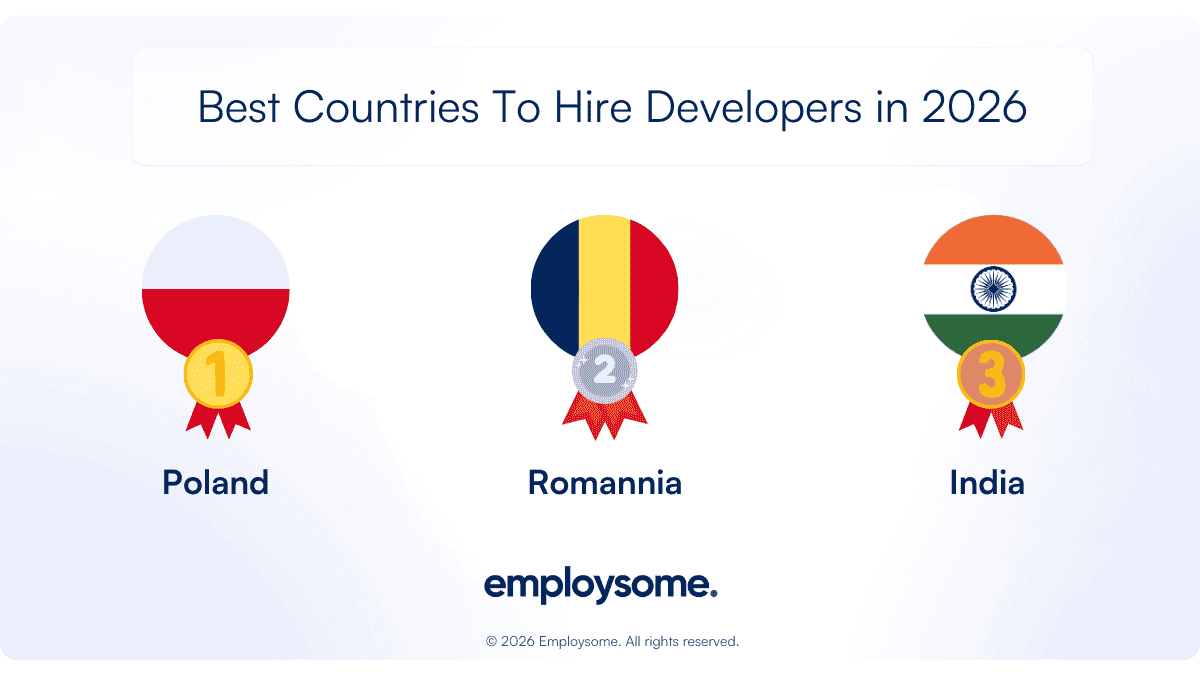
The Top 20 Countries to Hire Developers – 2026 Ranking
Here’s our independent 2026 ranking of the best countries to hire developers, based on weighted scores across talent depth, cost efficiency, legal protection, English proficiency, and ecosystem maturity.
|
Rank |
Country |
Talent |
Cost |
Legal |
English |
Ecosystem |
Score |
Hiring Guide |
|---|---|---|---|---|---|---|---|---|
|
1 |
Poland |
5 |
4 |
5 |
4 |
5 |
92 / 100 |
|
|
2 |
Romania |
4 |
5 |
5 |
5 |
4 |
92 / 100 |
|
|
3 |
India |
5 |
5 |
3 |
3 |
5 |
86 / 100 |
|
|
4 |
Ukraine |
5 |
5 |
2 |
4 |
4 |
83 / 100 |
|
|
5 |
Czech Republic |
4 |
3 |
5 |
4 |
4 |
79 / 100 |
|
|
6 |
Portugal |
3 |
3 |
5 |
5 |
4 |
76 / 100 |
|
|
7 |
Philippines |
3 |
5 |
2 |
5 |
3 |
72 / 100 |
|
|
8 |
Argentina |
4 |
5 |
2 |
3 |
3 |
72 / 100 |
|
|
9 |
Vietnam |
4 |
5 |
2 |
2 |
4 |
71 / 100 |
|
|
10 |
South Africa |
3 |
4 |
3 |
5 |
3 |
71 / 100 |
|
|
11 |
Brazil |
4 |
4 |
3 |
2 |
4 |
70 / 100 |
|
|
12 |
Serbia |
3 |
5 |
3 |
3 |
3 |
70 / 100 |
|
|
13 |
Malaysia |
3 |
4 |
3 |
3 |
3 |
65 / 100 |
|
|
14 |
Mexico |
3 |
4 |
3 |
2 |
3 |
62 / 100 |
|
|
15 |
Turkey |
3 |
4 |
3 |
2 |
3 |
62 / 100 |
|
|
16 |
Kenya |
2 |
5 |
2 |
4 |
2 |
61 / 100 |
|
|
17 |
Pakistan |
3 |
5 |
2 |
2 |
2 |
61 / 100 |
|
|
18 |
Colombia |
2 |
5 |
2 |
3 |
2 |
58 / 100 |
|
|
19 |
Nigeria |
2 |
5 |
2 |
3 |
2 |
58 / 100 |
|
|
20 |
Egypt |
2 |
5 |
2 |
2 |
2 |
55 / 100 |
Country-by-Country Breakdown
Below, we break down each country in detail using the same weighted scoring framework explained above. For every market, we analyze the size and quality of the developer talent pool, real salary benchmarks, English proficiency data, legal and IP protection strength, and the maturity of the local tech ecosystem.
This section goes beyond surface-level rankings. It explains why each country scored the way it did, where the real advantages lie, and what trade-offs companies should expect when hiring developers internationally. Whether you’re optimizing for cost efficiency, EU compliance, technical depth, or time zone alignment, the breakdown below helps you make a decision based on strategy – not hype.
1. Poland: Our #1 To Hire Developers
Score: 92: Talent 5 | Cost 4 | Legal 5 | English 4 | Ecosystem 5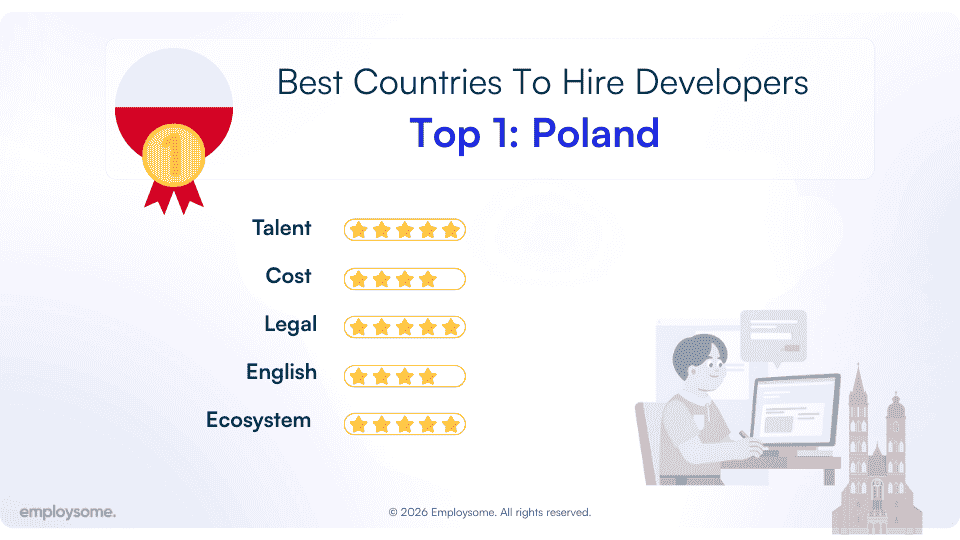
Poland has emerged as Europe’s premier destination for hiring software developers, and the data supports the hype. With over 430,000 professional developers and 40,000+ IT graduates entering the workforce each year, the country’s talent pipeline is both deep and sustainable. Polish developers consistently rank in the top three globally on HackerRank’s competitive programming challenges, particularly excelling in algorithms, data structures, and problem-solving.
As an EU member, Poland offers full GDPR compliance, robust contract law, and predictable intellectual property protections: a major advantage over non-EU competitors. The EF English Proficiency Index 2025 places Poland at #15 globally with a score of 600, now in the “very high proficiency” band. Polish developers are known for their direct communication style and experience working with Western European and North American clients.
Mid-level developer salaries range from $53,000 to $60,000 annually, which delivers significant savings compared to US or UK rates while maintaining output quality that rivals onshore teams. Poland accounts for roughly 25% of Central and Eastern Europe’s IT outsourcing market, and R&D tax incentives of up to 200% make the country even more attractive for companies establishing engineering centers.
Best for: Companies prioritizing EU compliance, code quality, and a balance between cost and senior talent. Ideal for AI/ML, cybersecurity, cloud, and enterprise-grade projects.
Explore our country guide: Learn how to hire developers compliantly and compare the best Employer of Record in Poland, including salary benchmarks, employment law requirements, and EOR pricing insights.
2. Romania: The EU’s Best-Kept Secret for Developer Talent
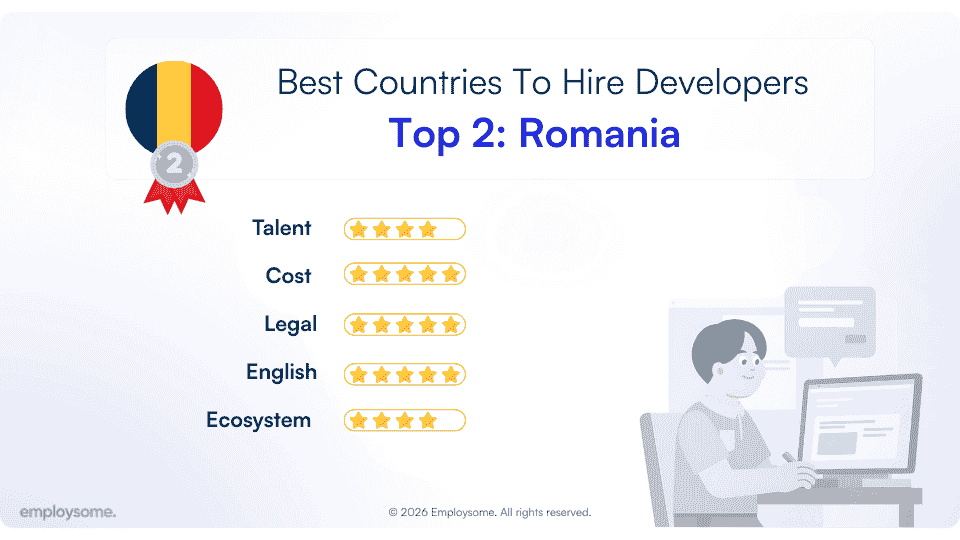
Score 92: Talent 4 | Cost 5 | Legal 5 | English 5 | Ecosystem 4
Romania ties Poland at the top of our ranking thanks to a compelling combination of strong English skills, EU legal protections, and notably lower costs than its Polish neighbor. The country has approximately 200,000 software developers and is producing a growing stream of technically skilled graduates from universities in Bucharest, Cluj-Napoca, and Timișoara.
What sets Romania apart is its English proficiency. The 2025 EF EPI ranks Romania at #11 globally with a score of 605, actually higher than Poland. This linguistic advantage translates directly into smoother collaboration, fewer misunderstandings, and faster onboarding for distributed teams.
Mid-level developer salaries average $50,000-$57,600 annually, roughly 5-10% below Polish equivalents. Combined with full EU and GDPR membership, Romania delivers outstanding value per dollar. Cluj-Napoca has earned a reputation as Romania’s “Silicon Valley,” home to a growing cluster of tech companies, R&D labs, and startup accelerators.
Best for: Cost-conscious EU-compliant hiring with excellent English. Strong fit for web development, backend engineering, and QA.
2. India: Unmatched Scale and Affordability
Score 86: Talent 5 | Cost 5 | Legal 3 | English 3 | Ecosystem 5
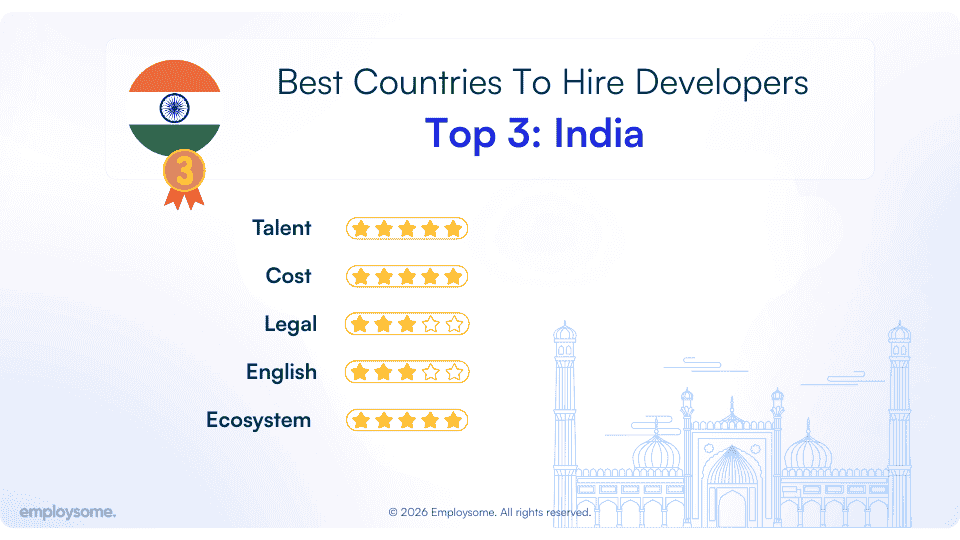
India’s tech industry generated $282.6 billion in revenue in FY2025, with over 5.4 million direct employees in IT services and BPO. India is home to over 1,750 Global Capability Centers (GCCs), employing 1.9 million professionals. The country produces approximately 1.5 million engineering graduates annually, making it the world’s largest engineering talent pipeline. Cities like Bangalore, Hyderabad, Pune, and Chennai serve as global R&D hubs for companies including Google, Microsoft, Amazon, and IBM.
The cost advantage is dramatic: mid-level developer salaries range from $13,000 to $30,000 per year, making India up to 80% cheaper than US-based hiring. AI and machine learning demand has surged 170% in recent years, and India’s full-stack and backend talent pools are among the deepest in the world.
Where India loses points is on IP protection and English. While the EF English Proficiency Index places India in the moderate-to-low proficiency band, professional English in the IT sector is typically much stronger than the national average. IP enforcement, while improving, still lags behind EU standards, and contract disputes can be slow to resolve. High attrition rates in Tier 1 cities and a 10.5-hour time zone gap with the US East Coast add further complexity.
Best for: Large-scale teams, cost-driven hiring, AI/ML specialization, and companies with experience managing offshore operations.
Explore our country guide: Learn how to hire developers compliantly and compare the best Employer of Record in India, including salary benchmarks, employment law requirements, and EOR pricing insights.
4. Ukraine: World-Class Talent Despite Geopolitical Headwinds
Score 83: Talent 5 | Cost 5 | Legal 2 | English 4 | Ecosystem 4
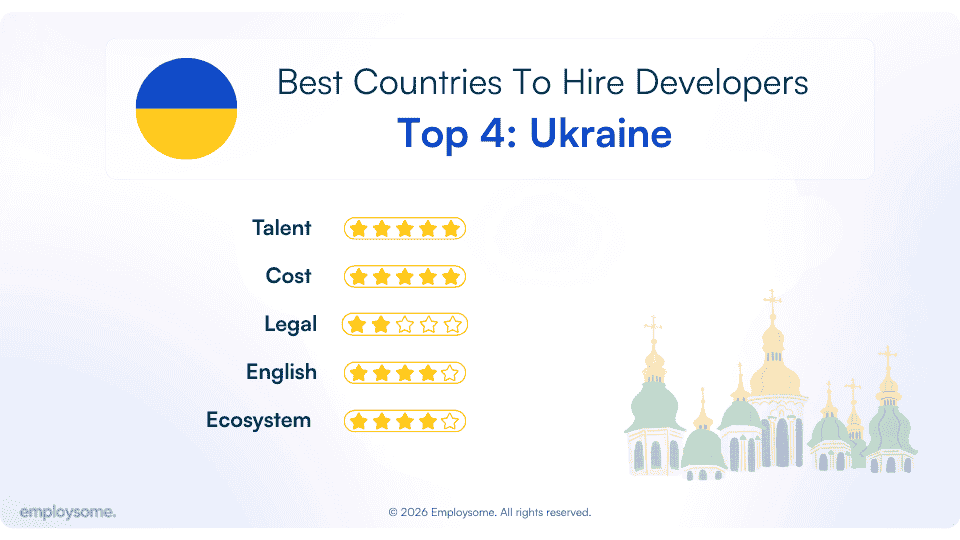
Ukraine continues to produce some of the world’s best software engineers. The country ranks in the top five globally for competitive programming , and its 285,000+ IT professionals are renowned for expertise in complex backend architecture, AI, blockchain, and cybersecurity.
Notable companies like Grammarly, GitLab, and Atlassian have relied heavily on Ukrainian engineering talent.
Salaries remain highly competitive at $48,000–$54,000 per year for mid-level developers, and approximately 85% of Ukrainian developers speak English at a professional level. The IT sector exported $7.3 billion in services in 2023 despite ongoing conflict, demonstrating remarkable resilience.
The key risk factor is geopolitical. While the Ukrainian tech industry has adapted impressively; with most developers working remotely and many companies maintaining backup operations in Western Ukraine or EU countries; the uncertainty persists. Ukraine is also not an EU member, meaning IP protections and regulatory frameworks are less robust than those in Poland or Romania.
Best for: Companies that prize technical excellence and can manage geopolitical risk through robust business continuity planning. Excellent for complex engineering, blockchain, and AI.
5. Czech Republic: Premium Quality with EU Security
Score 79: Talent 4 | Cost 3 | Legal 5 | English 4 | Ecosystem 4
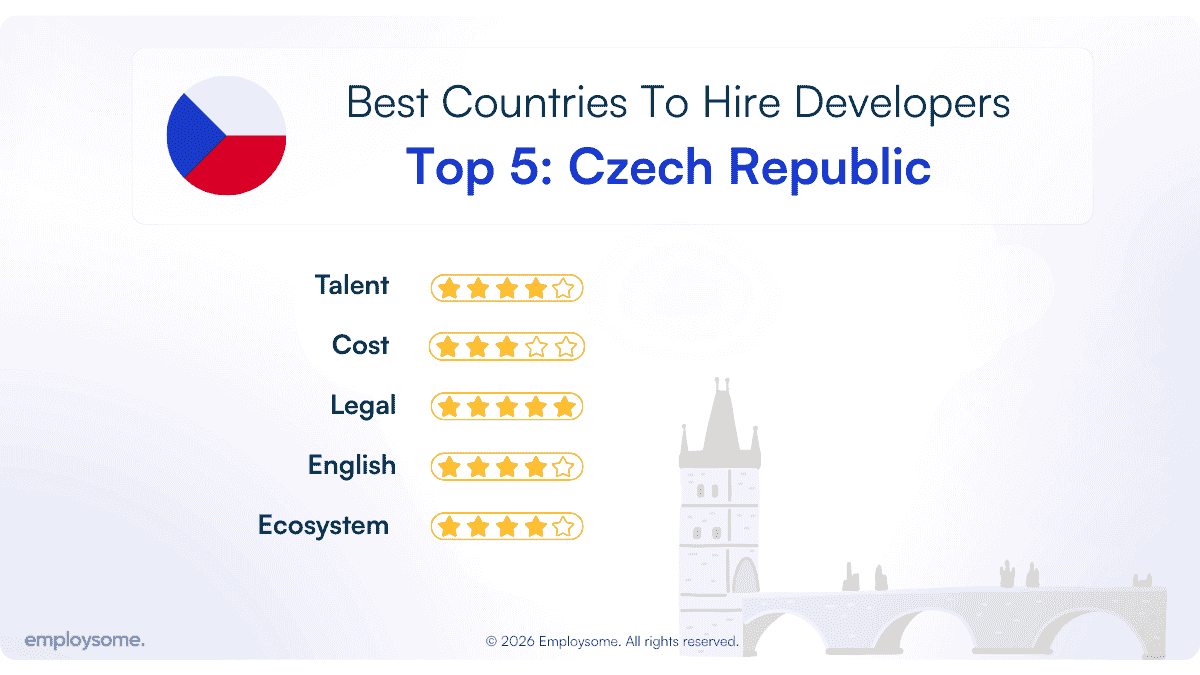
The Czech Republic offers a smaller but exceptionally well-educated developer workforce of approximately 150,000 professionals. The country’s strong computer science tradition, reinforced by institutions like Charles University and Czech Technical University, produces engineers with deep theoretical foundations.
As an EU member, the Czech Republic provides full GDPR compliance and strong IP protections. English proficiency is solid at #23 on the EF EPI (score: 582), placing it in the “high proficiency” band. Prague has become an attractive tech hub for European headquarters and R&D centers.
The trade-off is cost. Mid-level salaries range from $49,000 to $55,000, and the smaller talent pool means hiring can take longer and competition for top candidates is intense. The Czech Republic works best as a quality-first choice rather than a volume play.
Best for: Smaller, high-quality teams requiring EU compliance. Strong for enterprise software, automation, and fintech.
Explore our country guide: Learn how to hire developers compliantly and compare the best Employer of Record in the Czech Republic, including salary benchmarks, employment law requirements, and EOR pricing insights.
6. Portugal: Europe’s Rising Star with Exceptional English
Score 76: Talent 3 | Cost 3 | Legal 5 | English 5 | Ecosystem 4
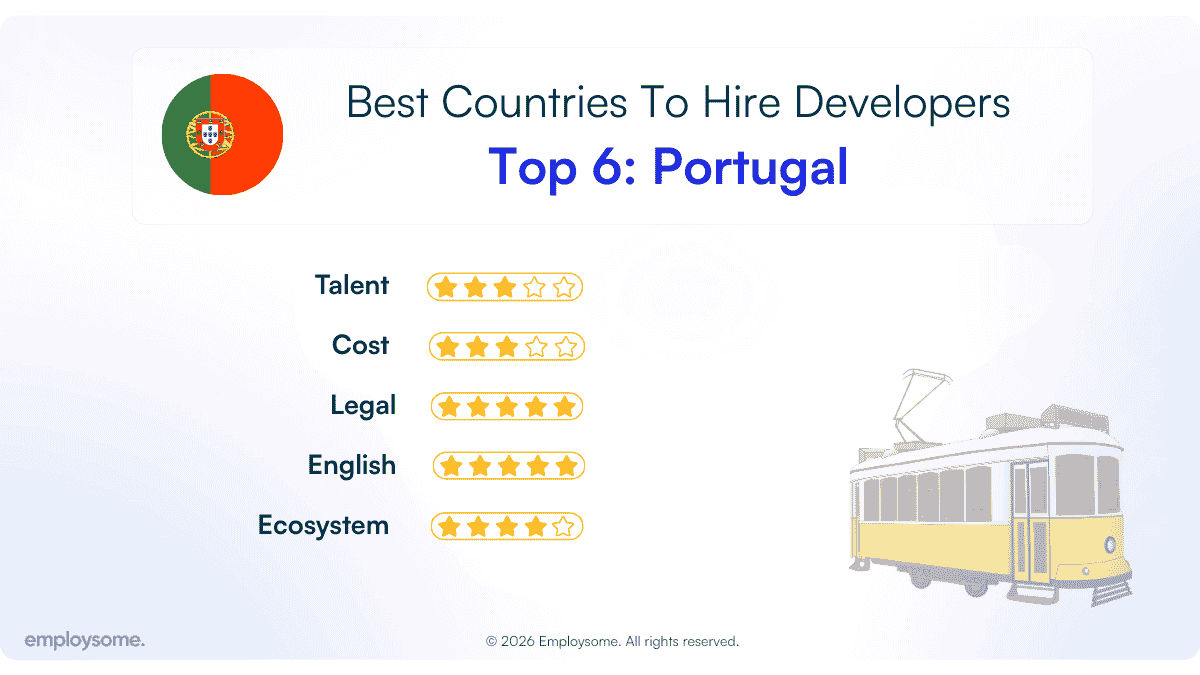
Portugal has quietly built a reputation as one of Europe’s most attractive tech destinations. With roughly 100,000 developers and Lisbon’s rapidly growing startup ecosystem as well as an attractive tax program called NHR, the country punches above its weight.
Portugal’s standout strength is English. The 2025 EF EPI ranks Portugal at #6 globally with a score of 612—in the “very high proficiency” band and ahead of every other country on this list. Combined with EU membership and strong IP protections, Portugal offers a near-frictionless experience for English-speaking companies.
The limitation is scale and cost. Developer salaries of $43,000–$55,000 are higher than Eastern European competitors, and the talent pool is simply smaller. Portugal is ideal for focused, high-trust teams rather than large-scale operations.
Best for: Companies that value seamless communication and EU protections over raw cost savings. Great for product teams, UX-focused work, and nearshoring from Western Europe.
Explore our country guide: Learn how to hire developers compliantly and compare the best Employer of Record in Portugal, including salary benchmarks, employment law requirements, and EOR pricing insights.
7. Philippines: Near-Native English at Unbeatable Prices
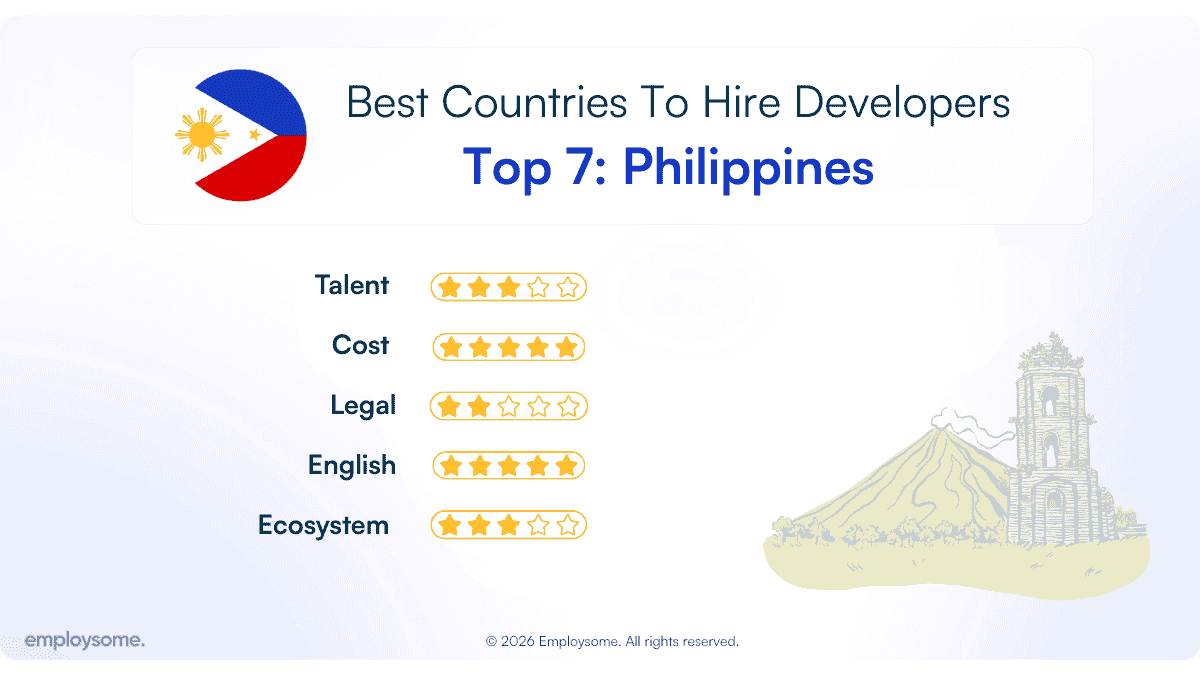
Score 72: Talent 3 | Cost 5 | Legal 2 | English 5 | Ecosystem 3
The Philippines’ software development sector is a rising star, building on the country’s dominant position in the broader BPO industry. With approximately 200,000 developers and near-native English proficiency rooted in the American educational system, the Philippines eliminates the communication barrier that plagues many low-cost alternatives.
Cost is the Philippines’ headline advantage: mid-level developer salaries range from just $7,000 to $16,000 per year, making it one of the most affordable markets globally. Cultural compatibility with Western (particularly American) companies is strong, and the workforce is known for its collaborative and service-oriented approach.
The downsides are weaker IP protections, infrastructure gaps (particularly outside Metro Manila), and a relatively limited pool of senior engineers with deep specialization in areas like AI/ML or cloud architecture. The time zone difference of 12-13 hours from the US East Coast can also be challenging.
Best for: Budget-conscious companies that need strong English and cultural fit. Ideal for frontend development, QA, and mobile development.
Explore our country guide: Learn how to hire developers compliantly and compare the best Employer of Record in the Philippines, including salary benchmarks, employment law requirements, and EOR pricing insights.
8. Argentina: LatAm’s Technical Powerhouse
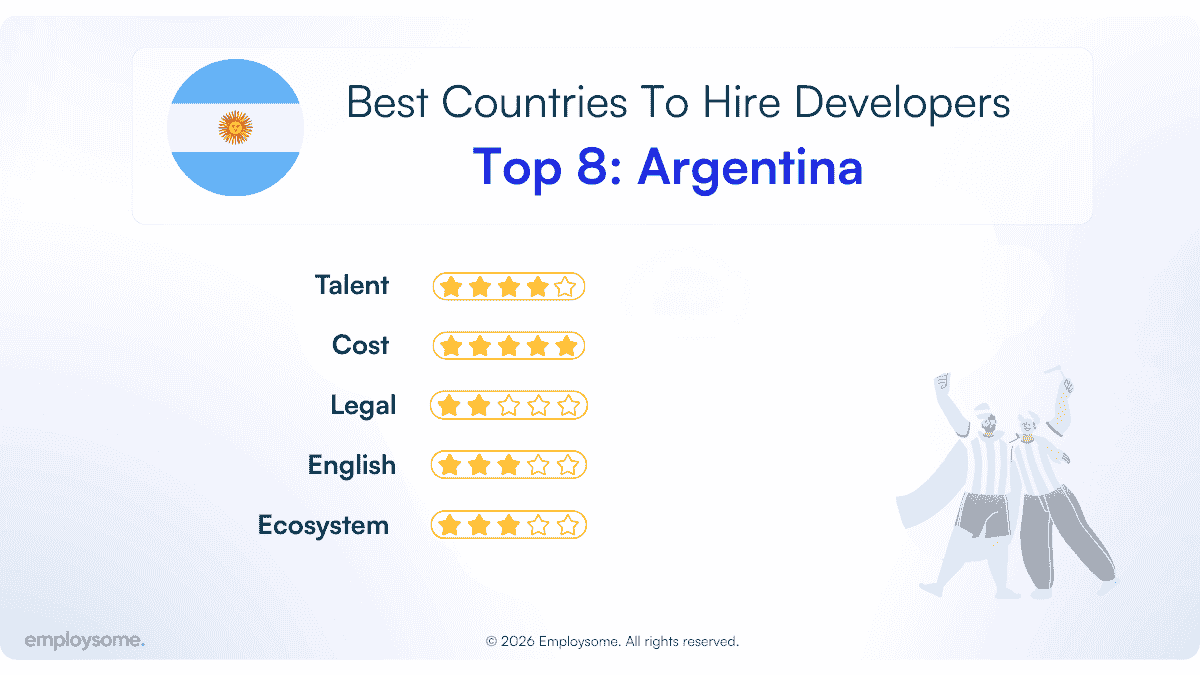
Score 72: Talent 4 | Cost 5 | Legal 2 | English 3 | Ecosystem 3
Argentina stands out in Latin America for its strong mathematical and computer science tradition. The country’s approximately 115,000 developers benefit from rigorous university programs like the University of Buenos Aires consistently ranks among the top institutions in the region and a culture that values engineering rigor.
Economic turbulence has made Argentina extremely cost-competitive, with mid-level developers earning $10,000–$25,000 annually. US time zone alignment (one hour ahead of Eastern Time) makes real-time collaboration seamless, and the developer community has strong engagement with global open-source projects.
The risks are economic instability, currency volatility, and relatively weak IP enforcement. English proficiency is moderate: functional for business but not as strong as European competitors. Companies hiring in Argentina should plan for currency management and ensure contracts are structured to mitigate economic risks.
Best for: US companies seeking nearshore talent with strong CS fundamentals at low cost. Excellent for backend engineering and data science.
9. Vietnam: Southeast Asia’s Fastest-Growing Tech Hub
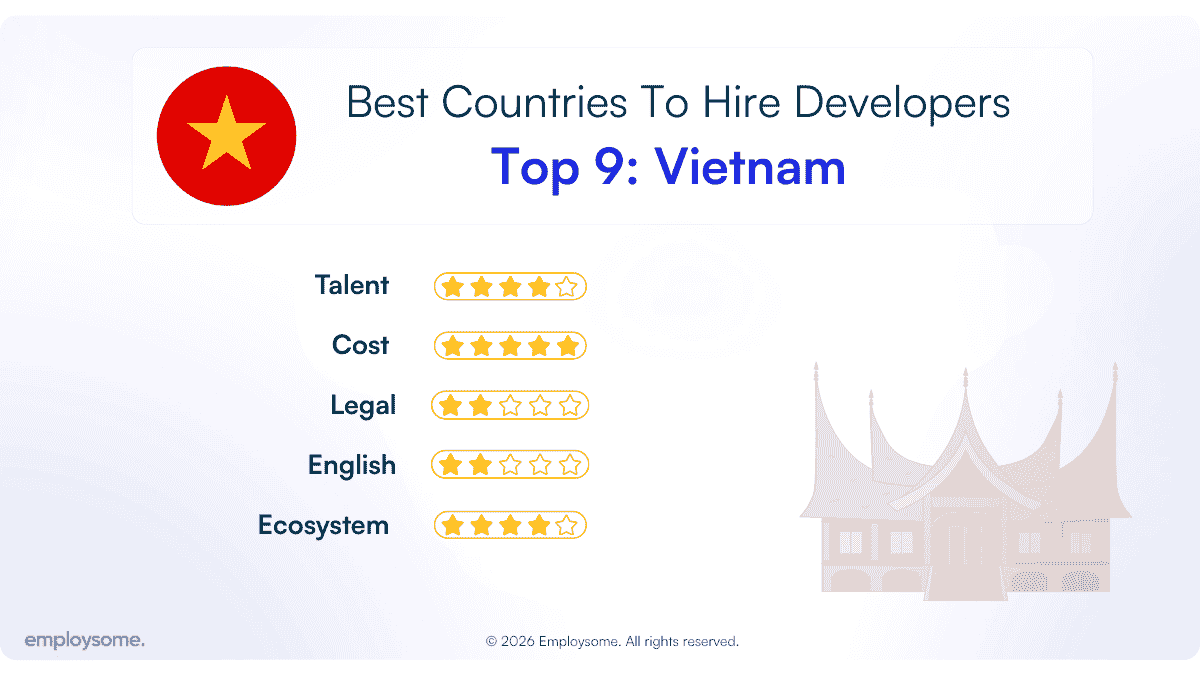
Score 71: Talent 4 | Cost 5 | Legal 2 | English 2 | Ecosystem 4
Vietnam has surged as a software outsourcing destination, with over 400,000 IT professionals and a government-backed push to reach 500,000 by 2026. Ho Chi Minh City and Hanoi anchor a rapidly maturing tech ecosystem, with growing expertise in mobile development, frontend technologies, and quality assurance.
Costs are among the lowest globally: mid-level salaries range from $10,000 to $25,000 per year. The government has invested heavily in digital skills development, coding academies, and tech infrastructure, and the results are showing in the quality of junior and mid-level talent entering the market.
Vietnam’s primary challenges are English proficiency (the EF EPI ranks it around #70 in the moderate band) and IP protection, which remains weak by Western standards. Senior talent with deep specialization is still limited compared to India or Eastern Europe, though this gap is narrowing. Companies typically need local management support or an experienced EOR partner to navigate labor regulations.
Best for: Cost-first hiring with a growing quality floor. Strong for mobile apps, frontend, QA, and companies willing to invest in team development.
Explore our country guide: Learn how to hire developers compliantly and compare the best Employer of Record in Vietnam, including salary benchmarks, employment law requirements, and EOR pricing insights.
10. South Africa: Africa’s Most Mature Tech Market
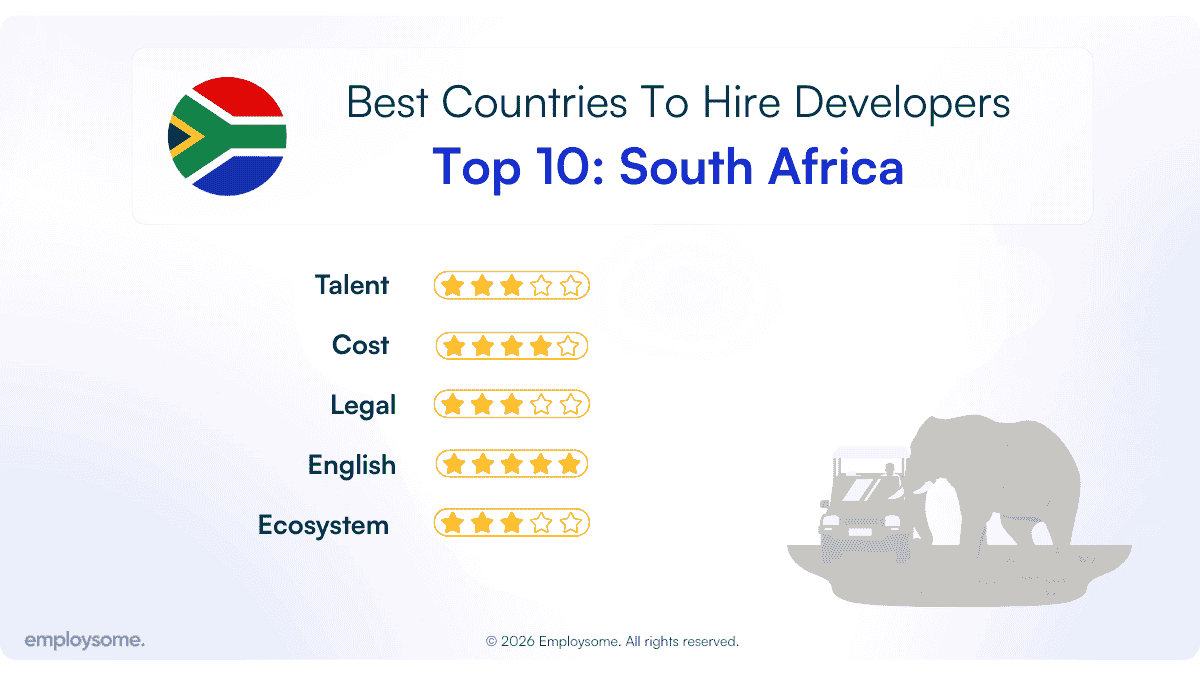
Score 71: Talent 3 | Cost 4 | Legal 3 | English 5 | Ecosystem 3
South Africa offers a unique combination among emerging markets: native English proficiency, excellent time zone alignment with Europe, and the continent’s most mature tech ecosystem. The country has approximately 120,000 software developers, with Cape Town and Johannesburg serving as primary tech hubs.
The EF EPI ranks South Africa at #13 globally (score: 602, “very high proficiency”), making communication seamless. Salaries range widely from $16,000 to $63,000 depending on seniority and location, offering flexibility for different budget levels. The fintech sector is particularly strong, with companies like PayFast, Yoco, and Jumo building world-class products locally.
Infrastructure reliability (particularly the ongoing load-shedding electricity crisis) remains a concern, though most tech companies have adapted with generators and remote work. IP protections are moderate, and the talent pool, while skilled, is significantly smaller than Asian competitors.
Best for: European companies seeking English-native developers in an aligned time zone. Strong for fintech, e-commerce, and mid-sized teams.
Explore our country guide: Learn how to hire developers compliantly and compare the best Employer of Record in South Africa, including salary benchmarks, employment law requirements, and EOR pricing insights.
Key Takeaways: Choosing the Right Country
If you need EU compliance and data protection:
Poland, Romania, Czech Republic, and Portugal all offer full GDPR membership and strong rule of law. Poland and Romania provide the best combination of quality and cost within the EU.
If cost is your primary driver:
India, Vietnam, the Philippines, and Argentina offer mid-level developers at $7,000–$30,000 per year. India provides the most scale, while the Philippines adds native English and cultural fit. Vietnam is the fastest-growing option in this tier.
If English proficiency is critical:
Portugal (#6 EF EPI), Romania (#11), the Philippines (near-native), and South Africa (native English) all score 5/5. These markets virtually eliminate the communication tax that plagues many offshore relationships.
If US time zone alignment matters:
Argentina and Mexico (just outside our top 10 at #12) offer same-day collaboration with US teams. Brazil and Colombia are also strong nearshore options for North American companies.
If you need maximum technical depth:
Poland, Ukraine, and India lead for specialized engineering in AI/ML, blockchain, cloud architecture, and cybersecurity. These markets have the deepest pools of senior engineers with complex project experience.
🚀 How to Get Started
Hiring developers internationally is no longer experimental – it’s a proven growth strategy used by startups and global enterprises alike. The key is aligning your priorities – cost, compliance, English proficiency, seniority level, and time zone – with the right country.
If you need EU legal stability, markets like Poland, Romania, or the Czech Republic are strong options. If cost efficiency and scale matter most, India, Vietnam, or the Philippines may be better fits. For senior, technically rigorous engineers, Poland and Ukraine stand out.
Once you’ve chosen a market, the smartest way to hire quickly and compliantly is through an Employer of Record (EOR). An EOR handles local contracts, payroll, tax withholding, statutory benefits, and IP protection – so you can focus on building your product.
If you’re unsure which country or EOR provider is right for your situation, we can help.
👉 Contact Us and we’ll match you with the best Employer of Record for your hiring strategy.

Written by
Courtney Pocock is a Copywriter & EOR/PEO Researcher at Employsome with 15+ years of experience writing for the HR, corporate, and financial sectors. She has a strong interest in global business expansion and Employer of Record / PEO topics, focusing on news that matters to business owners and decision-makers. Courtney covers industry updates, regulatory changes, and practical guides to help leaders navigate international hiring with confidence.
Our content is created for informational purposes only and is not intended to provide any legal, tax, accounting, or financial advice. Please obtain separate advice from industry-specific professionals who may better understand your business’s needs. Read our Editorial Guidelines for further information on how our content is created.