The 15 Best Cities to Work Remotely in 2026
The 15 best cities to work remotely in 2026, ranked by people who actually care about internet speed, timezone overlap, and visa compliance rather than Instagram aesthetics. From Lisbon and Mexico City to Taipei and Tbilisi, with honest monthly costs, real downsides, digital nomad visa requirements, and the compliance angle every other list ignores: whether your employer can actually hire you legally while you work from these places.


Table of Contents
- Quick Comparison
- 1. Lisbon, Portugal
- 2. Mexico City, Mexico
- 3. Medellin, Colombia
- 4. Barcelona, Spain
- 5. Bangkok, Thailand
- 6. Buenos Aires, Argentina
- 7. Taipei, Taiwan
- 8. Cape Town, South Africa
- 9. Chiang Mai, Thailand
- 10. Split, Croatia
- 11. Tbilisi, Georgia
- 12. Valencia, Spain
- 13. Da Nang, Vietnam
- 14. Budapest, Hungary
- 15. Tallinn, Estonia
- Can Your Employer Hire You There?
- Digital Nomad Visa & Tax Comparison
Every “best cities for remote work” list on the internet says the same thing. Lisbon. Bali. Chiang Mai. Rinse. Repeat. And sure, those cities are on this list too, because they earned their spots. But we’re going to be honest about what it’s actually like to work from each of them in 2026, not what the coworking space’s Instagram page wants you to believe.
This is a list for people who work real jobs with real deadlines, not lifestyle influencers who film themselves typing on a beanbag. We care about fast internet (not “decent WiFi at the cafe”), timezone overlap with clients, visa options that don’t require you to do a visa run every 90 days, and a cost of living that makes remote work worthwhile rather than just a lateral move with more mosquitoes.
We also care about something most of these lists ignore: whether your employer can actually hire you legally from these places. If your company is based in the US or Europe and you want to move to Medellin, someone needs to deal with Colombian employment law, social security, and tax withholding. That’s where an Employer of Record comes in, and it’s why this list includes compliance context alongside the lifestyle advice.
Here are 15 cities, ranked by how much we’d genuinely want to live and work there in 2026.

Quick Comparison
|
City |
Monthly Cost |
Internet |
Visa Option |
US Timezone |
Tax Scheme |
Vibe |
|
Lisbon |
$2,200-3,200 |
100-500 Mbps |
D8 (1yr, renew) |
UTC+0/+1 |
IFICI+: 20% flat, 10yr |
Cafe culture |
|
Mexico City |
$1,400-2,200 |
50-200 Mbps |
Tourist 180d |
UTC-6 (CT) |
No special regime |
Chaotic energy |
|
Medellin |
$1,200-2,000 |
50-150 Mbps |
DN visa 2yr |
UTC-5 (ET) |
Exempt <183 days |
Eternal spring |
|
Barcelona |
$2,500-3,800 |
100-600 Mbps |
DN visa 1yr |
UTC+1/+2 |
Beckham Law: 24% flat, 6yr |
Beach + city |
|
Bangkok |
$1,200-2,200 |
100-500 Mbps |
LTR / DTV |
UTC+7 |
Complex; 183-day rule |
Never sleeps |
|
Buenos Aires |
$1,000-1,800 |
50-200 Mbps |
DN visa 6mo |
UTC-3 |
Exempt <183 days |
Late nights |
|
Taipei |
$1,500-2,500 |
200-1000 Mbps |
Gold Card 1-3yr |
UTC+8 |
Gold Card: foreign income exempt first 183d |
Underrated gem |
|
Cape Town |
$1,400-2,500 |
50-200 Mbps |
DN visa 1yr |
UTC+2 |
Exempt if ≤183 days |
Nature + city |
|
Chiang Mai |
$800-1,400 |
50-200 Mbps |
DTV 180d |
UTC+7 |
Complex; 183-day rule |
OG nomad hub |
|
Split |
$1,600-2,500 |
50-200 Mbps |
DN visa 18mo |
UTC+1/+2 |
Full exemption on foreign income |
Adriatic calm |
|
Tbilisi |
$800-1,400 |
30-100 Mbps |
1yr visa-free |
UTC+4 |
Non-residents: 0% on foreign |
Wine + culture |
|
Valencia |
$1,800-2,800 |
100-600 Mbps |
DN visa 1yr |
UTC+1/+2 |
Beckham Law: 24% flat, 6yr |
Affordable Spain |
|
Da Nang |
$800-1,400 |
30-100 Mbps |
e-visa 90d |
UTC+7 |
No DN tax regime |
Beach + cheap |
|
Budapest |
$1,400-2,200 |
100-500 Mbps |
White Card 1yr |
UTC+1/+2 |
Exempt <183 days; else 15% flat |
Thermal baths |
|
Tallinn |
$1,600-2,500 |
100-500 Mbps |
DN visa 1yr |
UTC+2/+3 |
Exempt if taxed at home |
Digital-first |
1. Lisbon, Portugal

Best for: European base, work-life balance, mild winters, pasteis de nata addiction
Lisbon is the default answer for a reason: it works. The D8 digital nomad visa gives you a legal year (renewable up to five, with a path to permanent residency and citizenship), the internet is genuinely fast, English is widely spoken, and the city is walkable, safe, and beautiful. The food is affordable by Western European standards. The weather is Mediterranean without the extreme heat of southern Spain.
The honest downside? Lisbon is not cheap anymore. Rents have climbed aggressively since 2022, and a comfortable one-bedroom apartment in a central neighbourhood like Principe Real or Chiado will run you €1,200 to €1,600/month. The D8 visa requires proof of €3,510/month income (four times the Portuguese minimum wage), which is the highest income threshold among popular European nomad visas. And the nightlife is great until you remember your standup is at 9am London time.
Visa: D8 Digital Nomad Visa. 1 year, renewable to 5. Requires €3,510/month income. Path to citizenship after 5 years.
Tax scheme: Portugal’s NHR regime has been replaced by the IFICI+ programme, which offers a 20% flat tax rate on qualifying income for 10 years. For full eligibility details and how it interacts with the D8 visa, see our Portugal NHR / IFICI+ guide.
2. Mexico City, Mexico

Best for: US timezone overlap, incredible food, vibrant culture, affordability
Mexico City is where you go when you want to feel like you’re living abroad without losing timezone alignment with New York or Chicago. At UTC-6, you’re perfectly synced with Central Time, one hour behind Eastern, and your afternoon meetings end in time for mezcal at sunset in Roma Norte. The food scene is arguably the best of any city on this list. The coworking infrastructure is mature. The city is enormous and endlessly interesting.
The honest downside? Mexico does not have a dedicated digital nomad visa. Most remote workers enter on a 180-day tourist entry (FMM), which technically does not authorise work. This grey area has been tolerated for years, but it creates genuine risk for anyone whose employer needs clean compliance. Air quality can be terrible during dry season. And the altitude (2,240m) takes a few days to adjust to.
Visa: No dedicated DN visa. Tourist entry up to 180 days (FMM). Temporary Resident Visa available for longer stays (~$4,200/month income or $71,000 savings required).
Tax scheme: No special tax regime for foreign remote workers. If you become a Mexican tax resident (183+ days), standard progressive rates of 1.92% to 35% apply to worldwide income. Mexico has tax treaties with many countries to avoid double taxation.
3. Medellin, Colombia
 Best for: Eastern Time alignment, spring weather year-round, lowest costs in the Americas
Medellin sits at 1,500m altitude in a valley that delivers 22 to 28°C year-round, which is why everyone calls it the City of Eternal Spring. At UTC-5 it lines up perfectly with US Eastern Time. The digital nomad visa is generous: two years, renewable, with a remarkably low income threshold of roughly $684/month (though most nomads spend far more). Coworking spaces like Selina and El Poblado Work are solid. The metro system actually works. And you can live very well for $1,200 to $2,000/month.
The honest downside? Safety requires street awareness, especially at night. The digital nomad community has grown so fast that certain neighbourhoods (El Poblado, Laureles) have become nomad bubbles with rising rents and decreasing local character. Internet is good but not great by European or East Asian standards. And Colombia’s employment law is complex: if your employer wants to hire you compliantly while you work from Medellin, they’ll need a local entity or EOR.
Visa: Digital Nomad Visa (Type V). Up to 2 years. Income requirement ~$684/month (Colombia Check MIG). No local tax on foreign income if under 183 days.
Tax scheme: Non-residents (under 183 days) are exempt from Colombian income tax on foreign-sourced income. If you exceed 183 days, Colombia claims tax residency and taxes worldwide income at progressive rates up to 39%. No special flat-rate regime for nomads.
4. Barcelona, Spain

Best for: Beach + city life, European quality, startup ecosystem, Beckham Law tax benefits
Barcelona delivers the entire Mediterranean package: beach, architecture, nightlife, food, culture, football, and a genuine startup scene. Spain’s digital nomad visa (under the Startup Act) is one of the strongest in Europe, offering up to five years with a path to permanent residency. The real kicker is the Beckham Law: qualifying nomads can pay a flat 24% tax rate on Spanish-sourced income for up to six years, which is wildly favourable by European standards.
The honest downside? Barcelona is expensive. A one-bedroom in Eixample or Gracia is €1,200 to €1,800/month, and the city has cracked down on short-term rentals. The Digital Nomand (DN) visa requires €2,760/month income and at least 80% of your earnings must come from outside Spain. The bureaucracy is famously slow. And while everyone in the tourism industry speaks English, daily life in Catalan-speaking Barcelona benefits enormously from knowing some Spanish (and ideally Catalan).
Visa: Digital Nomad (Telework) Visa. 1 year initial, extendable to 3, then renewable. €2,760/month income. Beckham Law: 24% flat tax for 6 years.
Tax scheme: The Beckham Law (Régimen Especial para Trabajadores Desplazados) allows qualifying workers who move to Spain to pay a flat 24% tax on Spanish-sourced income instead of the standard progressive rates (up to 47%) for up to six years. For a full breakdown of eligibility, application process, and how it interacts with EOR employment, see our Beckham Law Spain 2026 guide.
5. Bangkok, Thailand

Best for: Value for money, infrastructure, food, city energy
Bangkok is the city that never stops. It is enormous, loud, and chaotic in the best possible way. The coworking scene is excellent (True Digital Park, Hubba, WeWork). The 5G coverage is better than most Western capitals. The food is legendary and absurdly cheap. And the city’s infrastructure, including the BTS, MRT, and Grab rides, makes getting around easy despite the traffic.
The honest downside? The timezone (UTC+7) is brutal for US collaboration. You’re 12 hours ahead of Eastern Time, which means either very late nights or very early mornings. The Long-Term Resident Visa requires $80,000+ annual income or $250,000 in assets, which prices out most nomads. The new Destination Thailand Visa (DTV) is more accessible (180 days, extendable) but the rules are still evolving. And the heat is relentless from March to May.
Visa: Destination Thailand Visa (DTV): 180 days, extendable 180d. Long-Term Resident (LTR): 10 years, requires $80K+ income. Thailand Privilege: 5-20 years, from $30K.
Tax scheme: Thailand’s tax rules for foreign income are complex and have tightened. From 2024, foreign income remitted to Thailand in the same tax year it is earned is taxable regardless of residency duration. If you stay 180+ days, you become a tax resident. The LTR visa offers a 17% flat tax on Thai-sourced income for qualifying professionals, but foreign income rules still apply. Seek professional advice.
6. Buenos Aires, Argentina
 Best for: Culture addicts, night owls, steak lovers, incredible value on a USD salary
Buenos Aires is the most European-feeling city in South America, with wide boulevards, cafe culture, world-class bookshops, and a nightlife that doesn’t start until midnight. For anyone earning in USD, the arbitrage is extraordinary: Argentina’s economic volatility means your dollar stretches further here than almost anywhere else on this list. A beautiful apartment in Palermo costs a fraction of what you’d pay for the equivalent in Barcelona or Lisbon.
The honest downside? Argentina’s economy is a rollercoaster. The exchange rate can shift dramatically in a matter of weeks. Internet speeds are adequate but not exceptional. The digital nomad visa is only six months (though renewable). The timezone (UTC-3) works well for US East Coast collaboration but poorly for Europe. And the city runs late: dinners at 10pm, meetings that start 15 minutes behind schedule, and a culture that values relationships over punctuality.
Visa: Digital Nomad Visa: 6 months, renewable for another 6. Income requirement ~$1,500/month. Tourist visa: 90 days.
Tax scheme: Non-residents (under 183 days) are not subject to Argentine income tax on foreign-sourced income. If you exceed 183 days, Argentina taxes worldwide income at progressive rates up to 35%. No special regime for digital nomads. The volatile exchange rate environment makes tax planning particularly important.
7. Taipei, Taiwan
 Best for: Fastest internet on this list, safety, food, incredibly underrated
Taipei is the city that nobody puts first on their list but everyone who visits immediately falls in love with. The internet is the fastest of any city here (fibre connections regularly hit 500Mbps to 1Gbps). The public transit is flawless. The night markets are a religion. The city is extraordinarily safe. Healthcare is world-class and affordable. And the Gold Card visa for skilled professionals offers three years of open residency with no income tax on foreign earnings for the first 183 days.
The honest downside? The timezone (UTC+8) is a 13-hour offset from Eastern Time, which makes real-time US collaboration nearly impossible. Mandarin is essential for anything beyond tourist-level interactions. The humidity from May to September is aggressive. And Taiwan’s rental market moves fast, with most decent apartments in Da’an or Xinyi going within days of listing.
Visa: Gold Card: 1-3 years for qualifying professionals (digital economy, science, etc.). No employer sponsorship needed.
Tax scheme: Gold Card holders who are first-time Taiwan tax residents get a significant benefit: foreign-sourced income is exempt from tax for the first 183 days of the tax year. After establishing residency, Taiwan’s progressive rates (5% to 40%) apply to domestic income, but foreign income is only taxed if it exceeds NT$1 million and you are a tax resident. For most remote workers earning from abroad, the effective tax rate is very low in the first year.
8. Cape Town, South Africa

Best for: Natural beauty, UK/EU timezone overlap, emerging tech scene, adventure lifestyle
Cape Town has everything: Table Mountain, stunning beaches, world-class wine regions 30 minutes away, a growing tech scene, and a timezone (UTC+2) that overlaps perfectly with European working hours. South Africa launched its digital nomad visa in 2024 and has been heavily promoting Cape Town as a remote work hub. The cost of living is remarkably low for the quality of life you get. A waterfront apartment with mountain views costs less than a shoebox in Lisbon.
The honest downside? Load shedding (rolling power cuts) has improved significantly but is not fully resolved. Many remote workers invest in a UPS or choose accommodation with backup power. Safety is a real consideration: Cape Town has high crime rates in certain areas, and you need to be aware of your surroundings. The digital nomad visa requires ZAR 1,000,000/year (~$54,000 USD) in income, which is on the higher end. And the 8 to 9 hour offset from US Eastern Time makes US client work challenging.
Visa: Digital Nomad Visa: 1 year, renewable. Income requirement ZAR 1,000,000/year (~$54,000). Tourist visa: 90 days.
Tax scheme: If you stay 183 days or fewer, you are a non-resident and South Africa does not tax your foreign income. If you exceed 183 days, you become a tax resident and are taxed on worldwide income at progressive rates (18% to 45%), though a foreign income exemption of up to ZAR 1.25 million may apply for qualifying employment income. No special flat-rate regime for nomads.
9. Chiang Mai, Thailand

Best for: The absolute lowest cost of living, temple-filled calm, OG nomad community
Chiang Mai is the city that started the digital nomad movement. It has been on every list since 2014, and it is still here because the fundamentals are unbeatable: you can live comfortably for $800 to $1,400/month, the old city is beautiful, the food is extraordinary, and the coworking community is deeply established. If Punspace or CAMP are your office, you’ll spend less on monthly expenses than you would on rent alone in most Western cities.
The honest downside? The burning season (February to April) fills the valley with haze from agricultural fires, and the air quality index regularly hits hazardous levels. It is not a joke and not something to ignore. Many long-term nomads leave during this period. The city is small and can feel repetitive after a few months. And the same timezone problem as Bangkok (UTC+7) applies: real-time US work is very difficult.
Visa: Same as Bangkok: DTV (180+180 days), LTR, or Thailand Privilege.
Tax scheme: Same as Bangkok. Thailand’s rules on foreign income remittance have tightened from 2024. See Bangkok entry for details.
10. Split, Croatia
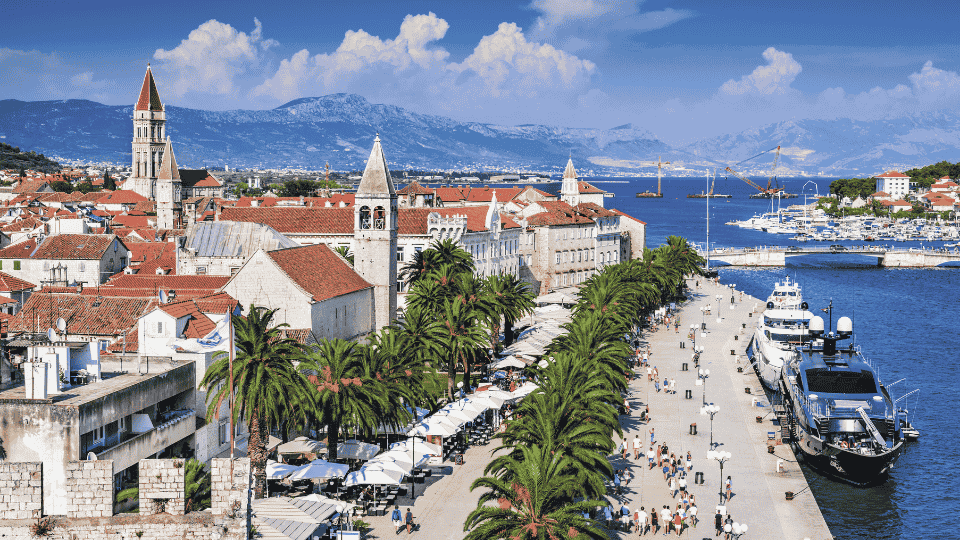
Best for: Adriatic lifestyle, EU access, tax-free income, Game of Thrones vibes
Split is the Mediterranean alternative to Barcelona at half the price. Croatia’s digital nomad visa is exceptionally generous: up to 18 months on a single permit, renewable for another 18 (three years total), with no local income tax on foreign earnings. The old town is literally built into a Roman palace. The Adriatic coast is stunning. And since Croatia joined Schengen in 2023, you can travel freely across Europe.
The honest downside? The city is small and very quiet in winter. If you need a buzzing social scene year-round, Split is not it. The coworking infrastructure is limited compared to larger cities. Internet is good but not exceptional. And the income requirement (~€3,295/month) is higher than you might expect for a smaller Croatian city.
Visa: Digital Nomad Residence Permit: 18 months, renewable to 36. €3,295/month income. Schengen access.
Tax scheme: Croatia fully exempts digital nomad visa holders from local income tax on foreign-sourced earnings. This is one of the cleanest tax-free setups in Europe. No local tax registration required, no complex exemption applications. If your income comes from outside Croatia and you hold the DN permit, you pay zero Croatian tax. This makes Split (and Zagreb, Dubrovnik, Zadar) among the most tax-efficient European destinations.
11. Tbilisi, Georgia

Best for: The easiest visa situation in the world, incredible wine, absurd value
Georgia lets citizens of 95+ countries stay for one full year without any visa at all. No application, no income proof, no bureaucracy. Just show up. On top of that, the “Remotely from Georgia” programme provides official status for remote workers earning at least $2,000/month. Tbilisi itself is a city of contradictions: crumbling Soviet architecture next to trendy wine bars, ancient churches overlooking rooftop parties, and some of the best hospitality culture on the planet.
The honest downside? Internet speeds are improving but inconsistent, especially outside central Tbilisi. The city is not particularly walkable compared to European capitals. English proficiency is growing but still limited among older residents. The timezone (UTC+4) is awkward for both European and US collaboration. And while the wine is spectacular, the nightlife scene is smaller than what you’d find in Lisbon or Barcelona.
Visa: Visa-free: 1 year for 95+ nationalities. “Remotely from Georgia”: official DN status, $2,000/month income.
Tax scheme: Non-residents pay 0% tax on foreign-sourced income. Even if you become a Georgian tax resident (183+ days), foreign-sourced income earned by individuals who are not Georgian citizens and who work remotely for foreign companies is generally not subject to Georgian tax. Georgia also offers a “Small Business Status” with a 1% turnover tax for freelancers earning under GEL 500,000/year (~$180,000). One of the most tax-friendly setups in the world.
12. Valencia, Spain

Best for: Barcelona’s lifestyle at a 30% discount, paella, City of Arts and Sciences
Valencia is increasingly where digital nomads go when they realise Barcelona is too expensive. It has the same Spanish DN visa and Beckham Law benefits, a beautiful beach, the futuristic City of Arts and Sciences, the best paella in the country (do not argue with Valencians about this), and a significantly lower cost of living. A one-bedroom in the Ruzafa or El Carmen neighbourhoods runs €800 to €1,200/month.
The honest downside? The city is smaller and quieter than Barcelona or Madrid. The startup and tech scene is growing but less mature. If you want a major international airport with direct flights everywhere, Barcelona and Madrid are better connected. And while Valencia is lovely, it lacks the jaw-dropping architecture and nightlife of Barcelona.
Visa: Same as Barcelona: DN visa, €2,760/month, Beckham Law eligible.
Tax scheme: Same as Barcelona. The Beckham Law applies nationwide.
13. Da Nang, Vietnam

Best for: Beach life on a shoestring, the best Bali alternative
Da Nang is the Vietnamese beach city that does everything Bali does at a lower price point without the Instagram circus. The beach is beautiful. The seafood is absurdly cheap. The city is clean and manageable. And the coworking scene, while smaller than Ho Chi Minh City or Hanoi, is growing fast. You can live comfortably for $800 to $1,400/month, which makes it one of the cheapest cities on this list.
The honest downside? Vietnam does not have a dedicated digital nomad visa. The e-visa gives you 90 days, which is fine for a stint but not for settling in. Internet speeds are acceptable but inconsistent. The rainy season (September to December) can be intense. And the timezone (UTC+7) is the same Asia challenge as Bangkok and Chiang Mai: very difficult for US-hours work.
Visa: e-visa: 90 days, single or multiple entry. No dedicated DN visa yet. Business visa options available through sponsors.
Tax scheme: Vietnam has no special tax regime for digital nomads. If you become a tax resident (183+ days or have a permanent residence), progressive rates of 5% to 35% apply to worldwide income. Most nomads stay under 90 days on an e-visa and avoid triggering residency. There is no formal DN tax exemption.
14. Budapest, Hungary

Best for: Cheapest major European capital, thermal baths, stunning architecture, ruin bars
Budapest is the best value proposition in Europe for remote workers. Hungary’s new White Card digital nomad visa (launched 2024) offers one year, renewable for another, with a €3,000/month income requirement. The city itself is gorgeous: Buda’s hills and castles on one side of the Danube, Pest’s grand boulevards and ruin bars on the other. The internet is fast. The thermal bath culture is unmatched. And monthly living costs of $1,400 to $2,200 make it one of the cheapest EU capitals.
The honest downside? Hungarian is one of the most difficult languages on Earth, and outside of tourist areas, English proficiency drops. The political environment is polarising. Winter is cold and grey. And while Budapest is beautiful, it lacks the beach lifestyle of Mediterranean alternatives.
Visa: White Card: 1 year, renewable once. €3,000/month income.
Tax scheme: White Card holders who stay under 183 days are not Hungarian tax residents and pay no local tax on foreign income. If you exceed 183 days, Hungary’s flat 15% personal income tax applies to worldwide income. The 15% flat rate is one of the lowest in the EU, making Budapest attractive even for those who trigger residency.
15. Tallinn, Estonia

Best for: Digital-first infrastructure, e-Residency, EU fintech hub, fairy-tale old town
Estonia is the most digitally advanced country on Earth, and Tallinn is its showcase. The e-Residency programme lets you start and manage an EU company entirely online. The digital nomad visa is clean and well-administered. The old town looks like it belongs in a medieval storybook. And the startup scene, powered by the success of companies like Bolt, Wise, and Pipedrive, gives the city an outsized tech energy for its small population.
The honest downside? It is cold. Very cold. Winters are dark and can push below -20°C. The city is small (fewer than 500,000 people) and can feel quiet. The cost of living, while lower than Scandinavia, is higher than other Eastern European cities like Budapest or Sofia. And while summer in Tallinn is magical (white nights, outdoor bars, the Baltic coast), it only lasts about three months.
Visa: Digital Nomad Visa: 1 year. e-Residency: not a visa, but allows you to run an EU company remotely.
Tax scheme: DN visa holders are exempt from Estonian income tax if their income is already taxed in their home country. Estonia’s corporate tax system is unique: companies pay 0% tax on retained earnings and 20% only on distributed profits. This makes e-Residency combined with an Estonian company structure attractive for freelancers, though personal income still needs to be taxed somewhere.
The Part Nobody Talks About: Can Your Employer Actually Hire You There?
Here is the thing that every “best cities for remote work” article conveniently ignores: a digital nomad visa gives you the right to live in a country. It does not automatically make your employment compliant.
If you are a W-2 employee of a US company and you move to Lisbon, your employer may create a permanent establishment risk in Portugal. If you work from Colombia for more than 183 days, you may trigger Colombian tax residency, and your employer may owe Colombian social security contributions. If you are in Spain under the Beckham Law, the tax benefits only apply if your employer handles the Spanish payroll correctly.
This is exactly where an Employer of Record becomes valuable. An EOR can legally employ you on behalf of your company in the country where you’re living, handle local tax withholding, social security contributions, and employment contracts, and keep both you and your employer compliant. It is the difference between “I’m working from Medellin on a tourist visa and hoping nobody notices” and “I’m legally employed in Colombia through an EOR while my company stays clean.”
💡 Employsome Insight: Your Visa Status and Your Employment Status Are Two Different Things
A digital nomad visa gives you immigration permission to live somewhere. It does not create an employment relationship, set up tax withholding, or satisfy social security obligations. If your employer wants to stay compliant while you work from a different country, they need either a local entity or an Employer of Record in that country. We review and score EOR providers across 35+ countries on Employsome, so you can find a provider that actually supports the country you want to work from. Visit employsome.com to compare providers.
Digital Nomad Visa & Tax Comparison: All Countries
|
Country |
Visa |
Duration |
Income Req. |
Tax Scheme for Foreigners |
Tax on Foreign Income |
Path to PR |
|
Portugal |
D8 |
1yr, renew 5 |
€3,510/mo |
IFICI+ (NHR successor): 20% flat, 10yr |
20% flat (IFICI+) or standard |
Yes (5yr) |
|
Spain |
Telework |
1yr, then 3yr |
€2,760/mo |
Beckham Law: 24% flat, 6yr |
24% flat (Beckham) or standard |
Yes (5yr) |
|
Croatia |
DN Permit |
18mo + 18mo |
€3,295/mo |
Full exemption on foreign income |
Exempt |
No |
|
Hungary |
White Card |
1yr + 1yr |
€3,000/mo |
Exempt <183d; 15% flat if resident |
0% or 15% flat |
No |
|
Estonia |
DN Visa |
1yr |
€3,504/mo |
Exempt if taxed at home |
Exempt |
No (direct) |
|
Italy |
DN Visa |
1yr, renew |
~€2,700/mo |
Impatriati: 50% exemption, 5yr (if eligible). DN tax regime under discussion. |
50% exempt (Impatriati) or standard |
Yes (5yr) |
|
Greece |
DN Visa |
1yr, renew 2yr |
€3,500/mo |
50% income tax reduction, 7yr |
50% reduced |
No (direct) |
|
Colombia |
Type V |
2yr |
~$684/mo |
No special regime |
Exempt (<183d) |
Yes (5yr) |
|
Argentina |
DN Visa |
6mo + 6mo |
~$1,500/mo |
No special regime |
Exempt (<183d) |
No |
|
Mexico |
No DN visa |
180d tourist |
N/A |
No special regime |
Standard if 183d+ |
No (direct) |
|
Georgia |
Visa-free |
1yr |
$2,000/mo (prog.) |
Non-residents: 0%. Small Business: 1% turnover. |
0% (non-resident foreign) |
No |
|
Thailand |
DTV |
180d + 180d |
Not specified |
LTR: 17% flat on Thai income |
Complex (remittance rules) |
No |
|
Taiwan |
Gold Card |
1-3yr |
Varies by field |
Gold Card: foreign income exempt first 183d; NT$1M threshold |
Exempt (first 183d) |
No (direct) |
|
South Africa |
DN Visa |
1yr, renew |
~$54,000/yr |
No special regime. ZAR 1.25M foreign income exemption. |
Exempt (≤183d) |
No (direct) |
|
Vietnam |
e-visa |
90d |
N/A |
No special regime |
Standard if 183d+ |
No |
💡 Planning to Work Remotely From Abroad?
If your company wants to hire or retain you compliantly while you work from another country, they may need an Employer of Record. Employsome reviews and scores EOR providers across 35+ countries. Compare the best EOR for your destination and find a provider that handles local employment law, tax, and social security so you can focus on the view from your new office.
Frequently Asked Questions
Chiang Mai and Tbilisi, both at $800 to $1,400/month for a comfortable lifestyle. Da Nang is similarly affordable. Buenos Aires can be even cheaper depending on the exchange rate.
Mexico City (UTC-6, Central Time) and Medellin (UTC-5, Eastern Time) are the best. Buenos Aires (UTC-3) works for East Coast collaboration with a 1 to 2 hour offset.
Taipei, with residential fibre regularly hitting 500Mbps to 1Gbps. Barcelona, Lisbon, Budapest, and Tallinn also offer excellent speeds (100-600 Mbps). Bangkok’s 5G infrastructure is also very strong.
Croatia (full exemption on foreign income), Georgia (0% for non-residents, 1% small business option), Spain (Beckham Law: 24% flat for 6 years), Portugal (IFICI+: 20% flat for 10 years), and Hungary (15% flat rate, one of the EU’s lowest). Greece also offers a 50% income tax reduction for 7 years.
Possibly. A DN visa gives you immigration status but does not make your employment compliant. If you spend more than 183 days in a country, you likely trigger tax residency, which means your employer may need to handle local payroll. An Employer of Record (EOR) solves this by becoming your legal employer in the host country.
Portugal (5 years), Spain (5 years), Colombia (5 years), and Italy (5 years) all offer pathways from digital nomad visa to permanent residency and eventually citizenship.

Written by
Courtney Pocock is a Copywriter & EOR/PEO Researcher at Employsome with 15+ years of experience writing for the HR, corporate, and financial sectors. She has a strong interest in global business expansion and Employer of Record / PEO topics, focusing on news that matters to business owners and decision-makers. Courtney covers industry updates, regulatory changes, and practical guides to help leaders navigate international hiring with confidence.
Our content is created for informational purposes only and is not intended to provide any legal, tax, accounting, or financial advice. Please obtain separate advice from industry-specific professionals who may better understand your business’s needs. Read our Editorial Guidelines for further information on how our content is created
Other posts
Along with our standard maps we offer highly customizable maps.