Average Salary in Vietnam Guide (2026): By Sector & Region
Vietnam’s average salary is approximately 8.7 million VND per month (~$340 USD) nationally, but this figure is heavily skewed by agricultural and informal sector jobs. Professional salaries in Hanoi and Ho Chi Minh City typically range from 12 to 18 million VND, while IT roles command 20 to 100+ million VND depending on seniority. Employers must add approximately 23.5% on top of gross salary for mandatory social insurance, health insurance, unemployment insurance, and trade union contributions. Vietnam’s four-region minimum wage increased by 7.2% from 1 January 2026 under Decree 293, with Region I (Hanoi, HCMC) now set at 5.31 million VND per month. While the 13th month salary is not legally required, it is a near-universal market practice and the Tet bonus typically adds one to three additional months of pay per year.

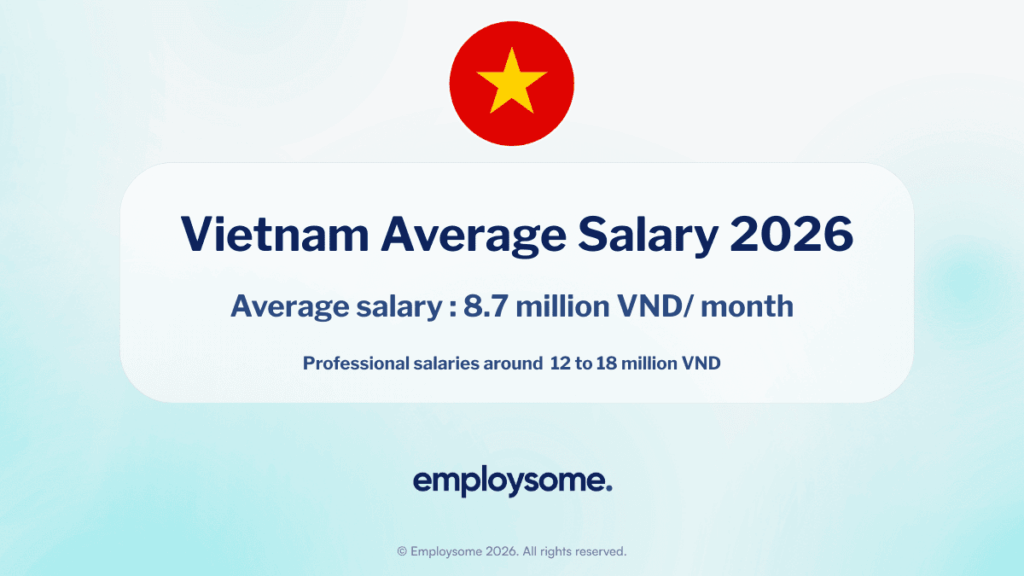
Table of Contents
- National Average Salary in Vietnam (2026)
- Average Salary by City and Region
- Average Salary by Sector
- Average Salary by Experience Level
- Minimum Wage in Vietnam (2026)
- Employer Social Insurance and Mandatory Contributions
- How Does Vietnam Compare to Other ASEAN Markets?
- Personal Income Tax (PIT) Overview
- FAQs
Vietnam’s labour market is one of the fastest-growing in Southeast Asia. With over 52 million people in the workforce, a young population (median age around 31), and rapid economic expansion targeting 10% GDP growth in 2026, the country has become a top destination for international companies hiring tech, manufacturing, and services talent.
For employers considering hiring in Vietnam, whether through a local entity or an Employer of Record, understanding real salary levels is essential for budgeting, making competitive offers, and calculating total employment costs including mandatory social insurance contributions.
This guide breaks down average salaries in Vietnam for 2026, covering national averages, regional differences, sector-by-sector data, experience-based progression, mandatory employer contributions, and how Vietnam compares to neighbouring ASEAN markets.
 Employsome Insight: The Headline Average Understates Professional Salaries
Vietnam’s national average salary of approximately 8.7 million VND/month (~$340 USD) is heavily skewed by low-paying agricultural and informal sector jobs, which still employ a large portion of the workforce. If you are hiring skilled professionals in Hanoi or Ho Chi Minh City, expect salaries 50–100% higher than the national average. Always benchmark against sector and city data, not the headline figure.

National Average Salary in Vietnam (2026)
According to data from the General Statistics Office (GSO) and Trading Economics, the average monthly wage in Vietnam reached approximately 8,684,000 VND (around $340 USD) in Q4 2025, continuing an upward trend of approximately 9–10% year-on-year wage growth. For 2026, wages are expected to continue rising, driven by foreign investment inflows, tightening labour markets in urban centres, and the 7.2% minimum wage increase effective 1 January 2026.
|
Metric |
Value (2026 Estimate) |
|
National average monthly salary |
~8.7 million VND (~$340 USD) |
|
Median monthly salary (professional roles) |
~14.9 million VND (~$580 USD) |
|
Salary range (all sectors, incl. bonuses) |
4.4 million to 76.9 million VND/month |
|
Average annual salary (incl. 13th month) |
~113 million VND (~$4,400 USD) |
|
Year-on-year wage growth |
~9.5% (2024–2025 trend) |
The gap between the national average and median salary in professional roles reflects the dual nature of Vietnam’s economy. Agricultural, informal, and low-skilled manufacturing roles pull the average down, while IT, finance, and professional services roles in major cities command significantly higher pay.
Average Salary by City and Region
Salaries in Vietnam vary significantly by geography. The two dominant economic centres, Hanoi and Ho Chi Minh City (HCMC), command the highest wages, followed by secondary cities like Da Nang, Hai Phong, and Can Tho.
|
City / Region |
Avg. Monthly Salary Range |
Notes |
|
Ho Chi Minh City |
12–18 million VND |
Highest salaries nationally. Strong tech, finance, and services sectors. |
|
Hanoi |
12–17 million VND |
Government, tech, and professional services hub. Slightly below HCMC for private sector. |
|
Da Nang |
10–15 million VND |
Growing tech and tourism hub. Lower cost of living than Hanoi/HCMC. |
|
Hai Phong |
9–14 million VND |
Major port city. Manufacturing and logistics focus. |
|
Can Tho |
8–12 million VND |
Mekong Delta’s economic centre. Agriculture and food processing. |
|
Rural areas |
6–10 million VND |
Agriculture-dominated. Significantly lower cost of living. |
The income gap between urban and rural areas is approximately 39%, with workers in major cities earning an average of around 10.1 million VND compared to approximately 7.3 million VND in rural regions. This gap directly affects recruitment costs and the competitiveness of salary offers.
Employsome Insight: Location Determines Your True Hiring Cost
If you are hiring a software developer in HCMC through an EOR, expect to pay 20–40 million VND/month (approximately $800–$1,600 USD) depending on seniority. This is 2–3x the national average. When comparing EOR quotes for Vietnam, always specify the city and role to get accurate cost estimates. A provider quoting based on national averages will significantly understate your real costs.
Average Salary by Sector
Vietnam’s salary landscape varies dramatically across industries. The technology sector commands the highest salaries, driven by strong demand from both domestic tech companies and foreign outsourcing operations. Manufacturing, while employing a large share of the workforce, pays considerably less.
|
Sector |
Avg. Monthly Salary |
Senior / Manager Level |
|
IT / Software Development |
20–40 million VND |
50–100+ million VND (CTO/VPoE: ~101 million VND) |
|
Finance / Banking |
15–30 million VND |
40–80 million VND |
|
Pharmaceuticals / Healthcare |
15–25 million VND |
30–80 million VND (specialists) |
|
Construction / Engineering |
12–20 million VND |
24–47 million VND (project managers) |
|
Sales / Marketing |
10–20 million VND |
30–60 million VND + commission |
|
Tourism / Hospitality |
8–15 million VND |
29–80 million VND (hotel/restaurant managers) |
|
Manufacturing (skilled) |
8–12 million VND |
15–25 million VND |
|
Manufacturing (unskilled) |
5–8 million VND |
N/A |
|
Education |
8–15 million VND |
15–30 million VND (international schools higher) |
|
Agriculture |
4–7 million VND |
8–12 million VND |
The IT sector stands out dramatically. According to the ITviec 2025/2026 IT Salary Report, CTO and VPoE positions command a median salary of approximately 101.25 million VND per month. Even mid-level backend developers earn 30–55 million VND, with data engineers reaching 57 million VND at 3–4 years of experience.
Employsome Insight: Vietnam’s IT Salaries Are Rising Fast
Salary growth in high-demand IT roles has reached up to 25% year-on-year for specialised positions in AI, data engineering, and cybersecurity. If you are hiring Vietnamese developers to save costs compared to Western markets, the savings are still significant (often 60–70% lower than US salaries for equivalent roles), but the gap is narrowing. Lock in compensation benchmarks early and build annual increments of 10–15% into your budget to retain talent.
Average Salary by Experience Level
Experience is one of the strongest determinants of salary in Vietnam. Vietnamese workers typically receive a salary increment of approximately 9% every 17 months, which is notably higher than the global average of 3% every 16 months.
|
Experience Level |
Typical Monthly Salary Range |
|
Fresh graduate (0–1 year) |
6–10 million VND |
|
Junior (1–3 years) |
10–18 million VND |
|
Mid-level (3–5 years) |
15–30 million VND |
|
Senior (5–10 years) |
25–50 million VND |
|
Manager / Director (10+ years) |
40–100+ million VND |
These ranges vary significantly by sector. A senior software developer with 7 years of experience in HCMC may earn 50–60 million VND, while a senior manufacturing supervisor with similar tenure may earn 18–25 million VND.
Minimum Wage in Vietnam (2026)
Vietnam operates a four-region minimum wage system under Decree 293/2025/ND-CP, effective 1 January 2026. The 2026 increase averages 7.2% across all regions.
|
Region |
Monthly Minimum |
Hourly Minimum |
Key Areas |
|
I |
5,310,000 VND (~$210) |
25,500 VND/hour |
Hanoi, HCMC, Hai Phong, Da Nang |
|
II |
4,730,000 VND (~$180) |
22,700 VND/hour |
Most of Binh Duong, Dong Nai, Can Tho |
|
III |
4,140,000 VND (~$157) |
20,000 VND/hour |
Parts of Hai Duong, Khanh Hoa, Long An |
|
IV |
3,700,000 VND (~$142) |
17,800 VND/hour |
Rural and less industrialised areas |
Employees with vocational training qualifications must be paid at least 7% above the regional minimum for their area. For employers operating in industrial zones or export processing zones that span multiple regions, the highest applicable minimum wage must be applied.
Non-compliance penalties range from 20 million to 75 million VND depending on the number of employees affected.
Employer Social Insurance and Mandatory Contributions
On top of gross salary, employers in Vietnam must contribute to social insurance (SI), health insurance (HI), unemployment insurance (UI), and the trade union fund. These mandatory contributions add approximately 21.5–23.5% to the total employer cost, depending on whether the employee is Vietnamese or foreign and whether a grassroots trade union has been established.
|
Contribution |
Employer Rate |
Employee Rate |
Notes |
|
Social Insurance (retirement, sickness, maternity, work injury) |
17.5% |
8% |
Capped at 20x reference salary |
|
Health Insurance |
3% |
1.5% |
Capped at 20x reference salary |
|
Unemployment Insurance |
1% |
1% |
Vietnamese employees only. Capped at 20x regional minimum wage. |
|
Trade Union Fund |
2% |
0.5%* |
*Employee rate increased to 0.5% from July 2025 (previously 1% only if union exists) |
|
Total (Vietnamese employee) |
23.5% |
11% |
|
|
Total (Foreign employee) |
20.5% |
9.5% |
No UI for foreign employees |
For a Vietnamese employee earning a gross salary of 20 million VND/month, the employer’s additional mandatory cost is approximately 4.7 million VND/month (23.5%), bringing the total employer cost to approximately 24.7 million VND/month before any EOR fees.
Employsome Insight: The 13th Month Salary Is Not Legally Required but Culturally Expected
While Vietnam’s Labour Code does not mandate a 13th month salary, it is standard practice across virtually all professional roles and multinational employers. The Tết (Lunar New Year) bonus is also widely expected and typically ranges from one to three months’ salary. Companies that skip these payments often struggle with retention, even when base pay is competitive. When calculating total annual cost per employee, add at least 1.5–2 months of salary for bonuses on top of the 12 months of gross pay and employer contributions.
How Does Vietnam Compare to Other ASEAN Markets?
Vietnam remains one of the most cost-competitive hiring markets in Southeast Asia, though the gap with neighbouring countries is narrowing as wages rise.
|
Country |
Avg. Monthly Salary (USD) |
Employer SI Rate |
Min. Wage (USD/month) |
|
Vietnam |
~$340 (national avg.) |
21.5–23.5% |
$142–$210 |
|
Philippines |
~$350–$400 |
~12–14% |
$200–$280 |
|
Indonesia |
~$300–$380 |
~15–18% |
$130–$260 (varies by province) |
|
Thailand |
~$500–$600 |
~5–6% |
~$310–$350 |
|
Malaysia |
~$700–$900 |
~13–15% |
~$380 (RM1,700) |
|
Singapore |
~$3,500–$4,500 |
~17% (CPF, varies by age) |
No national min. wage (sector-specific PWM) |
Vietnam’s combination of competitive base salaries, a large skilled workforce (particularly in IT and engineering), and strong government support for foreign investment makes it one of the most attractive hiring markets in the region. However, the relatively high employer social insurance burden (23.5% vs. 5–6% in Thailand) means total employer costs are closer to Thailand’s than the base salary gap suggests.
Employsome Insight: Vietnam vs. Philippines for Remote Tech Hiring
Both Vietnam and the Philippines are popular choices for remote tech hiring in ASEAN. Vietnam offers stronger engineering and STEM talent, particularly in software development, while the Philippines has stronger English proficiency and customer service capabilities. Base salaries are similar, but Vietnam’s higher employer SI rate (23.5% vs. ~12–14% in the Philippines) means total employer costs are approximately 8–10% higher in Vietnam for equivalent roles. Factor this into your country comparison.
Personal Income Tax (PIT) Overview
Vietnam applies a progressive personal income tax (PIT) on employment income for tax residents. The employer is responsible for withholding PIT from the employee’s gross salary each month and filing with the tax authority. The 2026 PIT brackets are:
|
Monthly Taxable Income (VND) |
Tax Rate |
|
Up to 5 million |
5% |
|
5–10 million |
10% |
|
10–18 million |
15% |
|
18–32 million |
20% |
|
32–52 million |
25% |
|
52–80 million |
30% |
|
Over 80 million |
35% |
Tax residents receive a personal deduction of 11 million VND/month and a dependent deduction of 4.4 million VND per dependent per month. Non-residents are taxed at a flat rate of 20% on employment income with no deductions. Salaries must be stated and paid in Vietnamese dong (VND), and monthly payroll reporting is mandatory.
Hiring in Vietnam?
Compare the best EOR providers for Vietnam on Employsome. We score each provider on entity ownership, local compliance expertise, onboarding speed, and payroll accuracy so you can hire compliantly without setting up a Vietnamese entity. See the full comparison.
Frequently Asked Questions
The national average salary is approximately 8.7 million VND per month (~$340 USD). However, professional salaries in Hanoi and HCMC typically range from 12 to 18 million VND, and IT professionals earn 20 to 100+ million VND depending on seniority.
Under Decree 293/2025/ND-CP effective 1 January 2026, the regional monthly minimum wage is 5.31 million VND (Region I, including Hanoi and HCMC), 4.73 million VND (Region II), 4.14 million VND (Region III), and 3.70 million VND (Region IV). This represents a 7.2% average increase.
Employers contribute approximately 23.5% of gross salary for Vietnamese employees (17.5% social insurance, 3% health insurance, 1% unemployment insurance, 2% trade union). For foreign employees, the rate is approximately 20.5% as unemployment insurance does not apply.
No. The 13th month salary is not legally required under the Labour Code. However, it is a near-universal market practice in professional roles and multinational companies. The Tết (Lunar New Year) bonus is culturally expected and typically ranges from one to three months’ salary.
Information technology and software development command the highest salaries, followed by finance/banking, pharmaceuticals/healthcare, and construction/engineering. Senior IT leadership roles (CTO, VPoE) reach approximately 100 million VND/month.
Yes. An Employer of Record becomes the legal employer in Vietnam and handles payroll processing, PIT withholding, social insurance registration and contributions, employment contracts, and statutory compliance. This allows foreign companies to hire in Vietnam without setting up a local entity.

Written by
Courtney Pocock is a Copywriter & EOR/PEO Researcher at Employsome with 15+ years of experience writing for the HR, corporate, and financial sectors. She has a strong interest in global business expansion and Employer of Record / PEO topics, focusing on news that matters to business owners and decision-makers. Courtney covers industry updates, regulatory changes, and practical guides to help leaders navigate international hiring with confidence.
Our content is created for informational purposes only and is not intended to provide any legal, tax, accounting, or financial advice. Please obtain separate advice from industry-specific professionals who may better understand your business’s needs. Read our Editorial Guidelines for further information on how our content is created
Other posts
Review other blog posts