Average Salary in Ukraine: What Workers Earn in 2026
The average salary in Ukraine is about UAH 28,000/month ($680), but the IT sector operates in a different universe: $1,500 to $6,000+ per month, mostly paid in USD. This guide breaks down what Ukrainians actually earn by sector, role, and city, how the war has reshaped the labour market (labour shortages, internal migration to Lviv, 20% nominal wage growth), the 22% flat employer social contribution, why most developers work as FOP contractors instead of employees, and what international companies need to know about hiring here in 2026.

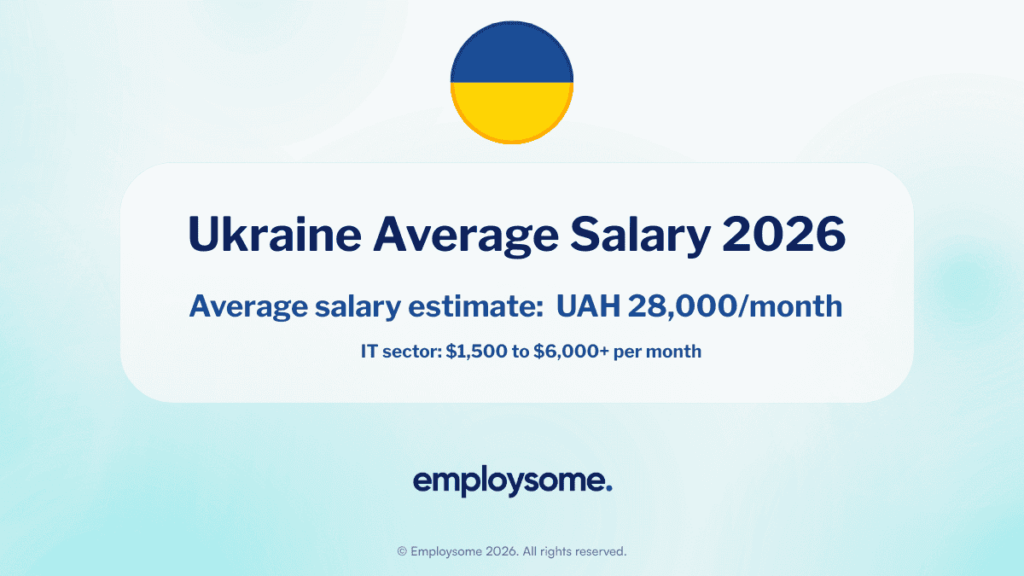
Table of Contents
- Average Salary in Ukraine: 2026 Overview
- Average Salaries by Sector
- IT Salaries
- Salaries by City
- Minimum Wage in Ukraine
- Employer Costs and Social Security
- The War's Impact on Salaries and the Labour Market
- How Ukraine Compares to Other Outsourcing Markets
- What International Companies Need to Know
- FAQs
Ukraine is a country at war, and any honest conversation about salaries here has to start with that fact. Since February 2022, the economy has been reshaped by the conflict: millions of workers have been displaced, entire cities in the east and south have lost their economic base, and the labour market has been compressed by military mobilisation pulling working-age men out of the civilian workforce. Real wages crashed by nearly 12% in 2022, then bounced back sharply in 2023 and 2024 as labour shortages pushed employers to compete harder for the workers who remained.
And yet, companies keep hiring here. Ukraine still has roughly 303,000 tech specialists, 25,000 new tech graduates per year, 10 universities ranked in the QS World Rankings for STEM, and a software development ecosystem that has produced 8 unicorns. The IT sector barely slowed down during the first year of the war, and by 2025 it was growing again. Wages in tech are now higher than pre-war levels. International companies that paused their Ukrainian operations in early 2022 have largely resumed them, and new ones are entering the market.
This guide covers what people in Ukraine actually earn in 2026, by sector, job title, and city. It also covers the minimum wage, employer costs (the 22% unified social contribution that surprises foreign employers), the flat 18% income tax, the impact of the war on the labour market, and what international companies need to understand if they are hiring Ukrainian talent.

Average Salary in Ukraine: 2026 Overview
|
Metric |
Amount (2026) |
|
Average monthly salary (all sectors) |
~UAH 28,000 (~$680 USD) |
|
Median monthly salary |
~UAH 23,500 (~$570 USD) |
|
National minimum wage (from January 2026) |
UAH 8,647/month (~$210 USD) |
|
Previous minimum wage (April 2024) |
UAH 8,000/month |
|
Average salary in IT sector |
$1,500-3,500/month (paid in USD by most tech companies) |
|
Senior IT specialist |
$3,500-6,000+/month |
|
Nominal wage growth (2025 vs 2024) |
~20% year-on-year |
|
Inflation (late 2025 / early 2026) |
~6-8% |
|
Currency |
Ukrainian Hryvnia (UAH / ₴). ~UAH 41.2 per USD (March 2026) |
The gap between the national average (UAH 28,000) and what IT workers earn ($1,500 to $5,000+) is one of the most extreme in any European country. Ukraine essentially has two labour markets running in parallel: a Hryvnia-denominated domestic market for most industries, and a dollar-denominated international tech market centred in Kyiv, Lviv, and a handful of other cities. If you are hiring Ukrainian tech talent, the national average is irrelevant to your budget.
Average Salaries by Sector
|
Sector |
Entry-Level (UAH/month) |
Mid-Level (UAH/month) |
Senior (UAH/month) |
|
IT / Software Development |
25,000-45,000 (or $600-1,100) |
60,000-120,000 (or $1,500-3,000) |
140,000-250,000+ (or $3,500-6,000+) |
|
Banking & Finance |
15,000-25,000 |
30,000-60,000 |
70,000-150,000 |
|
Telecommunications |
15,000-22,000 |
25,000-50,000 |
55,000-100,000 |
|
Energy & Utilities |
15,000-25,000 |
30,000-55,000 |
60,000-120,000 |
|
Manufacturing |
10,000-18,000 |
20,000-35,000 |
40,000-70,000 |
|
Retail & FMCG |
9,000-15,000 |
18,000-30,000 |
35,000-60,000 |
|
Agriculture |
9,000-14,000 |
15,000-25,000 |
30,000-50,000 |
|
Healthcare (public) |
8,647-12,000 |
14,000-22,000 |
25,000-45,000 |
|
Education (public) |
8,647-10,000 |
12,000-18,000 |
20,000-30,000 |
|
Public Administration |
10,000-15,000 |
18,000-30,000 |
35,000-65,000 |
The IT sector dominates the high end so completely that it distorts any national average. According to the State Statistics Service, the average salary across all sectors reached UAH 26,913 at the end of 2025, with IT, finance, and energy at the top. Education and healthcare (both primarily public-sector) sit at the bottom, often barely above the minimum wage. Many teachers and nurses earn under UAH 12,000 per month, which is roughly $290.
💡 Employsome Insight: Ukrainian IT Workers Are Mostly Paid in USD, Not Hryvnia
This is the single most important thing to understand about the Ukrainian tech labour market. Most IT companies, including the major outsourcing firms (EPAM, SoftServe, GlobalLogic, Luxoft, Ciklum) and startups, pay developers in USD or EUR, either directly or as a Hryvnia equivalent pegged to a dollar rate. This means tech salaries are partly insulated from Hryvnia devaluation, which is why developer wages barely dipped during the 2022 crash and have since exceeded pre-war levels. If you are hiring a Ukrainian developer, benchmark against dollar rates, not Hryvnia averages.
IT Salaries: The Sector That Defines Ukrainian Compensation
Ukraine’s tech sector deserves its own section because it is the primary reason international companies hire here. The talent pool is deep (303,000 specialists), well-educated (strong STEM universities), and battle-tested in every sense of the word. Here is what IT roles pay:
|
Role |
Junior ($/month) |
Mid ($/month) |
Senior ($/month) |
|
JavaScript / React Developer |
$800-1,400 |
$2,000-3,200 |
$3,500-5,500 |
|
Python Developer |
$700-1,200 |
$1,800-3,000 |
$3,500-5,500 |
|
Java Developer |
$800-1,400 |
$2,200-3,500 |
$4,000-6,000 |
|
C# / .NET Developer |
$900-1,400 |
$2,400-3,200 |
$3,500-5,000 |
|
DevOps Engineer |
$1,200-2,000 |
$2,500-4,000 |
$4,500-6,500 |
|
Data Scientist / ML Engineer |
$1,000-1,800 |
$2,500-4,000 |
$4,500-7,000+ |
|
QA Engineer |
$600-1,000 |
$1,500-2,500 |
$3,000-4,500 |
|
Product Manager |
$1,000-1,800 |
$2,500-4,000 |
$4,000-6,000 |
|
UI/UX Designer |
$600-1,200 |
$1,500-2,800 |
$3,000-5,000 |
These are dollar rates, which is how the Ukrainian IT market operates. Developers at major outsourcing firms or international product companies are typically paid in USD or EUR. Smaller Ukrainian companies may pay in Hryvnia but peg the amount to a dollar exchange rate with periodic adjustments. AI/ML and DevOps command the highest premiums, reflecting global demand patterns.
Key cities for IT hiring: Kyiv remains the largest hub with the deepest talent pool. Lviv has grown significantly as developers relocated westward for safety after 2022, and it now rivals Kyiv for some specialisations. Dnipro, Odesa, and Kharkiv remain active but carry higher operational risk due to proximity to conflict zones. Smaller western cities like Uzhhorod, Chernivtsi, and Vinnytsia have seen talent inflows and offer lower costs.
Salaries by City
|
City |
Avg Salary (UAH/month) |
IT Avg ($/month) |
Notes |
|
Kyiv |
35,000-40,000 |
$2,500-3,600 |
Capital. Largest talent pool. HQ of most major tech companies. |
|
Lviv |
28,000-33,000 |
$2,300-3,600 |
Major tech hub. Safest large city. Growing fast since 2022. |
|
Dnipro |
25,000-30,000 |
$2,000-3,000 |
Industrial city. Strong engineering talent. Moderate risk. |
|
Odesa |
25,000-30,000 |
$2,000-3,200 |
Port city. Growing IT scene. Occasional security incidents. |
|
Kharkiv |
22,000-28,000 |
$1,800-2,800 |
Major pre-war tech hub. Significant talent outflow since 2022. Higher risk. |
|
Vinnytsia / Uzhhorod / Chernivtsi |
18,000-25,000 |
$1,500-2,500 |
Smaller western cities. Lower costs. Growing due to internal migration. |
Minimum Wage in Ukraine
The national minimum wage increased to UAH 8,647 per month ($210 USD) from January 1, 2026, up from UAH 8,000 (set in April 2024). Before that, it was UAH 7,100. The increases have been modest relative to inflation, and the minimum wage remains one of the lowest in Europe.
The minimum wage matters in Ukraine for a specific reason beyond pay: it is the basis for calculating the military reservation threshold. To reserve (defer from mobilisation) employees in 2026, companies must pay them at least 2.5 times the minimum wage, which is UAH 21,617.50 per month. This has created an incentive for companies to push salaries above this threshold for male employees of mobilisation age, which has contributed to wage growth in some sectors.
Employer Costs and Social Security
Ukraine has one of the simplest employer contribution systems in Europe: a single Unified Social Contribution (USC, or YeSV in Ukrainian) at a flat rate of 22% of gross salary. That is it. No separate pension fund, no separate health insurance, no separate unemployment contribution. All social security is bundled into this one payment.
|
Contribution |
Rate |
|
Unified Social Contribution (employer) |
22% of gross salary |
|
Minimum USC base |
UAH 8,647/month (minimum wage) |
|
Maximum USC base |
15x minimum wage = UAH 129,705/month |
|
Employee income tax (PIT) |
18% flat rate on all income |
|
Military levy (employee) |
1.5% of gross salary (wartime measure, may increase to 5%) |
|
Total employer cost above gross |
22% (employer USC only) |
The 22% USC is capped at 15 times the minimum wage (UAH 129,705/month in 2026). For employees earning above this ceiling, the employer still pays 22% on the first UAH 129,705 and nothing on the excess. This cap makes high-salary hires (particularly in IT) more cost-effective as a percentage of total compensation.
The employee side is also straightforward: 18% flat income tax plus a 1.5% military levy (introduced in 2014 as a temporary wartime measure, still in effect, and there have been discussions about increasing it to 5%). Total employee deductions are 19.5% of gross. No additional social security is deducted from the employee’s pay.
💡 Employsome Insight: The B2B / FOP Model Is How Most IT Workers Operate
A large portion of Ukrainian IT workers are not employed as traditional employees. They operate as FOP (Fizychna Osoba Pidpryiemets), which is a private entrepreneur status similar to being a sole trader or independent contractor. Under FOP Group 3, the tax is 5% of revenue plus 22% USC (on the minimum wage only), which results in a dramatically lower tax burden than the standard 18% + 22% employer USC structure. This is why many international companies engage Ukrainian developers as B2B contractors rather than employees. If you are using an EOR in Ukraine, your workers will be on standard employment contracts with full 18% + 22% deductions. If you are hiring contractors directly, they are likely on FOP status. Understand which model you are using, because the cost difference is substantial.
The War’s Impact on Salaries and the Labour Market
You cannot write honestly about Ukrainian wages in 2026 without addressing the war. Here is what has actually changed:
Labour shortage. Military mobilisation has removed a significant number of working-age men from the civilian workforce. An estimated 2.2 to 2.5 million Ukrainians work informally (partly to avoid mobilisation-related documentation). The EBA (European Business Association) reports that 94% of companies plan salary increases in 2026, driven largely by the struggle to retain and recruit workers in a shrinking labour pool.
Internal migration. Millions of people have relocated from eastern and southern Ukraine to western cities (Lviv, Uzhhorod, Chernivtsi, Ivano-Frankivsk). This has expanded the talent pool in the west while devastating it in cities like Kharkiv and Zaporizhzhia. Lviv, in particular, has seen its IT workforce grow substantially.
Wage growth despite everything. Nominal wages grew approximately 20% year-on-year in 2025, and real wages (adjusted for inflation of 6-8%) grew roughly 6%. The National Bank of Ukraine projects continued real wage growth in 2026, though at a slightly slower pace as the post-2022 recovery effect fades.
Regional salary disparities have widened. Wages in frontline or formerly occupied regions have dropped, while wages in Kyiv and western Ukraine have risen. The pre-war salary map no longer applies.
IT has been resilient. Ukraine’s IT export revenue exceeded $7 billion in 2024. Most tech workers relocated early, set up remote work infrastructure, and kept delivering. International clients who initially paused Ukrainian engagements in March 2022 largely resumed within months. The sector’s ability to operate through the war has actually increased confidence among some international employers.
How Ukraine Compares to Other Outsourcing Markets
|
Ukraine |
Poland |
Romania |
India |
Philippines |
|
|
Avg salary (USD) |
$570-680 |
$1,400-1,800 |
$1,100-1,500 |
$400-500 |
$300-400 |
|
Mid-level dev (USD) |
$2,000-3,200 |
$3,000-5,000 |
$2,500-4,000 |
$1,500-2,500 |
$1,200-2,000 |
|
Employer SI rate |
22% (capped) |
~20% (no cap) |
~22-25% |
~12-15% |
~10-12% |
|
Income tax |
18% flat |
12% (up to PLN 120K), 32% |
10% flat |
5-30% progressive |
20-35% progressive |
|
EU member |
No (EU candidate) |
Yes |
Yes |
No |
No |
|
Timezone (UTC) |
UTC+2 / +3 |
UTC+1 / +2 |
UTC+2 / +3 |
UTC+5:30 |
UTC+8 |
|
Key risk |
War, mobilisation |
Rising costs |
Talent pool size |
Timezone gap |
Timezone gap, infrastructure |
Ukraine sits in a unique position: developer quality comparable to Poland and Romania, at costs 30 to 50% lower, with excellent European timezone overlap. The trade-off is war risk, which is real but has been managed effectively by most companies operating here since 2022. For companies willing to accept that risk, Ukraine remains one of the best value-for-quality markets in global tech outsourcing.
What International Companies Need to Know
Most tech hiring is B2B, not employment. The majority of Ukrainian developers work as FOPs (private entrepreneurs), not employees. This means lower taxes and more flexibility, but also means you are engaging a contractor, not an employee. If you need a full employment relationship (for IP protection, non-compete, or compliance reasons), you will need an EOR or a local entity with standard employment contracts.
The reservation system matters. Companies can reserve (defer from military mobilisation) male employees aged 25 to 60 if the company meets certain criteria, including paying an average salary of at least 2.5x minimum wage (UAH 21,617.50/month in 2026). This is a real factor in talent retention and should be discussed with your EOR or local legal advisor.
Power and internet infrastructure requires planning. Rolling blackouts from Russian attacks on energy infrastructure are a recurring issue. Most professional remote workers have backup power (generators, battery inverters, Starlink). Budget a remote work stipend of $50 to $150/month to help cover these costs. Co-working spaces in Kyiv and Lviv typically have full backup power systems.
Lviv is now the safest major tech hub. If operational continuity is your primary concern, Lviv offers the best combination of talent depth, safety, and infrastructure. Kyiv has the largest talent pool but is subject to occasional missile and drone attacks. Both cities have adapted well, but risk tolerance varies by company.
Use an EOR if you want formal employment. An EOR in Ukraine handles employment contracts, the 22% USC contribution, 18% PIT withholding, military levy, and all payroll reporting. For companies hiring 1 to 10 employees (as opposed to contractors), the EOR model avoids entity setup and local registration requirements.
💡 Hiring in Ukraine?
Ukraine’s tech talent, European timezone, and competitive costs make it one of the strongest outsourcing markets despite the ongoing war. Compare the best EOR providers for Ukraine on Employsome. We score each provider on local entity ownership, payroll accuracy, USC compliance, and mobilisation reservation support. Visit our Best EOR in Ukraine Guide to see the full comparison.
Frequently Asked Questions
The average monthly salary across all sectors is approximately UAH 28,000 ($680 USD). In IT, the average is much higher at $1,500 to $3,500/month, with senior roles exceeding $5,000. The national average is heavily skewed by low wages in education, healthcare, and agriculture.
UAH 8,647 per month ($210 USD) from January 2026, up from UAH 8,000. It remains one of the lowest in Europe.
Mid-level: $1,500 to $3,200/month. Senior: $3,500 to $6,000+. DevOps and AI/ML specialists command the highest rates. Most are paid in USD or EUR, not Hryvnia.
Most international companies that hire Ukrainian talent do so for remote work, which has continued largely uninterrupted since 2022. The IT sector adapted quickly with backup power, Starlink connectivity, and relocation to safer western cities. Operational risk exists but has been managed effectively by the vast majority of tech teams.
22% Unified Social Contribution on gross salary, capped at 15x minimum wage. No additional employer-side social security, health, or pension contributions. The 22% rate is the total employer burden. Employees pay 18% income tax plus 1.5% military levy.
Most international companies engage Ukrainian IT workers as B2B contractors under FOP status, which carries a lower tax burden (5% + minimal USC). Full employment through an EOR costs more (18% PIT + 22% USC) but provides stronger IP protection, non-compete enforceability, and compliance certainty. The right model depends on your risk tolerance and legal requirements.

Written by
Courtney Pocock is a Copywriter & EOR/PEO Researcher at Employsome with 15+ years of experience writing for the HR, corporate, and financial sectors. She has a strong interest in global business expansion and Employer of Record / PEO topics, focusing on news that matters to business owners and decision-makers. Courtney covers industry updates, regulatory changes, and practical guides to help leaders navigate international hiring with confidence.
Our content is created for informational purposes only and is not intended to provide any legal, tax, accounting, or financial advice. Please obtain separate advice from industry-specific professionals who may better understand your business’ needs. Read our Editorial Guidelines for further information on how our content is created.
Other posts
Review other blog posts