Average Salary in Tunisia (2026): What Workers Earn And Cost
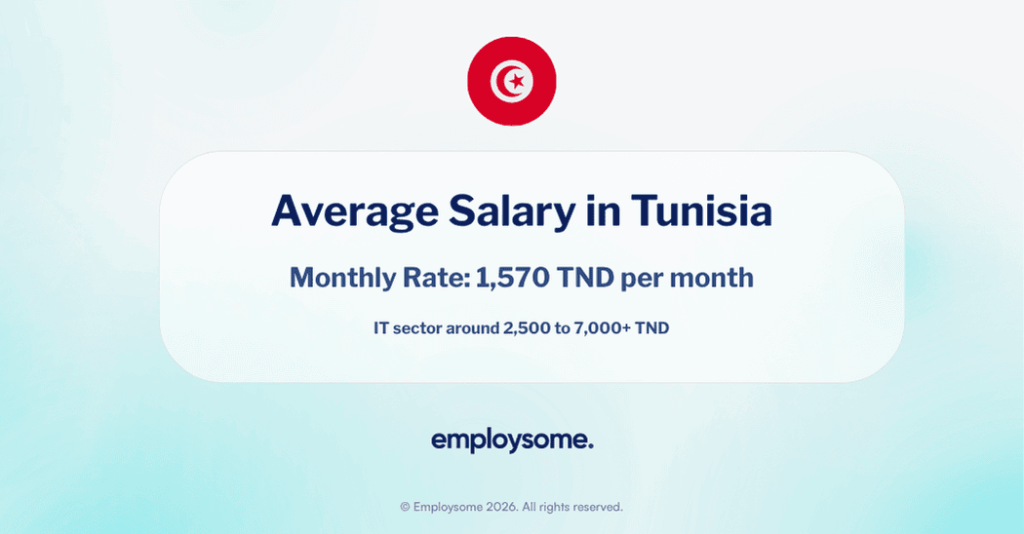
The average salary in Tunisia is about 1,570 TND per month ($530 USD), making it one of the cheapest formal labour markets in the Mediterranean. But the IT sector pays 2,500 to 7,000+ TND while call centres sit near the 528 TND minimum wage. This guide covers real salaries by sector, job title, and city, the 2025 minimum wage increase (7.5%), employer costs including the new CNSS rates and unemployment fund introduced by the Finance Law 2025, the restructured income tax brackets (0% to 40%), how Tunisia compares to Morocco and Egypt for francophone outsourcing, and what international companies hiring through an EOR need to know.

Tunisia is not the first country that comes to mind when companies talk about outsourcing or nearshoring. But it should be. The country sits one hour from mainland Europe by plane, its workforce is bilingual in French and Arabic (with growing English proficiency in tech), labour costs are a fraction of what you would pay in Morocco or Egypt for comparable skills, and it has a surprisingly deep talent pool in software development, finance, customer support, and engineering.
The headline number is roughly 1,570 TND per month, which is about $530 USD at current exchange rates. That makes Tunisia one of the cheapest formal labour markets in the Mediterranean basin. But the number hides a lot. A call centre agent in Sousse might earn 700 TND. A software engineer in Tunis might earn 3,500 TND. A senior finance manager at a multinational subsidiary might earn 6,000 TND or more. And for employers, the real cost is not the salary but what sits on top: CNSS social security contributions of roughly 17% (employer side), a development levy, a housing levy, and progressive income tax that was restructured in January 2025.
This guide covers what people in Tunisia actually earn by sector, job title, and city. It also covers the minimum wage (which was increased twice in the past two years), employer costs (CNSS, levies, and total burden), the 2025 income tax reform, and what international companies need to understand if they are hiring Tunisian talent remotely or through an EOR.

Salary Overview
|
Metric |
Amount (2026) |
|
Average monthly salary (formal sector) |
~1,570 TND (~$530 USD) |
|
Median monthly salary |
~1,481 TND (~$500 USD) |
|
Minimum wage (SMIG, 48-hour week) |
528.32 TND/month (~$178 USD), effective January 2025 |
|
Minimum wage (SMIG, 40-hour week) |
448.24 TND/month (~$151 USD) |
|
Agricultural minimum wage (SMAG) |
20.32 TND/day (~$6.85 USD) |
|
Inflation (June 2025) |
~5.4% |
|
GDP growth (2025 forecast) |
~1.9% |
|
Unemployment rate |
~15.7% |
|
Currency |
Tunisian Dinar (TND). ~TND 2.96 per USD (March 2026) |
A few things jump out from this table. First, the unemployment rate of 15.7% is extremely high by global standards. This means there is no labour shortage in Tunisia. Employers have significant leverage, and competition for jobs keeps wages low. Second, the gap between the average (1,570 TND) and the minimum wage (528 TND) is relatively narrow compared to countries like Nigeria or Ukraine, which tells you that a large proportion of the formal workforce earns close to the floor. Third, inflation at 5.4% is eroding purchasing power, but the recent minimum wage increases (7% in 2024, 7.5% in January 2025) have partially offset this.
💡 Employsome Insight: Tunisia’s Real Labour Cost Advantage Is Against Morocco, Not Europe
Most companies compare Tunisia’s salaries to European rates and think “cheap.” The more useful comparison is against Morocco, which is Tunisia’s direct competitor for francophone outsourcing. For equivalent roles in customer support, back-office processing, and entry-level software development, Tunisia is typically 15-25% cheaper than Casablanca or Rabat. The talent pool is smaller, but the cost advantage is real, and the timezone (UTC+1) is identical to Western Europe.
Average Salaries by Sector
|
Sector |
Entry-Level (TND/month) |
Mid-Level (TND/month) |
Senior (TND/month) |
|
IT / Software Development |
1,200-1,800 |
2,500-4,000 |
4,500-7,000+ |
|
Banking & Finance |
1,000-1,500 |
2,000-3,500 |
4,000-6,500 |
|
Telecommunications |
1,000-1,400 |
1,800-3,000 |
3,500-5,500 |
|
Offshore / BPO / Call Centres |
600-900 |
1,000-1,800 |
2,000-3,500 |
|
Manufacturing |
550-800 |
900-1,500 |
1,800-3,000 |
|
Tourism & Hospitality |
530-700 |
800-1,300 |
1,500-2,500 |
|
Healthcare (private) |
800-1,200 |
1,500-2,500 |
3,000-5,000 |
|
Education (public) |
800-1,000 |
1,200-1,800 |
2,000-3,000 |
|
Agriculture |
530-600 (SMAG-based) |
700-1,000 |
1,200-1,800 |
|
Public Administration |
800-1,100 |
1,300-2,000 |
2,500-4,000 |
The IT sector is the clear outlier. Software engineers in Tunis can earn 3,500 to 7,000+ TND per month, which is 4 to 10 times the minimum wage. This reflects global demand for Tunisian tech talent, particularly from French companies that value the linguistic and cultural alignment. The offshore/BPO sector is the largest private employer of young graduates but pays the least, which is why turnover in Tunisian call centres is notoriously high.
Salaries by Job Title
|
Job Title |
Monthly Range (TND) |
~USD Equivalent |
|
Software Engineer (mid-level) |
2,500-4,000 |
$845-$1,350 |
|
Senior Software Engineer |
4,500-7,000 |
$1,520-$2,365 |
|
Data Analyst |
1,500-2,500 |
$507-$845 |
|
Call Centre Agent |
600-900 |
$203-$304 |
|
Accountant |
1,200-2,000 |
$405-$676 |
|
HR Manager |
2,000-3,500 |
$676-$1,182 |
|
Marketing Manager |
1,800-3,000 |
$608-$1,014 |
|
Graphic Designer |
800-1,500 |
$270-$507 |
|
Administrative Assistant |
600-900 |
$203-$304 |
|
Mechanical Engineer |
1,500-2,800 |
$507-$946 |
|
Pharmacist (private sector) |
1,800-3,000 |
$608-$1,014 |
|
Teacher (public school) |
900-1,400 |
$304-$473 |
Salaries by City
|
City |
Salary vs National Average |
Key Industries |
|
Tunis (Greater Tunis) |
20-40% above national average |
IT, finance, telecoms, government, multinational HQs, offshore BPO |
|
Sfax |
At or slightly above national average |
Manufacturing, olive oil processing, maritime, SMEs |
|
Sousse |
At national average |
Tourism, offshore call centres, light manufacturing |
|
Monastir / Mahdia |
5-15% below national average |
Textiles, tourism, agriculture |
|
Interior regions (Kairouan, Sidi Bouzid, Kasserine) |
20-40% below national average |
Agriculture, public sector, informal economy |
Tunisia’s economy is heavily concentrated on the coast. Greater Tunis, the Sahel (Sousse, Monastir), and Sfax account for the vast majority of formal-sector employment and higher wages. The interior governorates, where the 2011 revolution began, remain significantly poorer with limited private-sector job opportunities. For international companies, this means that virtually all your hires will be based in or around Tunis unless you are specifically targeting manufacturing or agriculture.
Minimum Wage
Tunisia’s minimum wage system distinguishes between non-agricultural workers (SMIG) and agricultural workers (SMAG), and within SMIG, between 48-hour and 40-hour work weeks.
The most recent increases took effect on January 1, 2025: the 48-hour SMIG rose to 528.32 TND/month (a 7.5% increase from the previous rate), and the 40-hour SMIG rose to 448.24 TND/month. Non-agricultural workers also receive mandatory transport and attendance allowances totalling 38.19 TND/month, which brings the effective minimum closer to 566 TND for a 48-hour worker.
For international companies, the minimum wage is relevant primarily for call centre, data entry, and entry-level administrative roles. Any role requiring a degree, specialised skills, or English proficiency will pay well above the minimum. The SMIG is a floor, not a benchmark for competitive hiring
Employer Costs: What You Pay on Top of Salary
Tunisia’s employer cost structure was updated in January 2025 with the Finance Law 2025 introducing a new 0.5% contribution for both employers and employees to fund an Unemployment Insurance Fund. Here is the full breakdown:
|
Contribution |
Employer Rate |
Employee Rate |
|
CNSS (social security: pensions, family, health) |
17.07% (up from 16.57% in 2025) |
9.68% (up from 9.18% in 2025) |
|
Development levy (TFP) |
2% (1% for industrial manufacturers) |
None |
|
Housing levy (FOPROLOS) |
1% |
None |
|
Work insurance |
0.5% |
None |
|
Unemployment Insurance Fund (new 2025) |
0.5% |
0.5% |
|
Total employer burden |
~21.07% of gross salary |
~10.18% (employee deductions) |
Total employer costs of roughly 21% on top of gross salary are moderate by global standards. Compare this to France (roughly 45%), Germany (roughly 20-21%), or Morocco (roughly 18-26% depending on sector). Tunisia’s employer burden is competitive, particularly given the low base salaries.
💡 Employsome Insight: The 2025 CNSS Increase and New Unemployment Fund Caught Many Employers Off Guard
The Finance Law 2025 increased both employer and employee CNSS contributions by 0.5% and introduced a brand new 0.5% unemployment insurance contribution for both parties. If your EOR or payroll provider did not update their rates in January 2025, you may be underpaying contributions, which creates a compliance liability with the CNSS. Verify that your payroll reflects the new 17.07% employer rate and the 10.18% total employee deduction rate.
Income Tax (IRPP)
Tunisia restructured its personal income tax brackets in January 2025 under the Finance Law 2025. The new system has more brackets with lower rates at the bottom and a higher top rate of 40% (up from 35%):
|
Annual Taxable Income (TND) |
Tax Rate |
|
0 – 5,000 |
0% |
|
5,001 – 10,000 |
15% |
|
10,001 – 20,000 |
25% |
|
20,001 – 30,000 |
30% |
|
30,001 – 40,000 |
33% |
|
40,001 – 50,000 |
36% |
|
50,001 – 70,000 |
38% |
|
Over 70,000 |
40% |
The 0% bracket on the first 5,000 TND of annual income means that minimum wage workers pay little to no income tax. The effective tax rate for an average earner (1,570 TND/month or ~18,840 TND/year) is roughly 12-15% after deductions. The 40% top rate applies to earnings above 70,000 TND/year, which is roughly 5,833 TND/month, a salary level reached only by senior professionals and executives.
How Tunisia Compares to Other Nearshore Markets
|
Tunisia |
Morocco |
Egypt |
Portugal |
|
|
Avg monthly salary (USD) |
~$530 |
~$650-750 |
~$250-350 |
~$1,400-1,600 |
|
Software engineer mid (USD) |
$845-1,350 |
$1,000-1,800 |
$600-1,200 |
$2,000-3,500 |
|
Languages |
French, Arabic, growing English |
French, Arabic, growing English |
Arabic, growing English |
Portuguese, English |
|
Timezone (UTC) |
UTC+1 |
UTC+1 |
UTC+2 |
UTC+0/+1 |
|
Employer SI costs |
~21% |
~18-26% |
~18-26% |
~23.75% |
|
Unemployment rate |
~15.7% |
~11-13% |
~7-8% |
~6-7% |
|
Key advantage |
Cost, French, proximity to Europe |
Larger talent pool, French |
Lowest cost, Arabic |
EU member, English, infrastructure |
Tunisia’s sweet spot is francophone outsourcing at lower cost than Morocco, with better European timezone alignment than Egypt. The main disadvantage is the smaller talent pool (Tunisia has 12 million people vs Morocco’s 37 million and Egypt’s 110 million) and weaker English proficiency outside the tech sector. For French-speaking roles, Tunisia is arguably the best value in the Mediterranean.
What International Companies Need to Know
French is the working language of Tunisian business. If your company operates in French or needs francophone customer support, back-office processing, or technical teams, Tunisia is a natural fit. English proficiency is improving, particularly among younger graduates and in the tech sector, but it is not yet at the level you would find in the Philippines or Eastern Europe.
The offshore sector is well-established. Tunisia has a legal framework for “offshore companies” (entreprises totalement exportatrices) that enjoy tax incentives, including reduced corporate tax rates and simplified customs procedures. Many BPO and tech companies operate under this regime. If you are setting up through an EOR, the EOR’s entity structure will determine whether you benefit from these incentives.
Housing costs are a real factor in talent retention. Average rents in Tunis are roughly three times the average wage. Employees earning 1,500 to 2,000 TND per month spend a disproportionate share on housing. Companies that offer even modest housing allowances or above-market salaries have a significant recruitment advantage.
Collective Bargaining Agreements matter. Many Tunisian sectors have CBAs that set minimum pay scales, bonus structures, and working conditions. The offshore/BPO sector, banking, and manufacturing all have active CBAs. Your EOR should be managing CBA compliance, but verify which agreement applies to your employees.
If you do not have a Tunisian entity, an EOR handles employment contracts, CNSS registration, monthly payroll, tax withholding, and all statutory filings. For most international companies hiring 1 to 15 people in Tunisia, this is the fastest and most compliant path.
Hiring in Tunisia?
Tunisia’s francophone talent pool, competitive salaries, and European timezone make it an attractive nearshore market for French-speaking roles. Compare the best EOR providers for Tunisia on Employsome. Visit our Best EORs in Tunisia Guide to see provider coverage, pricing, and compliance scores.
Frequently Asked Questions
The average monthly salary in the formal sector is approximately 1,570 TND ($530 USD). IT and finance pay significantly more (2,500-7,000+ TND), while call centres and agriculture sit near the minimum wage.
528.32 TND/month for a 48-hour work week, or 448.24 TND/month for a 40-hour week, effective January 2025. Agricultural workers receive 20.32 TND/day. Non-agricultural workers also receive transport and attendance allowances of 38.19 TND/month.
Approximately 21% of gross salary: CNSS 17.07%, development levy 2%, housing levy 1%, work insurance 0.5%, and the new unemployment fund 0.5%. This was updated in January 2025 with increases to both CNSS and the new unemployment contribution.
Yes, typically 15-25% cheaper for equivalent francophone roles. Tunisia’s main advantage is cost. Morocco’s advantage is a larger talent pool and slightly better English proficiency. Both share the same timezone (UTC+1) and French language capability.
Yes, through an Employer of Record. The EOR becomes the legal employer in Tunisia, handles CNSS registration, payroll, tax withholding, and compliance with Tunisian labour law and applicable CBAs.
French and Arabic are the primary languages. French is the working language of business, particularly in professional services, tech, and the offshore sector. English proficiency is growing among younger graduates and in IT but is not yet widespread. For French-language roles, Tunisia is one of the strongest talent markets in Africa and the Mediterranean.

Written by
Courtney Pocock is a Copywriter & EOR/PEO Researcher at Employsome with 15+ years of experience writing for the HR, corporate, and financial sectors. She has a strong interest in global business expansion and Employer of Record / PEO topics, focusing on news that matters to business owners and decision-makers. Courtney covers industry updates, regulatory changes, and practical guides to help leaders navigate international hiring with confidence.
Our content is created for informational purposes only and is not intended to provide any legal, tax, accounting, or financial advice. Please obtain separate advice from industry-specific professionals who may better understand your business’s needs. Read our Editorial Guidelines for further information on how our content is created.
Other posts
Review other blog posts