Average Salary in Taiwan 2026: By Sector, City & Cost Guide
The average salary in Taiwan is approximately NT$58,000 gross per month in 2026, with a median closer to NT$45,000. Taiwan’s economy is dominated by semiconductors and technology, with TSMC alone producing nearly 90% of the world’s most advanced chips. The minimum wage is NT$29,500 per month from January 2026. Employer costs add approximately 14-19% on top of gross salary through labor insurance, National Health Insurance, and mandatory pension contributions. This guide covers average salaries by sector, city, and experience level, the full employer cost breakdown, income tax brackets, and how Taiwan compares to other Asian hiring markets.

Table of Contents
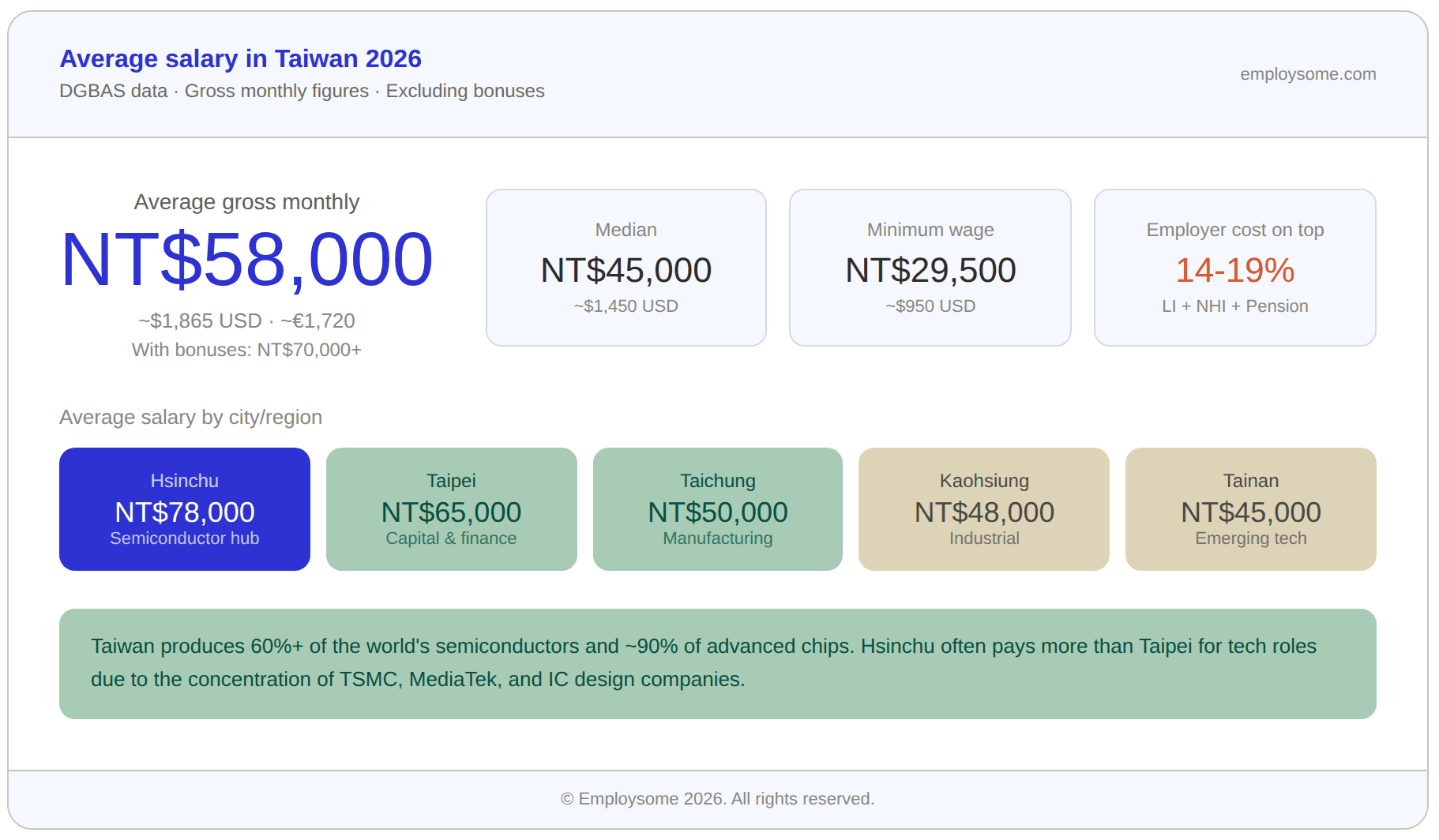
The average salary in Taiwan is approximately NT$58,000 gross per month in 2026, based on data from the Directorate-General of Budget, Accounting and Statistics (DGBAS). That is roughly $1,865 USD or €1,720. The median salary sits lower at approximately NT$45,000 gross per month (~$1,450 USD), reflecting a significant gap between average and median that indicates wage inequality driven by high earners in the semiconductor and financial sectors.
When bonuses and overtime are included, total monthly compensation in Taiwan averages approximately NT$70,000+, because many Taiwanese employers pay 13th or 14th month bonuses, particularly before the Lunar New Year. These year-end bonuses are customary rather than legally required, but they are deeply embedded in Taiwan’s employment culture and employees factor them into their total expected compensation.
The average salary in Taiwan has been rising steadily. In 2024, the average regular monthly salary reached NT$46,450, up 2.77% from the previous year. When adjusted for inflation, the real increase was 0.58%, reflecting the reality that nominal wage growth has been partially eroded by rising costs. Taiwan’s GDP grew by 4.84% in 2024, and the labour market remains tight, particularly in technology, semiconductors, and engineering.
For international companies, the average salary in Taiwan tells a compelling story about cost-competitive access to world-class technical talent. A senior semiconductor engineer in Hsinchu earns significantly less than a comparable role in Silicon Valley or Munich, while working at the global frontier of chip manufacturing. Combined with a well-educated workforce, strong IP protections, and strategic location in Asia, Taiwan has become one of the most important hiring markets for technology, electronics, and advanced manufacturing.
But the average salary in Taiwan is only one piece of the employer cost equation. Mandatory contributions to labor insurance, National Health Insurance (NHI), and pension add approximately 14-19% on top of gross salary, depending on salary level and industry risk classification.

Average Salary in Taiwan by Sector
Salaries in Taiwan vary significantly by industry. The semiconductor and technology sectors consistently pay the highest wages, while service, retail, and hospitality roles sit at the lower end. The following figures represent approximate gross monthly salaries for mid-level professionals in 2026, excluding bonuses.
|
Sector |
Average Gross Monthly Salary (NT$) |
Approx. USD |
|
Semiconductors / IC Design |
80,000-150,000 |
$2,500-$4,700 |
|
Software / IT |
60,000-100,000 |
$1,875-$3,125 |
|
Financial Services / Insurance |
55,000-95,000 |
$1,720-$2,970 |
|
Pharmaceuticals / Biotech |
50,000-85,000 |
$1,560-$2,660 |
|
Engineering / Manufacturing |
45,000-75,000 |
$1,400-$2,340 |
|
Marketing / Communications |
40,000-65,000 |
$1,250-$2,030 |
|
Accounting / Audit |
40,000-70,000 |
$1,250-$2,190 |
|
Logistics / Supply Chain |
38,000-60,000 |
$1,190-$1,875 |
|
Education |
35,000-55,000 |
$1,095-$1,720 |
|
Retail / Hospitality |
30,000-45,000 |
$940-$1,400 |
The semiconductor sector stands apart. Taiwan produces over 60% of the world’s semiconductors and nearly 90% of the most advanced chips, largely through TSMC and its supply chain. Hsinchu Science Park is the epicentre, and salaries there often exceed Taipei levels for technical roles. The financial and insurance sector is notable for its generous year-end bonuses, averaging 3.74 months of regular wages in 2025, the highest of any sector.
According to the Ministry of Labor’s 2025 occupational salary survey, the highest-paid roles in Taiwan are airline pilots (NT$323,000/month average), actuaries (NT$212,000), doctors (NT$180,000), and professional athletes (NT$143,000).
Average Salary in Taiwan by City
Location significantly impacts the average salary in Taiwan. Taipei is the capital and commercial centre, but Hsinchu often pays higher salaries for technical roles due to the concentration of semiconductor companies. Southern cities offer lower salaries but also substantially lower living costs.
|
City/Region |
Average Gross Monthly Salary (NT$) |
Notes |
|
Hsinchu |
65,000-90,000 |
Semiconductor hub, highest tech salaries |
|
Taipei |
55,000-75,000 |
Capital, financial and services centre |
|
Taichung |
42,000-58,000 |
Growing tech and manufacturing base |
|
Kaohsiung |
40,000-55,000 |
Industrial hub, petrochemicals, shipping |
|
Tainan |
38,000-52,000 |
Emerging tech corridor (TSMC new fab) |
|
Rural/other |
30,000-42,000 |
Close to minimum wage for many roles |
The Taipei vs Hsinchu dynamic is unusual compared to most countries. In Taiwan, the highest salaries are not always in the capital. Hsinchu’s proximity to TSMC, MediaTek, and hundreds of IC design companies creates intense competition for engineers, pushing salaries and bonuses above Taipei levels for technical roles. Tainan is emerging as a secondary semiconductor hub with TSMC’s new advanced fabs, which is beginning to pull salaries upward in the region.
Hiring in Taiwan?
Taiwan offers world-class technical talent, particularly in semiconductors, electronics, and advanced manufacturing. If you are looking to hire in Taiwan without setting up a local entity, an Employer of Record handles employment contracts, labor insurance, NHI, pension, and statutory compliance on your behalf. See our Best Employer of Record comparison for providers ranked on compliance execution and in-country infrastructure.
Average Salary in Taiwan by Experience Level
Experience is one of the strongest salary drivers in Taiwan. Workers with 2-5 years of experience earn approximately 32% more than entry-level workers, with the gap widening further at senior levels.
|
Experience Level |
Average Gross Monthly Salary (NT$) |
Approx. USD |
|
Entry-level (0-2 years) |
30,000-40,000 |
$940-$1,250 |
|
Junior (2-5 years) |
40,000-55,000 |
$1,250-$1,720 |
|
Mid-level (5-10 years) |
55,000-80,000 |
$1,720-$2,500 |
|
Senior (10-15 years) |
75,000-120,000 |
$2,340-$3,750 |
|
Director / Executive (15+ years) |
110,000-250,000+ |
$3,440-$7,800+ |
Salary growth rates in Taiwan are approximately 3-5% annually for most professionals, with higher jumps achievable through job changes, particularly in the technology sector.
Minimum Wage in Taiwan 2026
The minimum wage in Taiwan from 1 January 2026 is NT$29,500 per month (NT$196 per hour), a 3.18% increase from NT$28,590 in 2025. This marks the ninth consecutive annual increase since 2016, with the minimum wage rising by approximately 43% over this period.
The minimum wage in Taiwan is set by the Basic Wage Review Committee under the Ministry of Labor and applies to all full-time employees. The monthly rate applies to full-time workers; the hourly rate applies to part-time workers.
💡 Employsome Insight: Taiwan’s minimum wage has risen consistently for nearly a decade, which is great for workers but creates real cost pressure for employers in lower-margin sectors. If you are hiring service, retail, or entry-level roles in Taiwan, factor in the trajectory, not just the current rate. Budget for annual increases of 3-4% as a baseline.
What Employers Actually Pay: Total Cost of Employment
The average salary in Taiwan does not reflect the total cost to the employer. Taiwan’s social insurance and pension system adds approximately 14-19% on top of gross salary, making it one of the more moderate employer cost environments in Asia.
Labor Insurance (LI): The total premium rate is approximately 11.5% of the employee’s insured monthly salary (capped at NT$45,800/month). Employers pay 70% of the premium, approximately 8.05%. Covers disability, death, retirement pensions, maternity, and sickness.
Occupational Accident Insurance: Employer-funded at 0.11% to 0.93% of insured salary, depending on industry risk level. Employers bear 100% of this cost.
Employment Insurance: Approximately 1% of insured salary, shared between employer (70%) and employee (20%), with government covering 10%. Employer share is approximately 0.7%.
National Health Insurance (NHI): The total premium is 5.17% of insured monthly salary (capped at NT$150,000/month). Employers pay 60% of the premium multiplied by the average number of dependents (currently 1.56), resulting in an employer rate of approximately 4.84%. A supplementary premium of 2.11% applies to non-regular income such as bonuses exceeding four times the monthly insured salary.
Labor Pension (mandatory): Employers must contribute a minimum of 6% of the employee’s monthly salary to an individual pension account (capped at NT$150,000/month). This is entirely employer-funded. Employees may voluntarily contribute an additional 6%.
Total employer social security cost: approximately 14-19% of gross salary, depending on salary level, industry risk classification, and NHI dependent calculations.
For an employee earning the national average of NT$58,000 gross per month, the approximate employer cost breakdown is: gross salary NT$58,000, employer contributions (approximately 17%) NT$9,860, total employer cost approximately NT$67,860 per month (~$2,120 USD). The employee’s take-home pay after all deductions is approximately NT$52,000-54,000 net, roughly 90-93% of gross (Taiwan’s relatively low employee-side deductions and no monthly income tax withholding mean take-home pay is high relative to gross salary).
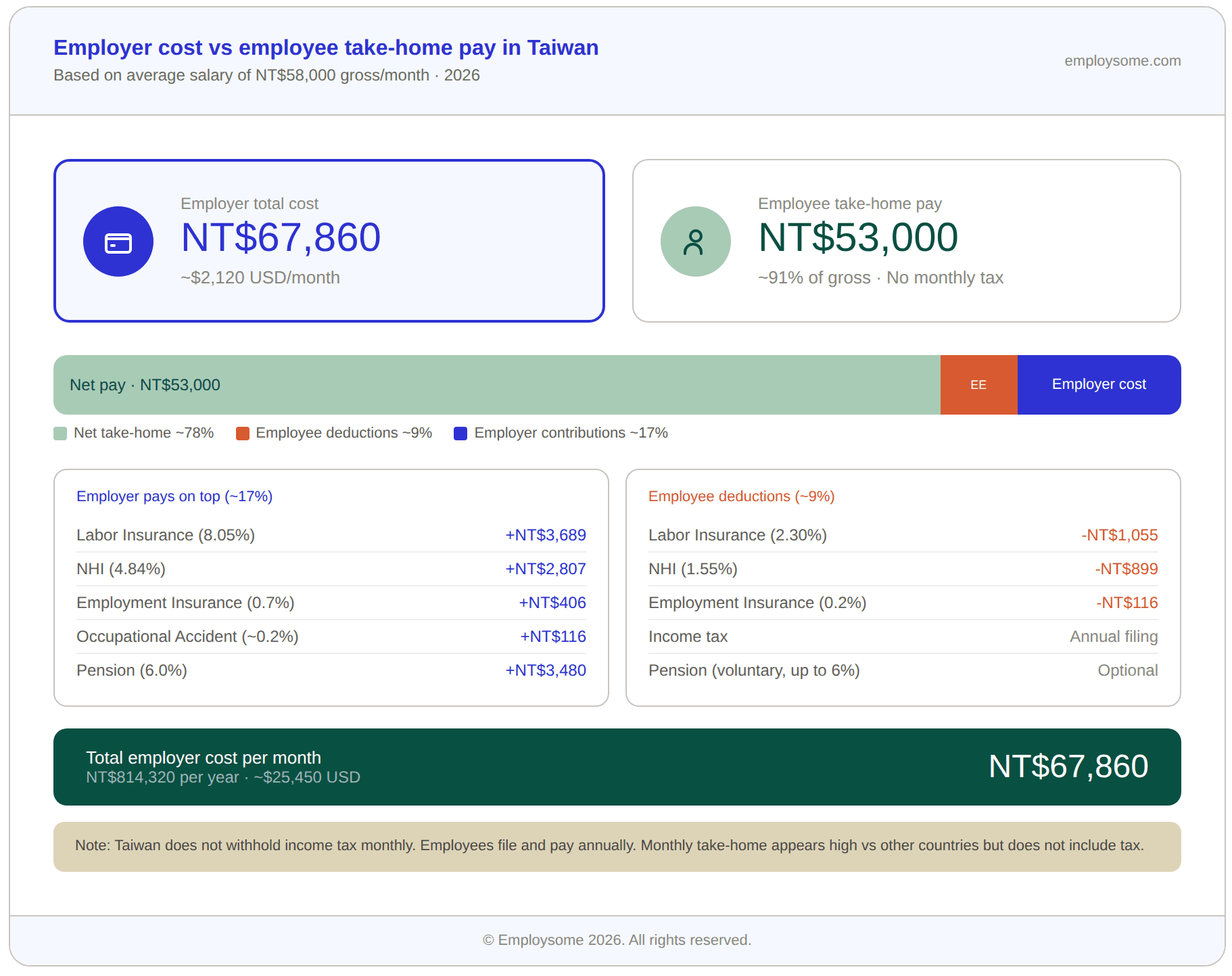
💡 Employsome Insight: Taiwan’s tax system is unusual in that income tax is not withheld monthly from payroll. Employees file and pay income tax annually. This means monthly take-home pay in Taiwan looks very high relative to other countries, but employees must budget for their annual tax bill. International employers often misunderstand this and set salaries too low because they compare Taiwan’s “net” pay (which does not include tax) with other countries’ genuinely post-tax figures.
Income Tax in Taiwan
Taiwan operates a progressive income tax system with rates ranging from 5% to 40%. Tax is assessed annually, not withheld monthly (except for withholding on non-residents).
|
Taxable Income (NT$) |
Tax Rate |
|
0 – 590,000 |
5% |
|
590,001 – 1,330,000 |
12% |
|
1,330,001 – 2,660,000 |
20% |
|
2,660,001 – 4,980,000 |
30% |
|
Above 4,980,000 |
40% |
A personal exemption of NT$97,000 and a standard deduction of NT$131,000 (or NT$262,000 for married couples filing jointly) reduce the taxable base. There is also a special salary income deduction of NT$218,000 that employees can claim. If itemised deductions (medical expenses, mortgage interest, etc.) exceed the standard deduction, taxpayers can claim those instead.
For the average salary in Taiwan of NT$58,000 per month (NT$696,000 annually), the effective income tax rate after exemptions and deductions is approximately 3-6%, making Taiwan’s tax burden on average earners relatively light compared to most developed economies.
Non-residents (staying fewer than 183 days) are subject to a flat 18% withholding tax on salary income, with no deductions or exemptions.
How the Average Salary in Taiwan Compares in Asia
|
Country |
Average Gross Monthly Salary |
Approx. USD |
Employer SI |
Min. Wage (Monthly) |
|
Taiwan |
NT$58,000 (~$1,865) |
~$1,865 |
~14-19% |
NT$29,500 (~$950) |
|
South Korea |
KRW 3,800,000 (~$2,750) |
~$2,750 |
~10% |
KRW 2,180,000 (~$1,580) |
|
Japan |
JPY 370,000 (~$2,470) |
~$2,470 |
~16% |
JPY 1,113/hr (~$7.40) |
|
Singapore |
SGD 5,800 (~$4,350) |
~$4,350 |
~17% CPF |
No national MW |
|
Hong Kong |
HKD 20,000 (~$2,560) |
~$2,560 |
~5% MPF |
HKD 40/hr (~$5.10) |
|
China (urban) |
CNY 10,000 (~$1,380) |
~$1,380 |
~30-40% |
Varies by city |
|
Vietnam |
VND 10,000,000 (~$400) |
~$400 |
~21.5% |
Varies by region |
|
Philippines |
PHP 25,000 (~$440) |
~$440 |
~10% |
Varies by region |
Taiwan occupies a strong middle position in Asia: salaries are lower than Singapore, South Korea, and Japan but significantly higher than Southeast Asian markets. The critical differentiator is Taiwan’s semiconductor and advanced technology ecosystem, which provides access to engineering talent that simply does not exist at comparable scale anywhere else in the world. When total employer cost is considered (salary plus social insurance of approximately 14-19%), Taiwan remains highly cost-competitive for the quality of talent available.
Cost of Living Context
The average salary in Taiwan must be understood alongside a cost of living that remains substantially lower than in Japan, South Korea, or Singapore. Monthly living costs for a single person (excluding rent) are approximately NT$15,000-20,000. Including rent, total monthly costs are approximately NT$30,000-40,000 in Taipei, NT$25,000-32,000 in Hsinchu, NT$20,000-28,000 in Taichung or Kaohsiung, and NT$18,000-25,000 in smaller cities.
This means an employee earning the average salary of NT$58,000 gross can maintain a comfortable standard of living in most Taiwanese cities and save meaningfully, particularly outside of Taipei. Housing costs in Taipei have risen substantially in recent years, but rents remain roughly 40-60% lower than comparable properties in Tokyo, Seoul, or Singapore.
What This Means for Companies Hiring Through an EOR
For companies hiring in Taiwan without a local entity, an Employer of Record handles all aspects of compliant employment: labor insurance and occupational accident insurance registration, NHI enrolment and contribution management, mandatory 6% pension contributions to individual accounts, annual income tax reporting (since Taiwan does not withhold monthly), employment contract issuance under the Labour Standards Act, and statutory leave administration.
Taiwan’s payroll system requires careful management of the interaction between labor insurance, NHI, and pension contributions, which each operate on separate insured salary grade tables with different caps and calculation methods. The Ministry of Labor uses automated cross-referencing of tax and insurance data to trigger labor inspections, so accuracy is critical. Employers must maintain payroll records for 5 years.
💡 Employsome Insight: The most common compliance mistake we see in Taiwan is misalignment between the insured salary grade and the employee’s actual salary. Each social insurance programme has its own salary bracket table, and errors in mapping the correct grade can trigger audits and penalties. An EOR with genuine Taiwan payroll infrastructure will manage this automatically; a provider using a partner model may not catch the nuances.
Frequently Asked Questions
The average salary in Taiwan is approximately NT$58,000 gross per month (~$1,865 USD). The median is approximately NT$45,000 (~$1,450 USD). Including bonuses and overtime, total compensation averages NT$70,000+.
NT$29,500 gross per month (NT$196 per hour) from 1 January 2026, a 3.18% increase. This is the ninth consecutive annual increase.
Employer contributions to labor insurance, NHI, occupational accident insurance, employment insurance, and pension add approximately 14-19% on top of gross salary.
Progressive from 5% to 40%, assessed annually (not withheld monthly). After exemptions and deductions, the effective rate for average earners is approximately 3-6%.
Semiconductors and IC design (NT$80,000-150,000+), financial services (NT$55,000-95,000), and software/IT (NT$60,000-100,000) consistently pay the highest salaries.
Taipei averages NT$55,000-75,000; Hsinchu averages NT$65,000-90,000. Hsinchu often pays more for technical roles due to the concentration of semiconductor companies around Hsinchu Science Park.
No. Taiwan does not withhold income tax from monthly payroll for residents. Employees file and pay tax annually. This makes monthly take-home pay in Taiwan appear higher than in countries with monthly withholding.
Taiwan sits between Southeast Asian markets (lower cost, lower skill) and Japan/South Korea/Singapore (higher cost, comparable skill). Taiwan’s unique advantage is access to the world’s largest semiconductor talent pool at salaries significantly below Silicon Valley or European levels.

Written by
Christa is a Copywriter at Employsome with 17 years of professional writing experience across global brands, startups, and online publications. A native English-Finnish writer, she brings strong editorial skills and a versatile background in business, SaaS, and finance. At Employsome, Christa focuses on clear, practical content about HR, payroll, and Employer of Record topics.
Our content is created for informational purposes only and is not intended to provide any legal, tax, accounting, or financial advice. Please obtain separate advice from industry-specific professionals who may better understand your business’s needs. Read our Editorial Guidelines for further information on how our content is created.
Other posts
Review other blog posts