Average Salary in Switzerland 2026: What Employers Pay
The median gross salary in Switzerland is CHF 7,024 per month (CHF 84,288 per year), making it the highest in Europe by a wide margin. But the average of CHF 95,000+ is inflated by finance and pharma executives in Zurich and Basel. A CHF 90,000 salary in Zug delivers more take-home pay than CHF 100,000 in Geneva because of cantonal tax differences. Add 13 to 15% employer social contributions, 7 to 18% mandatory pension, and the near-universal 13th month salary, and total employer cost reaches 130 to 140% of base salary. This guide covers real numbers by industry, canton, and role.

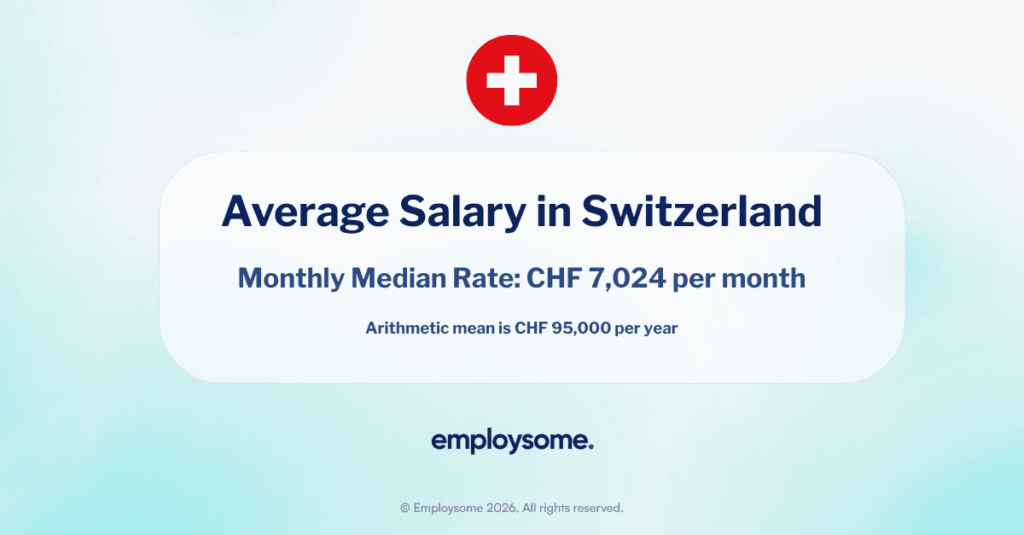
Table of Contents
- Switzerland Average Salary 2026
- Average Salary by Industry
- Average Salary by Canton
- Total Employer Cost
- Minimum Wage: No National Floor, Five Cantonal Minimums
- Employee Income Tax
- Working Hours, Overtime, and Leave
- How Switzerland Compares Globally
- What Changed in 2026
- Hiring in Switzerland Through an EOR
- FAQs
Switzerland pays the highest salaries in Europe. The median gross salary is CHF 7,024 per month (CHF 84,288 per year), according to the Federal Statistical Office’s 2024 Salary Structure Survey. The arithmetic mean is higher, exceeding CHF 95,000 per year, pulled up by executive compensation in finance and pharmaceuticals. In USD terms, that median translates to roughly $8,750 per month or $105,000 per year.
These numbers are real, but they are also misleading if you stop there. Switzerland is not one labour market. It is 26 cantons with different tax rates, different costs of living, different industry concentrations, and (in five cantons) different minimum wages. A software engineer earning CHF 130,000 in Zurich takes home less than the same engineer earning CHF 120,000 in Zug, because Geneva and Zurich tax at 35 to 38% effective rates while Zug and Schwyz tax at 22 to 25%. The gross number alone tells you very little about either the employee’s purchasing power or the employer’s total cost.
This guide is built for international employers evaluating Switzerland as a hiring market. It covers real salaries by industry and canton, employer-side costs (social contributions, pension, accident insurance), the 13th month salary, cantonal minimum wages for comparison, and how an Employer of Record handles Swiss payroll compliance.

Switzerland Average Salary 2026: The Headline Numbers
|
Metric |
2026 Figure |
|
Median gross monthly salary (full-time) |
CHF 7,024 (~USD 8,750) |
|
Average (mean) gross annual salary |
~CHF 95,000 to 100,000 (~USD 118,000 to 125,000) |
|
Median gross annual salary |
CHF 84,288 (~USD 105,000) |
|
Average monthly salary (blue-collar / LO workers) |
~CHF 5,100 to 5,500 |
|
Average monthly salary (white-collar / TCO workers) |
~CHF 7,800 to 8,500 |
|
13th month salary |
~90% of employees receive it (contractual or customary) |
|
National minimum wage |
None. 5 cantons have cantonal minimums (CHF 19 to 24.59/hour). |
|
Wage growth (2026) |
~1.5 to 1.8% |
The gap between average and median matters. High earners in banking (UBS, Credit Suisse successor), pharma (Roche, Novartis), and commodities trading (Glencore, Trafigura) in Zurich, Basel, and Geneva pull the average well above what the typical Swiss worker earns. The median of CHF 7,024/month is the more useful benchmark for most hiring decisions.
Average Salary by Industry
Switzerland’s highest-paying sectors are pharmaceuticals, finance, IT, and professional services. The lowest-paying are hospitality, retail, and agriculture. The spread between the top and bottom is roughly 2.5x.
|
Industry |
Avg Monthly Gross (CHF) |
Approx Annual (CHF) |
|
Pharmaceuticals & Life Sciences |
10,500 to 13,000 |
126,000 to 156,000 |
|
Financial Services & Banking |
10,000 to 12,500 |
120,000 to 150,000 |
|
IT & Software Engineering |
9,000 to 12,000 |
108,000 to 144,000 |
|
Engineering & Manufacturing |
8,500 to 10,500 |
102,000 to 126,000 |
|
Consulting & Professional Services |
8,500 to 11,000 |
102,000 to 132,000 |
|
Healthcare (non-specialist) |
7,000 to 8,500 |
84,000 to 102,000 |
|
Education |
7,500 to 9,500 |
90,000 to 114,000 |
|
Construction |
6,500 to 8,000 |
78,000 to 96,000 |
|
Retail & Trade |
5,000 to 6,500 |
60,000 to 78,000 |
|
Hospitality & Catering |
4,200 to 5,500 |
50,000 to 66,000 |
For international companies evaluating where to hire developers, Switzerland offers exceptional talent quality but at the highest price point globally. A senior software engineer in Zurich commands CHF 130,000 to 160,000. The same profile in Bangalore costs INR 20 to 30L (~USD 24,000 to 36,000). The cost multiplier is 4 to 5x, which is why many companies hire Swiss-based management but build engineering teams in lower-cost markets.
Average Salary by Canton
Cantonal variation is driven by two factors: industry concentration and tax rates. Zurich and Basel have the highest gross salaries because that is where finance and pharma headquarters sit. But Zug and Schwyz have the highest net salaries because their tax rates are dramatically lower.
|
Canton |
Median Monthly (CHF) |
Top Industry |
Effective Tax Rate |
Cantonal Min Wage |
|
Zurich |
~7,050 |
Finance, IT |
~30 to 33% |
None |
|
Basel-Stadt |
~7,200 |
Pharma |
~32 to 35% |
CHF 21/hr (from 2025) |
|
Geneva |
~6,760 |
International orgs, finance |
~35 to 38% |
CHF 24.59/hr |
|
Zug |
~6,900 |
Commodities, crypto, HQ |
~22 to 25% |
None |
|
Vaud (Lausanne) |
~6,600 |
Tech, EPFL ecosystem |
~33 to 36% |
None |
|
Bern |
~6,400 |
Government, services |
~30 to 33% |
None |
|
Neuchatel |
~6,100 |
Watchmaking, micro-tech |
~32 to 35% |
CHF 21.09/hr |
|
Ticino |
~5,200 |
Services, manufacturing |
~28 to 32% |
Sector-specific |
The canton paradox: a CHF 90,000 salary in Zug delivers more purchasing power than CHF 100,000 in Geneva. International employers often default to Geneva or Zurich because those are the cities they know, but from a total cost perspective, Zug, Schwyz, and Nidwalden offer significantly better employer economics for roles that do not require physical presence in a specific city.
💡 Employsome Insight: Always Ask Whether the Salary Includes the 13th Month
Approximately 90% of Swiss employees receive a 13th month salary, either by contract or by custom. When comparing offers, always clarify whether the annual figure includes 12 or 13 payments. A job offer of CHF 96,000 “per year” could mean CHF 8,000/month x 12, or CHF 7,385/month x 13. The difference in monthly cash flow is significant.
Total Employer Cost: Switzerland’s Three-Pillar System
Switzerland’s employer costs are built around a three-pillar pension and social security system. The first pillar (AHV/IV/EO) is mandatory state pension. The second pillar (BVG/LPP) is mandatory occupational pension. The third pillar is voluntary private savings (not employer-funded). On top of the pension system, there is unemployment insurance and accident insurance.
|
Contribution (2026) |
Employer Share |
Employee Share |
|
AHV/IV/EO (1st pillar: old-age, disability, income compensation) |
5.3% |
5.3% |
|
ALV (unemployment insurance) |
1.1% |
1.1% |
|
BVG/LPP (2nd pillar: occupational pension) |
3.5 to 9% (age-dependent) |
3.5 to 9% (age-dependent) |
|
UVG BU (occupational accident insurance) |
0.1 to 2% (industry risk) |
0% |
|
UVG NBU (non-occupational accident insurance) |
0% (typically) |
1 to 3% |
|
FAK (family allowance fund) |
~1 to 3% (cantonal) |
0% |
|
Total employer (typical office, age 35 to 44) |
~13 to 15% + BVG |
~11 to 14% |
The BVG (occupational pension) contribution is the variable that makes Swiss employer costs hard to predict. It is age-dependent: employers pay less for younger employees and more for older ones. The standard BVG schedule (minimum statutory rates) is roughly 7% total for ages 25 to 34, 10% for ages 35 to 44, 15% for ages 45 to 54, and 18% for ages 55 to 65, split at least 50/50 between employer and employee. Many employers pay more than the minimum, sometimes 60/40 or even 100% employer-funded, as a competitive benefit.
Example at CHF 8,000 gross/month (age 40): AHV/IV/EO employer share: CHF 424 (5.3%). ALV: CHF 88 (1.1%). BVG employer share: ~CHF 400 to 500 (5 to 6% of insured salary). UVG BU: ~CHF 40 (0.5%). FAK: ~CHF 160 (2%). Total employer cost: approximately CHF 9,100 to 9,200/month, or roughly 114 to 115% of gross salary. Add the 13th month salary and the true annual cost is closer to 130 to 140% of the 12-month base.
💡 Employsome Insight: The BVG Age Effect Is a Real Budget Factor
Hiring a 55-year-old in Switzerland costs substantially more in pension contributions than hiring a 30-year-old for the same role at the same salary. The BVG rate roughly doubles between age 35 and age 55. This is not discrimination, it is the statutory pension schedule. International companies used to flat employer cost models are often surprised by this. When your EOR quotes a per-employee cost, make sure the BVG component is calculated for the actual employee’s age, not a generic average.
Minimum Wage: No National Floor, Five Cantonal Minimum
Switzerland has no national minimum wage. Voters rejected a CHF 22/hour minimum in a 2014 referendum by 76%. Wages are set through collective bargaining agreements (Gesamtarbeitsvertrage/GAV) covering approximately 50% of workers, and through individual contracts for the rest.
However, five cantons have enacted their own statutory minimum wages:
|
Canton |
Hourly Min (CHF) |
Monthly (~40 hrs/wk) |
Year Enacted |
|
Geneva |
CHF 24.59 |
~CHF 4,262 |
2020 |
|
Basel-Stadt |
CHF 21.00 |
~CHF 3,640 |
2025 |
|
Neuchatel |
CHF 21.09 |
~CHF 3,656 |
2017 |
|
Jura |
CHF 20.60 |
~CHF 3,571 |
2018 |
|
Ticino |
Sector-specific |
~CHF 3,200 to 3,500 |
2021 |
Geneva’s CHF 24.59/hour is the highest minimum wage in the world. Even so, it is considered a bare minimum for one of the most expensive cities on earth. For context, a one-bedroom apartment in Geneva costs CHF 2,000 to 2,200/month, and mandatory health insurance premiums run CHF 350 to 500/month per adult.
Employee Income Tax
Swiss income tax is levied at three levels: federal, cantonal, and municipal. The federal rate is progressive with a top marginal rate of 11.5%. Cantonal and municipal rates vary enormously and make up the bulk of the total tax burden.
|
Tax Component |
Typical Range |
|
Federal income tax |
0% to 11.5% (progressive) |
|
Cantonal + municipal tax |
15% to 35% (varies massively by canton) |
|
Total effective tax rate (typical professional) |
22% to 38% depending on canton and income |
|
Withholding tax (Quellensteuer) for foreign workers |
Applied at source for permit B holders under CHF 120,000 (varies by canton) |
For foreign employees on B permits earning under CHF 120,000, tax is withheld at source (Quellensteuer). The rate depends on the canton, marital status, and number of children. Above CHF 120,000 (threshold varies by canton), employees must file an ordinary tax return.
Working Hours, Overtime, and Leave
|
Rule |
Details |
|
Standard workweek |
41.5 to 45 hours depending on sector (many companies operate at 40 to 42.5). |
|
Maximum workweek |
45 hours (industrial, office, retail, technical) or 50 hours (other sectors) |
|
Overtime premium |
25% surcharge (or time off in lieu if agreed) |
|
Annual leave |
Minimum 4 weeks (20 days). 5 weeks for employees under 20. Many employers offer 5 weeks as standard. |
|
Public holidays |
8 to 15 days (varies by canton). Only 1 August is nationally mandated. |
|
Maternity leave |
14 weeks at 80% of salary (capped), funded through EO insurance. |
|
Paternity leave |
2 weeks at 80% of salary (since 2021), funded through EO insurance. |
|
Sick leave |
Employer pays full salary for a “limited period” based on tenure (3 weeks in year 1, scaling up). Most employers carry daily sickness insurance (KTG/IJM) covering 80% for up to 720 days. |
|
Notice period |
1 month (year 1), 2 months (years 2 to 9), 3 months (year 10+). Can be extended by contract. |
|
13th month salary |
Not legally mandatory but contractually standard for ~90% of employees. |
Switzerland’s standard workweek of 41.5 to 45 hours is longer than most of Western Europe (Germany: 40, France: 35, Netherlands: 36 to 40). This partially explains why gross salaries look so high: Swiss workers put in more hours. When calculating a cost-per-hour comparison, the gap between Switzerland and its neighbours narrows somewhat.
How Switzerland Compares Globally
|
Country |
Median Monthly (USD) |
Employer SI |
Pension |
13th Month |
Workweek |
|
Switzerland |
~$8,750 |
~6.5% |
7 to 18% (BVG, age-based) |
~90% (custom) |
41.5 to 45 hrs |
|
Germany |
~$4,800 |
~20 to 21% |
Included in SI |
No |
40 hrs |
|
Netherlands |
~$4,200 |
~18 to 22% |
Included in SI |
8% holiday pay |
36 to 40 hrs |
|
United Kingdom |
~$3,900 |
~13.8% |
~3 to 5% (auto-enrolment) |
No |
37.5 to 40 hrs |
|
United States |
~$5,200 |
~7.65% (FICA) |
Voluntary (401k) |
No |
40 hrs |
|
Singapore |
~$4,500 |
~17% (CPF) |
Included in CPF |
No (AWS common) |
44 hrs |
Switzerland’s gross salaries are roughly 1.5 to 2x higher than Germany’s, but the total employer cost gap is narrower because Germany’s social insurance contributions (20 to 21%) are higher than Switzerland’s base rate (6.5% before pension). Once you add the BVG pension (especially for older employees), the total employer cost in Switzerland for a mid-career professional is 130 to 140% of gross salary, which is comparable to France and close to Scandinavian countries.
What Changed in 2026
13th AHV pension introduced. For the first time, Swiss retirees will receive a 13th AHV pension payment in December 2026. This was approved by popular referendum in March 2024. It does not directly affect employer contributions in 2026, but funding discussions are ongoing and may lead to higher AHV contributions in future years.
Retroactive Pillar 3a contributions. From 2026, employees can make retroactive contributions to their Pillar 3a (private pension) for missed years going back to 2025. This is a tax optimization opportunity that your Swiss employees will ask about.
AHV/IV/EO rates unchanged at 10.6%. Despite the 13th pension introduction, the contribution rate remains stable in 2026. However, the Federal Council has signalled that increases are likely post-2026 to fund the additional payments.
Health insurance premiums increased. Mandatory health insurance (LAMal/KVG) premiums rose again in 2026. While these are paid by individuals (not employers), they affect salary expectations and negotiations. An employee earning CHF 7,000/month may spend CHF 400 to 500/month just on mandatory health insurance.
Hiring in Switzerland Through an EOR
Switzerland is not in the EU. It has bilateral agreements with the EU that allow free movement for EU/EFTA nationals, but non-EU hiring requires work permits through cantonal migration offices. The permit system (B, C, G, L permits) adds a compliance layer that varies by canton.
An Employer of Record with a Swiss entity handles employment contracts under the Swiss Code of Obligations (OR), AHV/IV/EO registration through the cantonal compensation office (Ausgleichskasse), BVG pension fund setup and administration, accident insurance (UVG) through SUVA or a private insurer, payroll processing with Quellensteuer withholding, and work permit coordination for non-EU/EFTA nationals.
When choosing a provider, check whether they handle cantonal tax variations correctly (a Zurich-based entity applying Geneva withholding rates is a common error), whether their BVG pension fund is competitive (some EORs use minimum statutory plans that Swiss employees consider inadequate), and whether they can support the full range of Swiss permit types. For companies hiring employees internationally across multiple European markets, Switzerland often requires a separate, specialised EOR rather than a global provider’s Swiss add-on.
Hiring in Switzerland?
Switzerland’s three-pillar system, cantonal tax variation, and age-dependent pension contributions make total employer cost harder to predict than in most European markets. Compare the best EOR providers for Switzerland on Employsome. We score each provider on Swiss labour law compliance, BVG pension quality, cantonal tax handling, and payroll accuracy.
Frequently Asked Questions
The median gross salary is CHF 7,024 per month (CHF 84,288/year). The average (mean) is higher at approximately CHF 95,000 to 100,000/year, inflated by high earners in finance and pharma. In USD terms, the median is roughly $8,750/month.
No national minimum wage. Five cantons have enacted their own: Geneva (CHF 24.59/hr, the world’s highest), Basel-Stadt (CHF 21/hr), Neuchatel (CHF 21.09/hr), Jura (CHF 20.60/hr), and Ticino (sector-specific). Wages in other cantons are set by collective agreements or individual contracts.
Employer social contributions total approximately 6.5% (AHV/IV/EO 5.3% + ALV 1.1%) plus BVG pension (3.5 to 9% depending on employee age) plus accident insurance (0.1 to 2%) plus family allowance fund (~1 to 3%). Total employer cost is approximately 130 to 140% of 12-month base salary when the 13th month and BVG are included.
Not legally mandatory, but contractually standard for approximately 90% of Swiss employees. It is a market expectation, not a statutory requirement. When comparing offers, always clarify whether the annual figure includes 12 or 13 payments.
Basel-Stadt and Zurich have the highest gross salaries, driven by pharma and finance. However, Zug and Schwyz deliver higher net salaries due to significantly lower cantonal tax rates (22 to 25% vs. 30 to 38%).
Yes. An EOR with a Swiss entity manages employment contracts, AHV registration, BVG pension fund administration, accident insurance, Quellensteuer withholding, and work permit coordination. Switzerland is not in the EU, so EOR providers need specific Swiss capabilities.

Written by
Courtney Pocock is a Copywriter & EOR/PEO Researcher at Employsome with 15+ years of experience writing for the HR, corporate, and financial sectors. She has a strong interest in global business expansion and Employer of Record / PEO topics, focusing on news that matters to business owners and decision-makers. Courtney covers industry updates, regulatory changes, and practical guides to help leaders navigate international hiring with confidence.
Our content is created for informational purposes only and is not intended to provide any legal, tax, accounting, or financial advice. Please obtain separate advice from industry-specific professionals who may better understand your business’s needs. Read our Editorial Guidelines for further information on how our content is created.
Other posts
Along with our standard maps we offer highly customizable maps.