Average Salary in India 2026: What Developers Actually Earn
The average salary in India is approximately INR 32,000 per month (~USD 382), but that number is almost meaningless for international employers hiring tech talent. A junior developer at TCS earns INR 3.5L per year. A senior full-stack engineer at a Bangalore product company earns INR 20 to 30L. A staff engineer at Google India earns INR 60L+. This guide breaks down real developer salaries by experience level, tech stack, and city, plus total employer costs including EPF, ESI, gratuity, and how an EOR handles it.

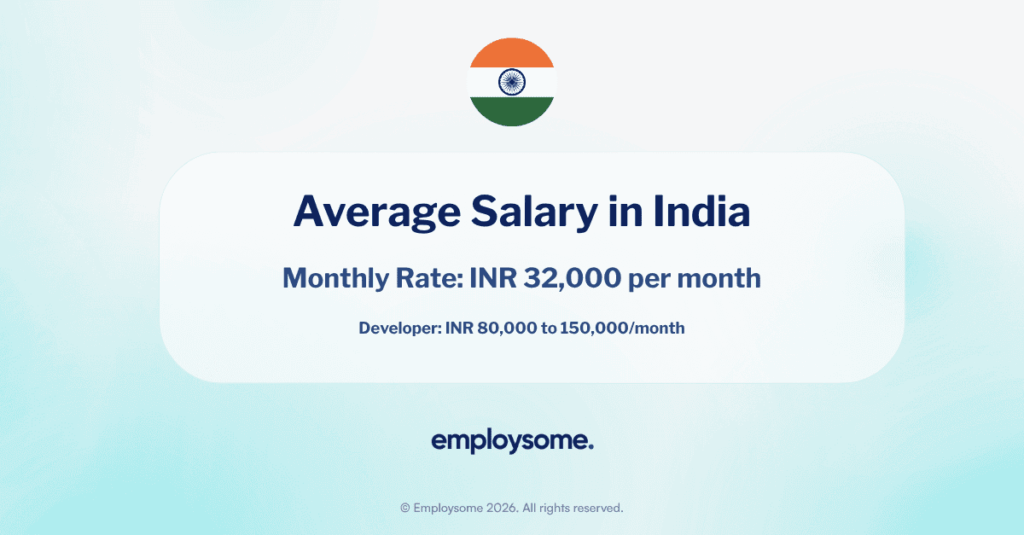
Table of Contents
- India Average Salary 2026: The Headline Numbers
- Software Developer Salaries in India by Experience Level
- Developer Salaries by Technology Stack
- Developer Salaries by City
- Total Employer Cost in India
- Employee Income Tax in India (2026)
- How India Compares Globally for Developer Hiring
- Hiring Developers in India Through an EOR
- FAQs
The average salary in India is approximately INR 32,000 per month (~USD 382). The median is lower: around INR 27,300. These are the numbers you will find in most salary reports, and they are essentially useless for international employers hiring developers, engineers, or any tech role.
The reason is simple: India’s salary distribution is extreme. A street-level worker in Bihar earns INR 8,000/month. A junior developer at Infosys earns INR 25,000 to 35,000/month. A mid-level full-stack engineer at a Bangalore startup earns INR 80,000 to 150,000/month. A staff engineer at Google India earns INR 500,000+/month. Averaging these numbers together produces a figure that describes nobody.
This guide is built for international companies evaluating India as a hiring destination for developers. It focuses on what tech talent actually costs in 2026, broken down by experience level, specialisation, and city, plus the employer-side costs (EPF, ESI, gratuity, professional tax) that sit on top of gross salary, and how an Employer of Record handles compliance.

India Average Salary 2026: The Headline Numbers
|
Metric |
2026 Estimate |
|
Average monthly salary (all sectors) |
~INR 32,000 (~USD 382) |
|
Median monthly salary |
~INR 27,300 (~USD 326) |
|
Average annual salary (all sectors) |
~INR 3.84L (~USD 4,600) |
|
Average annual salary (IT sector) |
~INR 7 to 9L (~USD 8,400 to 10,800) |
|
Average annual salary hike (2026) |
~9% across sectors |
|
Unemployment rate |
~7.5% (urban ~6.5%) |
|
IT workforce size |
~5.4 million developers |
India’s IT sector is the outlier. While the national average sits at INR 3.84L/year, the IT industry average is INR 7 to 9L/year, roughly double. And within IT, product companies (startups, SaaS firms, global tech R&D centres) pay significantly more than service companies (TCS, Infosys, Wipro, Cognizant). Understanding this split is essential for international employers benchmarking salaries.
Software Developer Salaries in India by Experience Level
Experience is the single biggest driver of developer compensation in India. The spread between a fresher and a senior engineer is 5 to 10x, far wider than in most Western markets.
|
Level |
Experience |
Annual CTC (INR) |
Approx USD/Year |
|
Fresher (Service Co.) |
0 to 1 year |
INR 3L to 4.5L |
$3,600 to $5,400 |
|
Fresher (Product Co.) |
0 to 1 year |
INR 6L to 12L |
$7,200 to $14,400 |
|
Junior Developer |
1 to 3 years |
INR 5L to 10L |
$6,000 to $12,000 |
|
Mid-Level Developer |
3 to 5 years |
INR 10L to 20L |
$12,000 to $24,000 |
|
Senior Developer |
5 to 8 years |
INR 15L to 30L |
$18,000 to $36,000 |
|
Staff / Lead Engineer |
8 to 12 years |
INR 25L to 50L |
$30,000 to $60,000 |
|
Principal / Architect |
12+ years |
INR 40L to 80L+ |
$48,000 to $96,000+ |
|
FAANG India (Senior+) |
5+ years |
INR 50L to 120L+ |
$60,000 to $144,000+ |
CTC (Cost to Company) is the standard salary metric in India. It includes base salary, employer EPF/ESI contributions, gratuity provision, and sometimes variable pay. The take-home (in-hand) salary is typically 65 to 75% of CTC after deductions for provident fund, income tax, and professional tax.
The service vs. product company split is critical. TCS, Infosys, and Wipro hire freshers at INR 3 to 4.5L. Companies like Razorpay, Zerodha, Flipkart, and global R&D centres (Google, Microsoft, Amazon) hire freshers at INR 8 to 25L. These are the same labour market, but two completely different salary bands. International employers hiring through an EOR in India typically compete in the mid-to-upper range.
💡 Employsome Insight: The Service Company Benchmark Is Wrong
If someone tells you a developer in India costs $5,000/year, they are quoting a TCS fresher salary. That is not the talent pool you are competing for. International companies hiring remotely through an EOR are typically targeting mid-level to senior developers with 3 to 8 years of experience and product company backgrounds. For that segment, budget INR 12L to 30L per year ($14,000 to $36,000), depending on specialisation and city. That is still 70 to 85% cheaper than a US-based engineer, but it is not the $5,000 number that gets thrown around.
Developer Salaries by Technology Stack
The framework, language, or domain a developer specialises in has a measurable impact on salary. High-demand, low-supply skills command premiums of 20 to 40% over generalist rates.
|
Specialisation |
Mid-Level (3-5 yrs, INR LPA) |
Senior (5-8 yrs, INR LPA) |
|
Full-Stack (React/Node) |
10L to 18L |
18L to 32L |
|
Backend (Java/Spring) |
10L to 16L |
16L to 28L |
|
Backend (Python/Django) |
10L to 17L |
17L to 30L |
|
Frontend (React/Angular) |
8L to 15L |
15L to 25L |
|
DevOps / Cloud (AWS/Azure) |
12L to 20L |
20L to 35L |
|
AI / Machine Learning |
14L to 22L |
22L to 45L |
|
Data Engineering |
12L to 20L |
20L to 38L |
|
Mobile (React Native/Flutter) |
10L to 18L |
18L to 30L |
|
Cybersecurity |
12L to 20L |
20L to 35L |
|
Blockchain / Web3 |
14L to 22L |
22L to 40L |
AI/ML and data engineering currently command the highest premiums, followed by DevOps/cloud and cybersecurity. These premiums are driven by genuine scarcity: India produces millions of CS graduates, but the percentage with production-level AI or cloud infrastructure experience is small. For a broader comparison of developer costs across countries, see our Best Countries to Hire Developers index.
Developer Salaries by City
Location still matters in India, though remote work is narrowing the gap. Bangalore commands the highest premiums because it has the highest density of product companies, VC-funded startups, and R&D centres of global tech companies.
|
City |
Mid-Level Dev (INR LPA) |
Senior Dev (INR LPA) |
Premium vs National |
|
Bangalore |
12L to 22L |
20L to 40L |
+30 to 40% |
|
Hyderabad |
10L to 18L |
18L to 32L |
+20 to 30% |
|
Pune |
10L to 17L |
16L to 28L |
+15 to 25% |
|
Delhi NCR (Gurgaon/Noida) |
10L to 18L |
18L to 32L |
+20 to 30% |
|
Mumbai |
10L to 17L |
17L to 30L |
+15 to 25% |
|
Chennai |
8L to 15L |
15L to 25L |
+10 to 15% |
|
Tier-2 (Jaipur, Ahmedabad, Kochi) |
6L to 12L |
12L to 20L |
Baseline |
For remote roles paid at Tier-1 rates, some companies are hiring from Tier-2 cities to access developers who earn less locally but are happy with Bangalore-level remote salaries. This arbitrage is narrowing as more companies adopt the same strategy, but it remains a valid approach in 2026.
Total Employer Cost in India
India’s employer-side contributions are relatively moderate but include several mandatory components that sit on top of gross salary:
|
Component |
Employer Rate |
Employee Rate |
|
Employees Provident Fund (EPF) |
12% of basic salary |
12% of basic salary |
|
Employees State Insurance (ESI) |
3.25% (if gross < INR 21,000/month) |
0.75% |
|
Gratuity (Payment of Gratuity Act) |
4.81% of basic salary (accrual) |
N/A |
|
Professional Tax (state-dependent) |
N/A |
INR 200/month max (varies by state) |
|
Labour Welfare Fund (state-dependent) |
INR 20 to 75/year |
INR 6 to 36/year |
The EPF calculation is important. EPF is calculated on basic salary, not gross/CTC. Most Indian companies structure CTC so that basic salary is 40 to 50% of CTC. So for an employee with INR 20L CTC and INR 8L basic, the employer EPF contribution is INR 96,000/year (12% of 8L), not INR 2.4L.
ESI only applies below INR 21,000/month gross. This means it affects minimum-wage workers and some junior roles, but not mid-level or senior developers. Most tech hires in India are above the ESI threshold.
Gratuity is payable after 5 years of continuous service (15 days of last-drawn salary for each year of service). However, employers must accrue for it from day one. The effective accrual rate is approximately 4.81% of basic salary.
As a rough budgeting rule, total employer cost in India is approximately 115 to 120% of CTC for tech roles above the ESI threshold, once you factor in EPF employer share, gratuity accrual, payroll processing, and any EOR management fee. For the full picture on EOR costs, see our dedicated guide.
💡 Employsome Insight: Watch the CTC vs. Take-Home Gap
When you offer an Indian developer a CTC of INR 20L, their monthly take-home is approximately INR 1.1L to 1.3L after EPF, income tax, and professional tax. That is 65 to 75% of CTC. If your candidate is comparing your offer against a competitor, they are comparing take-home, not CTC. Make sure your EOR provides a clear CTC-to-take-home breakdown before you make the offer. A INR 20L CTC from you vs. INR 18L CTC from a competitor might actually deliver the same take-home if your salary structure allocates more to EPF.
Employee Income Tax in India (2026)
India offers two tax regimes. The New Tax Regime (default since FY 2023-24) has lower rates but fewer deductions. Most salaried employees now use the new regime:
|
Annual Income (INR) |
Tax Rate (New Regime) |
|
Up to 3,00,000 |
0% |
|
3,00,001 to 7,00,000 |
5% |
|
7,00,001 to 10,00,000 |
10% |
|
10,00,001 to 12,00,000 |
15% |
|
12,00,001 to 15,00,000 |
20% |
|
Above 15,00,000 |
30% |
A developer earning INR 15L CTC pays approximately INR 1.5L to 1.8L in income tax under the new regime, giving an effective tax rate of roughly 10 to 12%. This is significantly lower than comparable income levels in Western Europe or the US.
How India Compares Globally for Developer Hiring
|
Country |
Mid Dev (USD/yr) |
Sr Dev (USD/yr) |
Employer SI |
Time Zone |
English |
|
India |
$12K to $24K |
$18K to $36K |
~17% of basic |
UTC+5:30 |
Strong |
|
Vietnam |
$14K to $24K |
$24K to $40K |
~24% |
UTC+7 |
Moderate |
|
Philippines |
$12K to $22K |
$22K to $36K |
~12% |
UTC+8 |
Strong |
|
Poland |
$30K to $55K |
$50K to $80K |
~20% |
UTC+1 |
Good |
|
Brazil |
$18K to $32K |
$30K to $50K |
~29% |
UTC-3 |
Low |
|
Mexico |
$20K to $35K |
$35K to $55K |
~25-35% |
UTC-6 |
Moderate |
|
United States |
$80K to $120K |
$120K to $180K |
~10-12% |
UTC-5 to -8 |
Native |
India’s combination of low cost, strong English proficiency, massive talent pool (5.4M+ developers), and favourable time zone overlap with Europe makes it one of the top global destinations for remote developer hiring. The main trade-off is time zone overlap with the US West Coast (11.5 to 13.5 hours difference), which works better for async teams than synchronous collaboration. For a full country-by-country developer hiring analysis, see our 2026 Developer Hiring Index.
Hiring Developers in India Through an EOR
India does not require a local entity to hire employees through an Employer of Record. The EOR acts as the legal employer, handling EPF/ESI registration, payroll processing, income tax withholding (TDS), gratuity accrual, and compliance with Indian labour law (including the four new Labour Codes that are progressively being implemented).
Key things to check when choosing an EOR for India: do they operate their own entity or use a local partner? How do they structure CTC (what percentage goes to basic vs. allowances)? Do they handle both old and new tax regime elections? Can they onboard within 5 to 10 business days? What is the management fee on top of CTC?
For Indian developers, the CTC structure matters more than in most countries. The split between basic salary, HRA (house rent allowance), special allowance, and variable pay directly affects EPF contributions, tax liability, and take-home pay. A good EOR will help you structure the CTC competitively, not just legally. For the full picture on EOR costs and legal considerations, see our dedicated guides.
Hiring Developers in India?
India’s 5.4 million developers, competitive salaries, and strong English proficiency make it one of the world’s top tech hiring markets. Compare the best EOR providers for India on Employsome. We score each provider on EPF/ESI compliance, CTC structuring, TDS handling, payroll accuracy, and onboarding speed. Visit our Best EORs in India Guide to see the full comparison.
Frequently Asked Questions (FAQs)
Approximately INR 32,000 per month (~USD 382) across all sectors. The median is INR 27,300. In the IT sector specifically, the average is INR 7 to 9L per year (~USD 8,400 to 10,800).
It varies enormously by experience and company type. Freshers at service companies earn INR 3 to 4.5L/year. Mid-level developers (3 to 5 years) earn INR 10 to 20L. Senior developers (5 to 8 years) earn INR 15 to 30L. Staff engineers at top product companies earn INR 40 to 80L+.
CTC (Cost to Company) is the total annual compensation package including base salary, employer EPF/ESI contributions, gratuity, variable pay, and any benefits. Take-home pay is typically 65 to 75% of CTC after deductions.
Employer contributions include EPF (12% of basic salary), ESI (3.25% if gross is below INR 21,000/month), and gratuity accrual (~4.81% of basic). For tech roles above the ESI threshold, total employer cost is approximately 115 to 120% of CTC.
Bangalore commands the highest premiums (30 to 40% above national average), followed by Hyderabad and Delhi NCR (20 to 30%), then Pune and Mumbai (15 to 25%). Tier-2 cities like Jaipur and Kochi pay less but are increasingly competitive for remote roles.
Yes. An EOR with an Indian entity handles employment contracts, EPF/ESI registration, payroll, income tax (TDS), gratuity, and compliance with Indian labour law. Most EORs can onboard an Indian developer within 5 to 10 business days.

Written by
Courtney Pocock is a Copywriter & EOR/PEO Researcher at Employsome with 15+ years of experience writing for the HR, corporate, and financial sectors. She has a strong interest in global business expansion and Employer of Record / PEO topics, focusing on news that matters to business owners and decision-makers. Courtney covers industry updates, regulatory changes, and practical guides to help leaders navigate international hiring with confidence.
Our content is created for informational purposes only and is not intended to provide any legal, tax, accounting, or financial advice. Please obtain separate advice from industry-specific professionals who may better understand your business’s needs. Read our Editorial Guidelines for further information on how our content is created.
Other posts
Review other blog poszs