Average Salary in Georgia 2026: What Employers Actually Pay
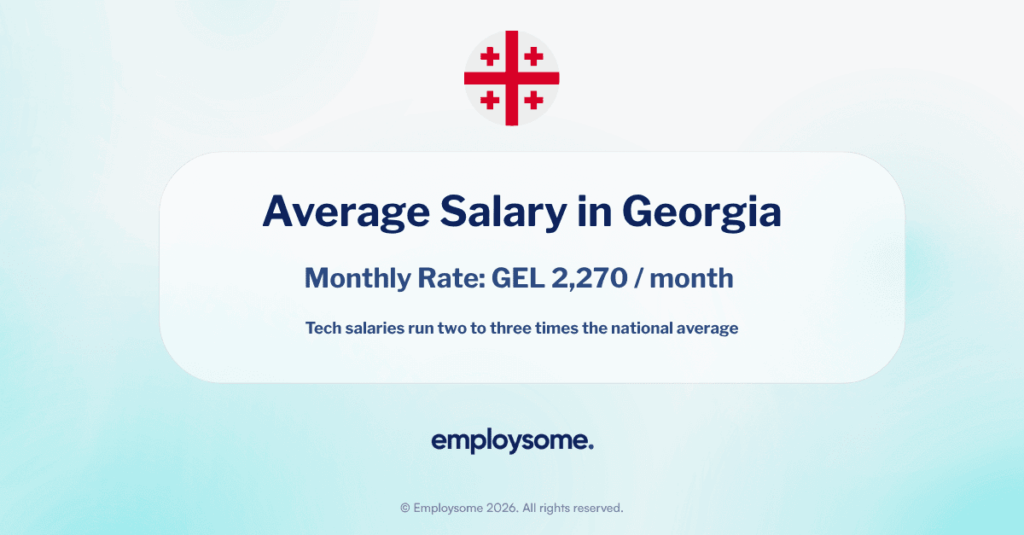
The average salary in Georgia is approximately GEL 2,270 per month gross (~$850 USD), but that number hides a sharp divide. Tbilisi tech salaries run two to three times the national average, while much of the country earns under GEL 1,500. With a flat 20% income tax, no social security contributions, and total employer costs among the lowest in the region, Georgia is increasingly attractive for international hiring. This guide covers salaries by role, city, and industry, plus tax, employer costs, and regional comparisons.

Georgia has quietly become one of the most interesting hiring markets in the Caucasus. Since 2022, Tbilisi has absorbed a wave of relocating tech talent from Russia and Belarus, deepening an already strong IT talent pool. Combined with a flat 20% income tax, no social security contributions, and an Employer of Record-friendly regulatory environment, the country offers a cost-to-talent ratio that is hard to match in the region.
The average salary in Georgia is approximately GEL 2,270 per month gross, which translates to roughly $850 USD. But that national average obscures a wide gap. In Tbilisi, where most international hiring happens, average gross salaries are closer to GEL 2,600. In IT and finance, mid-career roles regularly exceed GEL 4,000. Outside the capital, salaries drop to GEL 1,000 to 1,500 in many regions.
This guide breaks down the average salary in Georgia by role, industry, and city. It also covers the tax system, total employer costs, and how Georgia compares to its neighbours. If you are evaluating Georgia as part of a distributed team strategy, the data here will help you benchmark compensation and understand the full cost of hiring internationally.

Average Salary in Georgia by Role (2026)
The following figures reflect gross monthly salaries for mid-career professionals (3 to 7 years of experience) in Tbilisi. Salaries outside the capital are 30 to 50% lower for comparable roles.
|
Role |
Gross Monthly (GEL) |
Approx USD |
Market Demand |
|
Software Engineer |
GEL 3,500 to 6,000 |
~$1,300 to 2,250 |
High demand |
|
DevOps / Cloud Engineer |
GEL 4,000 to 7,000 |
~$1,500 to 2,630 |
Very high demand |
|
Data Analyst |
GEL 2,500 to 4,000 |
~$940 to 1,500 |
Growing |
|
Product Manager |
GEL 4,000 to 6,500 |
~$1,500 to 2,440 |
Emerging |
|
Marketing Manager |
GEL 2,500 to 4,000 |
~$940 to 1,500 |
Moderate |
|
Accountant / Finance |
GEL 2,000 to 3,500 |
~$750 to 1,310 |
Stable |
|
HR Manager |
GEL 2,500 to 4,000 |
~$940 to 1,500 |
Moderate |
|
Customer Support |
GEL 1,500 to 2,500 |
~$560 to 940 |
High volume |
|
Graphic Designer |
GEL 1,800 to 3,000 |
~$675 to 1,130 |
Competitive |
|
Project Manager |
GEL 3,000 to 5,000 |
~$1,130 to 1,880 |
Moderate |
USD conversions use a rate of approximately GEL 2.67 to $1. The Georgian lari has been relatively stable compared to many regional currencies, which makes salary planning more predictable than in markets like Turkey or Egypt.
💡 Employsome Insight: The Relocation Effect Changed the Market
The influx of Russian and Belarusian tech professionals since 2022 had two effects. First, it deepened the senior talent pool in Tbilisi, particularly in backend engineering, DevOps, and data. Second, it pushed up market salaries for experienced roles because many relocating professionals came with higher salary expectations benchmarked to Moscow or European rates. Companies hiring junior to mid-level Georgian talent still find excellent value. But senior hires now command rates closer to Eastern European levels than traditional Caucasus pricing.
Average Salary by City
Georgia’s economy is heavily concentrated in Tbilisi. The capital accounts for roughly half of the country’s GDP and the vast majority of formal private-sector employment. Batumi has a growing hospitality and tourism economy, and Kutaisi is emerging as a secondary city for some services roles, but the gap with Tbilisi is significant.
|
City |
Avg Gross Monthly (GEL) |
Typical Rent (1-bed) |
Key Sectors |
|
Tbilisi |
GEL 2,500 to 3,500 |
GEL 2,000 to 4,000 |
Tech, finance, services |
|
Batumi |
GEL 1,500 to 2,200 |
GEL 1,200 to 2,500 |
Tourism, hospitality, trade |
|
Kutaisi |
GEL 1,200 to 1,800 |
GEL 800 to 1,500 |
Manufacturing, agriculture |
|
Rustavi |
GEL 1,200 to 1,700 |
GEL 700 to 1,200 |
Industrial, petrochemical |
Tbilisi rent has increased notably since 2022 due to the relocation wave. Central apartments that were GEL 1,500/month in 2021 now commonly command GEL 3,000 to 4,000. For remote workers, Tbilisi still ranks well on the cost-adjusted quality-of-life index. Our best cities to work remotely guide covers how it compares globally.
Average Salary by Industry
|
Industry |
Gross Monthly Range (GEL) |
Notes |
|
IT & Communications |
GEL 3,500 to 6,500 |
Strongest sector, post-2022 talent surge |
|
Finance & Banking |
GEL 2,500 to 5,000 |
TBC Bank, Bank of Georgia drive market |
|
Construction |
GEL 2,500 to 4,000 |
Infrastructure boom, project-based |
|
Healthcare |
GEL 1,500 to 3,000 |
Below average, public sector drag |
|
Tourism & Hospitality |
GEL 1,200 to 2,500 |
Seasonal, Batumi and Tbilisi focused |
|
Education |
GEL 1,000 to 2,000 |
Public sector dominated, low pay |
|
Agriculture |
GEL 800 to 1,500 |
Informal economy, rural regions |
|
Professional Services |
GEL 2,500 to 4,500 |
Legal, consulting, audit |
IT and communications is the standout sector, with average wages roughly double the national average. Georgia’s government has actively supported the tech ecosystem through free trade zones, tax incentives for IT companies, and the Virtual Zone Person (VZP) status that exempts qualifying IT companies from profit tax on foreign-sourced income. For companies building distributed engineering teams, Georgia sits in an interesting spot between top developer hiring markets and traditional outsourcing destinations.
Tax System and Total Employer Cost
Georgia’s tax system is remarkably simple by international standards. There is a flat 20% personal income tax on all employment income. There are no social security contributions. The only mandatory employer cost beyond gross salary is the pension contribution introduced in 2019.
|
Item |
Rate |
Notes |
|
Personal income tax |
20% flat |
Withheld by employer |
|
Pension (employer share) |
2% of gross salary |
Mandatory since 2019 |
|
Pension (employee share) |
2% of gross salary |
Withheld by employer |
|
Pension (government match) |
2% (up to GEL 24,000/yr income) or 1% |
Paid by state |
|
Social security |
0% |
None |
|
Total mandatory employer cost |
~2% above gross salary |
Pension only |
This is Georgia’s single biggest advantage for employers. Total mandatory cost above gross salary is just 2%. Compare that to Turkey at 22.5%, Spain at roughly 30%, or Romania at 2.25%. The flat 20% income tax is also straightforward: no progressive brackets, no cumulative calculations, no mid-year rate changes. Payroll is simple.
💡 Employsome Insight: The 20 GEL Minimum Wage Is a Relic, Not a Policy
Georgia’s statutory private-sector minimum wage of GEL 20 per month has been unchanged since 1999. It is effectively meaningless. No one earns GEL 20. The number exists as a legal reference point for government calculations (fines, fees), not as a labour market floor. The public-sector minimum is GEL 115/month, which is also well below actual wages. In practice, the lowest formal-sector wages in Tbilisi start around GEL 800 to 1,000. There have been political proposals to raise the minimum to GEL 950, but nothing has been enacted as of 2026. For employer planning purposes, ignore the statutory minimum and benchmark to actual market rates by role and city.
How Georgia Compares Regionally
|
Country |
Avg Monthly (USD) |
Income Tax |
Employer SI |
Key Factor |
|
Georgia |
~$850 |
20% flat |
~2% |
Simplest tax, lowest employer cost |
|
Armenia |
~$700 |
20% flat |
~5% |
Growing tech hub, lower cost |
|
Turkey |
~$850 to 1,270 |
15 to 40% |
~22.5% |
Larger talent pool, higher cost |
|
Romania |
~$1,200 to 1,800 |
10% flat |
~2.25% |
EU access, strong IT |
|
Ukraine |
~$600 to 1,000 |
18% + 1.5% |
22% |
Large talent pool, conflict risk |
|
Azerbaijan |
~$600 |
14% progressive |
~25% |
Oil-driven, smaller tech pool |
Georgia’s positioning is clear: it is the lowest-cost market for employers in this comparison once you factor in total cost above gross salary. The flat 20% income tax with just 2% employer pension contribution means total employment cost is essentially gross salary + 2%. In Turkey, the same hire costs gross + 22.5%. In Ukraine, gross + 22%. Armenia is close on tax structure but has higher social contributions. Romania offers EU market access but at roughly double the salary level.
For companies comparing hiring costs across the Caucasus and Eastern Europe, our EOR cost breakdown covers how provider fees layer on top of these mandatory contributions.
Hiring in Georgia Through an Employer of Record
Georgia does not have dedicated EOR legislation, which means the regulatory framework is more flexible than in countries like Germany or France. An Employer of Record in Georgia acts as the legal employer, registers the employee, handles payroll and income tax withholding, manages the mandatory pension scheme, and issues compliant employment contracts under the Georgian Labour Code.
Provider quality varies significantly. Some EORs operate through wholly owned Georgian entities with local HR teams in Tbilisi. Others rely on thin partner arrangements with limited accountability. Since 2022, Georgian authorities have become stricter around company incorporation and bank account opening, particularly for entities linked to sanctioned-country activity. Choosing an EOR with a well-established, clean Georgian entity matters more than it did three years ago.
We have independently reviewed the top providers operating in Georgia. See our rankings for pricing, entity ownership, onboarding speed, and compliance depth. If you want a deeper look at the leading local provider, our Gegidze review covers their strengths and limitations in detail.
The pros and cons of using an EOR in Georgia come down to simplicity versus control. Georgia’s low employer burden and simple tax system mean the EOR’s compliance lift is lighter than in high-regulation markets, but having a local entity and HR presence still matters for contract execution, dispute resolution, and maintaining employee experience.
Hiring in Georgia?
If you are looking to hire employees in Georgia without setting up a local entity, an Employer of Record handles employment contracts, payroll, income tax withholding, and pension compliance on your behalf. We have independently reviewed and ranked the top providers operating in the Georgian market. See our Best Employer of Record in Georgia ranking for pricing, entity ownership, onboarding speed, and compliance depth across 10+ providers.
Frequently Asked Questions
The national average gross salary is approximately GEL 2,270 per month (~$850 USD). In Tbilisi, the average is closer to GEL 2,600. IT professionals earn GEL 3,500 to 6,500, while hospitality and agriculture roles fall between GEL 800 and 2,500.
The private-sector statutory minimum wage is GEL 20 per month, unchanged since 1999. It is effectively non-binding and irrelevant for actual compensation planning. The public-sector minimum is GEL 115/month. Actual entry-level wages in Tbilisi start around GEL 800 to 1,000.
Georgia applies a flat 20% personal income tax on all employment income. There are no progressive brackets. Employers withhold and remit monthly. There are no social security contributions beyond the mandatory 2% employer and 2% employee pension contribution.
Total mandatory employer cost above gross salary is approximately 2% (pension contribution only). There are no social security contributions. This makes Georgia one of the lowest total-cost hiring markets in the region. For a GEL 3,000/month employee, the total employer cost is approximately GEL 3,060.
Yes, particularly for tech roles. Georgia offers a deep IT talent pool (boosted by post-2022 relocations), a flat 20% income tax, minimal employer burden, and a time zone (GMT+4) that overlaps with both Europe and the Middle East. Tbilisi’s cost of living is rising but still well below European capitals. You can compare EOR providers on Employsome to find the right partner for Georgian hiring.
The Georgian lari (GEL). As of early 2026, 1 USD is approximately 2.67 GEL. The lari has been relatively stable compared to regional currencies like the Turkish lira, making salary planning more predictable.

Written by
Christa is a Copywriter at Employsome with 17 years of professional writing experience across global brands, startups, and online publications. A native English-Finnish writer, she brings strong editorial skills and a versatile background in business, SaaS, and finance. At Employsome, Christa focuses on clear, practical content about HR, payroll, and Employer of Record topics.
Our content is created for informational purposes only and is not intended to provide any legal, tax, accounting, or financial advice. Please obtain separate advice from industry-specific professionals who may better understand your business’s needs. Read our Editorial Guidelines for further information on how our content is created.
Other posts
Along with our standard maps we offer highly customizable maps.