Average Salary in Chile: The 2026 Expert Guide
Chile’s average salary is approximately CLP 1,050,000 to 1,120,000 per month (~$1,100 USD), with a median of ~CLP 800,000. Mining professionals in Antofagasta earn 2 to 3x the national average, while IT roles in Santiago pay $18,000 to $35,000 annually. Employer contributions are currently low at 5 to 8% but a new mandatory pension contribution starting in 2025 will escalate to 8.5% by 2033. The standard workweek drops to 42 hours from April 2026 under Ley 21.561, with no reduction in pay allowed.

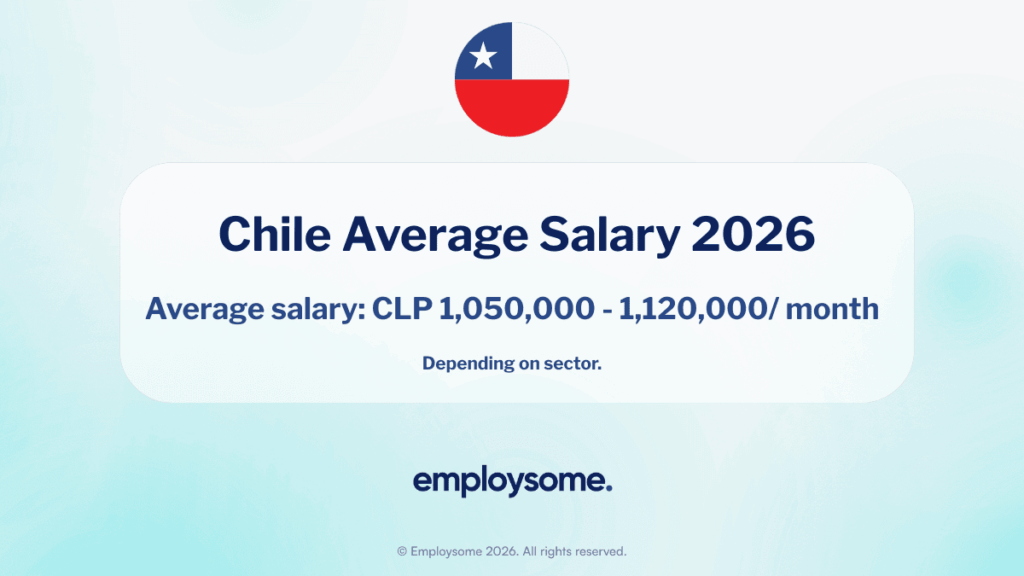
Chile has the highest per-capita income in Latin America and one of the most stable economies in the region. The average gross monthly salary is approximately CLP 1,050,000 to 1,120,000 (~$1,100 to $1,170 USD) as of early 2026, with a median of around CLP 800,000 (~$850 USD). However, these national figures mask dramatic variation: mining professionals in the Atacama region can earn 3 to 4x the national average, while service sector workers in rural areas earn close to the minimum wage.
For employers hiring in Chile, whether through a local entity or an Employer of Record, understanding real salary levels is essential for making competitive offers. Chile is also undergoing two major labour reforms in 2026: the reduction of the standard workweek to 42 hours (from April 2026 under Ley 21.561) and the phased introduction of mandatory employer pension contributions under the new mixed pension system (Law 21.735). Both will affect total employment costs.
💡 Employsome Insight: Chile’s Employer Costs Are Low, but Rising Fast
Unlike Brazil (28–36% employer contributions) or Argentina, Chile has historically placed most of the social security burden on the employee side (~17.6% of gross salary). Employer contributions have been limited to approximately 5–6%. However, the 2025 pension reform introduces a new mandatory employer contribution starting at 1% in August 2025 and gradually increasing to 8.5% by 2033. Factor this escalating cost into any multi-year hiring budget for Chile.

National Average Salary in Chile (2026)
|
Metric |
Value (2026) |
|
Average gross monthly salary |
CLP 1,050,000 to 1,120,000 (~$1,100 to $1,170 USD) |
|
Median monthly salary |
~CLP 800,000 (~$850 USD) |
|
Salary range (all sectors) |
CLP 400,000 to 6,000,000+/month |
|
Average hourly wage |
~CLP 10,800 (~$11.50 USD) |
|
Minimum wage (18 to 65) |
CLP 539,000/month (~$575 USD) from Jan 2026 |
|
Minimum wage (under 18 / over 65) |
CLP 402,082/month (~$430 USD) |
|
Average annual salary increment |
~7% every 19 months (~4% annualised) |
|
Inflation (late 2025/early 2026) |
~3 to 4% |
The gap between average and median salary reflects Chile’s significant income inequality: the top 20% of earners take home approximately half of all income, while the bottom 80% share the other half. For employers, this means the national average overstates what most workers actually earn. Always benchmark against sector and city data.
Average Salary by City and Region
Santiago dominates Chile’s economy, producing approximately 45% of national GDP and offering the highest salaries. Salaries decrease as you move away from the capital, with the exception of mining regions in the north (Antofagasta, Atacama) where resource sector pay pushes averages higher.
|
City / Region |
Avg. Monthly Salary |
Notes |
|
Santiago (Metropolitan) |
CLP 1,200,000 (~$1,280 USD) |
Financial, tech, and professional services hub. 40% of population. |
|
Puente Alto / La Florida (Greater Santiago) |
CLP 1,100,000 to 1,150,000 |
Suburban Santiago. Slightly lower than central Santiago. |
|
Antofagasta |
CLP 1,400,000 to 1,800,000+ |
Copper mining region. Mining salaries push average significantly higher. |
|
Valparaíso |
CLP 950,000 to 1,050,000 |
Port city and university hub. Tourism and services. |
|
Concepción |
CLP 900,000 to 1,000,000 |
Industrial and university city. Manufacturing and forestry. |
|
Temuco / Araucanía |
CLP 750,000 to 900,000 |
Agricultural region. Lower cost of living. |
|
Rural / Southern Chile |
CLP 600,000 to 800,000 |
Agriculture-dominated. Many workers near minimum wage. |
💡 Employsome Insight: Mining Regions Distort the National Average
If you are hiring for tech, finance, or professional services roles, Santiago is your benchmark, not the national average. Santiago salaries for professional roles are typically 15 to 25% above the national average. Conversely, if you are hiring for mining operations in the Atacama or Antofagasta, expect to pay 50 to 100% above Santiago rates due to the remote location premium and specialised skills required.
Average Salary by Sector
Chile’s salary landscape is dominated by mining (the country produces nearly 30% of the world’s copper), followed by financial services, IT, and professional services.
|
Sector |
Avg. Monthly Salary (CLP) |
Senior / Manager Level (CLP) |
|
Mining & Resources |
1,800,000 to 3,500,000 |
4,000,000 to 8,000,000+ |
|
Finance / Banking |
1,200,000 to 2,500,000 |
3,000,000 to 6,000,000+ |
|
IT / Software Development |
1,200,000 to 2,200,000 |
2,500,000 to 5,000,000 |
|
Engineering |
1,100,000 to 2,000,000 |
2,400,000 to 4,500,000 |
|
Telecommunications |
1,000,000 to 1,800,000 |
2,000,000 to 4,000,000 |
|
Healthcare / Medical |
900,000 to 1,800,000 |
2,500,000 to 6,000,000+ (specialists) |
|
Legal / Professional Services |
1,000,000 to 2,000,000 |
2,500,000 to 5,000,000+ |
|
Education |
700,000 to 1,200,000 |
1,500,000 to 2,500,000 |
|
Retail / Hospitality |
550,000 to 900,000 |
1,200,000 to 2,000,000 |
|
Agriculture / Forestry |
500,000 to 800,000 |
1,000,000 to 1,800,000 |
Chile is also emerging as a significant nearshoring destination for IT and software development, with Google, Amazon, and Microsoft operating in Santiago. Software developers earn between $18,000 and $35,000 annually, roughly 60 to 70% less than US equivalents for comparable roles. The government’s “Chile Digital 2035” initiative is further strengthening the tech talent pipeline.
💡 Employsome Insight: Chile’s IT Sector Is a Nearshoring Sweet Spot for the Americas
Chile’s timezone alignment with the US (GMT-3 to GMT-4), strong English proficiency in Santiago, political stability, and growing tech ecosystem make it one of the best nearshoring options in Latin America. Developer salaries are 60 to 70% lower than the US. If you are hiring remote developers for a US-based company, Chile offers better timezone overlap than Eastern Europe and stronger IP protection than most LATAM alternatives.
Average Salary by Experience Level
|
Experience Level |
Typical Monthly Salary Range (CLP) |
|
Entry-level (0 to 2 years) |
550,000 to 800,000 |
|
Junior (2 to 5 years) |
800,000 to 1,300,000 |
|
Mid-level (5 to 10 years) |
1,200,000 to 2,000,000 |
|
Senior (10+ years) |
1,800,000 to 3,500,000 |
|
Director / C-suite |
3,500,000 to 8,000,000+ |
Employees with a Master’s degree earn approximately 29% more than those with a Bachelor’s degree. A Bachelor’s degree holder earns about 24% more than someone with only a diploma or technical certificate. Education credentials are a strong salary differentiator in Chile, particularly in professional services, finance, and engineering.
Employer Costs and Social Security Contributions
Chile’s social security system places most of the contribution burden on the employee. However, the 2025 pension reform is introducing a new mandatory employer contribution that will gradually increase over the next 8 years.
|
Contribution |
Employer Rate |
Employee Rate |
|
Pension (AFP) |
1% (Aug 2025, rising to 8.5% by 2033) |
~10% + AFP commission (~0.5 to 1.5%) |
|
Health Insurance (FONASA/ISAPRE) |
0% (employer does not contribute) |
7% |
|
Unemployment Insurance (indefinite contracts) |
2.4% |
0.6% |
|
Unemployment Insurance (fixed-term contracts) |
3% |
0% |
|
Disability & Survivorship Insurance (SIS) |
~1.5% (transitioning to FAPP from Aug 2026) |
0% |
|
Work Accident Insurance (Mutual) |
0.93% to 3.4% (varies by risk) |
0% |
|
Total employer contributions (2026) |
~5 to 8% |
~17.6 to 19% |
For 2026, total employer contributions remain relatively low at approximately 5 to 8% of gross salary (depending on risk classification and contract type). This is significantly lower than Brazil (~28 to 36%), Argentina, or most European countries. However, the new employer pension contribution will escalate this figure year by year through 2033.
Worked Example: Professional Employee in Santiago
|
Cost Component |
Monthly Amount (CLP) |
|
Gross salary |
1,500,000 |
|
Employer pension (1% in 2026) |
15,000 |
|
Unemployment insurance (2.4%) |
36,000 |
|
SIS (~1.5%) |
22,500 |
|
Work accident insurance (~1.5% avg) |
22,500 |
|
Total monthly employer cost |
1,596,000 (~$1,700 USD) |
|
Aguinaldo bonuses (amortised monthly) |
~25,000 to 50,000 |
💡 Employsome Insight: The Pension Reform Will Significantly Increase Your Costs by 2033
The new employer pension contribution starts at just 1% in 2025/2026, but it escalates to 8.5% by 2033. For a CLP 1,500,000/month employee, that’s an additional CLP 127,500/month by 2033 that does not exist today. When building long-term hiring budgets for Chile, model the escalating employer pension contribution year by year. Ask your EOR provider whether their pricing adjusts automatically as the rate increases.
The 42-Hour Workweek (April 2026)
Chile is implementing a phased reduction of the standard workweek under Ley 21.561. The workweek reduced from 45 to 44 hours in 2024, and from April 2026, it drops further to 42 hours per week. The final target is 40 hours per week by 2028.
Critically, the law prohibits any reduction in pay as a result of the shorter workweek. This effectively increases the hourly cost of labour without changing the monthly salary. For employers, this means overtime kicks in earlier and the cost per productive hour rises.
Overtime in Chile is paid at 150% of the normal hourly rate and is limited to 2 hours per day. Sunday and holiday work is paid at 200%.
Income Tax (Impuesto Único de Segunda Categoría)
Chile applies a progressive income tax on employment income, calculated using the Unidad Tributaria Mensual (UTM), an inflation-adjusted unit. The employer withholds tax from the employee’s salary after deducting mandatory social security contributions.
|
Monthly Taxable Income (UTM) |
Tax Rate |
|
0 to 13.5 UTM |
0% (exempt) |
|
13.5 to 30 UTM |
4% |
|
30 to 50 UTM |
8% |
|
50 to 70 UTM |
13.5% |
|
70 to 90 UTM |
23% |
|
90 to 120 UTM |
30.4% |
|
Over 120 UTM |
35% |
For a minimum wage earner at CLP 539,000, the entire salary falls within the 0% tax bracket after social security deductions. For a professional earning CLP 1,500,000, the effective tax rate is low (approximately 2 to 5%) because most of the salary falls within the lower brackets and social security contributions are deducted before tax.
Latin American Comparison
|
Country |
Avg. Monthly (USD) |
Min. Wage (USD) |
Employer SI Rate |
Workweek |
|
Chile |
~$1,100 |
~$575 |
~5 to 8% (rising) |
42 hrs (Apr 2026) |
|
Brazil |
~$340 (national avg) |
~$300 |
~28 to 36% |
44 hrs |
|
Mexico |
~$600 to $700 |
~$450 |
~25 to 30% |
48 hrs |
|
Colombia |
~$400 to $500 |
~$280 |
~20 to 25% |
42 hrs (Jul 2026) |
|
Argentina |
~$400 to $600 (volatile) |
~$200 to $300 |
~25 to 30% |
48 hrs |
|
Peru |
~$400 to $500 |
~$280 |
~9 to 11% |
48 hrs |
Chile stands out in Latin America for its combination of the highest average salaries, the lowest employer contribution rates (though rising), strong IP protection, political stability, and a workforce with above-average English proficiency. The transition to a 42-hour workweek also positions Chile alongside Colombia as the most progressive labour markets in the region for work-life balance.
Hiring in Chile? Compare the best EOR providers for Chile on Employsome. We score each provider on entity ownership, local compliance expertise, payroll accuracy, and pricing transparency so you can hire compliantly without setting up a Chilean entity. Visit our Best EOR in Chile Guide to see the full comparison.
Frequently Asked Questions
The average gross monthly salary is approximately CLP 1,050,000 to 1,120,000 (~$1,100 to $1,170 USD). The median is lower at around CLP 800,000 (~$850 USD). Salaries in Santiago are typically 15 to 25% above the national average.
CLP 539,000 per month (~$575 USD) for workers aged 18 to 65, effective 1 January 2026. Workers under 18 or over 65 receive CLP 402,082/month (~$430 USD).
Approximately 5 to 8% of gross salary in 2026, covering unemployment insurance (2.4%), disability/survivorship insurance (~1.5%), work accident insurance (0.93 to 3.4%), and the new employer pension contribution (1% in 2026, rising to 8.5% by 2033). Unlike Brazil or Mexico, the employee bears most of the social security burden in Chile (~17.6%).
Mining and resources pay the highest salaries, with professionals in Antofagasta and Atacama earning CLP 1.8 to 3.5+ million per month. Finance/banking, IT, and engineering follow, with senior roles exceeding CLP 3 million.
Yes. Under Ley 21.561, the standard workweek drops to 42 hours from April 2026 (from 44 hours in 2024). The final target is 40 hours by 2028. Pay cannot be reduced as a result of the shorter workweek.
Yes. An Employer of Record becomes the legal employer under Chilean labour law and handles employment contracts, payroll, AFP pension contributions, health insurance deductions, unemployment insurance, income tax withholding, and statutory compliance. This allows foreign companies to hire in Chile without setting up a local entity.

Written by
Courtney Pocock is a Copywriter & EOR/PEO Researcher at Employsome with 15+ years of experience writing for the HR, corporate, and financial sectors. She has a strong interest in global business expansion and Employer of Record / PEO topics, focusing on news that matters to business owners and decision-makers. Courtney covers industry updates, regulatory changes, and practical guides to help leaders navigate international hiring with confidence.
Our content is created for informational purposes only and is not intended to provide any legal, tax, accounting, or financial advice. Please obtain separate advice from industry-specific professionals who may better understand your business’s needs. Read our Editorial Guidelines for further information on how our content is created
Other posts
Review other blog posts