
Maternity Leave in India 2026: Complete Employer Guide
Maternity leave in India is 26 weeks of fully paid leave for first and second children, governed by the Code on Social Security 2020 effective 21 November 2025. This guide covers eligibility (80 days work, 10+ employees), wage payment under the new Code, ESI coverage for women earning under ₹21,000, the 2026 Supreme Court ruling on adoptive mothers, crèche obligations, and the paternity leave gap.

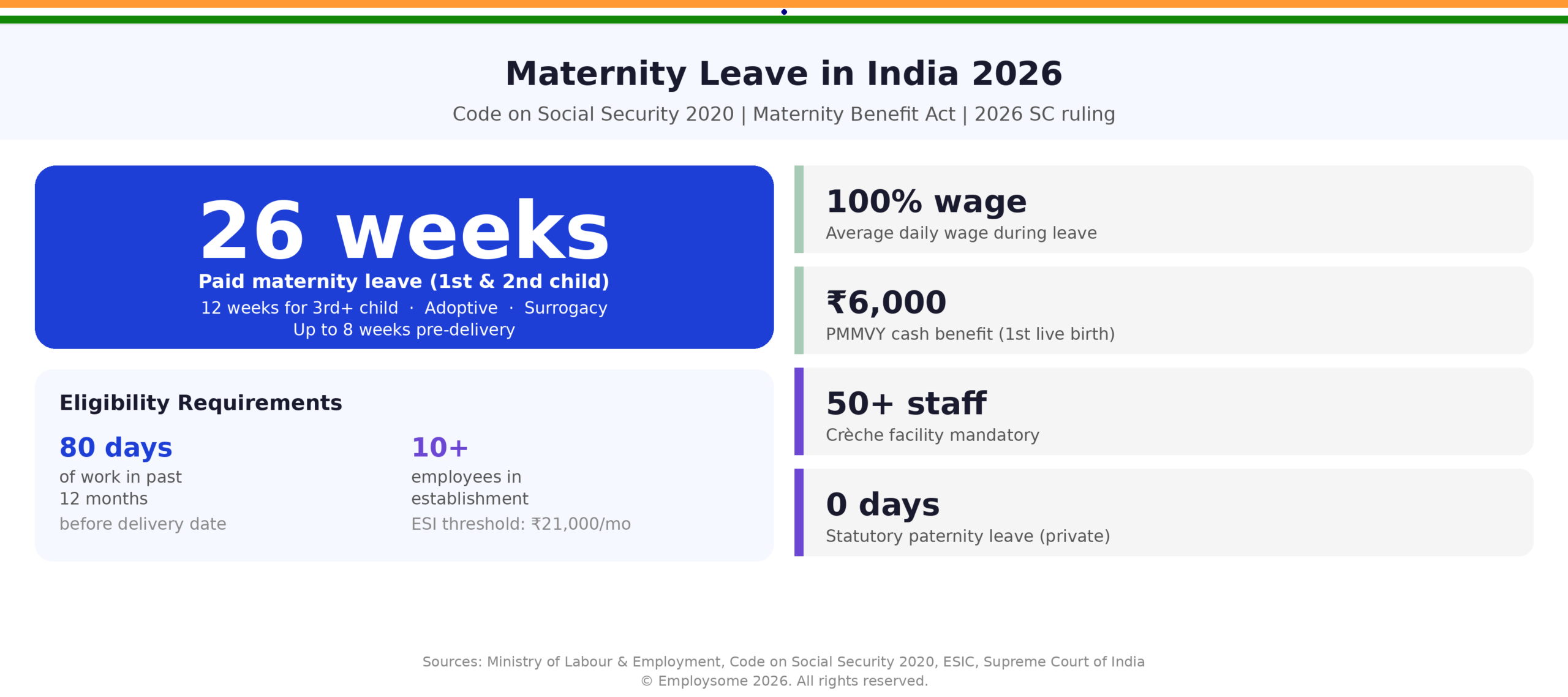
India offers 26 weeks of fully paid maternity leave for first and second children, one of the most generous statutory entitlements in the world. For third and subsequent children, the entitlement drops to 12 weeks. The framework was established under the Maternity Benefit Act 1961, significantly expanded by the 2017 Amendment, and is now governed by Chapter VI of the Code on Social Security 2020, which came into effect on 21 November 2025 as part of India’s four new labour codes. Final central rules are expected by 1 April 2026, at which point full enforcement begins.
For international employers hiring in India, maternity compliance is non-negotiable: it applies to any establishment with 10 or more employees, covers permanent, temporary, and contract workers who meet the 80-day eligibility rule, and triggers significant ongoing employer obligations including paid leave, crèche facilities (50+ employees), nursing breaks, work-from-home options, and a complete prohibition on termination during pregnancy or maternity leave. Around 73% of Indian women still quit working after childbirth, making maternity policy a critical retention lever for any company hiring in India.
This 2026 guide to maternity leave in India covers everything employers and HR teams need to know: the full 26-week / 12-week leave structure, eligibility rules, wage payment calculations under the Code on Social Security 2020, miscarriage and tubectomy leave, adoptive and commissioning mother provisions (including the landmark 2026 Supreme Court ruling in Hamsaanandini Nanduri v. Union of India), the ESI scheme for employees earning under ₹21,000 per month, the Pradhan Mantri Matru Vandana Yojana (PMMVY) cash benefit, crèche facility requirements, the current state of paternity leave (and what may change), and what international companies hiring through an Employer of Record (EOR) need to budget in 2026.

Maternity Leave in India 2026: Duration and Structure
Maternity leave in India is now governed by Chapter VI of the Code on Social Security 2020 (SS Code), which consolidated and replaced the Maternity Benefit Act 1961. The SS Code took effect on 21 November 2025 alongside the three other new labour codes (Code on Wages, Industrial Relations Code, and OSH Code), with final central rules expected by 1 April 2026. During the transition period, the substantive provisions of the Maternity Benefit Act continue to apply, with key enhancements brought in by the SS Code.
The core maternity entitlements in 2026 are:
| Type of Maternity Leave | Duration | Pre-Delivery Limit | Notes |
| First or second child | 26 weeks (182 days) paid | Up to 8 weeks before delivery | Most common scenario, fully paid by employer |
| Third or subsequent child | 12 weeks (84 days) paid | Up to 6 weeks before delivery | Reduced to 12 weeks for women with 2+ surviving children |
| Adoptive mother | 12 weeks paid | From date child is handed over | 2026 SC ruling removed the 3-month child age limit |
| Commissioning (surrogacy) mother | 12 weeks paid | From date child is handed over | Mother who uses her own eggs via surrogacy |
| Miscarriage or medical termination | 6 weeks paid | From date of incident | With medical certification |
| Tubectomy operation | 2 weeks paid | From date of operation | Family planning incentive |
| Complications during pregnancy or post-delivery | 1 month additional | In addition to standard leave | With medical certification |
Maternity leave is structured to provide up to 8 weeks before the expected delivery date and up to 18 weeks after childbirth for first and second children. Mothers can choose to take less pre-delivery leave (or none at all) and use the full 26 weeks post-delivery, depending on health and personal circumstances. For third and subsequent children, pre-delivery leave is capped at 6 weeks.
Eligibility Rules for Maternity Benefits in India
Eligibility for statutory maternity leave in India under the SS Code 2020 requires three conditions to be met:
- Establishment threshold: The employer must have 10 or more employees. Smaller establishments are not legally required to provide maternity leave under the Act, although many voluntarily do as part of HR best practice.
- Service requirement: The employee must have worked for the same employer for at least 80 days in the 12 months immediately preceding the expected delivery date. The 80 days do not need to be continuous.
- Worker classification: The benefit applies to permanent, temporary, part-time, and contract employees who meet the service requirement. It is not limited to permanent staff. Recent Supreme Court rulings have also extended maternity benefits to daily-wage workers in specific contexts.
Critical note for employers: Eligibility extends beyond biological mothers. Adoptive mothers, commissioning mothers (surrogacy), and unmarried women are all entitled to maternity benefits under the law. The Supreme Court has explicitly held that reproductive autonomy falls under Article 21 of the Constitution, meaning unmarried women have the same maternity rights as married employees.
Workers covered by ESI: Women employed in establishments covered by the Employees’ State Insurance (ESI) Act and earning up to ₹21,000 per month in wages receive their maternity benefits through the ESI Corporation rather than directly from the employer. Once an employee is covered by ESI, the Maternity Benefit Act does not apply to them simultaneously, and benefits cannot be claimed under both schemes. ESI maternity benefit equals the full average daily wage for the same 26-week / 12-week duration.
💡 Employsome Insight: The 80-Day Rule Catches Many International Employers Off Guard
The 80-day rule catches many international employers off guard. If you hire a woman in India and she becomes pregnant within her first three months of employment, she may not qualify for statutory maternity leave under the Act. However, you cannot use this as a reason to terminate her employment, refuse her hiring, or treat her differently — doing so is a clear violation of the Act and Article 15 of the Constitution. Best practice for international employers is to provide maternity leave voluntarily even when the 80-day threshold is not strictly met, both to comply with evolving judicial interpretation and to avoid costly discrimination claims.
Wage Payment, Medical Bonus, and PMMVY Cash Benefit
The financial structure of maternity leave in India places the cost burden almost entirely on the employer (except for ESI-covered employees). The Code on Social Security 2020 introduces a uniform definition of “wages” that is now used for maternity benefit calculations, aligned with the definition in the Code on Wages 2019.
| Payment Component | Amount / Calculation | Paid By |
| Maternity benefit (paid leave wages) | Full average daily wage for 26 weeks / 12 weeks | Employer (or ESI Corporation if ESI-covered) |
| Wage calculation basis | Average daily wage of last 3 months preceding leave | — |
| Medical bonus | ₹1,000 (lump sum, no complications) | Employer |
| PMMVY cash benefit | ₹6,000 in 3 installments (first live birth only) | Government (Pradhan Mantri Matru Vandana Yojana) |
| National Food Security Act maternity bonus | ₹6,000 | Government |
| Crèche facility | Mandatory cost (in-house or shared) | Employer (50+ employees) |
The average daily wage is calculated from the average of the last three months’ salary preceding the start of leave. Under the new uniform definition in the SS Code 2020, “wages” means basic pay plus dearness allowance plus retaining allowance, with the rule that allowances cannot exceed 50% of total remuneration (CTC). This is a meaningful change because Indian employers historically kept basic pay artificially low (30-40% of CTC) to minimise statutory contributions; the 50% wage rule increases the wage base used for maternity benefit calculations. Read more about the 50% wage rule and India’s new labour codes.
For ESI-covered employees (earning under ₹21,000 per month): Maternity benefits are disbursed by the Employees’ State Insurance Corporation, not the employer. Employees must have contributed to ESI for at least 70 days in the two consecutive contribution periods immediately preceding the expected delivery date. ESI maternity benefit also covers full average daily wages for the same 26-week / 12-week duration, plus a confinement expense allowance of ₹5,000 per delivery.
PMMVY (Pradhan Mantri Matru Vandana Yojana): A government cash transfer scheme providing ₹6,000 in three installments for the first live birth only, paid by the central government to encourage institutional deliveries and improved nutrition. The scheme is targeted at women in the unorganised sector but also benefits formal-sector workers who meet criteria. PMMVY is paid in addition to (not in place of) employer-provided maternity benefits.
Employer Obligations Beyond Paid Leave
Beyond paid leave, the Maternity Benefit Act and SS Code 2020 impose several specific obligations on employers that international companies routinely overlook until enforcement action begins. Compliance is monitored by labour inspectors, and penalties under Section 12 of the Act include fines and criminal liability for repeat violations.
| Employer Obligation | Threshold / Trigger | Detail |
| Crèche facility | Establishments with 50+ employees | In-house, shared, or common facility within prescribed distance; women allowed 4 daily visits |
| Nursing breaks | All eligible mothers, post-return | 2 paid nursing breaks per working day until child is 15 months old |
| Work-from-home option | After 26-week leave ends | Mutual agreement based on nature of work |
| No physically demanding work | 10 weeks before due date | No standing for long hours, no arduous work, no work that may harm pregnancy |
| Mandatory written notification | At time of appointment | Employer must inform every female employee of her maternity rights in writing and via email |
| Visible workplace notice | All establishments with 10+ employees | Display required notice in workplace |
| No termination during maternity | Pregnancy and full leave duration | Termination during pregnancy or maternity leave is prohibited and triggers Section 12 penalties |
| Pay benefits on time | Throughout leave | Average daily wages must be paid in advance or on regular cycle, not delayed |
| Maintain records and registers | Always | Records of maternity leave, payments, and notifications must be retained |
Crèche facility specifics: Establishments with 50 or more employees must provide a crèche (daycare) facility either individually or through a shared/common facility within a prescribed distance from the workplace. Working mothers are entitled to up to four visits to the crèche per day, including rest periods. Many international employers in India satisfy this obligation through partnerships with third-party crèche providers like Klay, KinderCare, and Footprints, which charge employers per-child monthly fees.
Termination prohibition: Under Section 12 of the Act, terminating a pregnant employee or one on maternity leave is a clear violation that can lead to reinstatement orders, back pay, damages, and criminal prosecution. The Supreme Court has consistently struck down workplace rules that discriminate against pregnant employees, including in the landmark X v. Principal Secretary, Health and Family Welfare ruling on reproductive autonomy.
The 2026 Supreme Court Ruling on Adoptive Mothers
A landmark Supreme Court ruling in 2026, Hamsaanandini Nanduri v. Union of India, significantly expanded maternity rights for adoptive mothers in India. The case challenged the existing rule that limited maternity benefits to mothers who adopted children below the age of three months, leaving mothers of older adoptive children with no statutory maternity protection.
In its judgment, a bench led by Justice Pardiwala struck down the three-month adoption age limit as discriminatory and inconsistent with Article 14 (equality) of the Constitution. The Court extended maternity benefit entitlements to all adoptive mothers regardless of the age of the adopted child, recognising that early bonding and care needs are not limited to infants under three months.
Key implications of the 2026 ruling for employers:
- All adoptive mothers are now entitled to 12 weeks of paid maternity leave, regardless of the adopted child’s age at the time of placement
- Internal HR policies that reference “under three months” adoption age limits are no longer enforceable and must be updated
- The ruling reinforces the broader trend of Indian courts treating maternity benefits as a Constitutional right rather than a contractual perk
- Employers should expect further judicial expansion of the framework, particularly around paternity leave and gig worker maternity protection
Within the same 100-page judgment, the Court also made a significant observation about paternity leave, urging Parliament to legislate paternity leave as a social security entitlement rather than leaving it to employer discretion. Justice Pardiwala observed that the absence of statutory paternity leave “entrenches gendered caregiving roles and deprives fathers of any meaningful chance to be present in their child’s earliest weeks.” This observation is not yet binding law, but signals likely future legislative reform.
Paternity Leave in India: Current State and What May Change
India does not currently have a statutory paternity leave law for private sector employees. This stands in stark contrast to the generous 26-week maternity entitlement and creates a meaningful gap that international employers must navigate carefully when designing their India parental leave policies.
The current paternity leave landscape in India breaks down as follows:
| Sector / Category | Paternity Leave Entitlement | Source |
| Central Government employees | 15 days paid (within 6 months of birth) | Rule 43A, Central Civil Services (Leave) Rules 1972 |
| State Government employees (varies) | 10-30 days, state-dependent | State leave rules |
| Sikkim state employees | 30 days | State rule (highest among states) |
| Karnataka, Andhra Pradesh, Tamil Nadu | 15 days | State leave rules (mirror central) |
| Kerala state employees | 10 days | State leave rules |
| Private sector employees | NO statutory entitlement | Employer policy only |
| Unorganised sector workers | NO statutory entitlement | None (covered by employer if any) |
Voluntary employer practices: Around 14% of Indian companies offer formal paternity leave, with leading employers offering generous policies as a competitive talent strategy:
- Zomato: 26 weeks paternity leave plus a ₹69,000 endowment to new parents
- Wipro: 8 weeks paid paternity leave (extended to biological, adoptive, and in loco parentis caregivers)
- Tata Consultancy Services (TCS): 15 days
- Top-tier startups: Increasingly 4-12 weeks to match global norms
- Most private sector employers: 5-15 days, often as part of broader leave entitlement
Future direction: The Paternity and Parental Benefit Bill 2025, introduced by MP Supriya Sule in the Lok Sabha, proposes 8 weeks paid paternity leave plus 8 weeks shared parental leave within 18 months of birth. The bill is currently a private member’s bill and has not been taken up for discussion. The Supreme Court’s 17 March 2026 observation in Hamsaanandini Nanduri urging Parliament to legislate paternity leave as a social security right increases the likelihood of formal legislation in the next 12-24 months.
Total Cost of Maternity Compliance for International Employers
For international employers hiring in India, the 26-week maternity commitment carries real cost and operational implications that must be built into hiring plans. While India’s maternity benefits are progressive on paper, around 73% of Indian women still quit working after childbirth, and nearly half of those who return leave again within four months. Designing thoughtful return-to-work programmes is therefore as important as bare compliance.
Direct cost of a 26-week maternity leave:
| Cost Component | Calculation | Example (₹10,00,000 CTC) |
| Maternity wages (26 weeks) | ~50% of annual gross salary | ~₹5,00,000 |
| Medical bonus | ₹1,000 (no complications) | ₹1,000 |
| Statutory contributions during leave | PF, gratuity, ESI continue accruing | ~₹60,000 |
| Crèche facility (per child, if 50+ employees) | ~₹10,000-25,000/month per child | ~₹1,20,000-3,00,000/year |
| Replacement / interim cover | Variable | Typically 50-80% of regular salary |
| Total direct cost (excl. crèche) | — | ~₹5,61,000 + replacement |
Operational implications:
- Workforce planning: Build maternity buffers into team headcount, particularly for India teams with high female representation in engineering, marketing, and customer success roles
- Documentation and notice: Provide written notification of maternity rights at appointment (legally required) and establish a clear leave application process
- Crèche planning: At 50+ India employees, evaluate options between in-house, shared/common, or third-party crèche providers (Klay, Footprints, KinderCare are common choices)
- Return-to-work programmes: Offer phased return, work-from-home, or reduced-hours options to reduce attrition. Companies offering these report return rates of 80%+ versus the 27% baseline
- Audit existing policies: Update internal HR policies to remove the three-month adoption age limit struck down in 2026, align wage definitions with the new SS Code, and ensure crèche eligibility is current
💡 Employsome Insight: EOR vs Direct Compliance for Maternity Management in India
For international companies hiring 1-50 employees in India, the most cost-effective and compliance-safe option is to use an Employer of Record (EOR) rather than manage maternity compliance directly. The EOR handles the full compliance stack: written notification at appointment, accurate eligibility assessment under the 80-day rule, wage calculation under the SS Code 2020 “wages” definition, ESI coordination where applicable, statutory contribution continuity during leave, crèche facility compliance (or shared facility access), nursing break tracking, and audit-ready documentation. EOR pricing in India typically ranges from USD 200-400 per employee per month on top of gross salary and statutory contributions.
What International Employers Need to Know
26 weeks paid maternity leave is the standard for first and second children
Under the Maternity Benefit Act and Code on Social Security 2020, eligible women in India receive 26 weeks (182 days) of fully paid maternity leave for first and second children, with up to 8 weeks taken before delivery. For third and subsequent children, the entitlement is 12 weeks.
Eligibility requires 80 days work in preceding 12 months
An employee must have worked for the same employer for at least 80 days in the 12 months immediately preceding her expected delivery date. The benefit applies to permanent, temporary, part-time, and contract workers. Establishments must have 10+ employees for statutory coverage.
The 2026 SC ruling expanded adoptive mother rights
In Hamsaanandini Nanduri v. Union of India, the Supreme Court struck down the three-month adoption age limit. All adoptive mothers now receive 12 weeks of paid maternity leave regardless of the adopted child’s age at placement. Update internal policies accordingly.
ESI handles maternity for employees earning under ₹21,000
Women earning up to ₹21,000 per month in wages are covered under ESI and receive maternity benefits from the ESI Corporation, not the employer. They cannot claim under both the Maternity Benefit Act and ESI simultaneously. ESI also pays a ₹5,000 confinement expense allowance.
Crèche facility is mandatory at 50+ employees
Establishments with 50 or more employees must provide a crèche facility individually or through a shared/common facility. Working mothers are entitled to four daily visits. Third-party crèche providers like Klay, Footprints, and KinderCare are commonly used to satisfy this requirement.
Termination during pregnancy or maternity is prohibited
Section 12 of the Maternity Benefit Act prohibits termination during pregnancy or maternity leave, with criminal penalties for violations. Employers must maintain records, provide written notification of rights at appointment, and protect employment continuity during the full leave period.
Paternity leave remains a private sector gap
Private sector employees have no statutory paternity leave entitlement. Central Government employees receive 15 days. Leading employers like Zomato (26 weeks), Wipro (8 weeks), and TCS (15 days) offer voluntary paternity benefits. The 2026 Supreme Court observation has urged Parliament to legislate paternity leave as a social security right.
Consider an EOR for compliant Indian hiring
For international companies hiring in India without a local entity, an Employer of Record handles maternity benefit administration, ESI coordination, crèche compliance, statutory notifications, and Code on Social Security 2020 compliance automatically. See our Best EOR in India guide for verified provider rankings.
Hiring in India?
Indian maternity compliance under the Code on Social Security 2020 requires the 80-day eligibility check, wage calculations under the new uniform definition, ESI coordination for low-wage workers, mandatory crèche facilities at 50+ employees, written rights notification, and termination protection. Compare the top Employer of Record providers for India in 2026 – verified pricing, compliance scores, and expert rankings from Employsome’s independent research team.
Frequently Asked Questions
In India, eligible women employees receive 26 weeks (182 days) of fully paid maternity leave for their first or second child, with up to 8 weeks taken before the expected delivery date and the remainder after birth. For the third and subsequent children, the entitlement reduces to 12 weeks (84 days) with up to 6 weeks pre-delivery. Adoptive mothers and commissioning mothers (surrogacy) receive 12 weeks from the date the child is handed over. The framework is governed by the Maternity Benefit Act 1961 and Chapter VI of the Code on Social Security 2020.
To qualify for statutory maternity leave in India, an employee must satisfy three conditions: (1) employed in an establishment with 10 or more employees, (2) worked at least 80 days for the same employer in the 12 months preceding the expected delivery date, and (3) be a biological, adoptive, or commissioning (surrogate) mother. The benefit applies to permanent, temporary, part-time, and contract workers. The Supreme Court has also extended maternity rights to unmarried women under the constitutional right to reproductive autonomy.
In Hamsaanandini Nanduri v. Union of India (2026), the Supreme Court struck down the rule limiting maternity benefits to mothers who adopted children below three months of age. The Court extended 12 weeks of paid maternity leave to all adoptive mothers regardless of the adopted child’s age at placement. Employers must now update internal HR policies to remove any three-month adoption age limits and provide equivalent maternity benefits to all adoptive mothers.
Maternity benefit equals the average daily wage calculated from the average of the last three months’ salary preceding the start of leave. Under the Code on Social Security 2020, “wages” means basic pay plus dearness allowance plus retaining allowance, with the rule that allowances cannot exceed 50% of total remuneration (CTC). For employees earning up to ₹21,000 per month, maternity benefits are paid by the ESI Corporation rather than the employer. Employees also receive a ₹1,000 medical bonus (no complications) and may be eligible for the ₹6,000 PMMVY cash benefit for first live birth.
The Maternity Benefit Act applies only to establishments with 10 or more employees. Smaller establishments are not legally required to provide statutory maternity benefits, although many do voluntarily as part of HR best practice. International employers should note that the Code on Social Security 2020 empowers the government to extend maternity protections to gig and platform workers via separate schemes, with draft rules under consultation in late 2025 and early 2026.
No. Under Section 12 of the Maternity Benefit Act, termination of a pregnant employee or one on maternity leave is strictly prohibited. Termination during this period can lead to mandatory reinstatement, full back pay, damages, and criminal prosecution under Section 21 of the Act. The prohibition extends through the entire pregnancy and the full duration of maternity leave (26 or 12 weeks). Even legitimate redundancy or performance concerns cannot be acted upon during this protected period.
Yes. Adoptive mothers and commissioning mothers (those using surrogacy with their own eggs) are entitled to 12 weeks of paid maternity leave from the date the child is handed over. Following the 2026 Supreme Court ruling in Hamsaanandini Nanduri v. Union of India, the previous rule limiting adoption-based maternity benefits to children under three months has been struck down. All adoptive mothers now qualify regardless of the adopted child’s age. Surrogate mothers (those carrying a child for someone else) are entitled to 12 weeks of leave following delivery.
Establishments with 50 or more employees must provide a crèche (daycare) facility either in-house, through a shared/common arrangement, or via a third-party provider within a prescribed distance from the workplace. Working mothers are entitled to up to four visits to the crèche per day, including rest periods. Many international employers satisfy this obligation through commercial crèche providers like Klay, KinderCare, and Footprints, with typical costs of ₹10,000-25,000 per child per month.
India does not have a statutory paternity leave law for private sector employees. Central Government employees receive 15 days of paid paternity leave under Rule 43A of the Central Civil Services (Leave) Rules 1972. State employees receive between 10 and 30 days depending on the state. In the private sector, paternity leave is purely employer-discretion: around 14% of Indian companies offer formal paternity benefits, ranging from 5-15 days at most employers to 26 weeks at progressive companies like Zomato. The Supreme Court urged Parliament in 2026 to legislate paternity leave as a social security right.
An Employer of Record (EOR) handles all maternity compliance on behalf of international employers. The EOR drafts compliant Indian employment contracts with mandatory maternity rights notification, applies the 80-day eligibility test correctly, calculates wage payments under the Code on Social Security 2020 “wages” definition, coordinates ESI maternity benefits for employees earning under ₹21,000, manages crèche facility access for employers with 50+ India employees, ensures statutory contribution continuity during leave, and maintains audit-ready documentation. For companies hiring 1-50 Indian employees, an EOR is typically faster and lower-risk than direct compliance management. See our Best EOR in India guide for provider rankings.
Copywriter
Christa is a Copywriter at Employsome with 17 years of professional writing experience across global brands, startups, and online publications. A native English-Finnish writer, she brings strong editorial skills and a versatile background in business, SaaS, and finance. At Employsome, Christa focuses on clear, practical content about HR, payroll, and Employer of Record topics.
Our content is created for informational purposes only and is not intended to provide any legal, tax, accounting, or financial advice. Please obtain separate advice from industry-specific professionals who may better understand your business’s needs. Read our Editorial Guidelines for further information on how our content is created.