
Average Salary in China 2026: Complete Employer Guide
The average salary in China in 2026 is RMB 124,110 per year per NBS data for urban non-private units, with foreign-invested enterprises averaging RMB 157,964. This guide covers wages by region (Eastern RMB 143,712 vs Central RMB 98,090), city (Beijing, Shanghai, Shenzhen, Hangzhou), industry, and experience level, plus the 7-bracket IIT tax (3% to 45%), Five Insurances and Housing Fund contributions, and total employer cost in China.

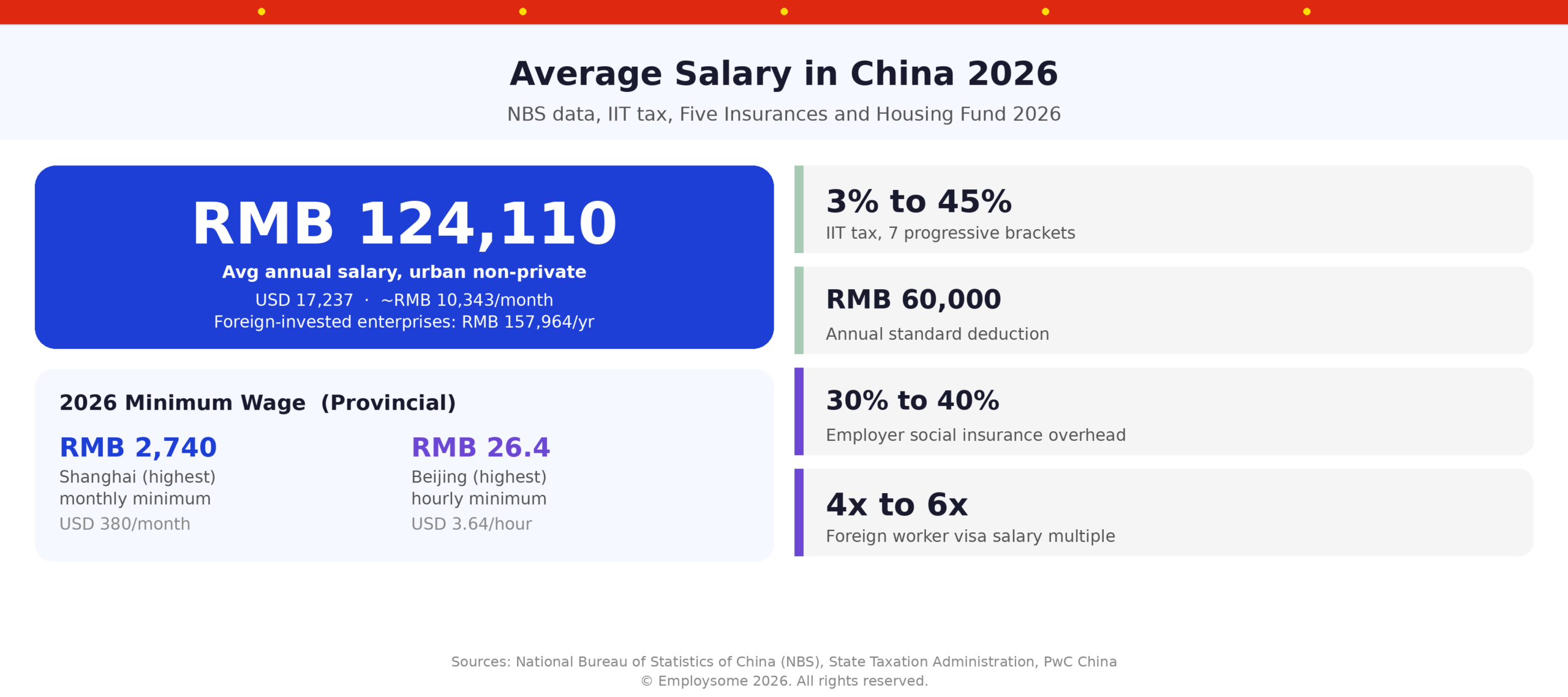
The average salary in China in 2026 must be read in segments rather than as a single number, because the country has the most fragmented wage benchmarks of any major economy. According to the latest National Bureau of Statistics (NBS) data, the average annual wage for urban non-private units is RMB 124,110 (approximately USD 17,237), equivalent to RMB 10,343 (USD 1,437) per month, while the average for urban private units is significantly lower at RMB 69,476 per year (USD 9,649) or roughly RMB 5,790 per month. For foreign-invested enterprises specifically, the average annual wage reaches RMB 157,964, making this the most relevant benchmark for international employers.
China is the world’s second-largest economy by nominal GDP and its largest by purchasing power parity, with a population of approximately 1.4 billion, GDP per capita of USD 27,105 (PPP-adjusted), and the world’s largest manufacturing sector (31.2% of global manufacturing output). Salary levels vary enormously across regions: the eastern coastal provinces averaged RMB 143,712 in 2024, compared to RMB 98,090 in central China, RMB 110,376 in the western region, and RMB 98,889 in the northeast. Industry differences are equally dramatic: IT and software services pay an average of RMB 238,966 per year, while hotels and catering pay just RMB 60,240.
This 2026 guide to average salary in China covers everything employers and HR teams need to budget compliantly: official 2026 wage data from the NBS, salary breakdowns by region, city (Beijing, Shanghai, Shenzhen, Guangzhou, Hangzhou), industry, and role, the 7-bracket Individual Income Tax (IIT) system from 3% to 45%, mandatory “Five Insurances and One Housing Fund” social insurance contributions varying by city, special additional deductions, total employer cost, work permit salary thresholds, and what international companies hiring Chinese workers need to budget in 2026.

Average Salary in China 2026: Latest NBS Data
China’s salary data is reported in segments by the National Bureau of Statistics (NBS), and choosing the right benchmark is essential for foreign employers. The NBS separates urban non-private units (state-owned enterprises and large formal employers), urban private units (smaller private companies), enterprises above the designated size, and foreign-invested units, each producing meaningfully different averages.
| Wage Benchmark (2024 NBS, applicable for 2026 planning) | Annual (RMB) | Monthly (RMB) | Approx. USD |
| Urban non-private units (state-owned and large formal employers) | 124,110 | 10,343 | ~1,437/month |
| Urban private units (smaller private companies) | 69,476 | 5,790 | ~804/month |
| Foreign-invested enterprises (most relevant for foreign employers) | 157,964 | 13,164 | ~1,828/month |
| Enterprises above designated size (overall) | 102,452 | 8,538 | ~1,186/month |
| Middle management and above (designated-size enterprises) | 203,014 | 16,918 | ~2,350/month |
| Professional and technical personnel | 148,046 | 12,337 | ~1,714/month |
| Office staff and related personnel | 93,189 | 7,766 | ~1,079/month |
| Production and manufacturing personnel | 78,561 | 6,547 | ~910/month |
For foreign employers benchmarking offers in China, the foreign-invested enterprise average of RMB 157,964 per year (~RMB 13,164 per month) is the most relevant figure, since international companies typically compete in this segment of the labour market. The urban non-private average (RMB 124,110) is the official headline national figure most often quoted in media.
China does not have a single national minimum wage. Instead, minimum wages are set at the provincial and municipal level, with massive regional variation. The 2026 minimum wage is highest in Shanghai at RMB 2,740 per month (up from RMB 2,690 in 2024), with Beijing leading on the hourly rate at RMB 26.4 per hour. Lower-tier rates in inland and rural provinces can be under RMB 1,500 per month. Minimum wages must be adjusted at least every 2-3 years per national guidelines.
💡 Employsome Insight: How to Read China’s Confusing Average Salary Numbers
Why are China’s average salary figures often confusing? Because there are at least four official NBS benchmarks (urban non-private, urban private, designated-size enterprises, and foreign-invested units), and another set of media-quoted averages from Salary Explorer, Glassdoor, and Zhaopin that range from RMB 9,500 to RMB 22,053 per month. For foreign employers, ignore generic media averages and use the NBS foreign-invested enterprise average (RMB 157,964/year) or the eastern-region urban non-private average (RMB 143,712/year) as your starting benchmark. Then localize by city (Beijing, Shanghai, Shenzhen pay 30-50% more than tier-2 cities) and by industry (IT and finance pay 60-95% above the cross-sector average).
Average Salary in China by Industry and Sector
Industry differences in China are among the largest in the world. The 2024 NBS data shows IT and software services at RMB 238,966 per year in urban non-private units (the highest-paying sector in China), finance at RMB 201,883, and manufacturing at RMB 107,987, while hotels and catering services average just RMB 60,240. The gap between top and bottom sectors is nearly 4x.
| Sector / Industry (2024 NBS, urban non-private) | Average Annual Salary (RMB) | Approx. Monthly (RMB) |
| Information transmission, software, and IT services | 238,966 | ~19,914 |
| Financial intermediation (banking, insurance) | 201,883 | ~16,824 |
| Scientific research and technical services | 178,000 to 195,000 | ~14,800 to 16,250 |
| Energy and electric utilities | 150,000 to 175,000 | ~12,500 to 14,580 |
| Pharmaceuticals and life sciences | 140,000 to 165,000 | ~11,667 to 13,750 |
| Education | 120,000 to 140,000 | ~10,000 to 11,667 |
| Healthcare | 115,000 to 145,000 | ~9,580 to 12,083 |
| Manufacturing (general) | 107,987 | ~9,000 |
| Construction | 85,000 to 100,000 | ~7,083 to 8,333 |
| Retail and wholesale trade | 80,000 to 95,000 | ~6,667 to 7,917 |
| Hotels and catering services | 60,240 | ~5,020 |
| Agriculture, forestry, and fishery | 55,000 to 70,000 | ~4,583 to 5,833 |
In urban private units, the same sector ranking holds but at lower absolute levels: IT services average RMB 123,193 (RMB 10,266/month), finance averages RMB 135,339 (RMB 11,278/month), and manufacturing averages RMB 71,467 (RMB 5,956/month). The private / non-private gap reflects that state-owned enterprises and large foreign-invested firms dominate the higher-paying segment.
Specific role benchmarks (gross monthly, foreign-invested enterprises in tier-1 cities): software engineers earn RMB 25,000-50,000, senior software engineers at major tech firms RMB 40,000-80,000+, financial analysts RMB 15,000-35,000, marketing managers RMB 18,000-40,000, HR managers RMB 18,000-35,000, and customer service representatives RMB 6,000-12,000. Executive roles at Chinese tech giants (Alibaba, Tencent, ByteDance, Huawei) and FAANG-tier multinationals in China can reach RMB 100,000-300,000+ per month including equity.
Average Salary by City: Beijing, Shanghai, Shenzhen, Hangzhou
Regional and city-level salary differences in China are exceptionally large. Tier 1 cities (Beijing, Shanghai, Shenzhen, Guangzhou) command the highest wages, driven by concentration of multinational HQs, financial services, and tech firms. Tier 2 cities (Hangzhou, Suzhou, Chengdu, Wuhan, Tianjin, Nanjing) pay 15-30% less but still attract major employers. Tier 3 and inland cities pay 30-50% below Tier 1 levels.
| City / Region | Average Gross Monthly Salary 2026 (RMB) | Notes |
| Beijing | RMB 16,500 to 25,000+ | Capital, multinational HQs, finance, tech, education |
| Shanghai | RMB 16,500 to 25,000+ | Financial capital, foreign-invested HQs, services |
| Shenzhen | RMB 14,000 to 22,000+ | Tech & manufacturing hub (Tencent, Huawei, BYD) |
| Guangzhou | RMB 12,000 to 18,000 | Trade, manufacturing, services |
| Hangzhou | RMB 11,000 to 17,000 | E-commerce capital (Alibaba), fintech, growing tech |
| Suzhou | RMB 10,000 to 15,000 | Manufacturing, foreign-invested industrial |
| Chengdu | RMB 9,000 to 14,000 | Western tech hub, services, lower cost of living |
| Wuhan | RMB 9,000 to 13,500 | Central China hub, automotive, optoelectronics |
| Tianjin | RMB 9,500 to 14,000 | Port city, manufacturing, free trade zone |
| Nanjing | RMB 9,500 to 14,500 | Yangtze Delta, education, electronics |
| Xi’an | RMB 7,500 to 11,500 | Western region, aerospace, defense, education |
| Smaller inland cities and rural areas | RMB 4,500 to 8,500 | Agriculture, traditional industries, lower-tier wages |
Regional averages (2024 NBS, urban non-private units): Eastern region RMB 143,712/year (the wealthiest, includes Beijing, Shanghai, Guangdong, Jiangsu, Zhejiang, Fujian); Western region RMB 110,376; Northeastern region RMB 98,889; Central region RMB 98,090. The gap between eastern and central/northeastern regions is approximately 45-50%, making location selection one of the most important variables in China hiring decisions.
Cost of living context: In Beijing or Shanghai, average monthly rent for a one-bedroom apartment in central districts is RMB 6,000-15,000+; utilities RMB 300-600; public transport RMB 200-400. A monthly salary of RMB 20,000-30,000 in Tier 1 cities provides comfortable middle-class living for a single professional; in Tier 2 cities, RMB 12,000-18,000 delivers similar quality of life. Tier 1 city housing absorbs 30-50% of gross income for most professionals, well above the OECD average.
💡 Employsome Insight: Hangzhou Is China’s Highest-Value Tier 2 Destination
Beijing, Shanghai, and Shenzhen are roughly comparable to mid-tier US and European cities on salary, while Hangzhou and Tier 2 cities offer 20-40% cost savings with access to large, educated talent pools. Hangzhou specifically has emerged as China’s fintech and e-commerce capital (anchored by Alibaba and Ant Group), making it the highest-value Tier 2 destination for foreign employers. Senior software engineers at top Chinese tech firms (Tencent, ByteDance, Huawei, Alibaba) earn RMB 60,000-120,000+ per month including equity, comparable to senior tech roles in major US cities. Budget for senior tech roles in foreign-invested companies at RMB 40,000-90,000 per month gross to compete with these domestic employers.
Average Salary by Experience Level and Education
Earnings in China rise predictably with experience, education, and seniority. China produces approximately 11 million university graduates each year, creating intense competition that has actually contributed to wage compression at junior levels (a phenomenon known as “overuceducation”). Mid-career and senior professionals, particularly in tech and finance, command significantly higher premiums.
| Experience Level | Average Gross Monthly Salary 2026 (RMB) |
| Entry-level (0-2 years) | RMB 6,000 to 10,000 |
| Junior (2-5 years) | RMB 9,000 to 16,000 |
| Mid-level (5-10 years) | RMB 14,000 to 28,000 |
| Senior (10-15 years) | RMB 25,000 to 50,000 |
| Lead / management | RMB 40,000 to 80,000 |
| Executive / C-suite | RMB 80,000 to 300,000+ |
Educational level has a meaningful effect on earnings in China. Diploma holders earn approximately 17% more than high school graduates; bachelor’s degree holders earn around 24% more than diploma holders; master’s degree holders earn 25-30% more than bachelor’s graduates; PhD holders typically earn 40-60% more than master’s peers, particularly in research, pharmaceuticals, and finance. Graduates from Tsinghua University, Peking University, Fudan University, Shanghai Jiao Tong University, and Zhejiang University command substantial premiums and are heavily recruited by tech giants and multinationals.
Foreign worker salary thresholds (work permits): From 2026, expat salaries are tied to multiples of the local average wage. Category A (high-end talent) work permits require a monthly salary of at least 6 times the local average; Category B (professional) requires 4 times the local average. In Beijing, this translates to roughly RMB 47,700/month for Category B and RMB 71,600/month for Category A. Foreign teaching English roles typically fall under Category B at the 4x threshold.
China Income Tax (IIT) 2026: 7 Progressive Brackets
China operates a progressive 7-bracket Individual Income Tax (IIT) system, governed by the Individual Income Tax Law and administered by the State Taxation Administration (STA). The 2026 IIT rates range from 3% to 45%, applied to annual comprehensive income (wages, labour services, author’s remuneration, and royalties combined) using a quick-deduction formula:
| Annual Taxable Income (RMB) | 2026 Marginal Rate | Quick Deduction (RMB) |
| Up to 36,000 | 3% | 0 |
| 36,001 to 144,000 | 10% | 2,520 |
| 144,001 to 300,000 | 20% | 16,920 |
| 300,001 to 420,000 | 25% | 31,920 |
| 420,001 to 660,000 | 30% | 52,920 |
| 660,001 to 960,000 | 35% | 85,920 |
| Above 960,000 | 45% | 181,920 |
IIT is withheld at source by the employer using the cumulative withholding method introduced in the 2019 IIT reform. The employer calculates and remits monthly, with annual reconciliation due between 1 March and 30 June for the previous tax year. Late filing penalties range from RMB 1,800 to RMB 35,000 plus surcharges.
Standard deduction: All taxpayers receive a standard basic deduction of RMB 60,000 per year (RMB 5,000 per month), applied before IIT calculation. This effectively means the first RMB 5,000 of monthly salary is exempt from IIT.
Special additional deductions (for residents): China offers six categories of personal deductions beyond the standard:
- Children’s education: RMB 24,000 per child per year (RMB 2,000 per month)
- Infant care (under age 3): RMB 24,000 per child per year
- Continuing education: RMB 4,800-19,200 per year depending on programme
- Serious illness medical expenses: Up to RMB 80,000 per year for out-of-pocket expenses above RMB 15,000
- Housing loan interest or housing rent: RMB 9,600-19,200 per year (rent, depending on city tier) or RMB 12,000 per year (mortgage interest)
- Elderly parent support (over age 60): RMB 24,000-36,000 per year
Residency rules: China applies a 183-day residency rule with a six-year exception. Non-domiciled individuals who stay 183+ days in a tax year are generally tax residents on China-source income; once they have lived in China for 183+ days for six consecutive years, worldwide income becomes taxable. Breaking the six-year chain by spending sufficient time outside China resets the count.
Total Employer Cost in China 2026
For companies hiring in China, gross salary is only the starting point. Mandatory “Five Insurances and One Housing Fund”, plus the standard practice of 13th-month pay (Spring Festival bonus), supplemental commercial health insurance, and meal/transport allowances add a substantial overhead. Below is an indicative breakdown for an employee on RMB 20,000 monthly gross salary (RMB 240,000 annually) in Shanghai, a typical mid-level professional:
| Cost Component (2026, Shanghai example) | Rate / Amount | Annual Cost (RMB) |
| Gross salary | — | 240,000 |
| Pension insurance (employer) | 16% | 38,400 |
| Medical insurance (employer, Shanghai ~10%) | ~10% | 24,000 |
| Unemployment insurance (employer) | 0.5% | 1,200 |
| Work-related injury insurance | ~0.2-0.5% | ~720 |
| Housing Provident Fund (employer, 7% example) | 7% | 16,800 |
| 13th-month bonus (typical, optional) | ~1 month gross | ~20,000 |
| Supplemental commercial insurance (optional, common) | ~RMB 800/month | ~9,600 |
| Meal and transport allowance (optional, common) | ~RMB 1,000/month | ~12,000 |
| Total fully-loaded annual cost | ~34% mandatory + ~17% benefits | ~RMB 321,120 to 362,720 |
For a RMB 240,000 gross annual salary, the true fully-loaded annual employer cost in 2026 ranges from approximately RMB 321,120 (mandatory only) to RMB 362,720 (with typical Chinese benefits package), a 34-51% uplift depending on optional benefits. Mandatory employer overhead in China is among the higher rates in Asia, but absolute salary levels remain competitive against developed economy benchmarks for skilled tech and finance roles.
The largest employer cost variables are city-level contribution rates (Beijing and Shanghai contribute meaningfully more than Tier 2 cities), Housing Provident Fund rate (5% to 12% range, with most large employers choosing 7-12%), and 13th-month bonus practices (essentially expected in China for white-collar roles, particularly around Spring Festival / Chinese New Year).
How International Companies Hire in China
For international companies hiring in China without a local entity, there are three practical options: establish a Wholly Foreign-Owned Enterprise (WFOE), engage workers as independent contractors, or use an Employer of Record (EOR).
Option 1: Establish a Wholly Foreign-Owned Enterprise (WFOE)
Setting up a WFOE in China is the traditional route for long-term presence but is operationally heavy. The process requires capital injection (typically minimum RMB 100,000-3 million depending on industry and city), business licence registration with SAMR (State Administration for Market Regulation), tax registration with the State Taxation Administration, social insurance and housing fund registration, foreign exchange registration with SAFE, and bank account establishment. Total timeline: typically 3 to 6 months. Ongoing costs include local accounting, tax compliance, and audit (RMB 50,000-200,000+ per year), plus Corporate Income Tax (CIT) at 25% standard rate (15% for qualified high-tech enterprises).
Option 2: Independent contractors (HIGH RISK)
Engaging Chinese workers as independent contractors carries significant misclassification risk. Chinese labour authorities scrutinize contractor relationships closely, and reclassification can trigger retroactive social insurance, IIT, severance liability, and substantial fines. For ongoing roles with regular working hours, integration into the client’s business, or exclusive arrangements, contractor status is generally not viable. Use only for genuine project-based, multi-client engagements with clear scope and limited duration.
Option 3: Employer of Record (EOR)
An EOR is a Chinese-registered entity (typically a WFOE or local company) that formally employs the worker on your behalf. The EOR handles compliant Chinese employment contracts (in Chinese, often bilingual), monthly payroll with proper IIT withholding and Five Insurances + Housing Fund remittance, social insurance bureau registration, housing fund management centre filings, annual IIT reconciliation, and ongoing compliance with the Labour Contract Law. Typical setup: 2 to 4 weeks. Typical cost: USD 600 to USD 1,200 per employee per month on top of gross salary, mandatory contributions, and any voluntary benefits.
For hiring 1-15 Chinese employees, or for short to medium-term projects, an EOR is almost always the faster and lower-risk option. For longer-term operations with 15+ Chinese employees, establishing a WFOE eventually becomes more cost-effective.
What International Employers Need to Know
2026 average wage benchmark depends on which segment you measure
For 2026 China hiring planning, use the NBS 2024 release as your base layer: urban non-private RMB 124,110/year (the headline figure), urban private RMB 69,476/year, and foreign-invested enterprises RMB 157,964/year (most relevant for foreign employers). Add city, industry, and role-specific adjustments before finalizing offers.
Tier 1 cities pay 30-50% more than Tier 2
Beijing, Shanghai, and Shenzhen command Tier 1 premiums for tech, finance, and professional services. Hangzhou is a top-value Tier 2 destination (Alibaba, Ant Group). Tier 2 cities offer 15-30% cost savings while still providing access to large educated talent pools.
Tech and finance pay 60-95% above the cross-sector average
IT and software services (RMB 238,966/year), finance (RMB 201,883/year), and scientific research lead Chinese sectoral pay. Manufacturing averages RMB 107,987 and hotels/catering just RMB 60,240. Industry choice often matters more than city choice for total compensation.
IIT ranges from 3% to 45% across 7 brackets
The 2026 IIT system is progressive across 7 brackets, with the top 45% rate applying only above RMB 960,000 annual income. Standard deduction is RMB 60,000/year (RMB 5,000/month), with six categories of additional deductions for education, housing, elderly support, and medical expenses.
Total employer overhead is approximately 34-51% on top of gross
Mandatory “Five Insurances and One Housing Fund” contributions total approximately 30-40% of gross salary on the employer side, with employees contributing another 17-22%. Adding voluntary 13th-month bonus, supplemental insurance, and meal allowances brings total fully-loaded employer cost to 45-55% above gross.
Foreign worker visas tied to local salary multiples
Category A (high-end talent) work permits require 6x the local average salary; Category B (professional) requires 4x. In Beijing, this means roughly RMB 47,700/month for Category B and RMB 71,600/month for Category A. Plan foreign hire budgets accordingly to ensure visa eligibility. Review our full work visa in China guide.
Consider an EOR for compliant Chinese hiring
For international companies without a Chinese WFOE, an Employer of Record handles social insurance registration, IIT withholding, housing fund management, and Labour Contract Law compliance automatically. See our Best EOR in China guide for verified provider rankings.
Hiring in China?
Chinese employment requires registration with local social insurance bureaus, housing fund management centres, and tax authorities, plus mandatory monthly IIT withholding, Five Insurances contributions, Labour Contract Law compliance, and bilingual Chinese contracts. Compare the top Employer of Record providers for China in 2026 – verified pricing, compliance scores, and expert rankings from Employsome’s independent research team.
Frequently Asked Questions
According to the most recent National Bureau of Statistics (NBS) data, the average annual wage for urban non-private units in China is RMB 124,110 (approximately USD 17,237), or RMB 10,343 (USD 1,437) per month. Urban private units average RMB 69,476 per year, while foreign-invested enterprises average RMB 157,964 per year (RMB 13,164 per month). Salary varies dramatically by region, city, and industry, with eastern coastal provinces averaging 45-50% more than central or northeastern regions, and IT/finance paying 60-95% above cross-sector averages.
China does not have a single national minimum wage. Instead, minimum wages are set at the provincial and municipal level, with significant regional variation. Shanghai has the highest 2026 monthly minimum wage at RMB 2,740 per month (approximately USD 380), up from RMB 2,690 in 2024. Beijing leads on the hourly rate at RMB 26.4 per hour (USD 3.64). Lower-tier rates in inland and rural provinces can be under RMB 1,500 per month. Local governments must adjust minimum wages at least every 2-3 years per national guidelines.
Beijing and Shanghai command the highest salaries in China. Average gross monthly salaries for knowledge-worker roles in both cities range from RMB 16,500 to RMB 25,000+, with senior tech and finance roles at multinationals reaching RMB 40,000-90,000+ per month. Both cities pay 30-50% more than Tier 2 cities for comparable roles. Cost of living is correspondingly higher: average rent for a one-bedroom apartment in central districts is RMB 6,000-15,000+, with most professionals spending 30-50% of gross income on housing.
According to 2024 NBS data for urban non-private units, the highest-paying sectors in China are information transmission and software/IT services (RMB 238,966 per year), financial intermediation (RMB 201,883), and scientific research and technical services (around RMB 178,000-195,000). The lowest-paying sectors are hotels and catering services (RMB 60,240) and agriculture (RMB 55,000-70,000). The gap between top and bottom sectors is nearly 4x. For foreign employers, IT and finance command meaningful additional premiums in foreign-invested enterprises.
China operates a progressive 7-bracket Individual Income Tax (IIT) system in 2026 ranging from 3% to 45%. Annual income up to RMB 36,000 is taxed at 3%; RMB 36,001-144,000 at 10%; RMB 144,001-300,000 at 20%; RMB 300,001-420,000 at 25%; RMB 420,001-660,000 at 30%; RMB 660,001-960,000 at 35%; and above RMB 960,000 at 45%. Most middle-class Chinese employees fall in the 10-20% effective bracket. Standard deduction is RMB 60,000/year (RMB 5,000/month), with additional deductions available for education, housing, elderly care, and medical expenses.
The Five Insurances and One Housing Fund (“wu xian yi jin”) are China’s mandatory social insurance and housing contributions. The five insurances are pension, medical, unemployment, work-related injury, and maternity insurance. The housing fund (Housing Provident Fund) is a savings programme for housing purchase or rent. Total employer contributions typically range from 30% to 40% of gross salary, with employees contributing another 17-22%. Rates and contribution bases vary significantly by city, with Beijing and Shanghai charging the highest rates.
Software engineers in China earn RMB 25,000-50,000 per month gross at foreign-invested enterprises in Tier 1 cities (Beijing, Shanghai, Shenzhen, Hangzhou). Senior software engineers at major Chinese tech firms (Tencent, Alibaba, ByteDance, Huawei) earn RMB 40,000-80,000+ per month including equity, with FAANG-tier total compensation reaching RMB 100,000+ per month. Junior engineers (0-2 years) earn RMB 9,000-15,000, mid-level (3-6 years) RMB 18,000-32,000, and senior engineers RMB 35,000-65,000+. Hangzhou and Shenzhen are competitive with Beijing and Shanghai for top tech talent.
From 2026, foreign workers in China need salaries tied to multiples of the local average wage to qualify for work permits. Category A (high-end talent) requires a monthly salary of at least 6 times the local average wage. Category B (professional) requires 4 times the local average wage. In Beijing, this translates to roughly RMB 47,700/month for Category B and RMB 71,600/month for Category A. Foreign English teaching positions typically fall under Category B at the 4x threshold. Failing to meet these minimums results in permit denial or downgrade.
China’s average salary sits in the middle of the Asian wage spectrum. Chinese workers earn approximately 4-5 times more than counterparts in India and Vietnam, but considerably less than workers in Japan, South Korea, Singapore, or Hong Kong. For tech roles specifically, China is competitive with Malaysia and Thailand at junior levels but commands premiums for senior tech talent, particularly at top Chinese tech giants. China’s minimum wage (Shanghai RMB 2,740/month) is among the highest in mainland Asia, ranking #10 out of 34 Asian countries with statutory minimum wages.
An Employer of Record (EOR) handles all Chinese employer compliance on behalf of international clients. The EOR maintains a Chinese WFOE or local entity, registers employees with local social insurance bureaus and housing fund management centres within 30 days, drafts compliant Chinese employment contracts (often bilingual), processes monthly payroll with proper IIT withholding and Five Insurances + Housing Fund remittance, files annual IIT reconciliation, and ensures compliance with the Labour Contract Law. For companies hiring 1-15 Chinese employees without a local entity, an EOR is almost always faster and more cost-effective than establishing a WFOE. See our Best EOR in China guide for provider rankings.
Dane Cobain is a Copywriter at Employsome and an accomplished author whose work spans fiction, non-fiction, and professional writing. Over the past decade, he has built a strong track record creating straightforward content for the HR, payroll, and corporate sectors. Dane brings a storyteller’s eye to the evolving world of global employment, with a particular focus on Employer of Record and PEO models. His articles explore industry trends and dedicated Best Of Guides when managing an international workforce.
Our content is created for informational purposes only and is not intended to provide any legal, tax, accounting, or financial advice. Please obtain separate advice from industry-specific professionals who may better understand your business’s needs. Read our Editorial Guidelines for further information on how our content is created.
Five Insurances and Housing Fund: Social Security Contributions
Chinese social insurance is structured as “Five Insurances and One Housing Fund” (五险一金, “wu xian yi jin”), covering pension, medical, unemployment, work-related injury, and maternity insurance, plus a mandatory housing fund. Both employers and employees contribute, with rates varying significantly by city and province. Total combined contributions typically reach 40-50% of gross salary.
Total social insurance and housing fund contributions in China can range from approximately 15.50% to 40.20% of an employee’s salary depending on city and income level, making China one of the higher social insurance overhead jurisdictions globally. The contribution base is typically the employee’s previous year average monthly salary, subject to a minimum (60% of local average wage) and maximum (300% of local average wage) cap.
Foreign worker participation: Since 2011, foreign workers in China have been required to participate in the social insurance system, though some bilateral totalization agreements (with Germany, South Korea, Canada, France, Japan, Switzerland, and others) provide partial exemptions. The Housing Provident Fund is often optional for foreigners depending on the employment contract terms.
City-level variation: Beijing, Shanghai, Shenzhen, and Guangzhou have the highest contribution bases and rates; smaller cities and inland provinces have meaningfully lower contributions. Employers must register with local social insurance bureaus, housing fund management centres, and the local tax authority within 30 days of hiring the first employee in each city.