Letter of Recommendation Template: 10 Examples for 2026
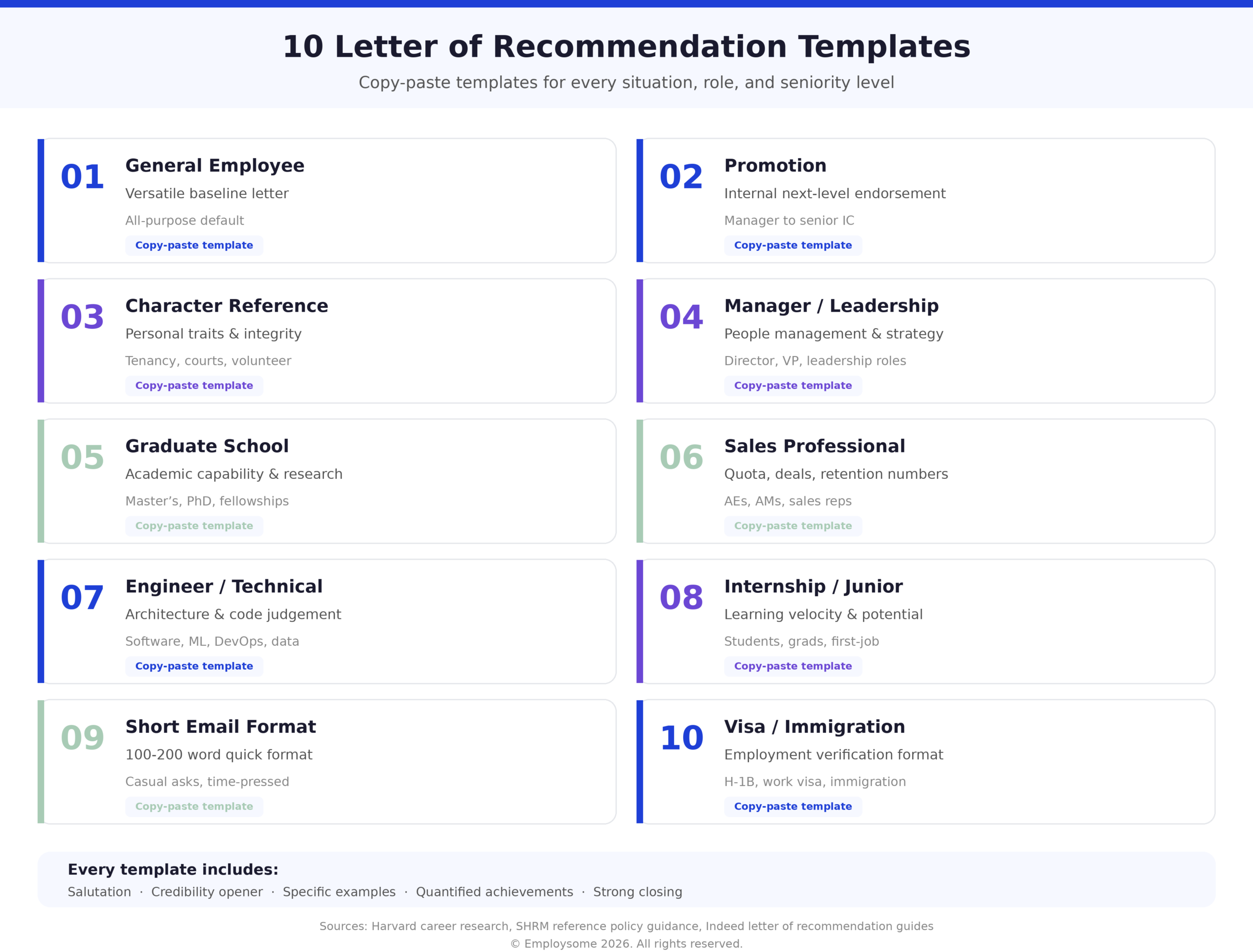
A strong letter of recommendation can make the difference between a candidate getting hired and getting overlooked. This guide provides 10 ready-to-use letter of recommendation templates for every common situation: general employee, promotion, character reference, manager, graduate school, sales, engineer, internship, short email, and visa support. Each template includes a copy-paste structure plus tips on what to customise for your specific candidate.


Table of Contents
- What Is It?
- Format & Structure
- 1. General Employee
- 2. Promotion
- 3. Character Reference
- 4. Manager / Leadership
- 5. Graduate School
- 6. Sales Professional
- 7. Engineer / Technical
- 8. Internship / Junior
- 9. Short Email Format
- 10. Visa / Immigration
- How to Write One
- Common Mistakes
- Legal Considerations
- After the Letter
- FAQs
A letter of recommendation (also called a recommendation letter or reference letter) is a formal document written by a manager, supervisor, professor, or colleague endorsing a candidate’s skills, character, and suitability for a specific role, programme, or opportunity. Despite increasingly data-driven hiring, recommendation letters remain a core part of recruitment: 95% of US employers conduct background checks on candidates, and 80%+ of Fortune 500 companies use formal reference verification as part of their hiring process. A strong, specific recommendation letter helps a candidate stand out and gives hiring managers context that goes beyond the CV.
Yet writing a recommendation letter from scratch is harder than it looks. Research from Harvard found that recommenders typically spend 2 to 4 hours writing a single letter of recommendation, and a Harvard career study showed that 88% of job seekers say they don’t have a recommendation letter because they never asked. The right template solves both problems: it gives the recommender a starting structure, and it makes asking for a letter feel less imposing for the candidate.
This guide provides 10 ready-to-use letter of recommendation templates covering the most common scenarios: general employee, promotion, character reference, manager/leadership, graduate school, sales professional, engineer/technical, internship, short email format, and employment visa support. Each template includes a copy-paste starter you can adapt in minutes plus tips on what to customise for your specific candidate.

What Is a Letter of Recommendation?
A letter of recommendation is a formal endorsement document, typically one to two pages long, written by someone who knows the candidate professionally or academically. It validates the candidate’s skills, character, work ethic, and suitability for a specific role, programme, or opportunity. The terms letter of recommendation, recommendation letter, and reference letter are used interchangeably in most contexts, with subtle differences:
- Letter of recommendation / recommendation letter: Typically forward-looking, written for a specific role, programme, or opportunity the candidate is applying to. Most personalised and persuasive.
- Reference letter: Often used interchangeably, but sometimes refers to a more general endorsement that the candidate can use for multiple applications.
- Character reference letter: Focused on personal traits and integrity rather than work performance. Often written by family friends, mentors, or community leaders rather than employers.
Every effective recommendation letter shares the same core structure regardless of context: an opening that establishes the writer’s credibility and relationship to the candidate, two to three body paragraphs with specific examples and achievements, and a strong closing that explicitly recommends the candidate and offers to provide more information.
Letter of Recommendation Format and Structure
A well-written recommendation letter follows a consistent four-part structure that should fit comfortably on one page. Use this structure as the skeleton for any of the 10 templates below:
| Section | Purpose | Length |
| Opening / Salutation | Address the recipient by name (preferred) or use “To Whom It May Concern”. State your purpose: that you are recommending the candidate. | 1-2 sentences |
| Your credibility & relationship | Who you are, your role, how you know the candidate, and for how long. This establishes why your endorsement matters. | 2-3 sentences |
| Body: Skills, achievements, examples | 2-3 paragraphs with specific, concrete examples. Focus on traits relevant to the role they’re applying for. Avoid repeating their CV. | 2-3 paragraphs |
| Strong closing & contact | Explicit recommendation language (“highest recommendation”, “without reservation”), offer to answer questions, contact details, signature. | 2-3 sentences |
Aim for a finished letter that fits on a single page (around 300-500 words). Letters longer than two pages signal padding rather than substance. Letters shorter than 200 words can come across as half-hearted or rushed.
1. General Employee Letter of Recommendation Template
This is the most versatile template, suitable when a former employee asks for a recommendation letter without a specific target role in mind, or for general use across multiple job applications. Use this as your default if you are not sure which template fits.
Date
[Recipient Name]
[Recipient Title]
[Company / Organisation]
Dear [Recipient Name],
It is my pleasure to recommend [Employee Name] for [position or general employment]. I had the privilege of working with [Employee Name] for [X years/months] at [Company Name], where I served as [your title] and [Employee Name] was [their title].
During [his/her/their] time at [Company Name], [Employee Name] consistently demonstrated [strengths: e.g. “strong analytical thinking, attention to detail, and a collaborative approach”]. [He/She/They] was responsible for [key duties], and consistently delivered work of high quality. Specifically, [Employee Name] [concrete achievement: “led our quarterly reporting redesign, reducing errors by 40% and saving the team approximately 8 hours per month”].
Beyond [his/her/their] technical capabilities, [Employee Name] is also a person of strong character. [He/She/They] [character trait: “communicates clearly, takes feedback well, and contributes positively to team culture”]. I would not hesitate to hire [him/her/them] again given the opportunity.
I give [Employee Name] my strongest recommendation. Please feel free to contact me at [email] or [phone] if you would like to discuss [his/her/their] qualifications further.
Sincerely,
[Your Name]
[Your Title]
[Company]
Customise: Fill in 1-2 specific quantified achievements; tailor the strengths to match the kind of roles the candidate is pursuing.
2. Letter of Recommendation Template for Promotion
Use this template when an internal candidate is being considered for a promotion within the same organisation, or when an external promotion-equivalent role is in play. The emphasis shifts from “they were a great employee” to “they are ready for the next level”.
Date
[Recipient: typically Hiring Committee or HR Director]
Dear [Recipient Name],
I am writing to enthusiastically recommend [Employee Name] for promotion to [new role title]. As [his/her/their] direct manager for the past [X years], I have had a front-row view of [his/her/their] consistent growth, leadership, and impact, and I believe [he/she/they] is fully ready for this next step.
In [his/her/their] current role as [current title], [Employee Name] has demonstrated the qualities required for [new title]. Specifically, [he/she/they] has [achievement showing scope/impact: “led a cross-functional team of 6 to launch our new customer onboarding programme, reducing time-to-first-value by 35%”]. [He/She/They] has also shown the strategic judgement and stakeholder management required at the next level, as evidenced by [second achievement].
What sets [Employee Name] apart from other strong performers is [he/she/they] is already operating at the next level on most dimensions. [He/She/They] [forward-looking observation: “coaches junior team members, drives difficult cross-team conversations, and pushes back constructively on prioritisation decisions”]. Promoting [him/her/them] formalises what is already happening in practice.
I give [Employee Name] my strongest recommendation for this promotion and am happy to discuss further.
Sincerely,
[Your Name]
[Your Title]
Customise: Lead with one stretch achievement that demonstrates the candidate is already operating at the new level. Promotion letters live or die on this evidence.
3. Character Reference Letter Template
A character reference letter focuses on the candidate’s personal qualities, integrity, and reliability rather than their work performance. Used when applying for tenancy, volunteer roles, court matters, or non-employment contexts. Often written by family friends, community leaders, or long-term mentors rather than employers.
Date
[Recipient Name or “To Whom It May Concern”]
Dear [Recipient Name or “To Whom It May Concern”],
I am pleased to provide this character reference for [Candidate Name]. I have known [Candidate Name] for [X years] in the capacity of [friend/neighbour/mentor/community leader], and during that time [he/she/they] has consistently shown [him/her/themselves] to be a person of [3 character traits: e.g. “integrity, kindness, and dependability”].
[Specific example demonstrating character: “When our community association needed someone to coordinate the annual fundraiser, [Candidate Name] volunteered immediately and went on to organise our most successful event in five years, raising over $12,000 for local schools. [He/She/They] did this while also caring for [other commitment], showing real generosity with [his/her/their] time.”]
In every interaction I have had with [Candidate Name], [he/she/they] has demonstrated honesty, sound judgement, and genuine care for others. [He/She/They] is the kind of person you can rely on, and I am confident [he/she/they] will represent themselves well in [the context of the application].
I give [Candidate Name] my full personal endorsement. Please feel free to contact me at [phone] or [email] for any further information.
Sincerely,
[Your Name]
[Your Title or Relationship to Candidate]
Customise: A character reference is most credible when it includes one specific moment that demonstrates the trait you are describing. Replace generic praise with a concrete story.
4. Letter of Recommendation Template for a Manager / Leadership Role
Use this template when recommending someone for a senior management or leadership role. The emphasis is on leadership impact, strategic judgement, and people management evidence rather than technical proficiency.
Date
[Recipient Name and Title]
[Company]
Dear [Recipient Name],
It is my pleasure to recommend [Candidate Name] for the position of [senior leadership title] at [Company]. As [your title] at [your company], I worked with [Candidate Name] for [X years] and saw firsthand the kind of leader [he/she/they] is.
[Candidate Name] led a team of [X] people through [significant change/challenge]. Under [his/her/their] leadership, the team [quantified outcome: “grew revenue 40% year-over-year”, “delivered the platform migration three months ahead of schedule”, “retained 95% of staff during a difficult restructuring”]. What stood out was not just the result but how [he/she/they] achieved it: through clear strategy, transparent communication, and genuine investment in team development.
I have seen [Candidate Name] handle the hardest parts of leadership: difficult performance conversations, cross-functional disagreements, and high-stakes board presentations. In every case, [he/she/they] has shown the judgement, composure, and emotional intelligence that distinguishes excellent leaders from merely competent ones.
I give [Candidate Name] my strongest recommendation for this role. [He/She/They] would be a meaningful addition to your leadership team. I am happy to discuss [his/her/their] candidacy in more detail at your convenience.
Sincerely,
[Your Name]
[Your Title]
[Phone] | [Email]
Customise: Leadership recommendations should always include one quantified outcome (revenue, retention, delivery) and one qualitative observation about how the candidate leads under pressure.
5. Graduate School Letter of Recommendation Template
Graduate school recommendation letters require a different structure than employment letters. Admissions committees expect detailed analysis of intellectual capability, research potential, and academic preparation. Most US graduate programmes require 2-3 academic recommendations.
Date
[Admissions Committee, Programme Name]
[University]
Dear Members of the [Programme Name] Admissions Committee,
It is with great enthusiasm that I write in support of [Candidate Name]’s application to your [Master’s/PhD] programme in [field]. I am [Your Name], [Your Title] at [University], where I have known [Candidate Name] for [X years] as [their professor in advanced statistics / their thesis advisor / their research supervisor].
In my [course/lab], [Candidate Name] consistently demonstrated exceptional intellectual curiosity and analytical rigour. [He/She/They] earned [grade] in my [course name], placing in the top [X%] of [Y students]. More importantly, [Candidate Name] consistently asked the kinds of questions I expect from graduate students rather than undergraduates: [example of an intellectually substantive question or contribution].
[Candidate Name]’s research project on [topic] was particularly impressive. [He/She/They] [specific research achievement: “designed an original experimental methodology, gathered and analysed data from 200+ participants, and produced a paper that was selected for presentation at the [conference] conference”]. The work demonstrated the kind of independent research capacity that will be essential for graduate work.
I have no doubt [Candidate Name] will excel in your programme. [He/She/They] is among the most promising students I have taught in the past [X] years, and I give [him/her/them] my highest recommendation.
Sincerely,
[Your Name]
[Your Academic Title]
[Department, University]
Customise: Academic letters benefit from class-ranking data (“top 5%”), specific research outputs, and at least one intellectual moment where the candidate showed graduate-level thinking.
6. Sales Professional Letter of Recommendation Template
Sales recommendation letters should lead with quantifiable performance: quota attainment, deal sizes, retention rates. Sales hiring managers expect to see numbers, and a sales letter without them feels evasive.
Date
[Recipient Name]
[Title]
[Company]
Dear [Recipient Name],
I am writing to recommend [Candidate Name] for the [Account Executive / Sales role] at [Company]. As [his/her/their] direct sales manager at [your company] for [X years], I can speak to [Candidate Name] both as a top performer and as a teammate.
In [his/her/their] [X] years on my team, [Candidate Name] consistently delivered results in the top [10/20%] of the sales organisation. Specifically, [he/she/they] [achieved 130% of quota in [year], closed our largest deal of the year at $850K, and built a $4M+ pipeline within [his/her/their] first six months]. [He/She/They] [grew average deal size by 35% over [his/her/their] tenure / opened three major new accounts that became multi-year customers].
What makes [Candidate Name] effective is not just hustle but discipline: [he/she/they] runs structured discovery calls, builds detailed account plans, forecasts accurately within 10%, and closes deals with rigorous handoff to customer success. [He/She/They] is also a strong teammate: [example of mentorship, knowledge sharing, or contribution to team culture].
I give [Candidate Name] my strongest recommendation. [He/She/They] would be an immediate contributor to your sales team. Please feel free to contact me at [email] for any additional context.
Best regards,
[Your Name]
[Your Title]
Customise: Always include at least three specific numbers: quota %, largest deal, pipeline size, ramp time, or retention rate. Sales managers will scan for these.
7. Engineer / Technical Letter of Recommendation Template
Engineering recommendation letters should reference specific technical contributions, architecture decisions, and code quality. Hiring managers in engineering value letters that demonstrate the candidate’s judgement on real technical decisions, not generic praise.
Date
[Recipient Name]
[Company]
Dear [Recipient Name],
I am writing to recommend [Candidate Name] for the [Senior Software Engineer / Tech Lead] position at [Company]. As Engineering Manager at [your company], I worked closely with [Candidate Name] for [X years] across [product area].
[Candidate Name] is an outstanding engineer with particularly strong skills in [specific technical area: e.g. “distributed systems, specifically Kafka-based event-driven architectures and Postgres performance optimisation”]. During [his/her/their] time on my team, [he/she/they] [concrete technical achievement: “architected and led the migration of our payments service from a monolith to event-driven microservices, reducing p99 latency from 3.2 seconds to 280ms and improving system reliability from 99.5% to 99.95%”].
Beyond execution, [Candidate Name] has the judgement expected of a senior engineer. [He/She/They] writes thoughtful design documents, pushes back appropriately on bad scope decisions, mentors junior engineers, and consistently raises the quality bar in code review without being pedantic. The team always functioned better when [he/she/they] was involved.
I give [Candidate Name] my strongest recommendation. [He/She/They] is exactly the kind of engineer I would hire again given the opportunity. Please reach out at [email] if you would like to discuss further.
Sincerely,
[Your Name]
[Engineering Manager / VP Engineering]
[Company]
Customise: Always cite at least one technical decision the candidate made and the measurable outcome. Vague phrases like “strong technical skills” don’t carry weight in engineering recommendations.
8. Internship / Junior Candidate Letter of Recommendation Template
Internship and junior-candidate recommendations need a different framing: instead of accomplishments, the letter focuses on potential, learning velocity, and character. Hiring managers reading internship letters know the candidate hasn’t shipped a $10M product yet.
Date
[Recipient Name]
[Company]
Dear [Recipient Name],
I am pleased to recommend [Candidate Name] for the [internship / entry-level position] at [Company]. I had the pleasure of supervising [Candidate Name] during [his/her/their] [internship/first role] at [your company], where [he/she/they] worked as [their title] for [X months].
From day one, [Candidate Name] demonstrated the qualities I look for in early-career talent: curiosity, willingness to learn, and humility. [He/She/They] [specific example: “taught herself SQL in the first two weeks because she realised she would need it to do her data analysis tasks well”, or “volunteered to take on a project no one else wanted, and delivered it ahead of schedule”]. [He/She/They] consistently asked great questions, took feedback extremely well, and pushed [him/her/themselves] beyond what was asked.
In just [X months], [Candidate Name] grew noticeably in [specific area]. By the end of the [internship/first role], [he/she/they] was [forward-looking observation: “owning her own analyses end-to-end, presenting findings directly to senior stakeholders”]. Given another year of growth, [he/she/they] will be operating well beyond entry-level.
I give [Candidate Name] my strong recommendation and expect [him/her/them] to be a meaningful contributor wherever [he/she/they] lands next. Please feel free to reach me at [email] with any questions.
Sincerely,
[Your Name]
[Your Title]
Customise: Lead with learning velocity rather than absolute achievements. “Taught themselves X in a week” says more about a junior than “built a complicated thing”.
9. Short Email Letter of Recommendation Template
When time is tight or the request is informal, a short email-format recommendation works well. This is also useful when a hiring manager asks for a quick reference rather than a formal letter. Aim for 100-200 words total.
Subject: Recommendation for [Candidate Name] – [Role at Company]
Hi [Recipient Name],
I’m writing to recommend [Candidate Name] for the [role] at [company]. [He/She/They] reported to me at [your company] from [start year] to [end year] as a [their role].
In short: [Candidate Name] is one of the strongest [role type] I’ve worked with. [One sentence of impact: “She led the redesign of our reporting pipeline, cutting weekly close time by 60% and catching three errors that had been missed for years.”] [He/She/They] is also genuinely great to work with: thoughtful, low-ego, and a strong communicator.
I would hire [him/her/them] again immediately. Happy to jump on a quick call if useful.
Best,
[Your Name]
[Your current title]
Customise: The short email format only works if you include one truly specific impact statement. Generic short emails read as low effort. Use real numbers or one vivid moment.
10. Visa / Immigration Support Letter of Recommendation Template
For immigration purposes (H-1B in the US, Skilled Worker visa in the UK, similar elsewhere), employers often need to write recommendation letters that double as employment verification supporting visa or work permit applications. These letters have specific factual requirements.
Date
[Embassy / Consulate / Immigration Authority / Recipient]
To Whom It May Concern,
This letter confirms that [Candidate Name] has been employed at [Your Company Name] from [Start Date] to [End Date / Present]. During this time, [he/she/they] has held the position of [Job Title], reporting to [Your Name, Your Title], with annual gross compensation of [Amount and Currency].
In [his/her/their] role at [Your Company Name], [Candidate Name] has been responsible for [3-5 specific job duties: e.g. “designing and implementing data engineering pipelines, leading the migration of legacy ETL systems to cloud-native architectures, and managing technical relationships with three external vendor partners”]. [He/She/They] has consistently performed at a high level, demonstrating the specialised skills required for the role.
[Candidate Name]’s expertise in [specific specialised skill area] is genuinely uncommon and would be difficult to replace through local hiring alone. We strongly support [his/her/their] [visa application / work permit / extension] and confirm that [he/she/they] continues to fill an essential role in our organisation.
Please contact me directly at [email] or [phone] for any verification or further questions.
Sincerely,
[Your Full Legal Name]
[Your Title]
[Company Name]
[Company Address]
[Direct phone / email]
Customise: Visa support letters must include exact start date, end date, job title, salary, and specific job duties. Vague descriptions can cause visa applications to be rejected. Always print on company letterhead for embassy/consulate submissions.
💡 Employsome Insight: If You Can’t Be Enthusiastic, Decline Politely
The single most important rule in writing a letter of recommendation: if you can’t recommend the candidate enthusiastically, don’t write the letter at all. A lukewarm letter is significantly worse than no letter. Hiring managers read between the lines, and faint praise (“Adequate work”, “Reasonable colleague”, “Functional team member”) reads as a damning signal. If you can’t honestly say you would hire the candidate again, decline politely: “I don’t think I’m the strongest reference for this role—you might have better luck with [someone else]”. The candidate will be better served by finding a referee who can write enthusiastically.
How to Write a Strong Letter of Recommendation
Whichever template you start with, the same writing principles apply. The difference between a forgettable recommendation letter and one that actually helps a candidate get hired comes down to specificity, structure, and tone.
- Get the specifics first: Ask the candidate for their CV, the job description (if applying for a specific role), and what they’d like you to emphasise. A great recommendation feels personalised; a generic one is worse than no letter.
- Lead with credibility: Open by stating who you are, your role, how you know the candidate, and for how long. Without this, the rest of the letter has no weight.
- Replace adjectives with examples: Anyone can say “hard-working” and “reliable”. Show it: “When our biggest client threatened to churn, [Name] led the rescue plan and turned a $300K loss into a $500K renewal”.
- Tailor to the role they’re applying for: A letter for a sales role should emphasise different traits than one for a research role. If you don’t know the role, ask before you write.
- Include 1-3 quantified achievements: Numbers are scannable and credible. “Reduced churn by 18%” is far stronger than “improved customer retention”.
- Close with explicit recommendation language: “I give [Name] my highest recommendation”, “without reservation”, “would hire again immediately”. Lukewarm closing language is worse than a lukewarm letter.
- Keep it to one page: 300-500 words is the sweet spot. Longer letters come across as padded; shorter letters feel rushed.
- Proofread carefully: Misspelling the candidate’s name, the company name, or the recipient is a credibility killer.
Common Letter of Recommendation Mistakes to Avoid
Writing a lukewarm letter when you can’t enthusiastically recommend. If you can’t give the candidate your full endorsement, decline politely. A weak letter (“Adequate worker”, “Reasonable team member”) damages the candidate more than no letter at all.
Generic praise without examples. “Hard-working, detail-oriented, and a great team player” describes 90% of professionals. The hiring manager has read 50 of these. Specific stories are what get remembered.
Repeating the CV. The hiring manager has already read the CV. The recommendation letter exists to add context, judgement, and stories, not list duties.
Omitting your relationship. Failing to state how you know the candidate, in what role, and for how long, leaves the reader unable to weight your endorsement.
Sending a 3-page letter. Length signals padding, not depth. A focused, single-page letter with a few specific examples is far more effective.
Including off-limits information. In many jurisdictions (US, UK, EU), it is unlawful to discuss protected characteristics (age, disability, pregnancy, race, religion, marital status). Stick to job-related performance and traits. When in doubt, check your local employment law or consult HR before sending.
Legal Considerations When Writing a Recommendation Letter
Recommendation letters carry legal weight, especially in the United States and the EU. Employers and individuals writing them should be aware of a few legal considerations:
- Defamation risk: Statements that are demonstrably false and damaging to a candidate’s reputation can give rise to defamation claims. Stick to factual, verifiable statements.
- Truthful negative information: In most US jurisdictions, employers have qualified immunity when sharing truthful, job-related information in good faith. SHRM reports that some states (such as California) provide explicit statutory protection for employers giving honest references.
- Company policy: Many large employers prohibit managers from giving individual references and instead direct all reference requests to HR. Always check your company policy before sending a letter on company letterhead.
- Protected characteristics: Do not reference age, race, religion, gender identity, sexual orientation, disability, pregnancy, marital or family status. These are protected categories under federal anti-discrimination law in most jurisdictions.
- EU GDPR considerations: In the EU, recommendation letters are considered personal data. The candidate generally has the right to know what is being said about them. Avoid writing anything you would not be comfortable showing the candidate.
- Visa and immigration letters: These are official documents that may be reviewed by immigration authorities. Inaccurate statements can affect both the candidate’s application and the company’s standing as an immigration sponsor.
After the Letter: Setting Up the New Hire for Success
Once a candidate uses your recommendation letter to land their next role, their next-employer’s focus shifts from hiring to onboarding. A great recommendation letter helps a candidate get hired; a great onboarding plan helps them succeed once they arrive. If you are on the receiving end and need a structured plan to set up your new hire for success, see our complete guide to onboarding plan templates, including 10 ready-to-use frameworks for different roles and seniority levels.
Got the new hire? Set them up to succeed
A great recommendation letter helps a candidate get hired. A great onboarding plan helps them succeed once they arrive. Read our complete guide to 10 onboarding plan templates covering 30-60-90 day plans, remote, sales, engineering, manager, executive, and internship onboarding.
Frequently Asked Questions
There is no meaningful difference. “Letter of recommendation”, “recommendation letter”, and “reference letter” are used interchangeably in most contexts. Some employers use “reference letter” for a more general endorsement that the candidate can use across multiple applications, while “letter of recommendation” is sometimes reserved for letters tailored to a specific role or programme. The structure, content, and format are essentially the same.
A letter of recommendation should fit on a single page, typically 300-500 words. Letters longer than two pages signal padding rather than substance and are less likely to be read in full by hiring managers. Letters shorter than 200 words can come across as half-hearted or rushed. The sweet spot is concise, focused, and substantive: a clear opening establishing your credibility, two to three body paragraphs with specific examples, and a strong closing that explicitly recommends the candidate.
Every effective letter of recommendation should include: a salutation (recipient name preferred over “To Whom It May Concern”), an introduction stating who you are and how you know the candidate, two to three body paragraphs with specific examples and quantified achievements, a strong closing with explicit recommendation language (“highest recommendation”, “without reservation”), your contact information, and your signature. Total length: one page, 300-500 words.
The ideal letter writer is someone who has worked closely with the candidate in a relevant capacity: a direct manager or supervisor for employment letters, a professor or research advisor for academic letters, or a long-term mentor or community leader for character references. The recommender should be senior enough to lend credibility but close enough to the candidate’s work to provide specific examples. Avoid asking family members, casual acquaintances, or people who barely know your work.
Yes, and you should decline if you cannot recommend the candidate enthusiastically. A lukewarm letter is significantly worse than no letter. Politely decline by saying something like: “I don’t think I’m the strongest reference for this particular role. You might have better luck with [someone else]”. This protects both your professional credibility and the candidate’s application. It is fairer not to write a recommendation than to write one expressing anything less than full confidence.
A character reference letter focuses on a candidate’s personal qualities, integrity, and reliability rather than their work performance. Used when applying for tenancy, court matters, volunteer roles, custody hearings, or non-employment contexts. Often written by family friends, neighbours, community leaders, or long-term mentors rather than employers. The structure is similar to an employment letter but emphasises personal traits with specific examples demonstrating those traits.
Ask in person or by email at least two weeks before the deadline. Provide the recommender with: the deadline, who the letter is addressed to (or whether “To Whom It May Concern” is acceptable), the role or programme you’re applying for, the job description, your CV, a few traits you’d like emphasised, and submission instructions (email, portal, post). Make it as easy as possible for them to say yes. Research from Harvard found 88% of job seekers who don’t have a recommendation letter say it’s because they never asked.
Three main considerations: (1) defamation risk – false and damaging statements can lead to legal claims, so stick to verifiable facts; (2) protected characteristics – do not reference age, race, religion, gender identity, sexual orientation, disability, pregnancy, or marital/family status; (3) company policy – many large employers prohibit managers from giving individual references and direct all requests to HR. Truthful, job-related statements made in good faith are generally protected in most US jurisdictions. In the EU, GDPR may give the candidate the right to see what was written.
For employment-related letters, yes. Writing on company letterhead lends credibility and confirms the recommender’s authority to speak on behalf of the organisation. For visa and immigration support letters, company letterhead is essentially required. For character references and personal letters, plain letterhead with the recommender’s contact details is acceptable. For academic letters, university or department letterhead is standard.
Visa support letters double as employment verification and have specific factual requirements that go beyond a typical recommendation. They must include exact employment dates, job title, salary, specific job duties, and clear language about the specialised skills required for the role. Vague descriptions can cause visa applications to be rejected. Always print on company letterhead with full company address and direct contact information for verification. For US H-1B and similar visa categories, the letter is reviewed by immigration officials, so accuracy matters more than persuasion.
Courtney Pocock is a Copywriter at Employsome with 15+ years of experience writing for the HR, corporate, and financial sectors. She has a strong interest in global business expansion and Employer of Record / PEO topics, focusing on news that matters to business owners and decision-makers. Courtney covers industry updates, regulatory changes, and practical guides to help leaders navigate international hiring with confidence. Connect with Courtney on LinkedIn.
Our content is created for informational purposes only and is not intended to provide any legal, tax, accounting, or financial advice. Please obtain separate advice from industry-specific professionals who may better understand your business’s needs. Read our Editorial Guidelines for further information on how our content is created.
Other posts
Review other templates