
Minimum Wage in the United States 2026: All Rates Explained
The federal minimum wage in the United States is $7.25 per hour in 2026, unchanged since 2009, but 30 states and DC set higher rates ranging from $17.95 in Washington DC down to the federal floor. This complete guide covers federal and state rates, city ordinances, tipped employee rules, federal contractor minimums, overtime requirements, exempt salary thresholds, and penalties for non-compliance in 2026.

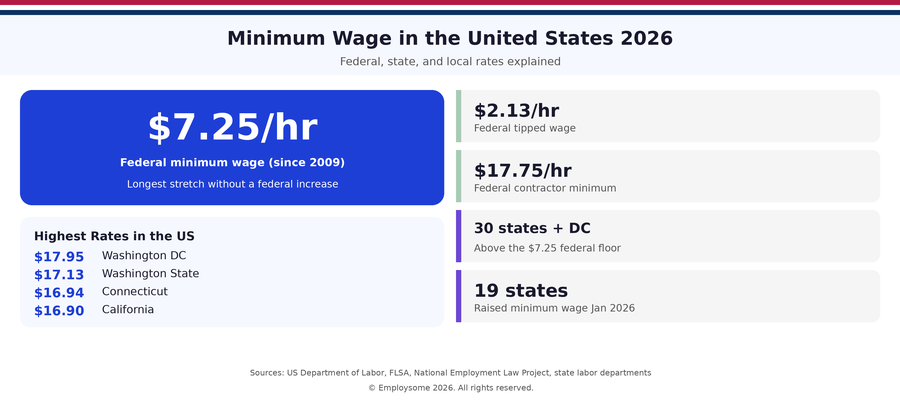
The federal minimum wage in the United States is $7.25 per hour in 2026, unchanged since July 2009 and now the longest stretch without a federal increase since the Fair Labor Standards Act (FLSA) was enacted in 1938. However, the federal floor is no longer the operative rate for most American workers. 30 states plus the District of Columbia have set higher minimum wages, and 19 states raised their rates on 1 January 2026.
The District of Columbia leads the country at $17.95 per hour, followed by Washington State at $17.13, Connecticut at $16.94, California at $16.90, New York at $16.50, and Hawaii at $16.00. At the other end, 20 states still peg their minimum wage to the federal $7.25 rate, creating a gap of more than $10 per hour for identical work depending on state. Federal contractors face a separate higher minimum of $17.75 per hour, tipped workers subject to federal law have a base cash wage of just $2.13 per hour, and local ordinances in cities such as Seattle, Denver, and New York City push rates above state minimums.
This 2026 guide to the US minimum wage covers the federal rate and its history, all 50 state minimum wages, city and local ordinances, tipped employee rules, federal contractor wages, youth and training wages, overtime obligations and penalties for non-compliance.

Federal Minimum Wage in the United States 2026
The federal minimum wage in the United States is $7.25 per hour and has remained at that rate since 24 July 2009. This is the longest period without a federal minimum wage increase since the FLSA introduced the first federal minimum in 1938 at $0.25 per hour. Adjusted for inflation, the original 1938 rate would be approximately $5.88 in 2026 dollars, so the current federal floor is actually higher in real terms than the original rate, though it has lost significant purchasing power since 2009.
The federal minimum applies to employees covered by the FLSA, which includes most private-sector workers at businesses with annual gross sales of $500,000 or more that engage in interstate commerce, plus individual workers whose duties involve interstate commerce regardless of employer size. The FLSA also sets the federal tipped minimum wage at $2.13 per hour, provided tips bring total compensation to at least $7.25 per hour. If tips fall short, the employer must make up the difference.
| Federal Minimum Wage Rate (2026) | Amount |
| Standard federal minimum wage | $7.25 per hour |
| Federal tipped minimum wage | $2.13 per hour (plus tips) |
| Federal contractor minimum (Executive Order 14026) | $17.75 per hour |
| Youth minimum wage (under 20, first 90 days) | $4.25 per hour |
| Full-time student workers (FLSA certified) | $6.16 per hour (85% of $7.25) |
Congress has raised the federal minimum wage 22 times since 1938, roughly every one to ten years. The current 17-year freeze is unprecedented. Multiple bills have been introduced in Congress to raise the federal rate, including proposals for $15 and $17 per hour, but none has passed. In the absence of federal action, state legislatures, ballot initiatives, and local ordinances have become the primary mechanism for wage increases in the US.
US Minimum Wage by State 2026: Complete List
Where state law sets a higher minimum than the federal $7.25, the higher state rate applies. Where state and federal rates conflict, employees are entitled to whichever is higher. The rates below are effective as of 1 January 2026. Alaska, DC, Oregon, and Florida have additional increases scheduled later in 2026.
| State / Jurisdiction | 2026 Minimum Wage | Notes |
| District of Columbia | $17.95 | Highest in the country |
| Washington | $17.13 | Highest state rate |
| Connecticut | $16.94 | Annual CPI indexation |
| California | $16.90 | Fast food sector: $20.00 |
| New Jersey | $15.92 | Annual adjustment |
| New York (NYC, Long Island, Westchester) | $17.00 | Higher downstate rate |
| New York (rest of state) | $16.50 | Statewide baseline |
| Maryland | $15.00 | Threshold reached 2024 |
| Massachusetts | $15.00 | No scheduled 2026 increase |
| Colorado | $15.16 | Annual CPI indexation |
| Illinois | $15.00 | Threshold reached 2025 |
| Arizona | $15.15 | Annual CPI indexation |
| Delaware | $15.00 | Threshold reached 2025 |
| Hawaii | $16.00 | Scheduled increase to $18 in 2028 |
| Maine | $15.10 | Annual CPI indexation |
| Missouri | $15.00 | First time at $15 (2026) |
| Montana | $10.85 | Annual CPI indexation |
| Nebraska | $15.00 | First time at $15 (2026) |
| Rhode Island | $16.00 | Scheduled $17 in 2027 |
| Vermont | $14.42 | Annual CPI indexation |
| Virginia | $12.77 | Annual CPI indexation |
| Michigan | $13.73 | Up from $12.48 in 2025 |
| Minnesota | $11.41 | Large employer rate |
| Ohio | $11.00 | Annual CPI indexation |
| South Dakota | $11.85 | Annual CPI indexation |
| Florida | $13.00 (→ $15.00 on 30 Sep 2026) | Mid-year scheduled increase |
| Oregon | $14.70 (→ increase July 2026) | Standard rate, Portland higher |
| Nevada | $12.00 (→ increase July 2026) | Unified rate 2024 |
| Alaska | $11.91 (→ $13.00 on 1 Jul 2026) | Mid-year increase |
| Arkansas | $11.00 | No 2026 increase |
| New Mexico | $12.00 | No 2026 increase |
| Georgia | $7.25 (state rate $5.15) | FLSA floor applies |
| Wyoming | $7.25 (state rate $5.15) | FLSA floor applies |
| Alabama, Louisiana, Mississippi, South Carolina, Tennessee | $7.25 (no state law) | Federal FLSA applies |
| All other FLSA-matching states | $7.25 | See list below |
The 20 states that match the federal $7.25 minimum in 2026 are: Alabama, Georgia, Idaho, Indiana, Iowa, Kansas, Kentucky, Louisiana, Mississippi, New Hampshire, North Carolina, North Dakota, Oklahoma, Pennsylvania, South Carolina, Tennessee, Texas, Utah, Wisconsin, and Wyoming. Five of these (Alabama, Louisiana, Mississippi, South Carolina, and Tennessee) have no state minimum wage law at all and default to the federal rate through the FLSA. Georgia and Wyoming have state statutes setting a $5.15 minimum, but the federal FLSA floor of $7.25 applies to any employer covered by federal law (which is the vast majority).
The $10.70 gap between DC ($17.95) and the federal floor ($7.25) represents one of the largest within-country minimum wage disparities in any developed economy. An employer with staff in both Washington state and Texas pays a minimum cash wage of $9.88 per hour more for a Washington worker than for a Texas worker performing identical work.
💡 Employsome Insight: Work Location Determines the Applicable Minimum Wage
For multi-state employers, applying the correct minimum wage depends on the state where the employee physically performs work, not where the employer is headquartered or where the employee lives. A remote worker living in Texas (where the $7.25 federal minimum applies) but physically working for a California-based employer is paid at the Texas rate. However, the reverse also holds: a remote worker physically in California performing duties for a Texas employer must receive California’s $16.90 minimum. This creates real compliance complexity for remote-first companies and is one of the top reasons US-based international employers choose an Employer of Record for multi-state hiring.
City and Local Minimum Wage Ordinances
More than 60 cities and counties across the US set their own minimum wage above the state rate. These local ordinances typically apply to any work physically performed within the jurisdiction, meaning an employer with staff in multiple cities within the same state may face several different minimum wage obligations.
| City / County | State | 2026 Local Minimum Wage |
| West Hollywood | California | $20.22 |
| Emeryville | California | $19.90 |
| Berkeley | California | $19.18 |
| San Francisco | California | $19.18 |
| Seattle | Washington | $20.76 |
| Tukwila (large employers) | Washington | $21.10 |
| SeaTac | Washington | $20.17 |
| Denver | Colorado | $18.81 |
| New York City | New York | $17.00 |
| Portland Metro | Oregon | $15.95 |
| Chicago (large employers) | Illinois | $16.60 |
| Montgomery County | Maryland | $17.65 |
| Saint Paul (large employers) | Minnesota | $15.97 |
| Minneapolis | Minnesota | $15.97 |
| Flagstaff | Arizona | $17.85 |
California is the most complex state for local minimum wage compliance, with at least 35 cities and counties setting their own rates above the state $16.90. Washington state follows with elevated rates in Seattle, SeaTac, Tukwila, and Bellingham. Some cities also tier their minimum wage by employer size: Chicago pays $16.60 at large employers and a lower rate at small employers with fewer than 21 workers.
Sector-specific rates further complicate compliance. California’s fast food minimum wage of $20.00 per hour applies to limited-service restaurant chains with 60+ national locations. California healthcare workers at covered facilities face tiered minimums reaching $25 per hour over the coming years. New York City maintains a separate minimum for tipped food service workers above the statewide tipped rate.
Tipped Employee Minimum Wage Rules
Tipped employee compensation is one of the most variable elements of US minimum wage law. The federal FLSA permits employers to pay tipped workers a cash wage of $2.13 per hour, provided actual tips bring total hourly compensation to at least $7.25. If tips fall short, the employer must pay the difference (the “tip credit” system).
| State | Tipped Cash Wage (2026) | Tip Credit Rules |
| Federal / FLSA baseline | $2.13 | Tips must reach $7.25/hr total |
| California | $16.90 (full minimum) | No tip credit permitted |
| Washington | $17.13 (full minimum) | No tip credit permitted |
| Oregon | $14.70 (full minimum) | No tip credit permitted |
| Minnesota | $11.41 (full minimum) | No tip credit permitted |
| Montana | $10.85 (full minimum) | No tip credit permitted |
| Nevada | $12.00 (full minimum) | No tip credit permitted |
| Alaska | $11.91 (full minimum) | No tip credit permitted |
| New York (NYC, Long Island, Westchester) | $11.35 (food service) | Limited tip credit |
| New York (rest of state) | $11.00 (food service) | Limited tip credit |
| DC | $10.00 (phasing out tip credit by 2027) | Tip credit being eliminated |
| Massachusetts | $6.75 | Limited tip credit |
| Illinois | $9.00 | Limited tip credit |
| Arizona | $12.15 | $3.00 maximum tip credit |
| Florida | $9.98 (rising September 2026) | $3.02 tip credit |
| Texas, Georgia, other $7.25 states | $2.13 | Federal tip credit applies |
Seven states require the full minimum wage for tipped workers: Alaska, California, Minnesota, Montana, Nevada, Oregon, and Washington. Employers in these states cannot take a tip credit under any circumstances and must pay the full state minimum regardless of tips received. The District of Columbia is phasing out the tip credit by 2027, bringing the DC tipped rate into parity with the standard minimum.
Federal Contractor and Sub-Minimum Wages
Federal contractors face a higher minimum wage than ordinary private-sector employees. Under Executive Order 14026 (signed April 2021), the federal contractor minimum wage is $17.75 per hour in 2026, adjusted annually for inflation by the Department of Labor. This rate applies to workers performing work on or in connection with covered federal contracts, including service contracts, construction contracts under the Davis-Bacon Act, and concession contracts.
The federal contractor minimum is more than double the standard federal minimum of $7.25. It applies regardless of the state where the work is performed. Federal contractor tipped workers are also entitled to the full $17.75, with no tip credit permitted on covered contracts.
The FLSA also establishes reduced rates for specific worker categories:
- Youth minimum wage ($4.25/hr): workers under 20 years old may be paid $4.25 per hour for their first 90 consecutive calendar days of employment with an employer
- Full-time student rate ($6.16/hr): full-time students working in retail, service, agriculture, or college jobs may be paid 85% of the minimum wage under an FLSA certification
- Certain disabled workers: Section 14(c) of the FLSA previously permitted subminimum wages for certain disabled workers under special certificates; new certificates are no longer being issued as of 2024
- Apprentices and learners: may be paid below minimum wage under FLSA certification in specific training programs
State laws may further restrict these subminimum wages. For example, California and Washington do not permit the $4.25 federal youth minimum and require young workers to receive the full state minimum wage.
Overtime Pay and Exempt Employee Salary Thresholds
The FLSA requires overtime pay of 1.5 times the regular rate for hours worked beyond 40 in a workweek. The overtime calculation is based on the worker’s actual regular rate, which must be at least the applicable minimum wage but may be higher. Overtime must be paid in cash, not as compensatory time off (except for public sector workers).
The federal minimum salary threshold for exempt executive, administrative, and professional employees was set at $684 per week ($35,568 annually) under federal law. The Department of Labor attempted to raise this to $58,656 by 2025, but the increase was struck down by federal courts in November 2024. Several states set higher exempt salary thresholds than federal rules:
| State | 2026 Exempt Salary Threshold (weekly) | Annual |
| California | $1,352.00 | $70,304 |
| Washington | $1,499.40 (large employers) | $77,969 |
| New York (NYC, Long Island, Westchester) | $1,237.50 | $64,350 |
| New York (rest of state) | $1,161.65 | $60,406 |
| Colorado | $1,086.54 | $56,500 |
| Maine | $846.15 | $44,000 |
| Federal default | $684 | $35,568 |
Misclassifying a non-exempt employee as exempt to avoid overtime is one of the most common FLSA violations. Employers must meet both the salary threshold and the duties test for a role to qualify as exempt. Paying a $50,000 salary does not automatically exempt an employee from overtime: the employee must also primarily perform executive, administrative, professional, computer, or outside sales duties as defined by the FLSA.
Penalties for Minimum Wage Violations
Minimum wage violations in the US carry significant penalties. The FLSA authorises the Department of Labor to pursue back wages, liquidated damages equal to the unpaid wages (effectively doubling the back-pay award), and civil money penalties of up to $1,200 per violation for willful or repeat offenders. Intentional violations can also trigger criminal prosecution, with fines up to $10,000 and potential imprisonment for repeat offences.
In addition to federal enforcement, employees may bring private civil lawsuits to recover unpaid wages, liquidated damages, attorney’s fees, and court costs. State wage-and-hour laws generally provide similar or greater remedies. California is particularly aggressive, authorising Private Attorneys General Act (PAGA) claims that allow employees to recover civil penalties on behalf of the state and other workers, often multiplying the effective liability.
Common violations that trigger enforcement action include:
- Paying below the applicable state, local, or federal minimum wage
- Failing to pay overtime for hours over 40 in a workweek
- Taking tip credits without meeting notice and tip-pooling requirements
- Misclassifying employees as independent contractors to avoid minimum wage obligations
- Deducting business expenses (uniforms, tools, cash shortages) that bring wages below minimum
- Failing to pay for pre-shift preparation, post-shift wrap-up, or mandatory training time
- Improper rounding of hours worked that consistently disadvantages employees
The statute of limitations on minimum wage and overtime claims is two years for ordinary violations and three years for willful violations under the FLSA. Many states extend this to three or even six years under state law. Records of hours worked and wages paid must be retained by the employer for at least three years under federal rules.
How International Companies Hire in the United States
For international companies hiring US employees without a US legal entity, there are three practical options:
Option 1: Establish a US subsidiary or branch
Forming a US LLC or corporation, registering as an employer with the IRS (EIN), registering with state employment tax authorities in each state of operation, and running US payroll requires significant setup. Timeline is typically 8 to 16 weeks, depending on state. Ongoing costs include US payroll administration ($80 to $200 per employee per month), state unemployment insurance, federal and state income tax withholding, FICA contributions, workers’ compensation insurance, and potentially health insurance if team size crosses the Affordable Care Act threshold. Viable for long-term US operations with 10+ employees.
Option 2: Employer of Record (EOR)
An EOR is a US-registered entity that formally employs the worker on your behalf. The EOR handles employment contracts compliant with each state’s law, federal and state payroll tax withholding, workers’ compensation, unemployment insurance, health insurance (required for groups of 50+ FTEs under the ACA), and ongoing compliance with FLSA minimum wage, overtime, and state-specific rules. Typical setup: 1 to 3 weeks. Typical cost: $400 to $900 per employee per month on top of gross salary and employer contributions. The EOR also handles local and city-level minimum wage compliance automatically, removing one of the most common compliance gaps for international employers.
Option 3: Independent contractor engagement
Engaging US workers as independent contractors (1099 workers) avoids minimum wage, overtime, and employment tax obligations because contractors are not employees. However, misclassification is a major risk: the IRS and state agencies apply strict tests to determine true independent contractor status, and misclassification penalties include back wages, unpaid payroll taxes, interest, and fines. California’s AB5 law applies the highly restrictive “ABC test”, making true contractor status difficult to establish for ongoing work. For work that is functionally full-time, contractor engagement is not a safe substitute for employment.
For hiring one to 10 US employees, or for 6 to 24 month projects, an EOR is almost always faster and less costly than forming a US subsidiary. For longer-term operations or larger teams, direct incorporation eventually becomes more cost-effective. Many international companies use an EOR to enter the US market, then transition to a subsidiary once they have 10+ permanent US employees. For provider comparisons, see our Best Employer of Record in the United States guide.
What International Employers Need to Know
Apply the highest of federal, state, and local rates
Where federal, state, and local minimum wages conflict, the highest rate applies to the employee. A worker in Seattle is entitled to Seattle’s $20.76 rate, not Washington state’s $17.13. A worker in San Francisco gets $19.18, not California’s $16.90. Always check city and county ordinances for the specific work location.
Track work location, not employer location
For remote employees, the applicable minimum wage is determined by where the employee physically performs work, not where the employer is based. A Texas-based employer hiring a remote worker in California must pay California’s $16.90 minimum, plus any local rate where the worker is physically located.
Budget for 22 to 30% on top of gross wages
In addition to gross wages, US employers pay FICA (7.65% for Social Security and Medicare), federal unemployment (FUTA, 0.6% on first $7,000), state unemployment (SUTA, typically 2-6%), workers’ compensation insurance (1-5% depending on role and state), and often health insurance contributions. Total employer overhead is typically 22 to 30% above gross salary for a US hire.
Plan for annual state-level increases
Most state minimum wages now include annual Consumer Price Index (CPI) indexation, meaning rates rise every year even without legislative action. 19 states raised their minimums on 1 January 2026. Compensation budgets set more than 12 months ago are likely below market in states like California, Washington, and Colorado.
Do not rely on independent contractor status to avoid minimum wage
Engaging workers as 1099 independent contractors to avoid FLSA minimum wage is high-risk. California’s ABC test, IRS scrutiny, and DOL enforcement have led to significant settlements and back-pay awards. If the work is full-time, ongoing, and under your direction, the worker is almost certainly an employee under US law regardless of the label applied.
Use an EOR for multi-state compliance
The US has 50 state minimum wages, 60+ city ordinances, federal contractor rules, and sector-specific minimums (California fast food, California healthcare). For companies hiring across multiple states, an EOR automates compliance with the correct rate for each worker’s physical work location and updates rates automatically when state or local laws change. Compare providers in our Best EOR United States guide.
Hiring in the United States?
The US has 50 state minimum wages, 60+ city ordinances, federal contractor rules, and sector-specific minimums. Navigating multi-state compliance, FLSA overtime rules, and state-by-state exempt salary thresholds requires local expertise. Compare the top Employer of Record providers for the United States in 2026 – verified pricing, compliance scores, and expert rankings from Employsome’s independent research team.
Frequently Asked Questions
The federal minimum wage in the United States is $7.25 per hour in 2026, unchanged since 24 July 2009. This is the longest stretch without a federal increase since the Fair Labor Standards Act (FLSA) established the first federal minimum in 1938. However, 30 states plus the District of Columbia have set higher minimum wages, so most US workers are covered by a state rate above the federal floor. The federal tipped minimum remains $2.13 per hour, and the federal contractor minimum is $17.75.
The District of Columbia has the highest minimum wage in the US at $17.95 per hour in 2026, though it is technically not a state. Among states, Washington State has the highest rate at $17.13 per hour, followed by Connecticut ($16.94), California ($16.90), New York ($16.50), and Hawaii ($16.00). The lowest rates are in the 20 states that match the federal $7.25 minimum, including Texas, Georgia, Pennsylvania, Wisconsin, and Alabama.
20 states match the federal $7.25 minimum in 2026: Alabama, Georgia, Idaho, Indiana, Iowa, Kansas, Kentucky, Louisiana, Mississippi, New Hampshire, North Carolina, North Dakota, Oklahoma, Pennsylvania, South Carolina, Tennessee, Texas, Utah, Wisconsin, and Wyoming. Five of these (Alabama, Louisiana, Mississippi, South Carolina, and Tennessee) have no state minimum wage law at all. Georgia and Wyoming have a state rate of $5.15, but the federal FLSA floor of $7.25 applies to any FLSA-covered employer.
Under federal FLSA, tipped employees may be paid a cash wage of $2.13 per hour, provided tips bring total hourly compensation to at least $7.25. If tips fall short, the employer must pay the difference. Seven states (Alaska, California, Minnesota, Montana, Nevada, Oregon, and Washington) prohibit tip credits and require the full state minimum wage for tipped workers. Other states set specific tipped rates, ranging from $6.75 in Massachusetts to $11.35 for food service workers in downstate New York.
Federal contractors are subject to a minimum wage of $17.75 per hour in 2026 under Executive Order 14026, more than double the standard federal minimum of $7.25. This rate applies to workers performing work on or in connection with covered federal contracts, including service contracts, construction contracts under the Davis-Bacon Act, and concession contracts. The rate is adjusted annually for inflation by the Department of Labor. No tip credit is permitted on covered federal contracts.
The federal minimum wage last increased on 24 July 2009, when it rose to its current rate of $7.25 per hour. This is the longest period without a federal minimum wage increase since the Fair Labor Standards Act was enacted in 1938. Congress has raised the federal minimum wage 22 times since 1938, roughly every one to ten years. Multiple bills have been introduced to raise it to $15 or $17 per hour, but none has passed. In the absence of federal action, state and local governments have driven wage increases.
The federal tipped minimum wage is $2.13 per hour, provided tips bring total hourly compensation to at least $7.25. If tips fall short, the employer must make up the difference. State rules vary widely: seven states (Alaska, California, Minnesota, Montana, Nevada, Oregon, Washington) require the full state minimum for tipped workers with no tip credit allowed. Other states set intermediate rates: Florida ($9.98), Arizona ($12.15), and New York ($11.35 downstate, $11.00 rest of state) for food service workers.
Remote workers are paid based on the state where they physically perform work, not the employer location. A Texas-based employer hiring a remote worker who lives and works in California must pay California’s $16.90 minimum wage, plus any local city minimum (for example, $19.18 in San Francisco). Similarly, a California employer hiring a remote Texas worker pays the federal $7.25 floor. For companies with distributed teams across multiple states, tracking each worker’s physical work location is a critical compliance obligation.
Under the FLSA, non-exempt employees must be paid 1.5 times their regular rate of pay for all hours worked beyond 40 in a workweek. Overtime must be paid in cash, not compensatory time off (except for public sector workers). Exempt employees (executive, administrative, professional) are not entitled to overtime if they meet both the salary threshold ($684/week federal, higher in California, Washington, New York, Colorado, Maine) and duties test. Misclassifying non-exempt employees as exempt is one of the most common FLSA violations.
Minimum wage violations under the FLSA carry significant penalties: back wages, liquidated damages equal to the unpaid wages (effectively doubling the back-pay award), civil money penalties up to $1,200 per violation for willful or repeat offenders, and potential criminal prosecution for intentional violations with fines up to $10,000 and imprisonment. Employees may also bring private civil lawsuits. California’s PAGA allows employees to recover civil penalties on behalf of the state, often multiplying effective liability. The statute of limitations is two years for ordinary violations and three years for willful violations under the FLSA.
Christa N’dure
Copywriter
Christa is a Copywriter at Employsome with 17 years of professional writing experience across global brands, startups, and online publications. A native English-Finnish writer, she brings strong editorial skills and a versatile background in business, SaaS, and finance. At Employsome, Christa focuses on clear, practical content about HR, payroll, and Employer of Record topics.
Our content is created for informational purposes only and is not intended to provide any legal, tax, accounting, or financial advice. Please obtain separate advice from industry-specific professionals who may better understand your business’s needs. Read our Editorial Guidelines for further information on how our content is created.