
Average Salary in Brazil 2026: By Sector, City & Employer Cost
The average salary in Brazil is approximately BRL 3,200 gross per month in 2026 based on IBGE and PNAD Contínua data, with the median at BRL 1,900 reflecting Brazil’s income inequality. Wages vary dramatically by sector (tech senior BRL 15,000-20,000+) and city (São Paulo +40-70% above average, Fortaleza -35-15%). This guide covers average salaries by industry, regional differences, the mandatory 13th month salary, total employer cost of 33-47%, and the 2026 income tax reform.

The average salary in Brazil is approximately BRL 3,200 gross per month in 2026, based on the latest data from the Brazilian Institute of Geography and Statistics (IBGE) and the PNAD Contínua household survey. Wages in Brazil rose to BRL 3,679 per month in February 2026 according to Trading Economics, reflecting steady real wage growth as the country’s labour market continues to tighten. The median monthly salary sits closer to BRL 1,900, highlighting Brazil’s substantial income inequality (Gini coefficient around 0.518).
These headline figures mask enormous variation by sector, region, and seniority. Software developers in São Paulo earn BRL 6,870 to BRL 20,000+ per month, finance professionals in tier-1 cities average BRL 8,000 to BRL 15,000, while administrative roles in Brazil’s northern and northeastern regions often sit at or near the national minimum wage of BRL 1,621. Total employer cost adds approximately 33 to 47% on top of gross salary once mandatory contributions are factored in.
This 2026 guide to the average salary in Brazil covers gross and net pay levels, salaries by sector and city, regional variations, how the mandatory 13th month salary works, total employer cost calculations, and what international companies hiring through an Employer of Record (EOR) need to budget when expanding into Brazil.

Average Salary in Brazil 2026: The Headline Numbers
Brazil’s average salary sits at a level that reflects its status as an upper-middle-income economy. The figures below represent gross monthly compensation from the latest IBGE data, cross-checked against PNAD Contínua and private wage trackers.
| Salary Metric (2026) | Amount BRL | Approx. USD |
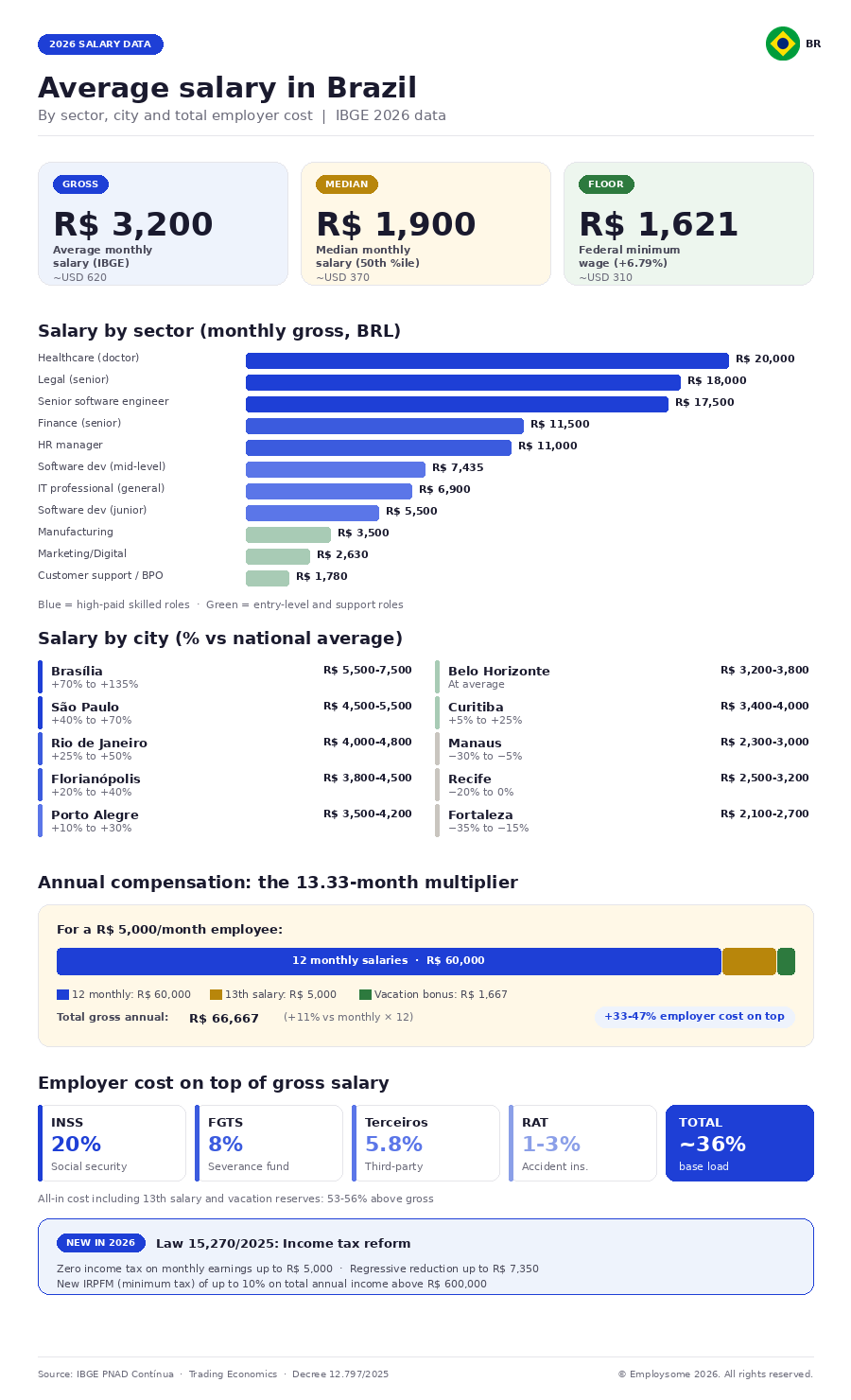
| Average monthly salary (gross) | BRL 3,200 | ~USD 620 |
| Wages index (latest, Feb 2026) | BRL 3,679 | ~USD 710 |
| Median monthly salary | BRL 1,900 | ~USD 370 |
| Federal minimum wage (from 1 Jan 2026) | BRL 1,621 | ~USD 310 |
| Hourly minimum | BRL 7.37/hour | ~USD 1.43/hour |
| Average annual salary (13 payments) | BRL 41,600 – BRL 45,000 | ~USD 8,000 – 8,700 |
| High-paid worker ceiling (private sector) | BRL 38,000+ | ~USD 7,600+ |
The gap between average and median salaries is a defining feature of Brazil’s labour market. Because a relatively small number of high earners pull the average upwards, the median (BRL 1,900) is a more accurate reflection of what a typical Brazilian worker actually earns. When benchmarking compensation for new hires, employers should reference both figures alongside sector- and city-specific data.
Brazil’s unemployment rate fell to 5.4% in the November 2025 – January 2026 quarter, the lowest in the PNAD time series dating back to 2012. Combined with rising real wages and Brazil’s recent income tax reform (Law 15,270/2025, effective January 2026, which zeroes out income tax for earnings up to BRL 5,000 per month), the Brazilian labour market is tighter and more competitive than it has been in over a decade.
💡 Employsome Insight: Median Is a More Useful Benchmark Than Average in Brazil
Always benchmark against median salary, not average salary, when setting base pay for mid-level professional roles in Brazil. The BRL 3,200 headline average is skewed by a small number of very high earners in finance, law, and executive roles. For realistic budgeting of administrative, support, and entry-level positions, the BRL 1,900 median is a better reference point. For skilled professional roles (tech, finance, marketing), reference the sector benchmarks below and expect to pay 2 to 5 times the national median.
Brazil Salaries by Sector and Industry
Sector has a larger impact on salary in Brazil than almost any other factor. Technology-driven roles, financial services, and legal professions command significant premiums over the national average. Here’s how average salaries break down across major sectors in 2026:
| Sector / Role | Average Monthly Gross (BRL) | Approx. USD |
| Software Engineer (Senior, São Paulo) | BRL 15,000 – 20,000+ | USD 2,900 – 3,870+ |
| Software Developer (Mid-level, “Pleno”) | BRL 6,870 – 8,000 | USD 1,330 – 1,550 |
| Software Developer (Entry-level, “Júnior”) | BRL 4,000 – 7,000 | USD 775 – 1,355 |
| IT Professional (general) | BRL 6,900 | USD 1,335 |
| Finance & Accounting (Senior) | BRL 8,000 – 15,000 | USD 1,550 – 2,900 |
| Finance & Accounting (Mid-level) | BRL 4,500 – 7,500 | USD 870 – 1,450 |
| Marketing/Digital Roles | BRL 2,630 | USD 510 |
| Legal Professional (Senior) | BRL 10,000 – 25,000+ | USD 1,935 – 4,840+ |
| HR Manager | BRL 8,000 – 14,000 | USD 1,550 – 2,710 |
| Customer Support / BPO Agent | BRL 1,780 | USD 340 |
| Manufacturing / Production | BRL 2,500 – 4,500 | USD 485 – 870 |
| Teaching (private schools) | BRL 3,500 – 7,000 | USD 680 – 1,355 |
| Healthcare Professional (doctor) | BRL 12,000 – 30,000+ | USD 2,320 – 5,800+ |
Brazilian tech salaries for remote international hires often run higher than domestic rates. Brazilian professionals working remotely for US or European companies can earn 2 to 3 times the local market rate, with senior engineers at international firms regularly exceeding BRL 25,000 per month. This creates upward pressure on the domestic tech market, particularly in São Paulo, Rio de Janeiro, and emerging hubs like Recife and Florianópolis.
Brazil ranks 2nd globally in data science skills and 4th in front-end development (HackerRank, Coursera Global Skills Index), and the country hosts over 1.5 million tech professionals. For companies hiring developers, the country’s technical strength combined with Latin American time zone alignment has made Brazil one of the most attractive global nearshoring destinations.
Brazil Salaries by City and Region
Where an employee lives in Brazil has a larger impact on salary than in most developed economies, reflecting the country’s dramatic regional economic disparities. The Southeast region (São Paulo, Rio de Janeiro, Minas Gerais) and the South (Rio Grande do Sul, Santa Catarina, Paraná) have average salaries significantly above the national mean, while the North and Northeast typically sit 30 to 50% lower.
| City / Region | Average Monthly Salary (BRL) | Relative to National Avg |
| São Paulo (city) | BRL 4,500 – 5,500 | +40 to +70% |
| Rio de Janeiro (city) | BRL 4,000 – 4,800 | +25 to +50% |
| Brasília (Federal District) | BRL 5,500 – 7,500 | +70 to +135% (civil service weighted) |
| Porto Alegre | BRL 3,500 – 4,200 | +10 to +30% |
| Florianópolis | BRL 3,800 – 4,500 | +20 to +40% |
| Belo Horizonte | BRL 3,200 – 3,800 | At or slightly above average |
| Curitiba | BRL 3,400 – 4,000 | +5 to +25% |
| Recife | BRL 2,500 – 3,200 | -20 to 0% |
| Salvador | BRL 2,200 – 2,800 | -30 to -15% |
| Fortaleza | BRL 2,100 – 2,700 | -35 to -15% |
| Manaus | BRL 2,300 – 3,000 | -30 to -5% |
Five Brazilian states set higher regional minimum wages above the federal floor of BRL 1,621: Rio Grande do Sul, Santa Catarina, Paraná, Rio de Janeiro, and São Paulo. Paraná currently leads with rates reaching BRL 2,408 for technical worker categories. These regional floors apply only in their respective states and cannot be reduced by collective bargaining agreements.
For international employers hiring remote talent, Brazil’s regional wage variation creates strategic sourcing opportunities. A senior developer in Recife or Fortaleza may accept 60 to 75% of a São Paulo salary while delivering identical quality, particularly if the role is fully remote. This is one of the reasons Brazil has emerged as a top LATAM hub for distributed engineering teams.
The 13th Month Salary and Vacation Bonus Explained
Brazilian employment law mandates a 13th month salary (salário decimo terceiro), which must be paid to every CLT-registered employee regardless of role or company size. This is a legal right under Law 4,090/1962 and is not optional. The 13th salary is equivalent to one month’s gross pay and is paid in two installments:
- First installment: Between February 1 and November 30, typically 50% of the employee’s November salary
- Second installment: By December 20, with all applicable deductions (INSS, income tax) applied
The 13th salary is proportional to time worked within the calendar year. An employee who started in July receives 6/12 of a full 13th salary. The payment is calculated on the employee’s most recent monthly salary, including any regular bonuses or commissions averaged over the year.
Brazilian workers also receive a vacation bonus (abono de férias) equivalent to one-third of their monthly salary when they take their annual vacation. Combined with the 13th salary, this means Brazilian employees effectively receive 13.33 months of pay per year, a structure that catches out many international employers when benchmarking Brazilian compensation against other markets.
| Annual Compensation Component | Amount (for BRL 5,000/month employee) |
| 12 monthly salaries | BRL 60,000 |
| 13th month salary | BRL 5,000 |
| Vacation bonus (1/3 of monthly salary) | BRL 1,667 |
| Total gross annual compensation | BRL 66,667 |
Calculating true annual cost requires applying the 13.33-month multiplier, not 12. A job advertised at “BRL 5,000 per month” costs the employer BRL 66,667 in gross wages alone, before any statutory contributions are added.
💡 Employsome Insight: Annual Cost Is 11% Higher Than Monthly Salary Suggests
Many foreign employers entering Brazil for the first time budget based on 12 months of salary and are then caught out by the 13th salary plus vacation bonus. The combined effect is that annual wage costs are 11% higher than the monthly salary suggests. When comparing compensation budgets between Brazil and countries without these mandatory payments (like the US or UK), multiply the Brazilian monthly salary by 13.33 for accurate annual comparisons, then add approximately 33% for employer contributions (see next section).
Total Employer Cost in Brazil 2026
In addition to the gross salary, employers hiring in Brazil must pay substantial mandatory contributions. Total employer cost typically adds 33 to 47% on top of gross wages once all statutory obligations are included.
| Employer Contribution | Rate | Notes |
| INSS (Social Security) | 20% of gross salary | Funds pensions, disability, maternity, healthcare |
| FGTS (Severance Fund) | 8% of gross salary | Monthly deposit to employee’s FGTS account |
| RAT (Work Accident Insurance) | 1% to 3% | Rate depends on industry risk classification |
| Third-party contributions (“Terceiros”) | ~5.8% | Funds SEBRAE, SENAI, INCRA, etc. |
| 13th salary reserve | ~8.33% effective | One month’s pay distributed across 12 months |
| Vacation reserve (inc. 1/3 bonus) | ~11.1% effective | Annual vacation + bonus accrued monthly |
| Total employer cost | ~53 to 56% | Including all reserves and contributions |
The figures above include both direct contributions and the effective cost of accrued benefits (13th salary and vacation). If you’re comparing only direct statutory charges, the total is closer to 33 to 35%. If you include the full effective cost of all mandatory benefits, the total climbs to 53 to 56%.
Additional costs commonly provided (though not legally required) include:
- Vale-transporte (transportation allowance): If applicable, employer pays up to 6% of employee salary for commuting; employee contributes difference
- Vale-alimentação / refeição (meal vouchers): Commonly BRL 400-800 per month, tax-deductible for the employer
- Private health insurance: Commonly offered for white-collar roles; BRL 300-1,200 per month depending on plan
- Private dental insurance: Typically BRL 30-100 per month
For a São Paulo software developer with a BRL 10,000 monthly base salary, total employer cost once all contributions, benefits, and reserves are included typically reaches BRL 15,500 to BRL 17,000 per month.
Net Salary: Employee Deductions and Income Tax
Brazilian employees pay two main deductions from their gross salary: INSS (employee social security contribution) and IRRF (income tax withheld at source). Net take-home pay is substantially lower than gross.
Employee INSS (progressive):
| Gross Salary Bracket (BRL) | INSS Rate |
| Up to 1,621.00 | 7.5% |
| 1,621.01 to 2,918.32 | 9% |
| 2,918.33 to 4,378.76 | 12% |
| 4,378.77 to 8,521.16 | 14% (capped) |
IRRF monthly income tax brackets (rates effective 1 January 2026 after Law 15,270/2025 reform):
| Monthly Income (BRL) | Rate | Deduction |
| Up to 2,428.80 | 0% (exempt) | – |
| 2,428.81 to 2,826.65 | 7.5% | BRL 182.16 |
| 2,826.66 to 3,751.05 | 15% | BRL 394.16 |
| 3,751.06 to 4,664.68 | 22.5% | BRL 675.49 |
| Above 4,664.68 | 27.5% | BRL 908.73 |
A major 2026 reform: Law 15,270/2025 introduces a monthly income tax reduction that effectively zeroes out income tax for earnings up to BRL 5,000 per month, with a regressive reduction for earnings between BRL 5,000 and BRL 7,350 per month. This reform shifted real take-home pay significantly upward for the Brazilian middle class in 2026.
From 2026, individuals earning more than BRL 600,000 per year from all sources (salary, dividends, investments, rental income) are subject to a new Minimum Individual Income Tax (IRPFM) under Law 15,270/2025. This particularly affects executives and high earners and is applied alongside, rather than replacing, the regular progressive income tax.
Deductions that reduce taxable income include employee INSS contributions (fully deductible), BRL 189.59 per dependant per month, fully documented medical expenses, education costs up to BRL 3,561.50 per student per year, and alimony payments. These deductions can meaningfully lower effective tax rates for middle and upper-middle income workers.
How Brazil Compares to Other Markets
Brazil’s average salary figures compare favourably to other major Latin American economies and offer significant cost advantages versus North American and Western European markets.
| Country | Average Monthly Salary (USD) | Minimum Wage (USD/mo) | Employer Cost Load |
| Brazil | ~USD 620 | USD 310 | ~33-47% |
| Mexico | ~USD 740 | USD 450 | ~27-35% |
| Argentina | ~USD 700 | USD 310 | ~27% |
| Colombia | ~USD 550 | USD 360 | ~40-45% |
| Chile | ~USD 900 | USD 530 | ~20-25% |
| United States | ~USD 4,900 | Federal USD 1,257 | ~15-20% |
| Portugal | ~USD 1,680 | USD 980 | ~23.75% |
For companies hiring in Brazil compared to the US, total landed cost (salary plus employer contributions) for a mid-level professional typically runs 30 to 40% of the equivalent US cost, while technical skill levels are comparable. This cost arbitrage, combined with time zone alignment for US companies and strong English proficiency in urban tech hubs, is the primary driver behind the expansion of Brazilian remote hiring over the past three years.
However, the cost advantage narrows for senior roles. A staff-level software engineer in São Paulo with offers from US-based employers can command BRL 25,000 to BRL 40,000 per month (roughly USD 4,800 to USD 7,700), rapidly approaching US salary levels minus location-based adjustments. Budget for aggressive competition at the senior end of the market.
What International Employers Need to Know
Benchmark against sector and city, not national averages
The BRL 3,200 national average is useful as a macro indicator but misleading for compensation decisions. Always benchmark against the specific sector, seniority, and city. A senior software engineer in São Paulo needs a very different package than a customer support agent in Fortaleza, and national averages paper over these differences.
Budget for 13.33 months of salary, not 12
The mandatory 13th month salary plus vacation bonus means effective annual compensation is 11% higher than monthly base salary suggests. A “BRL 5,000 per month” job costs BRL 66,667 in gross wages annually, plus approximately 33 to 47% in employer contributions. Build this into your initial cost model.
Factor in the 2026 income tax reform for net pay comparisons
Law 15,270/2025 zeroes out income tax for earnings up to BRL 5,000 per month from January 2026. This significantly increased net take-home pay for Brazilian middle-class workers, making equivalent gross salaries more attractive to candidates in 2026 compared to previous years. Candidates may accept slightly lower gross offers than they would have in 2025 because their net pay is higher.
Consider EOR legal risks specific to Brazil
Employer of Record arrangements in Brazil operate in a legal grey area under CLT labour law. Brazilian courts may reclassify EOR arrangements as direct employment with the client in certain circumstances. For full legal analysis, see our Expert Spotlight with Montgomery & Associados, which details the risks and mitigation strategies.
Use an EOR with deep Brazilian infrastructure
Brazil’s payroll complexity, combined with the 13th salary, multiple mandatory contributions, and progressive income tax reform, makes local expertise essential. For provider comparisons ranked on Brazilian in-country performance, see our Best Employer of Record in Brazil guide. For broader context on structuring international hires, see our how to hire employees internationally guide.
Hiring in Brazil?
Brazil’s salary structure includes a mandatory 13th month payment, vacation bonus, and 33-47% employer contributions on top of gross wages. CLT labour law creates legal complexity around EOR arrangements that international employers need to navigate carefully. Compare the top Employer of Record providers for Brazil in 2026 – verified pricing, compliance scores, and expert rankings from Employsome’s independent research team.
Frequently Asked Questions
The average salary in Brazil is approximately BRL 3,200 gross per month in 2026 (around USD 620), based on IBGE data. The latest Wages Index from Trading Economics shows BRL 3,679 per month in February 2026. The median salary is lower at BRL 1,900, reflecting Brazil’s significant income inequality. Average annual compensation including the mandatory 13th salary and vacation bonus reaches BRL 41,600 to BRL 45,000.
A good salary in Brazil depends on location and family situation. For a single professional in São Paulo, Rio de Janeiro, or Brasília, BRL 8,000 to BRL 12,000 per month gross is considered a good professional salary, comfortably above the national average. In smaller cities or the Northeast, BRL 4,500 to BRL 7,000 per month provides a similar standard of living. For senior tech and finance roles in tier-1 cities, BRL 15,000+ is typical.
The federal minimum wage in Brazil is BRL 1,621 per month (BRL 7.37 per hour) from 1 January 2026, a 6.79% increase under Decree 12.797/2025. Five states (Rio Grande do Sul, Santa Catarina, Paraná, Rio de Janeiro, São Paulo) set higher regional minimums, with Paraná reaching BRL 2,408 for technical worker categories. The minimum wage serves as the base for calculating many benefits, pensions, and employer contributions.
Software developer salaries in Brazil vary significantly by seniority and location. Junior developers (Júnior) earn BRL 4,000 to BRL 7,000 per month. Mid-level (Pleno) developers earn BRL 6,870 to BRL 8,000. Senior developers in São Paulo can command BRL 15,000 to BRL 20,000+ per month, and staff-level engineers working for international companies may exceed BRL 25,000 per month. Brazilian developers rank 2nd globally in data science skills.
The 13th month salary (salário decimo terceiro) is a mandatory additional month’s pay required under Brazilian Law 4,090/1962 for all CLT-registered employees. It is paid in two installments: the first between February 1 and November 30 (typically 50% of the employee’s November salary), and the second by December 20 with all applicable deductions. The 13th salary is proportional to time worked within the calendar year, and is separate from the annual vacation bonus of one-third monthly salary.
Total employer cost in Brazil typically adds 33 to 47% on top of gross salary for direct contributions (INSS 20%, FGTS 8%, RAT 1-3%, third-party contributions ~5.8%). When including the effective cost of the mandatory 13th salary and vacation bonus plus common benefits (meal vouchers, transport, private health insurance), true total employer cost can reach 53 to 56% above gross salary. A BRL 10,000 per month role typically costs the employer BRL 15,500 to BRL 17,000 monthly all-in.
The average salary in São Paulo city is approximately BRL 4,500 to BRL 5,500 per month, which is 40 to 70% above the national average. São Paulo concentrates the majority of Brazil’s highest-paying professional roles in finance, technology, and law. Professional white-collar roles in São Paulo typically pay BRL 8,000 to BRL 15,000 per month, with senior tech and executive positions often exceeding BRL 25,000 monthly.
Brazilian income tax (IRRF) is progressive, ranging from 0% to 27.5%. Under Law 15,270/2025 effective January 2026, monthly earnings up to BRL 2,428.80 are fully exempt, with 7.5%, 15%, 22.5%, and 27.5% brackets applying progressively above that. The 2026 reform also introduced an effective zero income tax for monthly earnings up to BRL 5,000 and a new Minimum Individual Income Tax (IRPFM) of up to 10% for individuals earning over BRL 600,000 per year from all sources.

Written by
Dane Cobain is a Copywriter at Employsome and an accomplished author whose work spans fiction, non-fiction, and professional writing. Over the past decade, he has built a strong track record creating straightforward content for the HR, payroll, and corporate sectors. Dane brings a storyteller’s eye to the evolving world of global employment, with a particular focus on Employer of Record and PEO models. His articles explore industry trends and dedicated Best Of Guides when managing an international workforce.
Our content is created for informational purposes only and is not intended to provide any legal, tax, accounting, or financial advice. Please obtain separate advice from industry-specific professionals who may better understand your business’s needs. Read our Editorial Guidelines for further information on how our content is created.