10 Employee Development Plan Template Examples for 2026
10 employee development plan template examples covering new hire onboarding, leadership pipelines, technical upskilling, remote team development, international employees, career transitions, and more. Each template includes goals, actions, timelines, and success metrics you can adapt for your organisation.


Table of Contents
- What Makes a Good Employee Development Plan
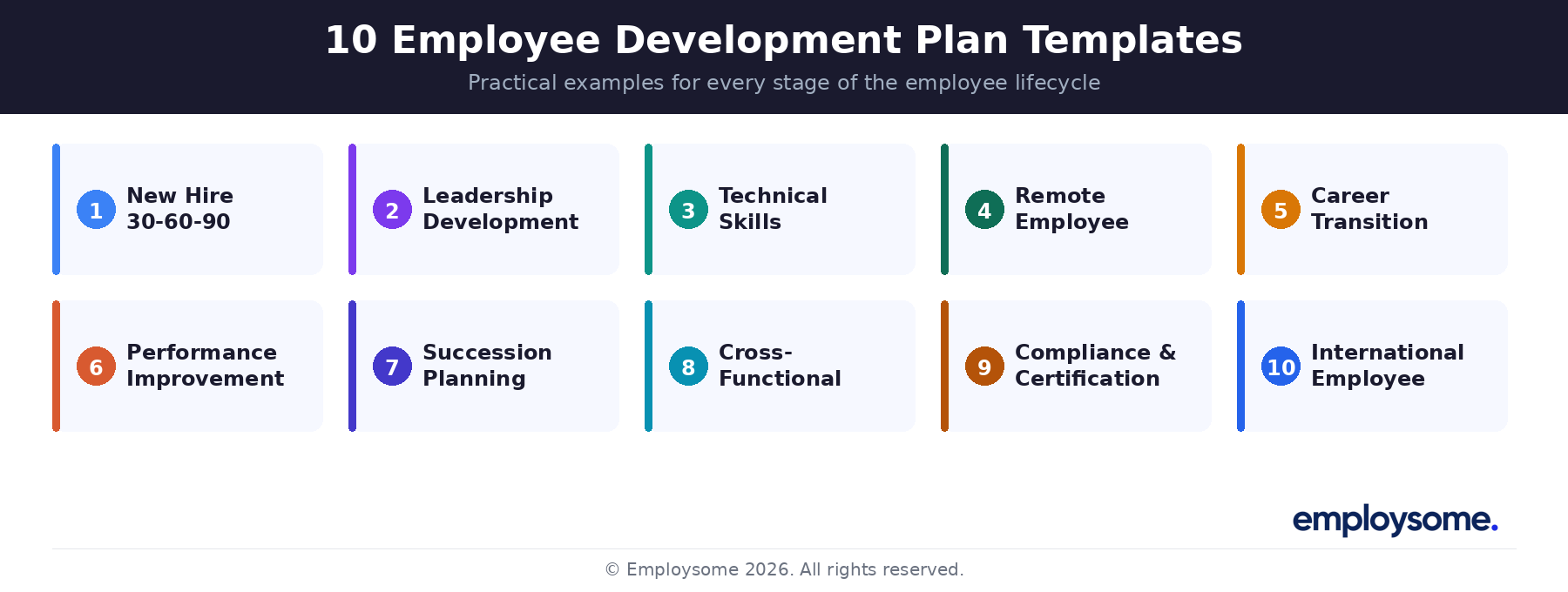
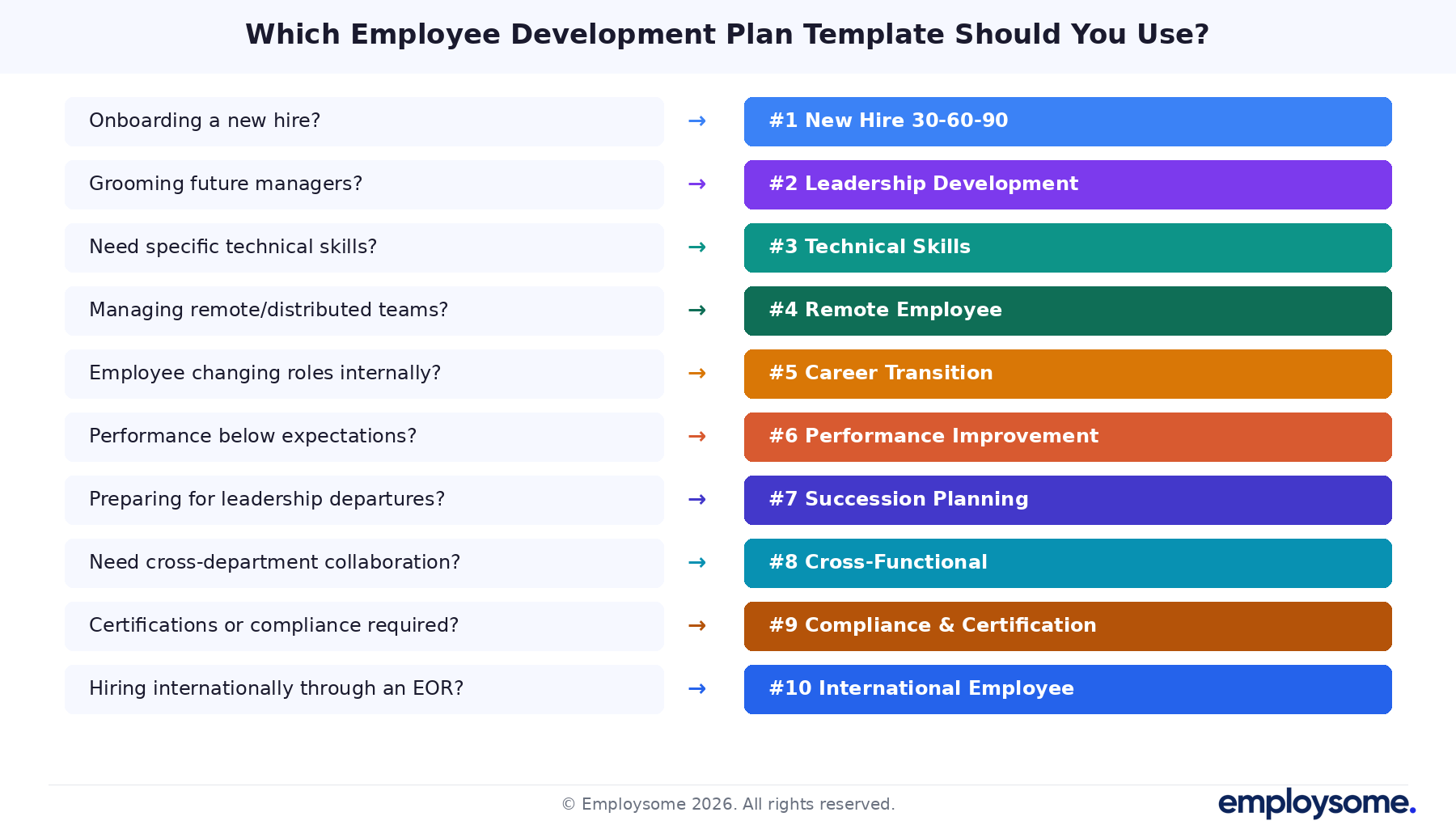
- 1. New Hire 30-60-90 Day Development Plan
- 2. Leadership Development Plan
- 3. Technical Skills Development Plan
- 4. Remote Employee Development Plan
- 5. Career Transition Development Plan
- 6. Performance Improvement Development Plan
- 7. Succession Planning Development Plan
- 8. Cross-Functional Development Plan
- 9. Compliance and Certification Development Plan
- 10. International Employee Development Plan
- How to Implement Employee Development Plans
- FAQ
An employee development plan is a structured roadmap that connects an employee’s career goals with the skills, training, and experiences they need to get there. Done well, it increases retention, improves performance, and gives managers a practical framework for career conversations that go beyond annual reviews.
The problem is that most development plans are either too generic to be useful or too complicated to maintain. Managers create them once, file them away, and never revisit them. Employees fill in vague goals like “improve leadership skills” with no concrete actions or timelines, and the plan becomes shelfware.
This guide provides 10 employee development plan template examples, each designed for a specific use case. Every template includes a clear structure with goals, actions, timelines, success metrics, and a worked example so you can adapt it immediately. Whether you are onboarding a new hire, building a leadership pipeline, upskilling a technical team, or supporting a career transition, there is a template here that fits.

What Makes a Good Employee Development Plan
Before diving into templates, it is worth understanding what separates a development plan that actually works from one that gets ignored.
A good employee development plan has five elements:
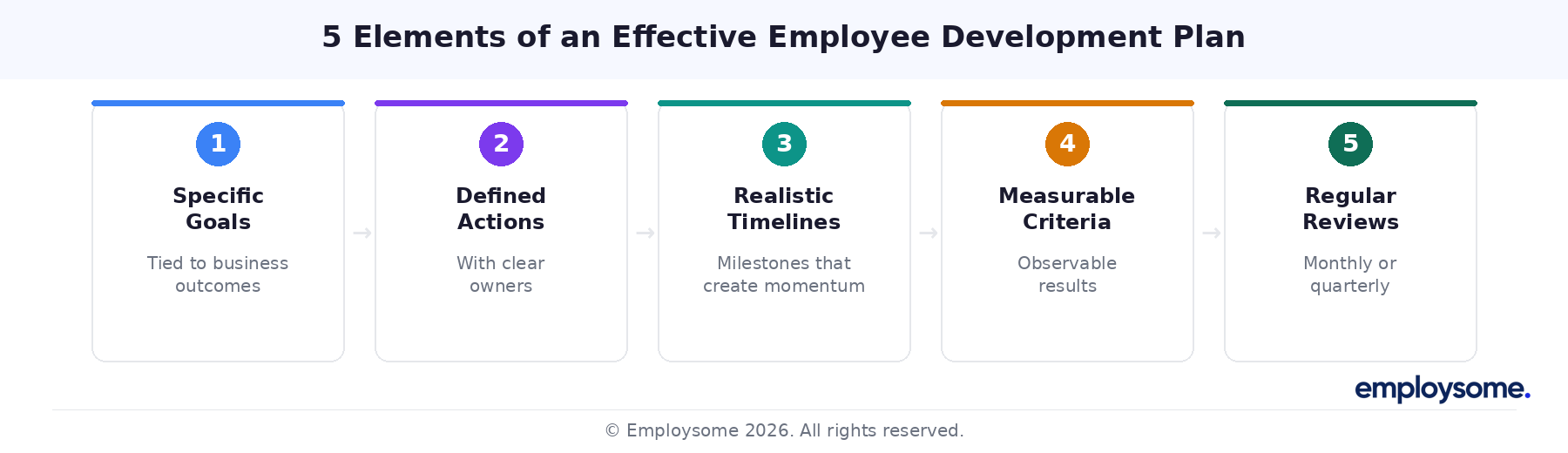
Specific goals tied to business outcomes. “Improve communication skills” is not a development goal. “Lead the Q3 client presentation independently by September” is. Every goal should connect to something the business needs.
Defined actions with owners. Each goal needs concrete steps: courses to complete, projects to join, people to shadow, certifications to earn. Both the employee and the manager should know who is responsible for what.
Realistic timelines. Development happens over months, not weeks. A 90-day plan for a new hire is different from a 12-month leadership pipeline plan. Set milestones that create momentum without overwhelming.
Measurable success criteria. How will you know the plan worked? Define what “done” looks like for each goal. Observable behaviours, completed deliverables, feedback scores, or certification passes all work.
Regular review cadence. Plans need check-ins. Monthly for short-term plans, quarterly for longer ones. Without reviews, plans drift and employees lose motivation.
1. New Hire 30-60-90 Day Development Plan
The 30-60-90 day structure works because it gives new hires permission to learn before they are expected to deliver. Too many onboarding processes throw people into the deep end with no structured ramp-up, leading to early frustration and turnover. The key is making the transition from “learn” to “own” gradual and explicit, so both the employee and manager know exactly what success looks like at each stage.
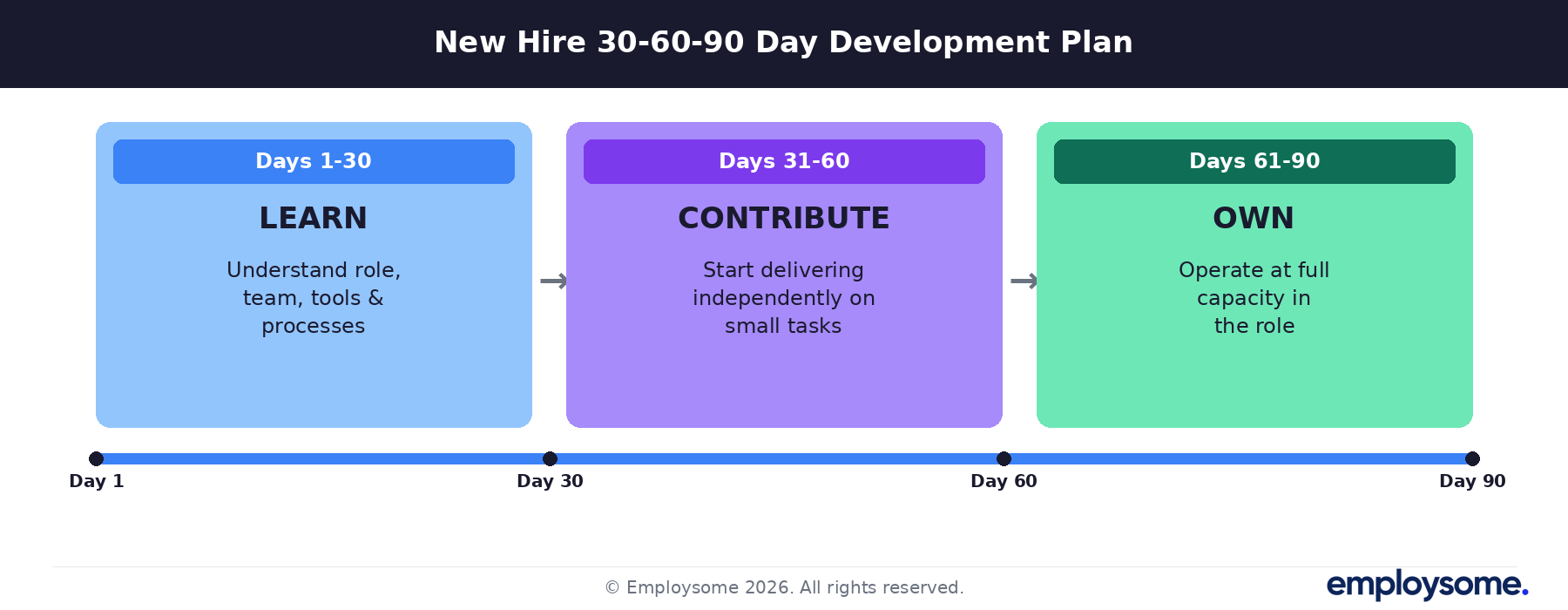
| New Hire 30-60-90 Day Development Plan | |||
| Phase | Goals | Actions | Success Metrics |
| Days 1-30: Learn | Understand role, team, tools, and processes | Complete onboarding modules. Shadow 3 team members. Meet all key stakeholders. Learn core systems. | Can explain team’s function and own role to a new person. Completed all onboarding tasks. |
| Days 31-60: Contribute | Start delivering independently on small tasks | Own 2-3 smaller projects. Attend client/stakeholder meetings. Start using all core tools independently. | Delivered first independent project. Positive feedback from team lead on quality. |
| Days 61-90: Own | Operate at full capacity in the role | Lead a project end-to-end. Identify one process improvement. Present work to the wider team. | Manager confirms role proficiency. Employee sets own Q2 goals with minimal guidance. |
Best for: Onboarding new employees in their first three months.
This template structures the critical first 90 days into three phases, each with escalating expectations. It prevents the common problem of new hires being left to figure things out on their own while giving managers a clear framework for assessing progress.
Example: A marketing associate joins a SaaS company. In month one, they learn the product, CRM, and content calendar. In month two, they write their first blog posts and manage social scheduling independently. By month three, they own the editorial calendar and pitch their first campaign idea.
2. Leadership Development Plan
The biggest mistake companies make with first-time managers is promoting their best individual contributor and expecting them to figure out management on their own. This template forces deliberate practice in the four areas where new managers struggle most: letting go of tasks, giving honest feedback, thinking beyond their own work, and building a team rather than just leading one. Spread over 12 months, it gives enough time for real behavioural change rather than just ticking off a training course.
| Leadership Development Plan (12-Month) | |||
| Competency | Current Level | Development Actions | Target & Timeline |
| Delegation | Tends to do everything themselves | Assign 2 tasks/week to junior team members. Complete delegation workshop. | Consistently delegates by Q2. Team feedback confirms. |
| Feedback delivery | Avoids difficult conversations | Shadow manager in 3 feedback sessions. Practice with role-play exercises. Deliver 2 real feedback conversations with coaching support. | Delivers constructive feedback independently by Q3. |
| Strategic thinking | Focused on execution, not strategy | Join quarterly planning meetings. Present one strategic recommendation to leadership. Read 2 books on strategic management. | Contributes meaningfully to Q4 planning process. |
| Team building | Limited cross-functional relationships | Lead a cross-functional project. Mentor one junior employee. Organise team knowledge-sharing sessions. | 360 feedback shows improvement in collaboration scores. |
Best for: High-potential individual contributors being groomed for management roles.
This template focuses on the specific skills gap between being a strong individual contributor and being an effective manager: delegation, feedback, conflict resolution, strategic thinking, and team building.
Example: A senior software engineer is identified for an engineering manager track. Over 12 months, they gradually take on sprint planning, conduct code reviews with developmental feedback rather than just technical corrections, and lead a cross-team initiative. By year-end, they are ready to manage a small team.
3. Technical Skills Development Plan
Technical development plans fail when they are just a list of courses to complete. This template pairs every learning activity with a hands-on project using real company data, which is where actual skill transfer happens. The proficiency levels (beginner, intermediate, advanced) give both the employee and manager a shared language for assessing progress objectively.
| Technical Skills Development Plan | |||
| Skill | Current Proficiency | Learning Path | Target Proficiency & Date |
| Python | Beginner | Complete online course (40 hrs). Build 2 internal automation scripts. Pair-program with senior dev weekly. | Intermediate by Month 4 |
| Cloud (AWS) | None | AWS Cloud Practitioner certification. Deploy one production service. Shadow DevOps team for 2 weeks. | Certified + practical experience by Month 6 |
| Data visualisation | Basic Excel | Tableau training (20 hrs). Create 3 dashboards for real business data. Present insights to stakeholders. | Can build dashboards independently by Month 3 |
Best for: Employees who need to learn specific technical skills for their current or future role.
This template is structured around concrete skill acquisition with clear proficiency levels, making it particularly useful for engineering, data, design, and other technical functions.
Example: A business analyst needs to transition from Excel-based reporting to building automated dashboards. The plan maps out specific courses, hands-on projects using real company data, and a certification milestone, with the manager reviewing progress monthly.
4. Remote Employee Development Plan
Remote employees do not lack talent or motivation; they lack the informal exposure that drives careers in offices. This template makes those invisible career drivers visible and deliberate: structured face time with leadership, explicit promotion criteria in writing, and a mentorship pairing that replaces the hallway conversations remote workers miss. Without these interventions, remote employees consistently get promoted less and leave more often.
| Remote Employee Development Plan | |||
| Focus Area | Challenge | Actions | Review Cadence |
| Visibility | Out of sight, out of mind for promotions | Present work at monthly all-hands. Share weekly written updates. Lead one cross-team initiative per quarter. | Monthly 1:1 |
| Skill building | No in-person training or shadowing | Annual learning budget (EUR 1,500). Access to online platform. Virtual mentorship pairing with senior colleague. | Quarterly review |
| Connection | Isolation and weak team bonds | Weekly video 1:1 with manager. Monthly virtual coffee with someone outside direct team. Annual in-person offsite. | Monthly check-in |
| Career progression | Unclear path without daily manager contact | Documented career ladder shared openly. Bi-annual career conversation with skip-level manager. Written promotion criteria. | Bi-annual |
Best for: Distributed or remote-first teams where development cannot rely on in-office proximity.
Remote employees often miss the informal learning that happens in offices: overhearing conversations, spontaneous mentoring, and visibility to leadership. This template compensates by structuring visibility, connection, and skill-building explicitly.
Example: A remote customer success manager in Portugal working for a US-headquartered company. The plan ensures they present quarterly business reviews to leadership (visibility), complete a customer success certification (skills), have a mentor in the US office (connection), and receive transparent promotion criteria (progression).
5. Career Transition Development Plan
Internal mobility saves the company the cost of an external hire and saves the employee the risk of changing organisations. This template de-risks the transition by keeping one foot in the current role while building competence in the new one, rather than making a hard switch on day one. The 6-month timeline with a gradual shift from 20% to 100% allocation gives both sides an exit ramp if the fit is not right.
| Career Transition Plan (6-Month) | |||
| Phase | Focus | Actions | Milestone |
| Month 1-2 | Explore & assess | Shadow target team for 2 weeks. Complete skills gap assessment with target manager. Identify 3 key competencies to build. | Gap assessment complete. Learning plan agreed. |
| Month 3-4 | Build & practice | Complete foundational training/certification. Take on 1-2 projects in target function (20% time). Weekly check-ins with mentor in new team. | First project delivered in new function. Positive feedback. |
| Month 5-6 | Transition & confirm | Increase allocation to 50-100% in new role. Hand over current responsibilities. Formal role change and title update. | Full transition complete. 90-day review scheduled. |
Best for: Employees moving into a different function or department within the same company.
Internal mobility is cheaper and lower-risk than external hiring, but only if the transition is properly supported. This template bridges the gap between the employee’s current skills and the requirements of their target role.
Example: An account executive wants to move into product management. Over 6 months, they shadow the PM team, complete a product management course, lead customer research for a feature, and gradually shift their workload. By month 6, they are a full-time associate product manager with their sales pipeline fully handed over.
6. Performance Improvement Development Plan
A PIP should be a genuine attempt to help someone improve, not a paper trail for termination. This template pairs every performance gap with specific support (training, coaching, reduced workload) so the employee has a real chance to close the gap. The 60-90 day window is long enough to show meaningful change but short enough to maintain urgency and protect the team.
| Performance Improvement Plan (60-90 Days) | |||
| Performance Gap | Expected Standard | Support Provided | Review Date |
| Missed 3 of last 5 project deadlines | Meet 90%+ of deadlines | Project management training. Weekly planning session with manager. Reduced project load during improvement period. | Day 30: Progress check. Day 60: Final review. |
| Client satisfaction scores dropped to 3.2/5 | Maintain 4.0/5 or above | Shadow top-performing colleague for 1 week. Review and practice client communication frameworks. Manager joins next 3 client calls for coaching. | Day 45: Score review. Day 90: Final assessment. |
Best for: Employees whose performance has fallen below expectations and need structured support to improve.
This is not a punishment document. A well-designed performance improvement plan gives the employee clarity on what needs to change, specific support to help them change it, and a fair timeline. It also protects the company legally if the situation does not improve.
Example: A support agent’s resolution time has increased by 40% over three months. The PIP identifies the root cause (unfamiliarity with a new product line), provides targeted product training, pairs them with a senior agent for two weeks, and reviews metrics at day 30 and day 60.
7. Succession Planning Development Plan
The difference between a name on a succession chart and a genuinely ready successor is 12-18 months of deliberate exposure to things they have never done before. This template focuses on the capabilities that cannot be learned from a course: managing a budget, presenting to a board, leading through a crisis, and building external relationships. Without this structured exposure, most succession plans collapse the moment the incumbent leaves.
| Succession Planning Development Plan (12-18 Months) | |||
| Capability | Gap | Development Activity | Readiness Target |
| P&L ownership | No budget management experience | Co-own departmental budget for 2 quarters. Complete finance for non-finance managers course. | Can present budget review to CFO by Month 12 |
| Board/exec communication | Has not presented to board | Attend 3 board meetings as observer. Present one section of quarterly business review. Executive communication coaching (4 sessions). | Presents independently to board by Month 15 |
| Crisis management | Untested under pressure | Lead incident response for next major issue. Complete crisis management simulation. Debrief with current leader after each critical event. | Has led at least 2 real crisis responses by Month 18 |
| External relationships | Limited network outside company | Attend 2 industry conferences. Join one industry advisory board. Build relationships with 5 key external partners. | Recognised externally as emerging leader |
Best for: Preparing internal candidates to step into critical roles when senior leaders depart.
Succession planning fails when it stays as a name on a spreadsheet. This template turns succession candidates into genuinely ready replacements by mapping the specific capabilities they need and creating real exposure to the demands of the target role.
Example: A VP of Operations is being prepared to succeed the COO within 18 months. The plan gives them P&L exposure they have never had, board presentation experience, and deliberate crisis management opportunities so the transition feels natural rather than abrupt.
8. Cross-Functional Development Plan
Most collaboration failures are not about personality; they are about ignorance of how other teams work, what they care about, and what constraints they face. This template sends the employee into other departments for structured learning rather than hoping cross-functional understanding will develop naturally. By the end of 6 months, they make better decisions because they can anticipate how their work affects sales, engineering, and finance.
| Cross-Functional Development Plan (6-Month) | |||
| Target Function | Learning Objective | Activity | Outcome |
| Sales | Understand customer objections and buying process | Join 5 sales calls. Review 10 lost deal post-mortems. Present product roadmap to sales team. | Can articulate top 5 customer objections. Sales team rates collaboration 4+/5. |
| Engineering | Understand technical constraints and sprint process | Attend 4 sprint planning sessions. Shadow an engineer for 1 day. Complete basic technical literacy course. | Can write technically informed product requirements. |
| Finance | Understand unit economics and budget process | Meet with finance partner monthly. Learn to read P&L and CAC/LTV metrics. Present one business case with financial model. | Incorporates financial impact into proposals. |
Best for: Employees who need to build skills and relationships across departments to be more effective in their current role.
Many roles require collaboration across functions, but employees default to working within their own team. This template deliberately builds cross-functional competence through projects, relationships, and shared objectives.
Example: A product manager spends 6 months deliberately building relationships and competence across sales, engineering, and finance. By the end, their product specifications include financial justification, they anticipate engineering constraints, and sales trusts them to address customer needs in the roadmap.
9. Compliance and Certification Development Plan
Compliance development is the one area where missing a deadline has immediate legal or regulatory consequences. This template separates mandatory certifications (which must be tracked to specific deadlines) from optional but career-enhancing credentials, so nothing falls through the cracks. It also creates a single view of all certification statuses, making it easy for HR to audit compliance across the team.
| Compliance & Certification Development Plan | |||
| Requirement | Status | Action | Deadline |
| GDPR Data Protection Officer certification | Not started | Enrol in accredited DPO course (40 hours). Complete exam. Register with supervisory authority. | June 2026 |
| Annual anti-money laundering refresher | Due for renewal | Complete online AML module (4 hours). Pass assessment with 80%+. | March 2026 |
| First aid certification | Expired | Book and attend 2-day first aid course. Renew certificate. | April 2026 |
| Industry-specific: AWS Solutions Architect (optional but valued) | Not started | Self-study (80 hours). Practice exams. Employer-funded exam voucher. | September 2026 |
Best for: Roles that require specific certifications, licences, or regulatory training to operate legally or competitively.
Some development is not optional. Regulated industries, professional services, and certain technical roles require employees to maintain active certifications. This template tracks mandatory development alongside discretionary growth.
Example: A fintech compliance officer needs to maintain their GDPR DPO certification, complete annual AML training, and the company wants them to add a CAMS (Certified Anti-Money Laundering Specialist) credential. The plan separates mandatory renewals from aspirational certifications and tracks deadlines to prevent lapses.
10. International Employee Development Plan
International employees hired through an EOR are often treated as a separate category from headquarters staff, which creates a two-tier system where remote international hires miss out on career progression. This template ensures international employees are mapped to the same career ladder, receive the same learning budgets, and get deliberate timezone-inclusive access to decision-making. The EOR handles employment compliance, but the development plan must be owned by the manager, not outsourced.
| International Employee Development Plan | |||
| Focus Area | Challenge | Actions | Review Cadence |
| Cultural integration | Disconnected from HQ culture and decision-making | Join weekly HQ all-hands. Participate in one HQ-led project per quarter. Visit HQ office annually if possible. | Monthly 1:1 |
| Career framework alignment | Unclear whether HQ promotion criteria apply | Map local role to HQ career ladder. Agree on promotion criteria with manager in writing. Bi-annual career conversation with skip-level. | Bi-annual |
| Local compliance knowledge | Employee unaware of local labour rights and benefits | EOR provides local employment handbook. Manager reviews local leave, benefits, and termination terms with employee. Annual local compliance update. | Annual |
| Skill development | Training budgets and programmes may not extend to EOR employees | Confirm annual learning budget applies equally to international hires. Provide access to same platforms as HQ employees. Identify local training or conferences relevant to role. | Quarterly |
| Timezone-inclusive participation | Excluded from meetings and decisions due to timezone gap | Record key meetings. Rotate meeting times quarterly. Ensure async decision-making tools (Notion, Loom) are standard practice. | Monthly check-in |
Best for: Employees hired through an Employer of Record or working in a different country from the company’s headquarters.
International employees face unique development challenges: cultural distance from headquarters, limited visibility to leadership, timezone misalignment for training, and uncertainty about whether home-country career frameworks apply to them. This template addresses those gaps directly.
Example: A product designer hired in Croatia through an EOR for a US-based SaaS company. The plan ensures they are mapped to the same career ladder as US designers (not treated as a contractor), receive the same EUR 1,500 annual learning budget, join the quarterly design critique by rotating meeting times, and visit the US office once a year for the team offsite. The EOR handles their Croatian employment compliance, but the development plan is owned by their US-based manager.
How to Implement Employee Development Plans
Having templates is not enough. Here is how to make development plans actually work in your organisation:
Start with a conversation, not a form. The best development plans come from genuine dialogue between the manager and employee about where they want to go and what the business needs. The template is the output, not the starting point.
Keep it to 2-3 goals maximum. Plans with 8 goals get ignored. Focus on the 2-3 things that will make the biggest difference in the next 6-12 months. You can always add more goals later.
Build development into existing workflows. Do not treat development as a separate activity that happens outside of work. The most effective development actions are real projects, real presentations, and real stretch assignments, not just courses.
Review regularly and adjust. Monthly for short-term plans (30-60-90, PIP), quarterly for longer ones (leadership, succession). If you are not reviewing, you are not developing.
Document progress, not just plans. Keep a running record of what was completed, what was learned, and what changed. This creates evidence for promotion decisions and shows employees their growth over time.
If you manage employees across multiple countries through an Employer of Record, development planning becomes more complex. Different markets have different norms around career progression, feedback culture, and training expectations. In some European countries, employers are legally required to provide training budgets or professional development time. An EOR can help you understand local requirements, but the development conversation itself should always be led by the manager, not outsourced to a platform. To learn more about hiring internationally, see our Best Employer of Record comparison.
Frequently Asked Questions
An employee development plan is a structured document that outlines an employee’s growth goals, the specific actions they will take to achieve them, timelines, and how success will be measured. It connects individual career aspirations with organisational needs.
Short-term plans (30-60-90 day, performance improvement) should be reviewed weekly or bi-weekly. Longer-term plans (leadership, succession, career transition) should be reviewed monthly or quarterly. The key is consistency: a plan that is never reviewed is a plan that is never followed.
Both the manager and the employee. The employee should drive their own development goals, while the manager provides context on business needs, identifies opportunities, and removes barriers. HR can provide templates and frameworks, but the content should come from the manager-employee relationship.
A development plan is forward-looking and growth-oriented: it helps good employees get better. A performance improvement plan (PIP) addresses specific performance gaps that need to be corrected within a defined timeframe. Both use similar structures, but the context and tone are different.
Two to three goals maximum for any 6-12 month period. More than that dilutes focus and reduces the likelihood that any single goal is achieved. Quality over quantity.
Yes. Templates 4 (Remote Employee) and 10 (International Employee) in this guide are specifically designed for distributed teams. The key difference is that remote and international plans must explicitly address visibility, timezone inclusion, and career framework alignment, which happen naturally in co-located teams but require deliberate effort when employees are distributed.
Template 2 (Leadership Development Plan) is designed specifically for individual contributors transitioning to management. It focuses on the skills that matter most in the first year: delegation, feedback delivery, strategic thinking, and team building.
Written by
Dane Cobain is a Copywriter at Employsome and an accomplished author whose work spans fiction, non-fiction, and professional writing. Over the past decade, he has built a strong track record creating straightforward content for the HR, payroll, and corporate sectors. Dane brings a storyteller’s eye to the evolving world of global employment, with a particular focus on Employer of Record and PEO models. His articles explore industry trends and dedicated Best Of Guides when managing an international workforce.
Our content is created for informational purposes only and is not intended to provide any legal, tax, accounting, or financial advice. Please obtain separate advice from industry-specific professionals who may better understand your business’s needs. Read our Editorial Guidelines for further information on how our content is created.
Other posts
Along with our standard maps we offer highly customizable maps.