Work Visa Ireland 2026: How to Get an Employment Permit
A work visa in Ireland requires an employment permit issued by the Department of Enterprise, Tourism and Employment (DETE). The two main routes are the Critical Skills Employment Permit (CSEP) and the General Employment Permit (GEP). From 1 March 2026, salary thresholds increased: CSEP requires €40,904 for roles on the Critical Skills Occupation List or €68,911 for all other eligible roles. GEP requires €36,605 for most occupations. No labour market test is needed for CSEP. Processing takes 4 to 8 weeks. CSEP holders can apply for Stamp 4 (open work permission) after just 21 months. This guide covers every permit type, salary thresholds, the application process, employer obligations, family reunification, and what it means for companies hiring through an EOR.


Table of Contents
- Types of Work Visa in Ireland
- Work Visa Ireland: Salary Thresholds from 1 March 2026
- The Critical Skills Occupation List
- Eligibility Requirements for a Work Visa in Ireland
- How to Apply for a Work Visa in Ireland: Step by Step
- Path to Stamp 4 and Permanent Residency
- Family Reunification
- The 50/50 Rule
- Employer Obligations
- What This Means for Companies Hiring Through an EOR
- FAQs
A work visa in Ireland is officially called an employment permit. It is issued by the Department of Enterprise, Tourism and Employment (DETE), not by immigration authorities. This distinction matters because the employment permit process and the visa/immigration process are two separate steps, and both must be completed before a non-EEA national can legally start working in Ireland.
EU/EEA nationals can work in Ireland without any permit or visa. For everyone else, the work visa Ireland process starts with securing a job offer from an Irish employer, applying for the correct employment permit through DETE, and then (if required) applying for a Long Stay D Visa to enter the country.
Ireland’s employment permit system is employer-driven. The employer must be registered with Revenue, trading in Ireland, and registered with the Companies Registration Office. The employee must be directly employed and paid by the employer in Ireland. Job offers through recruitment agencies or intermediaries are not accepted for employment permit applications.
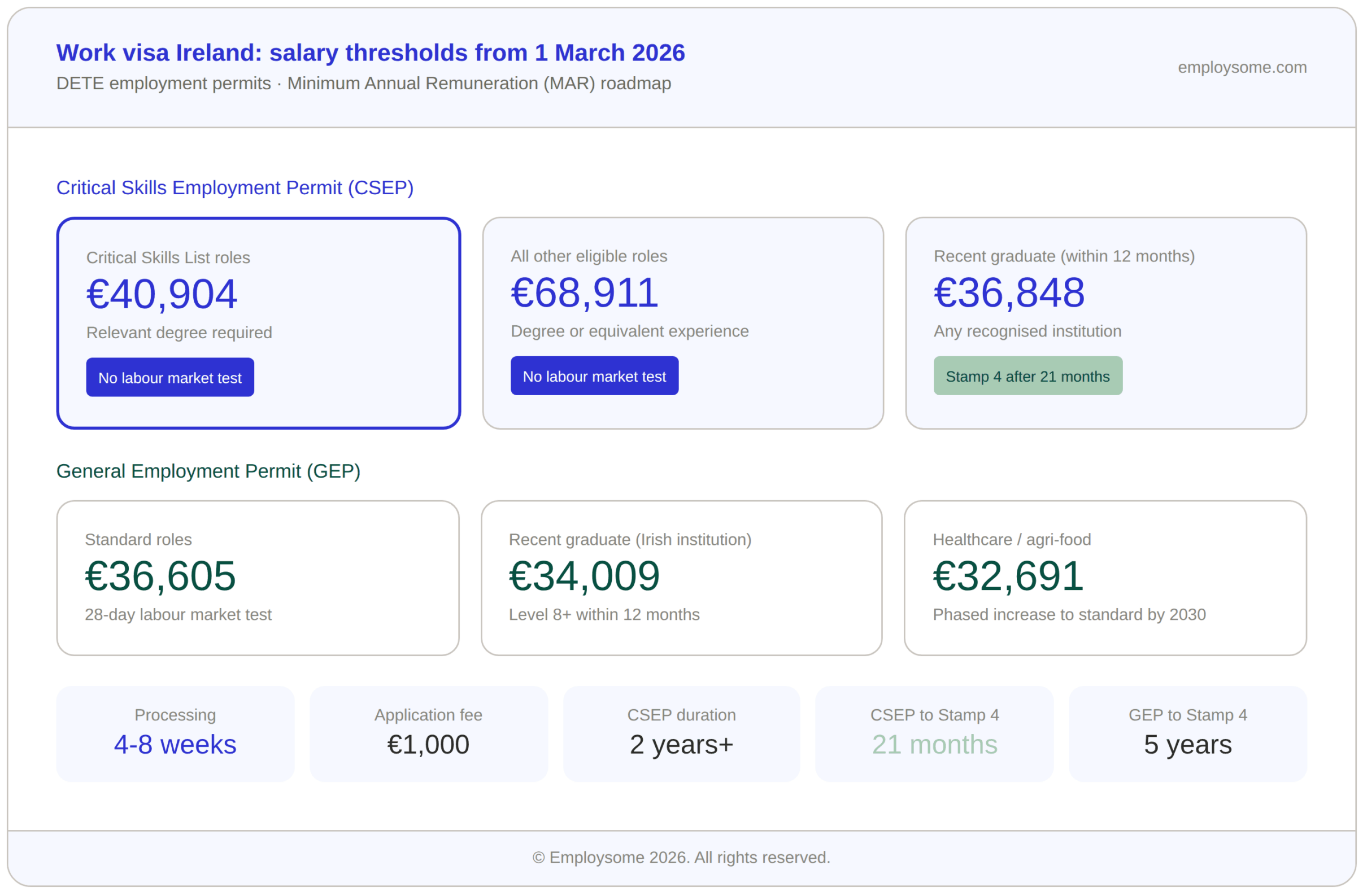
From 1 March 2026, salary thresholds increased across all permit categories as part of a new Minimum Annual Remuneration (MAR) roadmap published by DETE. These increases of approximately 7.66% are phased through to 2030 and represent a significant change for employers planning international hires.

Types of Work Visa in Ireland
Ireland offers several employment permit types, but two dominate the work visa Ireland landscape for professional hires.
Critical Skills Employment Permit (CSEP)
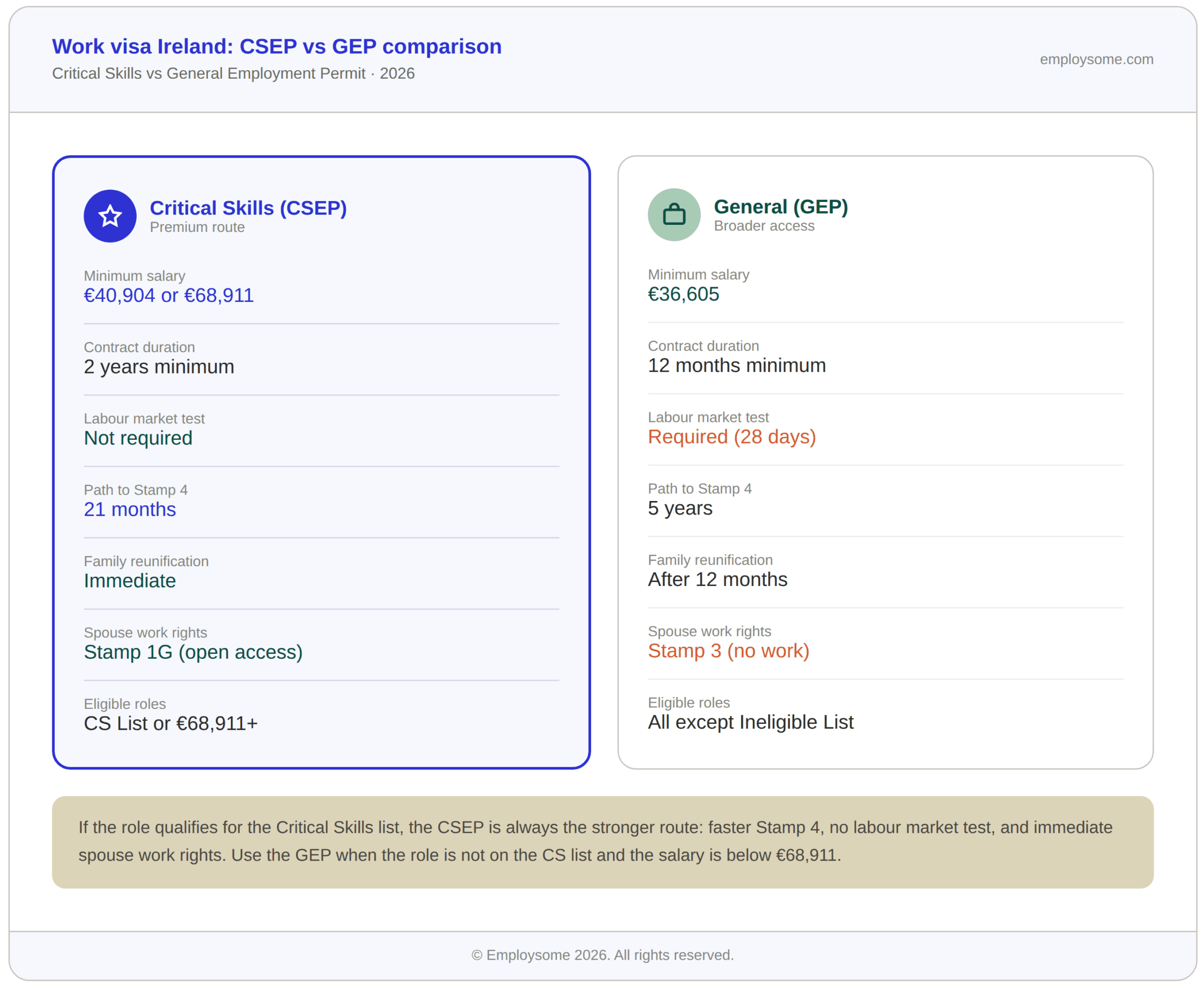
The CSEP is the premium work visa Ireland route, designed to attract highly skilled workers in occupations experiencing critical shortages. It offers the fastest path to permanent residency and the most attractive conditions for both employer and employee.
There are two qualification routes. The first is for roles on the Critical Skills Occupation List with a minimum annual salary of €40,904 (from 1 March 2026). A relevant degree or higher qualification is required. The second is for any occupation not on the Ineligible List with a minimum annual salary of €68,911 (from 1 March 2026). A relevant degree or equivalent experience is required.
Key advantages of the CSEP: no labour market test required (the employer does not need to prove they tried to hire locally first), immediate family reunification (spouse/partner gets Stamp 1G with open work rights), and the permit holder can apply for Stamp 4 after just 21 months, which removes the need for any employment permit and grants full labour market access.
The job offer must be for at least 2 years or permanent. The CSEP is the strongest work visa Ireland route for technology, engineering, healthcare, science, and finance professionals.
General Employment Permit (GEP)
The GEP covers a broader range of occupations than the CSEP. All occupations are eligible unless they appear on the Ineligible List. The minimum annual salary is €36,605 from 1 March 2026 (previously €34,000). For certain sector-specific roles (healthcare assistants, home carers, meat processors, horticulture workers), a lower threshold of €32,691 applies.
Unlike the CSEP, the GEP requires a Labour Market Needs Test (LMNT) in most cases. The employer must advertise the role for at least 28 days on the Department of Social Protection Employment Services/EURES network and an additional online platform. The LMNT is waived if the role is on the Critical Skills Occupation List, the salary exceeds €68,911, or the employer has a recommendation from Enterprise Ireland or IDA Ireland.
The GEP is issued for up to 2 years initially and can be renewed for a further 3 years. After 5 years of continuous residence, the holder can apply for Stamp 4. Family reunification is available after 12 months.
The job offer must be for at least 12 months.
Other Permit Types
Ireland also offers several other work visa Ireland categories for specific situations. The Intra-Company Transfer Employment Permit is for senior managers, key personnel, or trainees transferring from a foreign office to an Irish branch. The Contract for Services Employment Permit is for foreign workers employed by a non-Irish company fulfilling a contract with an Irish entity. The Reactivation Employment Permit is for workers who fell out of the employment permit system through no fault of their own.
Work Visa Ireland: Salary Thresholds from 1 March 2026
|
Permit Type |
Minimum Annual Salary |
Notes |
|
CSEP (Critical Skills List roles) |
€40,904 |
Relevant degree required |
|
CSEP (all other eligible roles) |
€68,911 |
Degree or equivalent experience |
|
CSEP (recent graduate, within 12 months) |
€36,848 |
Any recognised institution |
|
GEP (standard) |
€36,605 |
Labour market test required |
|
GEP (recent graduate, within 12 months) |
€34,009 |
Irish institution, Level 8+ |
|
GEP (healthcare/agri-food sectors) |
€32,691 |
Phased increase to standard by 2030 |
These thresholds are indexed to average earnings growth across the Irish labour market. DETE has confirmed further phased increases through to 2030, with the average annual adjustment approximately 4.9% based on CSO earnings data. Existing live permits are not affected until renewal, at which point the new thresholds apply.
💡 Employsome Insight: The March 2026 salary increases caught some employers off guard despite being announced in December 2025. If you are planning a work visa Ireland application, ensure the employment contract reflects the new thresholds before submission. DETE will reject applications where the advertised salary in the Labour Market Needs Test does not match the new minimums.
The Critical Skills Occupation List
The Critical Skills Occupation List determines which roles qualify for the CSEP at the lower €40,904 threshold. The list is reviewed periodically by DETE based on analysis from the Expert Group on Future Skills Needs. Key categories include:
Technology: software developers, data analysts, data scientists, cybersecurity specialists, DevOps engineers, database administrators, IT project managers. Engineering: civil, mechanical, electrical, chemical, production, and biomedical engineers. Healthcare: doctors across most specialties, specialist nurses, radiographers, radiation therapists, pharmacists, clinical scientists. Science: biochemists, physicists, chemists, research scientists, environmental scientists. Finance: actuaries, financial analysts, risk managers, quantitative analysts. Construction: quantity surveyors, construction project managers, BIM specialists. Other: town planning officers (added 2024), certain veterinary and agricultural science roles.
The list changes periodically. A role that was eligible six months ago may have been removed. Always verify the current list on the DETE website before submitting an application.
Eligibility Requirements for a Work Visa in Ireland
Employer requirements:
The employer must be registered with Revenue Commissioners. The employer must be registered with the Companies Registration Office (CRO). The employer must be actively trading in Ireland. At least 50% of employees must be EEA nationals at the time of application (the 50/50 rule). This rule can be waived for start-ups within 2 years of establishment that are supported by Enterprise Ireland or IDA Ireland. The employee must be directly employed and paid by the employer. Job offers through recruitment agencies are not accepted.
Employee requirements:
The applicant must have qualifications relevant to the role. For CSEP at the €40,904 level, a relevant degree or higher is required. For CSEP at the €68,911 level, a relevant degree or equivalent professional experience is accepted. For GEP, relevant skills, qualifications, or experience matching the role are required. For regulated professions (nursing, medicine, pharmacy), Irish registration or recognition is required. Nurses and midwives must hold a qualification recognised by the Nursing and Midwifery Board of Ireland.
Job requirements:
CSEP: minimum 2-year contract or permanent. GEP: minimum 12-month contract. The role must not be on the Ineligible List of Occupations. The salary must meet the relevant threshold.
How to Apply for a Work Visa in Ireland: Step by Step
Step 1: Secure a job offer. The employer provides a written job offer or employment contract that meets the salary threshold and specifies the role, hours, and duration. The role must not be on the Ineligible List.
Step 2: Labour Market Needs Test (GEP only). The employer advertises the role for at least 28 continuous days on DSP Employment Services/EURES and one additional online platform. The advertisement must include the employer’s name, job description, annual salary, location, and hours per week. This step is not required for CSEP applications.
Step 3: Apply online through DETE. Either the employer or the employee can submit the application through the Employment Permits Online System (EPOS). The application fee is €1,000 for permits of 2 years or more, or €500 for permits of less than 2 years. 90% of the fee is refunded if the application is refused.
Step 4: DETE processes the application. Current processing times are approximately 4 to 8 weeks, though busy periods can extend this. DETE may request additional documentation during processing.
Step 5: Permit granted. The employment permit is issued and sent to the applicant or employer.
Step 6: Apply for a visa (if required). Applicants from visa-required countries must apply for a Long Stay D Visa from their nearest Irish embassy or consulate. Processing typically takes 4 to 8 weeks. Applicants from non-visa-required countries can travel directly to Ireland with their employment permit.
Step 7: Arrive and register. Upon arrival, the permit holder must register with their local immigration registration office and obtain an Irish Residence Permit (IRP) card. The IRP confirms their immigration permission (Stamp 1 for GEP, Stamp 1 for CSEP initially, then Stamp 4 after 21 months).
Path to Stamp 4 and Permanent Residency
One of the strongest features of the work visa Ireland system is the relatively fast path to Stamp 4.
CSEP holders can apply for Stamp 4 after 21 months of continuous employment. This is one of the fastest routes to open work permission in Europe. Once granted, Stamp 4 allows the holder to work for any employer without needing an employment permit.
GEP holders can apply for Stamp 4 after 5 years of continuous residence. This is a longer pathway but still provides a clear route to permanent settlement.
Stamp 4 applications are handled entirely by the Department of Justice. Since November 2023, applicants no longer need a letter of support from DETE.
Family Reunification
CSEP holders: Can apply for immediate family reunification. The spouse or de facto partner receives Stamp 1G, which grants the right to work in Ireland without needing a separate employment permit. Children aged 16 and over also receive Stamp 1G (updated policy). Family members from visa-required countries must apply for separate visas.
GEP holders: Can apply for family reunification after 12 months of employment. Family members initially receive Stamp 3 (no work rights), though minor dependants now receive Stamp 1G when they turn 16.
The 50/50 Rule
A work visa Ireland application will not be granted if more than 50% of the employer’s workforce are non-EEA nationals at the time of application. This is the single most common eligibility issue for smaller companies and startups.
The rule can be waived for start-ups within 2 years of establishment that are client companies of Enterprise Ireland or IDA Ireland. It also does not apply where the employer has no employees and the foreign national will be the sole employee.
Employer Obligations
Employers sponsoring a work visa in Ireland must ensure the employment contract meets Irish employment law standards, pay the employee directly (no intermediaries), maintain the salary at or above the permit threshold throughout the permit duration, notify DETE within 4 weeks if the employee is made redundant, comply with Irish payroll, tax, and PRSI obligations, and maintain records for inspection by the Workplace Relations Commission.
Irish employer costs add approximately 11.25% on top of gross salary for employer PRSI (at the higher rate, applicable to salaries above €552 per week). For a full breakdown of Irish employer costs, tax, and take-home pay calculations, see our average salary in Ireland guide.
Hiring in Ireland?
If you are looking to hire in Ireland without setting up a local entity, an Employer of Record handles employment permits, PAYE payroll, PRSI, and statutory compliance on your behalf. See our Best Employer of Record comparison for providers ranked on compliance execution and in-country infrastructure.
What This Means for Companies Hiring Through an EOR
For companies hiring in Ireland without a local entity, an Employer of Record can serve as the registered Irish employer for work visa Ireland purposes. The EOR handles employment contract issuance, DETE permit applications, PAYE and PRSI payroll compliance, and ongoing statutory obligations.
Ireland’s work visa system requires the sponsoring employer to be registered with Revenue and the CRO and actively trading in Ireland. An EOR with an owned entity in Ireland meets these requirements. The 50/50 rule applies to the EOR’s workforce, not the client company’s, which can be an advantage for companies whose own headcount would not meet the threshold.
For a broader overview of how to structure international hiring across complex immigration systems, see our international hiring guide.
Frequently Asked Questions
A work visa in Ireland is officially called an employment permit, issued by DETE. Non-EEA nationals need an employment permit before they can legally work in Ireland. Some applicants also need a Long Stay D Visa to enter the country.
From 1 March 2026: CSEP requires €40,904 (Critical Skills List roles) or €68,911 (all other eligible roles). GEP requires €36,605 for most occupations. Recent graduates benefit from lower thresholds.
Employment permit processing typically takes 4 to 8 weeks. If a D Visa is also required, add another 4 to 8 weeks. Total timeline from application to arrival is typically 8 to 16 weeks.
The CSEP is Ireland’s premium employment permit for highly skilled workers. It offers no labour market test, immediate family reunification with spouse work rights, and Stamp 4 (open work permission) after just 21 months.
Not for CSEP applications. GEP applications require a 28-day Labour Market Needs Test unless the salary exceeds €68,911, the role is on the Critical Skills List, or the employer has an Enterprise Ireland/IDA recommendation.
CSEP holders: employer changes require a new permit application. GEP holders: a new permit is required for each employer change, but the Labour Market Needs Test is waived if the previous permit holder was made redundant within 6 months. After obtaining Stamp 4, no permit is needed.
CSEP: immediate family reunification with spouse/partner receiving Stamp 1G (open work rights). GEP: family reunification available after 12 months.
At least 50% of the employer’s workforce must be EEA nationals at the time of application. This can be waived for IDA/Enterprise Ireland-backed startups within 2 years of establishment.
No. Ireland does not currently offer a digital nomad or remote work visa. All work permissions require employer sponsorship and an employment permit.

Written by
Courtney Pocock is a Copywriter & EOR/PEO Researcher at Employsome with 15+ years of experience writing for the HR, corporate, and financial sectors. She has a strong interest in global business expansion and Employer of Record / PEO topics, focusing on news that matters to business owners and decision-makers. Courtney covers industry updates, regulatory changes, and practical guides to help leaders navigate international hiring with confidence.
Our content is created for informational purposes only and is not intended to provide any legal, tax, accounting, or financial advice. Please obtain separate advice from industry-specific professionals who may better understand your business’ needs. Read our Editorial Guidelines for further information on how our content is created.
Other posts
Review other guides