Minimum Wage in Nigeria 2026: What Employers Actually Pay
The minimum wage in Nigeria is ₦70,000 per month (approximately $42 USD), set by the National Minimum Wage (Amendment) Act 2024 and unchanged in 2026. Despite being Africa’s largest economy, Nigeria’s minimum wage is one of the lowest in the world in dollar terms, eroded further by inflation above 33% and naira depreciation. Implementation varies dramatically across the country’s 36 states, with Lagos paying ₦85,000 and some states still struggling to pay the legal minimum. This guide covers everything: the current rate, state-by-state variations, employer costs including pension, NSITF, and PAYE, how the minimum wage compares across Africa, the labour push for ₦154,000, and what it means for international companies hiring Nigerian talent.

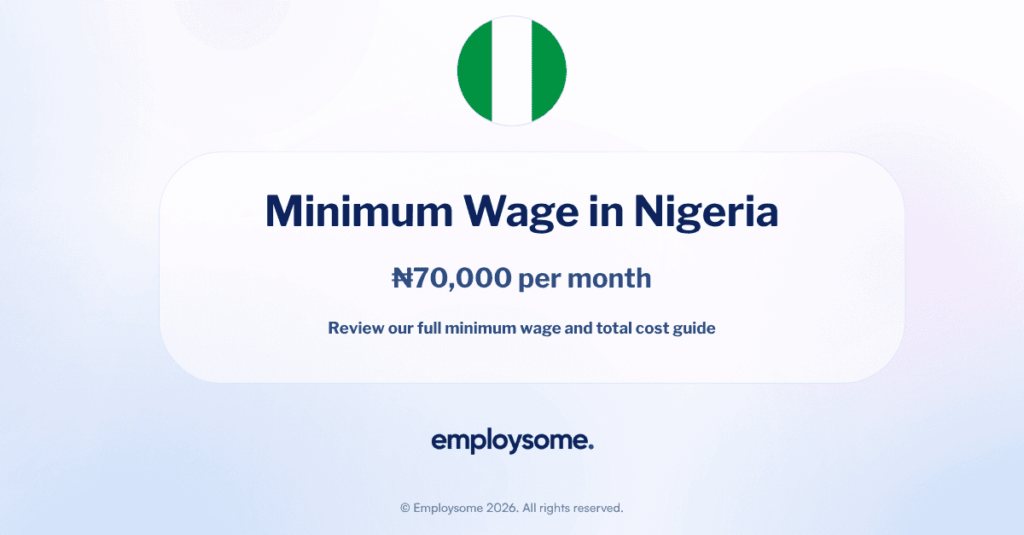
Table of Contents
- The 2026 Rate: ₦70,000 Per Month
- State-by-State Implementation: The Real Picture
- What Employers Actually Pay: The Full Cost
- The ₦154,000 Demand: What Comes Next
- How the Minimum Wage in Nigeria Compares Across Africa
- Working Hours and Employment Structure
- What This Means for International Employers
- FAQs
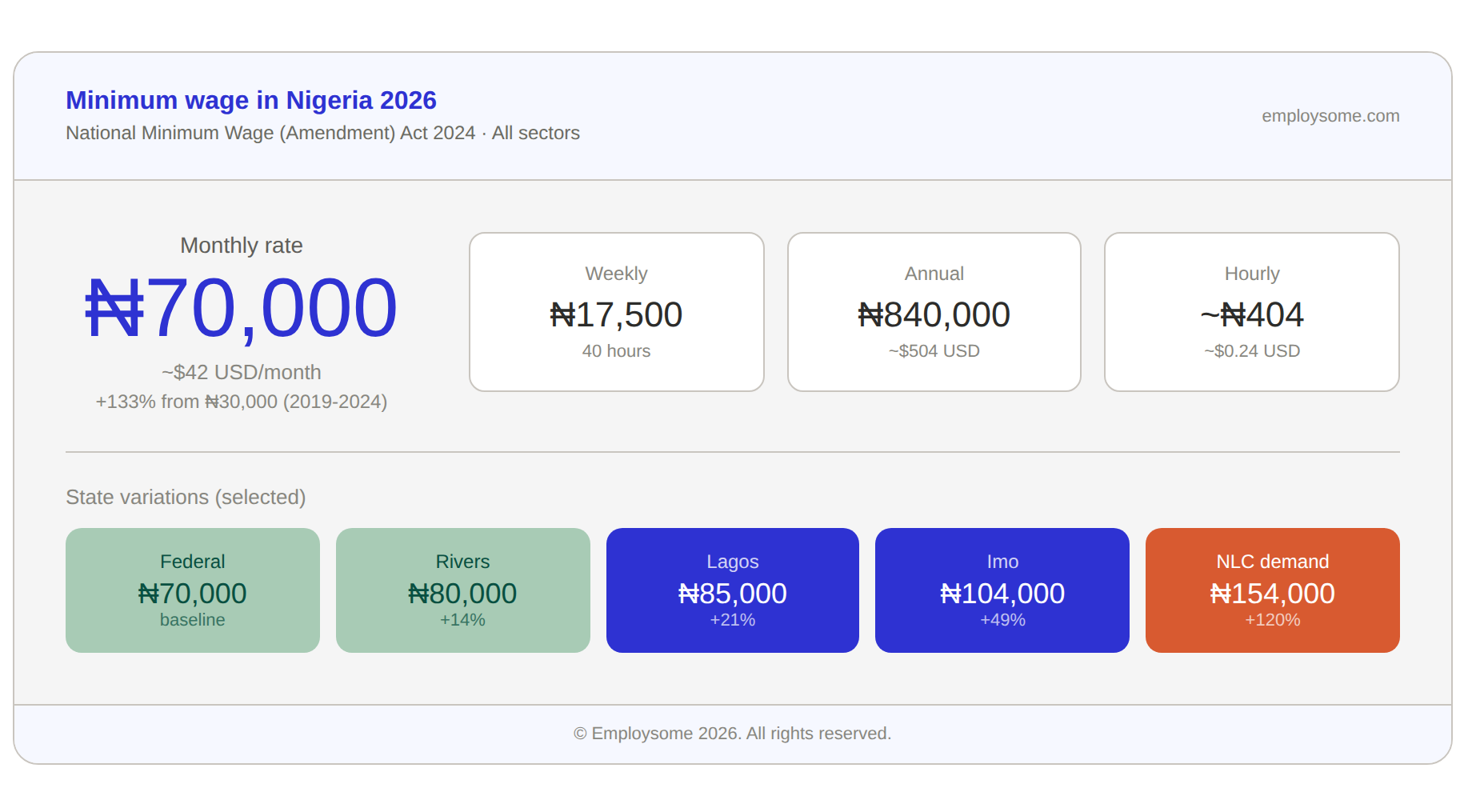
The minimum wage in Nigeria is ₦70,000 per month. That has been the legal rate since the National Minimum Wage (Amendment) Act 2024 was signed into law by President Bola Tinubu in July 2024, more than doubling the previous floor of ₦30,000 that had been in place since 2019. As of 2026, the rate remains unchanged.
In dollar terms, ₦70,000 is approximately $42 per month. That is not a typo. Nigeria’s minimum wage is one of the lowest in the world when converted to international currency, a fact that reflects both the naira’s steep depreciation and the enormous gap between statutory wage floors and actual living costs in Africa’s most populous country.
But the headline figure masks a far more complex picture. Implementation varies dramatically across Nigeria’s 36 states and the Federal Capital Territory. Some states pay above the minimum. Others cannot afford to pay it at all. Inflation above 33% has already eroded the purchasing power of the 2024 increase. Labour unions are demanding ₦154,000 as the new floor. And for international companies hiring Nigerian talent remotely or through an Employer of Record, the minimum wage is almost irrelevant, because market rates for skilled professionals in Lagos and Abuja are many multiples of the statutory floor.
This guide breaks down the minimum wage in Nigeria as it works in practice: what the law says, what states actually pay, what employers owe beyond the headline figure, and what the rate means in the context of Africa’s largest and most complex labour market.

The 2026 Rate: ₦70,000 Per Month
The minimum wage in Nigeria is set at ₦70,000 per month under the National Minimum Wage (Amendment) Act 2024. This applies to all employers in both the public and private sectors. The rate is a monthly figure, not hourly, reflecting Nigeria’s employment structure where the standard work week is typically 40 hours across five or six days.
The ₦70,000 rate was a hard-fought compromise. The Nigeria Labour Congress (NLC) and the Trade Union Congress (TUC) initially demanded ₦494,000 per month. The federal government offered ₦62,000. After months of negotiations, threats of a general strike, and a tripartite committee process involving government, labour, and employer representatives, the parties settled on ₦70,000.
Under the Act, the minimum wage must be reviewed every three years (reduced from the previous five-year cycle). The next statutory review is due in 2027. However, the NLC has already called for an urgent review in 2026, citing inflation and the continued deterioration of workers’ purchasing power.
The minimum wage applies to all employees regardless of sector. The only exemptions are businesses with fewer than 25 employees (which are exempt from the Act) and workers employed by close family members in sole trader businesses. For all other employers, ₦70,000 is the legal floor.
State-by-State Implementation: The Real Picture
The minimum wage in Nigeria is a federal law, but its implementation depends heavily on state governments, which employ the majority of public sector workers outside the FCT. This creates a patchwork where the experience of a minimum wage worker varies enormously depending on where in Nigeria they work.
|
State/Region |
Minimum Wage Paid |
Status |
|
Federal Government |
₦70,000 |
Implemented |
|
Lagos |
₦85,000 |
Above federal minimum |
|
Rivers |
₦80,000 |
Above federal minimum |
|
Imo |
₦85,000-₦104,000 |
Significantly above |
|
Abuja (FCT) |
₦70,000 |
Implemented |
|
Most southern states |
₦70,000 |
Implemented |
|
Several northern states |
Below ₦70,000 |
Partial/delayed implementation |
Lagos State’s decision to pay ₦85,000 reflects the reality that ₦70,000 does not cover basic living costs in Nigeria’s commercial capital, where rent for a modest apartment can consume an entire minimum wage salary. Even at ₦85,000, the Lagos minimum falls far short of the estimated ₦180,000 monthly living wage for the city.
Several states, particularly in the north, have struggled to implement the ₦70,000 rate, citing revenue shortfalls. Some have negotiated phased implementation with local labour unions. Others have simply not paid the new rate despite it being law. Enforcement is largely driven by union pressure and political accountability rather than regulatory inspection.
What Employers Actually Pay: The Full Cost
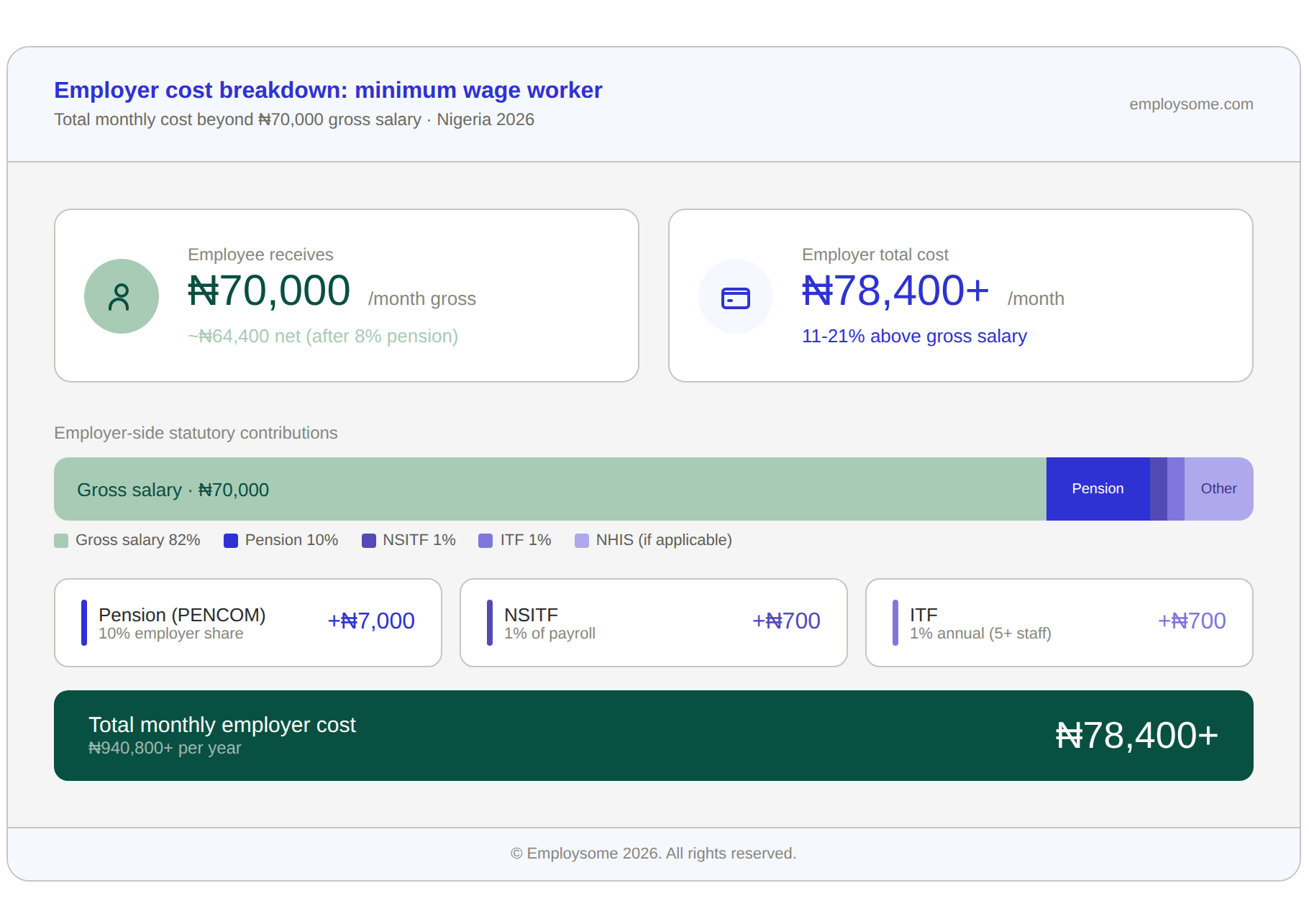
The minimum wage in Nigeria is ₦70,000 per month for the employee. But the total cost to the employer is significantly higher once statutory contributions are factored in. Nigeria’s payroll system includes several mandatory employer contributions that sit on top of the gross salary.
Pension (PENCOM)
Under the Pension Reform Act 2014, employers with 3 or more employees must participate in the Contributory Pension Scheme. The minimum contribution is 18% of pensionable income (basic salary plus housing and transport allowances), split as 10% from the employer and 8% from the employee. The employee’s share is deducted from salary. The employer’s share is an additional cost. Contributions must be remitted to an approved Pension Fund Administrator within 7 days of salary payment. For employers with fewer than 3 employees, pension contributions are not mandatory but are encouraged.
NSITF (Nigeria Social Insurance Trust Fund)
All employers must contribute 1% of total monthly payroll to the NSITF Employee Compensation Scheme. This funds workplace injury compensation and occupational disease coverage. The contribution is entirely employer-funded and is not deducted from the employee’s salary. Remittance is due by the 16th of the following month.
ITF (Industrial Training Fund)
Employers with 5 or more employees or an annual turnover of ₦50 million or above must contribute 1% of annual payroll to the ITF. This funds employee training programmes. Non-compliant employers lose the 50% training cost refund benefit.
NHF (National Housing Fund)
Employees contribute 2.5% of basic salary to the NHF, which employers must deduct and remit to the Federal Mortgage Bank of Nigeria. This is technically an employee deduction, but the administrative burden falls on the employer. Enforcement in the private sector has been inconsistent.
NHIS (National Health Insurance)
Employers with 10 or more employees must participate in the National Health Insurance Scheme. The contribution rate is 15% of basic salary, split as 10% employer and 5% employee (though many employers pay the full amount).
PAYE (Pay As You Earn)
Nigeria operates a progressive income tax system under the Personal Income Tax Act. Employees earning at or below the minimum wage (₦70,000 per month or ₦840,000 per year) are effectively exempt from PAYE after applying statutory reliefs (consolidated relief allowance of ₦200,000 plus 20% of gross income, plus pension deductions). This means minimum wage workers pay little to no income tax.
For a minimum wage employee, the approximate total employer cost breaks down as follows: gross salary of ₦70,000, employer pension (10%) of approximately ₦7,000, NSITF (1%) of approximately ₦700, and ITF and NHIS costs depending on company size. The total employer cost for a minimum wage worker is approximately ₦78,000 to ₦85,000 per month, roughly 11 to 21% above the headline salary.
The ₦154,000 Demand: What Comes Next
The minimum wage in Nigeria is under active political pressure. In March 2026, the Joint National Public Service Negotiating Council (JNPSNC) formally demanded that the federal government increase the minimum wage to ₦154,000, a 120% increase from the current ₦70,000. The NLC and TUC have backed this demand, citing persistent inflation, naira depreciation, rising fuel and transport costs, and the widening gap between wages and living costs.
The demand reflects a genuine crisis in purchasing power. When the ₦70,000 minimum was agreed in mid-2024, it was worth approximately $50 at prevailing exchange rates. By early 2026, naira depreciation has reduced that to approximately $42. Food inflation has remained above 30%, meaning the real purchasing power of the minimum wage has declined significantly since it was set.
Under the 2024 Act, the next statutory review is not due until 2027. However, unions are pushing for an early review, and the political pressure is significant. Any increase would have major implications for state government budgets (which are already stretched) and for private sector employers operating on thin margins.
For international companies, the minimum wage debate is largely academic. Market rates for the skilled professionals typically hired through EOR arrangements (software developers, customer support agents, finance professionals) are typically ₦300,000 to ₦1,500,000+ per month, well above any proposed minimum.
Hiring in Nigeria?
If you are looking to hire employees in Nigeria without setting up a local entity, an Employer of Record handles employment contracts, PENCOM pension registration, PAYE withholding, NSITF and ITF contributions, and NHIS compliance on your behalf. Nigeria’s payroll system spans multiple agencies with different remittance deadlines and calculation bases, and state-level PAYE administration adds a further layer of complexity. An EOR with genuine Nigerian payroll infrastructure manages this end to end. See our Best Employer of Record in Nigeria comparison for providers ranked on compliance execution and in-country infrastructure.
How the Minimum Wage in Nigeria Compares Across Africa
Africa
|
Country |
Monthly Minimum Wage |
Approx. USD |
Employer SI |
Notes |
|
South Africa |
ZAR 4,892 (~₦450,000) |
~$270 |
~2% UIF |
Highest in sub-Saharan Africa |
|
Kenya |
KES 15,840 (~₦180,000) |
~$120 |
~5% NSSF |
Varies by location |
|
Ghana |
GHS 570 (~₦65,000) |
~$44 |
~13% SSNIT |
Recently increased |
|
Nigeria |
₦70,000 |
~$42 |
~11-21% |
Varies by company size |
|
Egypt |
EGP 7,000 (~₦200,000) |
~$140 |
~18.75% |
Private sector |
|
Ethiopia |
No statutory minimum |
N/A |
~11% |
Sector-specific only |
|
Tanzania |
TZS 100,000-400,000 |
~$38-$150 |
~10% NSSF |
Varies by sector |
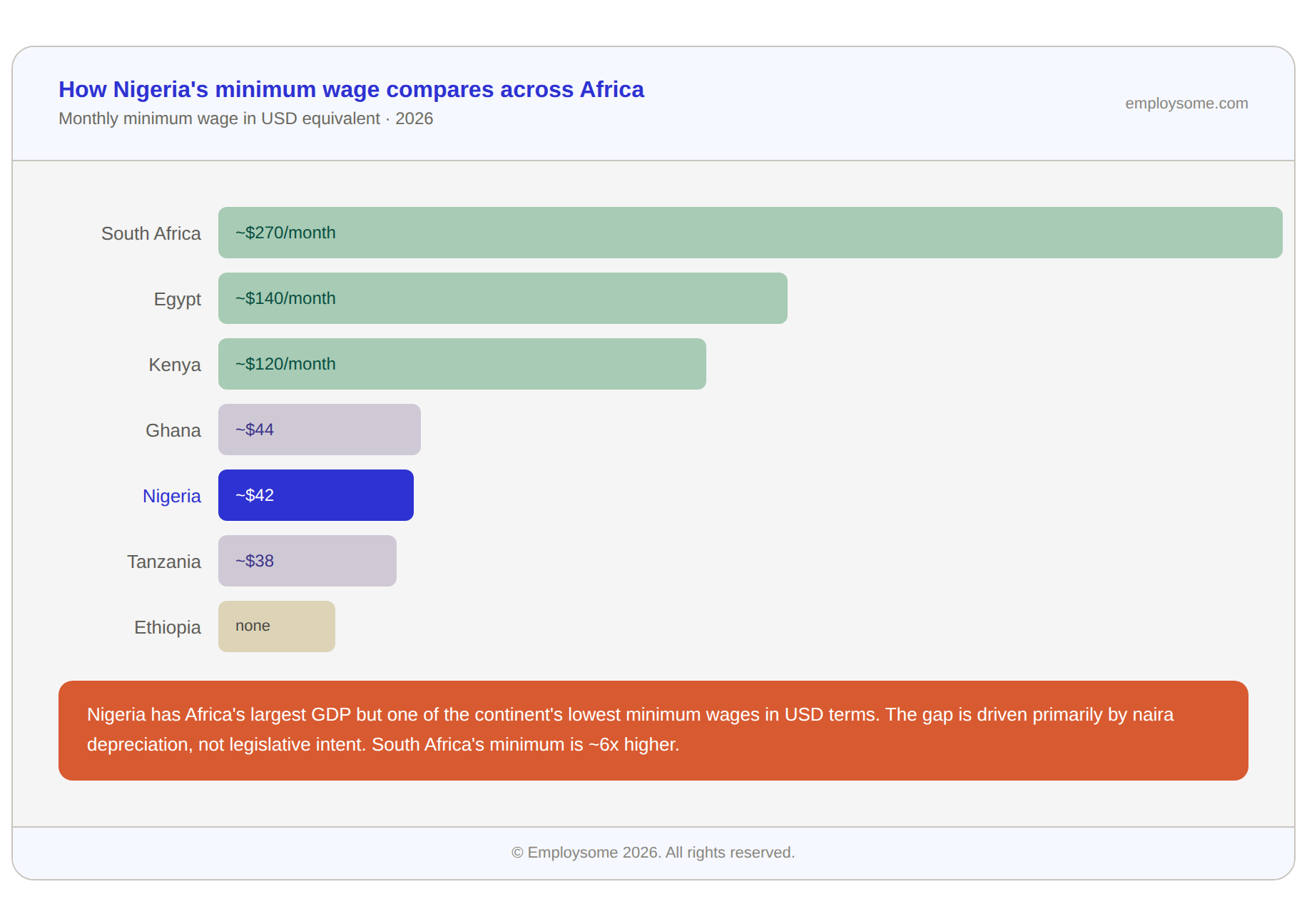
Nigeria’s minimum wage is among the lowest in Africa in dollar terms, despite having the continent’s largest GDP. South Africa’s minimum is roughly six times higher. Kenya’s is nearly three times higher. Even Ghana, a much smaller economy, has a comparable minimum in dollar terms. The gap is largely driven by the naira’s depreciation rather than differences in legislative intent.
Working Hours and Employment Structure
The standard work week in Nigeria is 40 hours, typically spread across five days (Monday to Friday), though six-day weeks are common in certain sectors such as retail, hospitality, and manufacturing. The Labour Act does not prescribe a specific maximum, but 40 hours is the widely accepted standard.
There is no statutory overtime rate in Nigeria. Overtime compensation is determined by the employment contract or collective bargaining agreement. In practice, many employers pay 1.5x to 2x the normal rate for overtime, but this is contractual rather than statutory.
Employees are entitled to a minimum of 6 working days of paid annual leave after 12 months of continuous service (Labour Act, Section 18). Many employers offer 15 to 25 days depending on seniority and sector. Nigeria has approximately 11 public holidays per year.
Notice periods are set by the employment contract. The Labour Act provides default minimums: one day for contracts of less than 3 months, one week for contracts of 3 months to 2 years, two weeks for contracts of 2 to 5 years, and one month for contracts of 5 years or more.
What This Means for International Employers
For companies hiring Nigerian talent through an Employer of Record, the minimum wage in Nigeria is relevant as a compliance baseline but rarely as a practical salary guide. The professionals typically hired through EOR arrangements, including software developers, data analysts, customer support specialists, project managers, and finance professionals, command market rates that are 4 to 20 times the minimum wage. Lagos-based software developers typically earn ₦400,000 to ₦1,200,000 per month, and senior professionals in finance or consulting can earn significantly more.
The EOR handles PENCOM pension registration and contributions, PAYE withholding and remittance to the relevant State Internal Revenue Service or FIRS, NSITF and ITF compliance, NHIS enrolment where applicable, and employment contract compliance with the Labour Act. Nigeria’s payroll system is complex because statutory obligations are spread across multiple agencies (FIRS, PENCOM, NSITF, ITF, NHIS, NHF) with different remittance deadlines, calculation bases, and enforcement bodies. State-level differences in PAYE administration add a further layer. An EOR with genuine Nigerian payroll infrastructure handles this complexity; one without it creates compliance gaps that may not surface until an audit or employee dispute.
Frequently Asked Questions
The minimum wage in Nigeria is ₦70,000 per month, set by the National Minimum Wage (Amendment) Act 2024. The rate has not changed since it took effect in July 2024.
Approximately $42 USD per month at current exchange rates, though this fluctuates with the naira. The dollar equivalent has declined since the rate was set due to continued naira depreciation.
Not equally. Lagos pays ₦85,000, Rivers pays ₦80,000, and some states pay above ₦100,000. Several northern states have struggled to implement the ₦70,000 rate due to revenue constraints.
Employers must contribute 10% of pensionable income to PENCOM, 1% of payroll to NSITF, and potentially ITF (1% annually) and NHIS (10% of basic salary) depending on company size. Total employer cost is approximately 11 to 21% above the gross salary.
The next statutory review is due in 2027 under the three-year review cycle. However, labour unions are pushing for an early review in 2026 and have demanded ₦154,000 as the new minimum.
Businesses with fewer than 25 employees are exempt from the National Minimum Wage Act. However, they are still expected to pay fair wages and are subject to state-level labour regulations.
No. Nigeria’s minimum wage is set as a monthly figure (₦70,000) rather than an hourly rate. For a standard 40-hour week, this equates to approximately ₦404 per hour (~$0.24 USD).

Written by
Courtney Pocock is a Copywriter & EOR/PEO Researcher at Employsome with 15+ years of experience writing for the HR, corporate, and financial sectors. She has a strong interest in global business expansion and Employer of Record / PEO topics, focusing on news that matters to business owners and decision-makers. Courtney covers industry updates, regulatory changes, and practical guides to help leaders navigate international hiring with confidence.
Our content is created for informational purposes only and is not intended to provide any legal, tax, accounting, or financial advice. Please obtain separate advice from industry-specific professionals who may better understand your business’s needs. Read our Editorial Guidelines for further information on how our content is created.
Other posts
Review other blog posts