Minimum Wage in Saudi Arabia 2026: What Employers Pay
Saudi Arabia does not have a universal minimum wage. The SAR 4,000/month threshold applies only to Saudi nationals counted toward Saudization (Nitaqat) quotas, while foreign workers have no statutory minimum. This guide covers the full picture: Nitaqat salary rules, sector-specific minimums, GOSI contributions, the Wage Protection System, working hours, end-of-service gratuity, and what it means for companies hiring through an EOR.

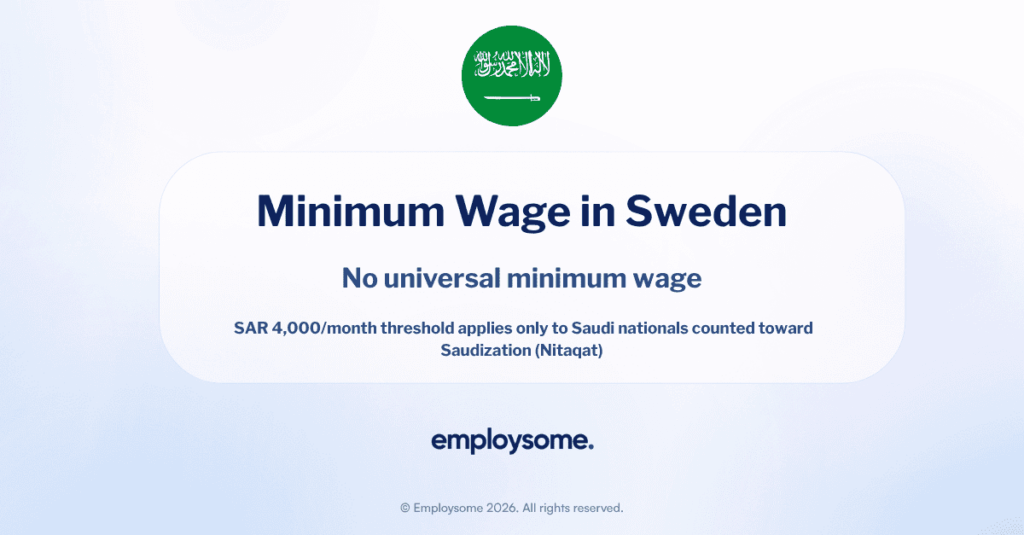
Saudi Arabia does not have a single minimum wage that applies to all workers. This is the first and most important thing international employers get wrong. The country operates a dual system where Saudi nationals in the private sector must earn at least SAR 4,000 per month to be counted toward the company’s Saudization (Nitaqat) quota, while foreign workers in the private sector have no statutory minimum wage at all.
This distinction matters because most international companies hiring in Saudi Arabia are employing foreign nationals. Their compensation is governed entirely by the employment contract, not by a wage floor. However, the Wage Protection System (WPS), GOSI registration requirements, and sector-specific Saudization rules all create practical thresholds that employers must understand before making their first hire.
For companies hiring in Saudi Arabia through an Employer of Record, the minimum wage question is only the starting point. GOSI contributions, end-of-service gratuity, Iqama sponsorship costs, and mandatory health insurance push the real cost of employment well beyond the contract salary. This guide covers all of it.
Hiring in Saudi Arabia?
If you are looking to hire employees in Saudi Arabia without setting up a local entity, an Employer of Record handles Iqama sponsorship, GOSI registration, WPS payroll, health insurance, and labour law compliance on your behalf. See our Best Employer of Record in Saudi Arabia guide for pricing, entity ownership, and compliance depth.

The SAR 4,000 Nitaqat Threshold and How It Works
The SAR 4,000 minimum was introduced in 2021 and applies specifically to Saudi nationals working in the private sector. It serves two purposes: it establishes a wage floor that makes private sector employment competitive with staying unemployed (where benefits can partially offset low wages), and it sets the threshold for counting an employee toward the company’s Nitaqat compliance score.
If an employer pays a Saudi employee less than SAR 4,000 per month, that employee does not count as contributing to the Saudization ratio. Since maintaining a compliant Nitaqat category is essential for accessing government services, renewing visas, and avoiding penalties, this creates a powerful incentive for employers to meet or exceed SAR 4,000 for every Saudi hire.
Saudi labour law does not specify whether the SAR 4,000 includes allowances, housing, transportation, or other benefits, or whether it applies only to the basic salary. In practice, most employers treat it as the total monthly compensation floor for Nitaqat purposes.
Part-time Saudi employees are counted proportionally. A Saudi working half-time at SAR 3,000 per month may count as half a Saudi employee for Nitaqat, subject to specific rules that have evolved over recent policy cycles. Employers should verify the latest counting rules through Qiwa or MHRSD directly.
Sector-Specific Salary Thresholds
Beyond the general SAR 4,000 floor, Saudi Arabia has introduced sector-specific minimum salaries for Saudi nationals in certain professions. These are designed to support targeted Saudization in priority industries under Vision 2030.
As of 2025-2026, key sector thresholds include engineering professions at a minimum of SAR 8,000 per month for Saudi engineers in private and non-profit sectors to count toward Saudization targets, and marketing and sales roles at a minimum of SAR 5,500 per month with a 60% Saudi workforce target. These sector-specific requirements are enforced through Nitaqat and apply only to Saudi nationals. Foreign workers in the same roles are not subject to these minimums, though market rates for skilled professionals typically exceed these thresholds regardless.
What Foreign Workers Actually Earn
There is no statutory minimum wage for foreign workers in Saudi Arabia’s private sector. Compensation is determined entirely by the employment contract, which must be registered through the Qiwa platform and specify the salary in Saudi Riyals.
In practice, foreign worker wages vary enormously. Domestic workers (housemaids, drivers, caregivers) typically earn SAR 1,500 to SAR 3,500 per month under a separate regulatory framework managed through the Musaned platform. Low-skilled foreign workers in construction, retail, and hospitality commonly earn SAR 1,500 to SAR 2,500 per month. Skilled foreign professionals in technology, healthcare, engineering, and finance earn SAR 15,000 to SAR 50,000 or more depending on qualifications, experience, and sector.
From January 2026, all domestic worker salaries must be paid electronically through the Musaned platform, extending the Wage Protection System to a category of workers previously at higher risk of delayed or withheld payments.
Employer Costs Beyond Salary
Saudi Arabia has no personal income tax, which makes the country attractive for employees. However, employers face significant costs beyond the contract salary.
GOSI (General Organisation for Social Insurance) contributions are the primary mandatory cost. For Saudi employees, the employer contributes 12% and the employee contributes 10%, covering pension, disability, and survivor benefits. An additional 2% from the employer and 1% from the employee goes toward SANED (unemployment insurance). For foreign employees, the employer pays only 2% for occupational hazard insurance, with no pension or unemployment contributions.
Mandatory health insurance is required for all employees and their dependents. Premiums vary by provider, coverage level, and number of dependents but typically range from SAR 3,000 to SAR 8,000 per employee per year for standard plans.
End-of-service gratuity is a significant cost that accrues over the employment period. For the first five years of service, the employee earns half a month’s salary for each year. After five years, they earn one full month’s salary for each additional year. This is calculated on the last drawn basic salary and is paid in a lump sum upon termination or resignation.
Iqama (residence permit) fees, visa costs, and recruitment expenses add further overhead, particularly for foreign hires.
💡 Employsome Insight: Saudi Arabia’s Employer Costs Are Lower Than They Look for Foreign Hires
At just 2% GOSI for foreign employees (compared to 14% for Saudis), the mandatory contribution burden is one of the lowest in the world. The real costs for foreign hires are health insurance, end-of-service gratuity accrual, and Iqama-related expenses. Budget for these from day one, because they compound over time and the gratuity liability alone can be substantial for long-tenured employees.
Working Hours, Overtime, and Leave
Standard working hours in Saudi Arabia are 8 hours per day and 48 hours per week, typically distributed over 5 or 6 days. During Ramadan, working hours for Muslim employees are reduced to 6 hours per day or 36 hours per week.
Overtime must be compensated at 150% of the regular hourly rate. Employees may not work more than 11 hours per day including overtime, and total overtime must not exceed specific annual limits set by the Ministry.
Annual leave starts at 21 days for employees with less than five years of service and increases to 30 days after five years. Saudi Arabia has four official public holidays per year: two for Eid al-Fitr, and two for Eid al-Adha (though in practice, longer holiday periods are commonly observed). Employees are also entitled to 5 days of bereavement leave, and female employees receive 12 weeks of paid maternity leave (4 weeks pre-birth, 8 weeks post-birth).
The Friday rest day is mandatory. Employers may designate either Thursday-Friday or Friday-Saturday as the weekend, depending on the sector and operational requirements.
The Wage Protection System
Saudi Arabia operates the Wage Protection System (WPS), administered by MHRSD through the Mudad platform, which requires all employers to pay salaries through authorised bank transfers. This system ensures wages are paid on time and at the contractually agreed amount.
Employers who fail to pay wages within the specified period face escalating penalties including suspension of government services, fines, and potential criminal prosecution. The WPS covers all employees regardless of nationality and has significantly reduced wage theft and delayed payment issues, particularly for lower-income foreign workers.
Non-compliance with WPS is one of the most common triggers for MHRSD enforcement actions. Companies using an EOR should confirm that the EOR processes all payroll through WPS-compliant channels with documented payment records.
How Saudi Arabia Compares in the Gulf
|
Country |
Min Wage (Saudi/National) |
Min Wage (Foreign) |
Employer SI (National) |
Employer SI (Foreign) |
Income Tax |
|
Saudi Arabia |
SAR 4,000 (~$1,067) |
None |
14% GOSI + SANED |
2% GOSI |
None |
|
UAE |
Sector-specific (AED 3,000-5,000) |
None |
12.5% pension (nationals) |
None |
9% corporate (from 2023) |
|
Kuwait |
KWD 75 (~$245) for nationals |
None |
~11.5% |
None |
None |
|
Bahrain |
BHD 300 (~$796) for nationals |
None |
12% SIO |
3% SIO |
None |
|
Qatar |
QAR 1,000 (~$275) universal |
QAR 1,000 |
None |
None |
None |
Saudi Arabia’s SAR 4,000 floor for nationals is the highest in the Gulf when applied. Qatar is the only GCC country with a universal minimum wage covering all workers regardless of nationality. The absence of personal income tax across all GCC states makes gross salary a close approximation to take-home pay.
Frequently Asked Questions
SAR 4,000 per month for Saudi nationals in the private sector, as a condition for counting toward Nitaqat Saudization quotas. There is no statutory minimum wage for foreign workers.
No. Foreign worker compensation is determined by the employment contract. In practice, wages range from SAR 1,500 for domestic workers to SAR 50,000+ for senior professionals.
GOSI contributions (14% for Saudis, 2% for foreigners), mandatory health insurance, end-of-service gratuity accrual, and Iqama/visa costs. For foreign hires, total employer overhead is typically 5 to 10% above salary.
A mandatory electronic salary payment system administered through the Mudad platform. All employers must pay wages through authorised bank transfers, and non-compliance triggers penalties including service suspension and fines.
Muslim employees work a maximum of 6 hours per day or 36 hours per week during Ramadan. Non-Muslim employees may be subject to the same reduced hours depending on company policy, though this is not legally required.

Written by
Courtney Pocock is a Copywriter & EOR/PEO Researcher at Employsome with 15+ years of experience writing for the HR, corporate, and financial sectors. She has a strong interest in global business expansion and Employer of Record / PEO topics, focusing on news that matters to business owners and decision-makers. Courtney covers industry updates, regulatory changes, and practical guides to help leaders navigate international hiring with confidence.
Our content is created for informational purposes only and is not intended to provide any legal, tax, accounting, or financial advice. Please obtain separate advice from industry-specific professionals who may better understand your business’s needs. Read our Editorial Guidelines for further information on how our content is created.
Other posts
Review other blog posts