Minimum Wage in Japan 2026: What Employers Need to Pay
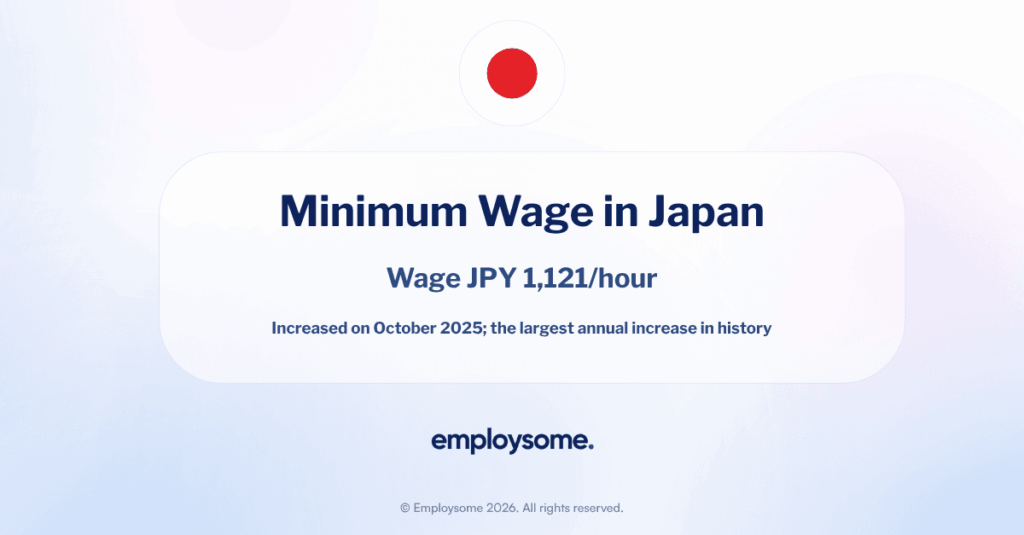
Japan’s minimum wage hit a record national average of JPY 1,121/hour in October 2025, the largest annual increase in history. With the government targeting JPY 1,500 by the late 2020s and a new Child Rearing premium launching in April 2026, employer costs are rising fast. This guide covers regional rates, employer social insurance, overtime rules, income tax, and what it means for EOR arrangements.

Japan does not have a single national minimum wage. Instead, each of the country’s 47 prefectures sets its own rate based on local economic conditions, cost of living, and labour market dynamics. On top of the regional minimums, certain industries have their own sector-specific minimum wages that override the prefectural rate when they are higher.
The most recent revision took effect between October 2025 and early 2026 (depending on the prefecture) and brought the national weighted average to JPY 1,121 per hour, a record increase of JPY 66 (~6.3%) over the previous year. For the first time in history, every prefecture now exceeds JPY 1,000 per hour. The government has set an explicit target of reaching JPY 1,500 per hour by the late 2020s, meaning continued steep annual increases are expected.
For international employers hiring in Japan, whether through a local entity or an Employer of Record, the minimum wage is only the starting point. Japan’s layered social insurance system adds approximately 15% to gross salary in employer-only costs, and a new Child Rearing premium launching in April 2026 will push that higher. This guide covers the full picture.

Regional Minimum Wage Rates (October 2025)
Japan groups its 47 prefectures into three categories (A, B, and C) for minimum wage adjustment purposes. In the 2025 cycle, Category C prefectures received the largest increase (JPY 64) for the first time, aimed at reducing regional economic disparities and addressing severe labour shortages in rural areas.
|
Prefecture |
Hourly Rate (JPY) |
Approx. USD |
|
Tokyo |
1,226 |
$7.86 |
|
Kanagawa |
1,225 |
$7.85 |
|
Osaka |
1,174 |
$7.53 |
|
Saitama |
1,154 |
$7.40 |
|
Aichi |
1,152 |
$7.38 |
|
Chiba |
1,148 |
$7.36 |
|
Kyoto |
1,138 |
$7.30 |
|
Hyogo |
1,122 |
$7.19 |
|
Hokkaido |
1,071 |
$6.87 |
|
Fukuoka |
1,070 |
$6.86 |
|
Hiroshima |
1,070 |
$6.86 |
|
National average |
1,121 |
$7.19 |
|
Okinawa (lowest) |
1,023 |
$6.56 |
USD conversions are approximate at JPY 156 = $1. Exchange rates fluctuate daily.
A full-time employee working 40 hours per week at Tokyo’s minimum wage earns approximately JPY 212,000 gross per month. After social insurance deductions and income tax, take-home pay is roughly JPY 160,000 to 170,000. This is well below what skilled professionals earn, but it sets the floor for all employment contracts including EOR arrangements.
What Minimum Wage Actually Costs the Employer
Japan’s social insurance system (Shakai Hoken) is shared between employer and employee, but the employer’s total burden is significant. As of March 2026, the key employer contributions are:
|
Contribution |
Employer Rate |
Notes |
|
Employees’ Pension (Kosei Nenkin) |
9.15% |
Cap at JPY 650,000/month standard salary |
|
Health Insurance (Kenko Hoken) |
~4.9 to 5.4% |
Varies by prefecture (Tokyo: 4.925%) |
|
Long-term Care Insurance |
0.81% |
Applies to employees aged 40 to 64 |
|
Child Allowance |
0.36% |
Employer-only, no employee share |
|
Child Rearing Support (new April 2026) |
0.115% |
New premium, shared 50/50 |
|
Employment Insurance (Koyou Hoken) |
0.95% |
Higher employer share than employee |
|
Workers’ Accident Compensation |
0.25 to 8.8% |
Employer-only, varies by industry |
|
Total employer burden (typical) |
~15 to 16% |
On top of gross salary |
The new Child Rearing Support Contribution launching in April 2026 is small (0.23% total, split 50/50) but represents an additional cost that will increase annually, expected to reach 0.4% by 2028. Employers must ensure their payroll systems are updated for this deduction from the April 2026 pay cycle.
Industry-specific accident compensation rates vary enormously: 0.25% for finance and office work, up to 8.8% for mining. Most white-collar EOR hires fall at the low end.
💡 Employsome Insight: Japan’s Employer Costs Are Lower Than They Look
At ~15% employer-only social insurance, Japan’s total employment cost burden is moderate compared to markets like France (~45%), Brazil (~35%), or even Germany (~21%). The catch is complexity, not cost. Japan’s payroll requires precision across multiple insurance systems, prefecture-specific health rates, standard salary tables, and biannual bonus calculations. Errors trigger retroactive corrections and penalties. For companies hiring through an EOR, payroll accuracy is the single most important evaluation criterion.
Working Hours and Overtime
Standard working hours in Japan are 8 hours per day and 40 hours per week under the Labour Standards Act. Overtime is permitted but tightly regulated.
Regular overtime (beyond 8 hours/day or 40 hours/week) must be paid at 125% of the regular hourly rate. For overtime exceeding 60 hours per month, all companies must now pay 150% (this was previously required only for large companies but was extended to SMEs from April 2023). Night work (10 p.m. to 5 a.m.) carries an additional 25% premium on top of any overtime rate. Work on designated rest days is paid at 135% of the regular rate.
Overtime is capped at 45 hours per month and 360 hours per year under standard agreements. With a special labour-management agreement (36 Agreement), this can be extended to 100 hours per month or 720 hours per year in exceptional circumstances, but the average over 2 to 6 months must not exceed 80 hours.
Japan takes overtime compliance seriously. Employers must maintain detailed records with employee signatures, and the Labour Standards Inspection Office actively audits compliance. For EOR arrangements, ensuring the EOR tracks and caps overtime correctly is critical.
Income Tax
Japan uses a progressive national income tax system with rates ranging from 5% to 45%, plus a 2.1% reconstruction surtax on all income tax. Resident tax (local inhabitants’ tax) adds approximately 10% of the previous year’s income, withheld monthly by the employer.
|
Taxable Income (JPY) |
Tax Rate |
|
Up to 1,950,000 |
5% |
|
1,950,001 to 3,300,000 |
10% |
|
3,300,001 to 6,950,000 |
20% |
|
6,950,001 to 9,000,000 |
23% |
|
9,000,001 to 18,000,000 |
33% |
|
18,000,001 to 40,000,000 |
40% |
|
Over 40,000,000 |
45% |
A minimum-wage worker in Tokyo earning approximately JPY 2.5 million annually falls in the 5 to 10% national tax bracket. Combined with resident tax and social insurance deductions, effective take-home is roughly 75 to 80% of gross for low earners.
From 2026, tax deduction increases for employment income and basic deductions are being phased in, slightly reducing the tax burden for lower and middle-income earners.
How Japan Compares in Asia
Asia
|
Country |
Min Wage (USD/hr equiv.) |
Employer SI |
Overtime Premium |
Key 2026 Change |
|
Japan |
~$7.19 (avg) |
~15% |
125 to 150% |
Child Rearing premium, JPY 1,500 target |
|
~$6.80 |
~12% |
150% |
Minimum wage JPY equivalent rising |
|
|
None (sector-specific) |
~17% CPF |
None mandated |
Workplace Fairness Act |
|
|
Australia |
~$15.50 AUD |
~11.5% super |
150 to 200% |
Super guarantee increase |
|
~$0.40 (national floor) |
~12 to 15% |
200% |
New labour codes, 50% wage rule |
Japan’s minimum wage sits in the middle of developed Asia. It is significantly lower than Australia but higher than South Korea when adjusted for purchasing power. The critical difference is Japan’s layered social insurance and overtime system, which adds real complexity that simpler markets do not have.
What This Means for EOR Arrangements
If you are hiring through an Employer of Record in Japan, the EOR handles enrolment in Shakai Hoken (health, pension, long-term care) within 5 days of the employment start date, monthly social insurance calculations using prefecture-specific standard salary tables, the new Child Rearing premium from April 2026, resident tax withholding and remittance to local authorities, overtime tracking and premium calculations (125%, 150%, night, rest day), and annual social insurance reporting to the Japan Pension Service by July.
Japan’s payroll is precision-driven. Small errors in standard salary classification, health insurance prefecture rates, or overtime calculations compound quickly and trigger retroactive corrections. Confirm your EOR uses Japan-specific payroll infrastructure, not a generic global system adapted for Japan.
Hiring in Japan?
If you are looking to hire employees in Japan without setting up a local entity, an Employer of Record handles Shakai Hoken enrolment, payroll, income tax, resident tax, and overtime compliance on your behalf. See our Best Employer of Record in Japan guide for pricing, entity ownership, and compliance depth.
Frequently Asked Questions
The national weighted average is JPY 1,121 per hour as of October 2025. Rates vary by prefecture, from JPY 1,023 in Okinawa to JPY 1,226 in Tokyo. The next revision is expected in October 2026.
Japan sets its minimum wage hourly, not monthly. For a full-time employee working 40 hours per week, the monthly equivalent at the national average is approximately JPY 194,000 gross.
Employer social insurance adds approximately 15 to 16% on top of gross salary. A minimum-wage employee in Tokyo earning JPY 212,000/month costs the employer roughly JPY 244,000 to 248,000 per month when all contributions are included.
The Japanese government has set a target of JPY 1,500 per hour by the late 2020s. At the current pace of ~6% annual increases, this target is achievable by 2028 or 2029.
Yes. Japan’s minimum wage applies equally to all workers regardless of nationality, including those on work visas, student visas with work permission, and employees hired through EOR arrangements.
A new Child Rearing Support Contribution (0.23%, split 50/50 between employer and employee) was introduced alongside health insurance premiums. This is a new payroll line item that did not exist before and will increase annually.

Written by
Courtney Pocock is a Copywriter & EOR/PEO Researcher at Employsome with 15+ years of experience writing for the HR, corporate, and financial sectors. She has a strong interest in global business expansion and Employer of Record / PEO topics, focusing on news that matters to business owners and decision-makers. Courtney covers industry updates, regulatory changes, and practical guides to help leaders navigate international hiring with confidence.
Our content is created for informational purposes only and is not intended to provide any legal, tax, accounting, or financial advice. Please obtain separate advice from industry-specific professionals who may better understand your business’s needs. Read our Editorial Guidelines for further information on how our content is created.
Other posts
Review other blog posts