(No) Minimum Wage in Sweden: What Employers Pay in 2026
Sweden has no national minimum wage and is not getting one in 2026. Instead, roughly 700 collective agreements between trade unions and employer associations set sector-specific pay floors covering approximately 90% of the workforce. Entry-level rates range from SEK 25,000 to 28,000/month depending on industry. Add 31.42% in mandatory employer contributions on top, and total employment cost is among the highest in Europe. This guide covers how the Swedish model works, what employers actually pay by sector, the June 2026 work permit salary threshold increase to SEK 33,390, and how an EOR handles compliance.

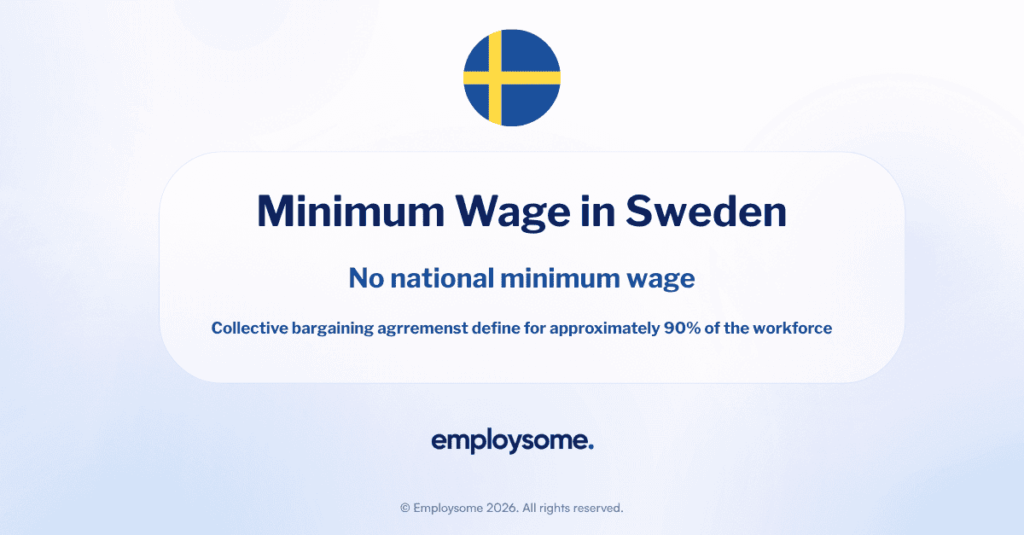
Table of Contents
- How the Swedish Collective Bargaining System Works
- What Employers Actually Pay: Rates by Sector
- Employer Costs: 31.42% on Top of Gross Salary
- The June 2026 Work Permit Salary Threshold: SEK 33,390
- Employee Income Tax
- Working Hours, Overtime, and Leave
- Nordic and European Comparison
- Hiring in Sweden Through an EOR
- FAQs
Sweden does not have a minimum wage. There is no government-mandated hourly rate, no national floor, no single number you can look up. Sweden is one of six EU countries (alongside Denmark, Finland, Austria, Italy, and Cyprus) that operates without a statutory minimum wage, and the EU Minimum Wage Directive does not force it to introduce one because collective bargaining coverage exceeds the 80% threshold.
What Sweden has instead is the Swedish Model (also called the Nordic Model or the Ghent system). Wages are negotiated between trade unions and employer associations through roughly 700 collective agreements that cover approximately 90% of the workforce. These agreements set sector-specific pay floors, working conditions, overtime rules, pensions, and insurance. The floors are not suggestions. They are legally binding on every employer covered by an agreement.
For international companies, the practical question is: what do you actually have to pay? This guide covers the sector-by-sector rates, the 31.42% employer contribution that sits on top, the new work permit salary threshold of SEK 33,390 taking effect June 2026, income tax, working hours, and how an Employer of Record handles compliance with a system that has no single rule book.

How the Swedish Collective Bargaining System Works
Sweden’s wage-setting process has followed a clear pattern since 1997. The export-oriented industrial sector negotiates first, setting a benchmark (the “industry standard” or “mark”) for cost increases. Other sectors then negotiate within this framework. This coordination keeps wage growth predictable and prevents inflationary spirals.
There are three main union federations: LO (blue-collar, ~1.4 million members), TCO (white-collar, ~1.3 million members), and SACO (professional/academic, ~700,000 members). On the employer side, the Swedish Enterprise Confederation (Svenskt Naringsliv) represents most private sector employers. Collective agreements are typically renegotiated every one to three years.
Of the approximately 700 collective agreements in Sweden, fewer than 250 include specific minimum wage levels (called lagstaloner). These are concentrated in LO-affiliated (blue-collar) sectors and Unionen (the largest private-sector white-collar union). In white-collar and professional sectors, wages are often negotiated individually at the time of hiring, with no explicit floor in the agreement.
Employers without a collective agreement can technically set any wage, but in practice they benchmark against the relevant sectoral agreement. Offering significantly below the agreement rate makes it nearly impossible to attract workers and can trigger union intervention. The Swedish National Mediation Office publishes data showing that only 0.3% of employees earn below 60% of the national median wage, which is one of the lowest low-pay incidence rates in the world.
What Employers Actually Pay: Rates by Sector
Since there is no single minimum wage, the best way to understand pay floors is to look at what the major collective agreements specify for entry-level workers. These are approximate monthly gross rates for adults (20+) without formal qualifications or relevant experience:
|
Sector / Agreement |
Entry-Level Monthly Gross (SEK) |
Approx EUR |
|
Hotel and Restaurant (Visita/HRF) |
~SEK 25,000 to 26,000 |
~EUR 2,170 to 2,260 |
|
Retail Trade (Svensk Handel/Handels) |
~SEK 25,500 to 27,000 |
~EUR 2,210 to 2,350 |
|
Cleaning (Almega/Fastighets) |
~SEK 24,000 to 26,000 |
~EUR 2,090 to 2,260 |
|
Construction (BI/Byggnads) |
~SEK 28,000 to 31,000 |
~EUR 2,430 to 2,690 |
|
Manufacturing / Industry (Teknikarbetsgivarna/IF Metall) |
~SEK 27,000 to 30,000 |
~EUR 2,350 to 2,610 |
|
Transport (Transportforetagen/Transport) |
~SEK 26,000 to 28,000 |
~EUR 2,260 to 2,430 |
|
Municipal Workers (SKR/Kommunal) |
~SEK 24,000 to 27,000 |
~EUR 2,090 to 2,350 |
|
IT / Tech (Almega/Unionen) |
No explicit floor (individually negotiated) |
Market: ~SEK 35,000+ |
|
Banking / Finance (BAO/Finansforbundet) |
No explicit floor (individually negotiated) |
Market: ~SEK 38,000+ |
The range is narrower than in countries like Italy, where CCNL floors vary from EUR 1,200 to EUR 2,350. Sweden’s lowest entry-level wages cluster around SEK 24,000 to 26,000 (EUR 2,090 to 2,260), which is already high by European standards. This is why Sweden does not need a statutory minimum wage: the collective bargaining system produces a floor that is naturally high.
💡 Employsome Insight: No Agreement Does Not Mean No Rules
If your company does not have a collective agreement in Sweden, you are not legally required to pay any specific minimum. But this is misleading. Without an agreement, unions can take industrial action against your company (strikes, blockades, sympathy actions) to force you to sign one. And the Swedish Labour Court has a long history of siding with unions in these disputes. For international companies hiring through an EOR, the EOR’s entity will almost certainly have a collective agreement in place, which means their sector’s pay floor applies automatically to your employee.
Employer Costs: 31.42% on Top of Gross Salary
Sweden’s employer contribution rate of 31.42% (arbetsgivaravgifter) is among the highest in Europe and applies to gross salary with no cap. This is not deducted from the employee’s salary. It is an additional cost paid entirely by the employer. Review our arbetsgivaravgifter guide to learn more.
|
Contribution Component (2026) |
Rate |
|
Old-age pension (aldersp.avgift) |
10.21% |
|
Survivor’s pension (efterlevandep.avgift) |
0.60% |
|
Health insurance (sjukforsakringsavgift) |
3.55% |
|
Parental insurance (foraldraforsakringsavgift) |
2.60% |
|
Work injury insurance (arbetsskadeavgift) |
0.20% |
|
Labour market (arbetsmarknadsavgift) |
2.64% |
|
General payroll tax (allman loneavgift) |
11.62% |
|
Total employer contribution |
31.42% |
Example at SEK 30,000 gross/month: Employer contributions add SEK 9,426, bringing total monthly employer cost to SEK 39,426 (~EUR 3,430). On top of this, many collective agreements require employers to provide occupational pension (typically ~4 to 5% of salary), collective insurance packages (~0.5 to 1%), and holiday pay supplements (0.43% per vacation day). The real total employer cost in Sweden is closer to 137 to 140% of gross salary.
For employees aged 67 or older at the start of the year, employers pay only the pension contribution of 10.21%. A temporary youth reduction (20.81% on salary up to SEK 25,000/month for workers aged 19 to 23) applies from April 2026 to September 2027. For EOR cost planning, use 31.42% as the default for most hires.
The June 2026 Work Permit Salary Threshold: SEK 33,390
From 1 June 2026, all new work permit applications in Sweden must meet a minimum monthly salary of SEK 33,390 (previously SEK 29,680). This threshold is set at 90% of Sweden’s median wage (SEK 37,100), up from the previous 80%. The change is part of the government’s broader tightening of labour immigration rules.
This threshold applies to non-EU/EEA nationals applying for a Swedish work permit (arbetstillstand). It does not replace or override collective agreement pay floors, but it sets a higher bar for immigration purposes. If the collective agreement floor for a sector is SEK 25,000 but the work permit threshold is SEK 33,390, the employer must pay at least SEK 33,390 to qualify for the permit.
Exemptions may apply for certain shortage occupations (the government has identified 152 exemptions). The EU Blue Card threshold is even higher: SEK 77,245/month (1.5x the forecast average wage).
Applications submitted before 1 June 2026 are processed under the old threshold. Extensions of permits granted before this date follow the previous rules if filed by 1 December 2026. For companies hiring employees internationally in Sweden, the new threshold directly affects compensation budgeting for non-EU hires.
Employee Income Tax
Sweden has one of the highest personal income tax rates in the world. The system combines municipal tax (kommunalskatt) with a state surcharge on higher earnings:
|
Income Level |
Tax Rate (2026) |
|
Municipal tax (all income) |
~32.38% average (varies by municipality, range 28% to 35%) |
|
State income tax (above SEK 643,100/year) |
20% on income exceeding this threshold |
|
Maximum marginal rate |
~52 to 55% |
|
SINK tax (non-residents, temporary) |
22.5% flat rate (reduced from 25% on 1 Jan 2026) |
The earned income credit (jobbskatteavdrag) and basic deduction (grundavdrag) reduce the effective rate for most workers. An employee earning SEK 30,000/month pays roughly SEK 22,000 to 23,000 in take-home after tax, depending on municipality. Sweden also offers expert tax relief for qualifying foreign professionals: a 25% income exemption for up to 5 years, which significantly reduces the effective tax rate for international hires.
Working Hours, Overtime, and Leave
|
Rule |
Details |
|
Standard workweek |
40 hours (many agreements specify 37.5 to 38.5 hours) |
|
Maximum overtime |
48 hours per 4-week period or 200 hours per year (can be extended by collective agreement to 150 additional hours) |
|
Overtime premium |
Set by collective agreement (typically 50 to 100% surcharge) |
|
Annual leave |
Minimum 25 days paid vacation per year (one of the highest in Europe) |
|
Holiday pay supplement |
0.43% of monthly salary per vacation day (on top of regular pay) |
|
Public holidays |
13 per year |
|
Sick leave (employer) |
Day 1: qualifying day (karensdag, no pay). Days 2 to 14: employer pays 80% of salary. |
|
Sick leave (state) |
Day 15 onwards: Forsakringskassan pays ~80% of salary up to a cap. |
|
Parental leave |
480 days shared between parents (390 days at ~80% salary, 90 days at flat rate). Among the most generous in the world. |
|
Notice period |
1 to 6 months depending on tenure (set by Employment Protection Act, LAS, or collective agreement) |
Sweden’s 25-day annual leave is statutory minimum. Many collective agreements and employers offer more. Combined with 13 public holidays and generous parental leave, Sweden’s total time-off package is among the most extensive globally. For a deeper comparison, see how this stacks up against countries like Germany in our European minimum wage guides.
💡 Employsome Insight: Collective Agreements Are Not Optional in Practice
Even though a collective agreement is technically voluntary for private employers, approximately 90% of Swedish workers are covered by one. If your EOR’s entity does not have a collective agreement, or if it has the wrong one for your employee’s sector, the union can take industrial action, including sympathy strikes involving other unions. When evaluating whether an EOR operates its own entity or uses a local partner, ask which collective agreement covers their entity and whether it matches your employee’s role.
Nordic and European Comparison
|
Country |
Statutory Min? |
Entry Floor (EUR/mo) |
Employer SI |
Annual Leave |
Parental Leave |
|
Sweden |
No (collective) |
~2,090 to 2,350 |
31.42% |
25 days |
480 days |
|
Denmark |
No (collective) |
~2,400 to 2,700 |
~0% (employer pays via taxes) |
25 days |
52 weeks |
|
Finland |
No (collective) |
~1,800 to 2,200 |
~20% |
25 days |
320 days |
|
Norway |
No (9 sectors only) |
~NOK 162 to 260/hr |
14.1% |
25 days |
49 weeks |
|
Germany |
Yes |
~2,161 |
~20 to 21% |
20 days |
14 months |
|
Netherlands |
Yes |
~2,070 |
~18 to 22% |
20 days |
16 weeks + 9 weeks |
|
Italy |
No (CCNL) |
~1,200 to 2,350 |
~29 to 32% |
20 days |
5 months |
Sweden’s total employer cost (31.42% contributions + ~5% occupational pension + holiday supplements) puts it near the top of Europe alongside France and Italy. What justifies the cost is the quality of the talent pool, political stability, and infrastructure. Sweden consistently ranks in the top 5 globally for ease of doing business, digital readiness, and English proficiency.
Hiring in Sweden Through an EOR
Sweden’s combination of collective agreements, high employer contributions, and strict labour immigration rules makes it one of Europe’s more complex hiring markets for companies without a local entity.
An Employer of Record with a Swedish entity handles employment contracts under the Employment Protection Act (LAS), collective agreement compliance, payroll processing through Skatteverket, employer contribution remittance (31.42%), occupational pension administration, and the monthly employer declaration filing. For non-EU employees, the EOR can also handle the work permit process, including meeting the new SEK 33,390 salary threshold.
When choosing a provider, verify which collective agreement covers their Swedish entity, whether they handle the June 2026 work permit salary threshold, and whether they include occupational pension and collective insurance in their cost estimate. For the full picture on EOR costs, see our dedicated guide.
Hiring in Sweden?
Sweden’s collective bargaining system, 31.42% employer contributions, and new work permit salary threshold make compliance more complex than countries with a simple statutory minimum. Compare the best EOR providers for Sweden on Employsome. We score each provider on collective agreement coverage, Skatteverket compliance, payroll accuracy, and work permit handling. Compare EOR providers and explore our global EOR guide to see the full rankings.
Frequently Asked Questions
No. Sweden has no statutory national minimum wage. Wages are set through collective bargaining agreements between trade unions and employer associations. Approximately 90% of the workforce is covered by these agreements.
Entry-level wages under the major collective agreements range from approximately SEK 24,000 to 28,000 per month (~EUR 2,090 to 2,430) for adults without qualifications. In IT, finance, and professional sectors, there is often no explicit floor and wages are negotiated individually.
The mandatory employer contribution is 31.42% of gross salary with no cap. On top of this, most collective agreements require occupational pension (~4 to 5%) and collective insurance (~0.5 to 1%). Total employer cost is approximately 137 to 140% of gross salary.
From 1 June 2026, work permit applicants must earn at least SEK 33,390 per month (90% of the median wage). The EU Blue Card threshold is SEK 77,245 per month. Exemptions exist for certain shortage occupations.
Yes. Qualifying foreign professionals, researchers, and key staff can receive a 25% income exemption for up to 5 years. This significantly reduces the effective tax rate and is one of the most attractive schemes in Europe for international hires.
Yes. An EOR with a Swedish entity manages employment contracts, collective agreement compliance, employer contributions (31.42%), payroll, occupational pension, and work permit processing. The EOR’s collective agreement determines which sector’s rules apply to your employee.

Written by
Dane Cobain is a Copywriter at Employsome and an accomplished author whose work spans fiction, non-fiction, and professional writing. Over the past decade, he has built a strong track record creating straightforward content for the HR, payroll, and corporate sectors. Dane brings a storyteller’s eye to the evolving world of global employment, with a particular focus on Employer of Record and PEO models. His articles explore industry trends and dedicated Best Of Guides when managing an international workforce.
Our content is created for informational purposes only and is not intended to provide any legal, tax, accounting, or financial advice. Please obtain separate advice from industry-specific professionals who may better understand your business’ needs. Read our Editorial Guidelines for further information on how our content is created7
Other posts
Review other blog posts