Minimum Wage in Chile: The Complete 2026 Guide
Chile raised its minimum wage to CLP 539,000/month (~USD 569) on 1 January 2026, completing a 54% increase since 2022. But the headline number is just one piece: Chile is also cutting the workweek to 42 hours in April 2026, adding new employer pension contributions (rising from 1% to 8.5% by 2035), and adjusting the legal gratification cap. This guide covers every number employers need.

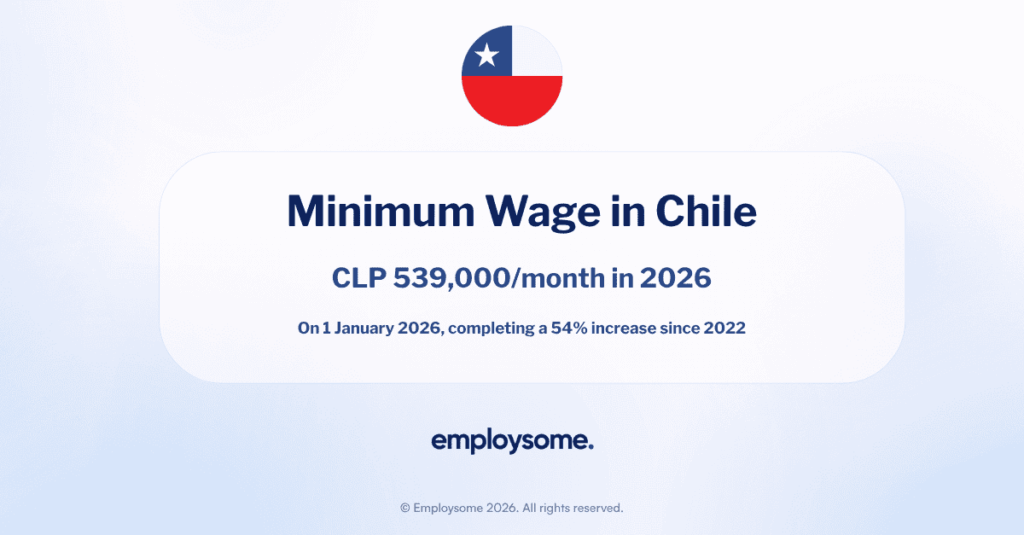
Chile’s minimum wage increased to CLP 539,000 per month (~USD 569) on 1 January 2026. For workers under 18 or over 65, the rate is CLP 402,082. This is the final step in a multi-year adjustment that took the minimum from CLP 350,000 when the current government took office in 2022 to CLP 539,000 today. Roughly 950,000 workers across Chile are directly affected.
But the minimum wage increase is the easy part. 2026 is also the year Chile implements two structural changes that affect every employer in the country. First, the standard workweek drops from 44 to 42 hours starting April 2026 under Ley 21.561, with no reduction in pay allowed. Second, the pension reform (enacted January 2025) begins adding new mandatory employer contributions to the pension system, starting at 1% in August 2025 and rising to 8.5% by 2035. Both changes increase real labour costs even if base salaries stay the same.
Add the mandatory legal gratification (profit-sharing bonus), unemployment insurance, and accident insurance on top, and total employer cost in Chile is higher than the headline minimum wage suggests. This guide covers all of it.
Hiring in Chile?
Chile’s 42-hour workweek, rising pension contributions, and mandatory gratification make payroll more complex than the headline minimum wage suggests. Compare the best EOR providers for Chile on Employsome. We score each provider on Codigo del Trabajo compliance, gratification handling, AFP/FONASA administration, and payroll accuracy. Compare 100+ EOR providers or explore our Chile EOR guide.

Chile Minimum Wage 2026: The Numbers
|
Metric |
2026 Rate |
|
Monthly minimum wage (ages 18 to 65) |
CLP 539,000 |
|
Monthly minimum wage (under 18 / over 65) |
CLP 402,082 |
|
Approximate monthly rate in USD |
~USD 569 |
|
Annual minimum wage (12 months, gross) |
CLP 6,468,000 (~USD 6,828) |
|
Increase from May 2025 |
CLP 10,000 (+1.9%) |
|
Increase from 2022 (government term) |
CLP 189,000 (+54%) |
|
Workers earning minimum wage |
~950,000 |
|
Standard workweek (from April 2026) |
42 hours (down from 44) |
Chile does not have regional minimum wage variations. The same national rate applies uniformly across all regions, from Santiago to Punta Arenas. However, the living wage in Santiago is commonly estimated at CLP 600,000 to 700,000, meaning the statutory minimum falls short of actual living costs in the capital.
Minimum Wage History: 2020 to 2026
Minimum Wage History: 2020 to 2026
|
Year |
Monthly (CLP) |
Approx USD |
Change |
|
2020 |
320,500 |
~400 |
+6.0% |
|
2021 |
337,000 |
~430 |
+5.1% |
|
2022 |
400,000 |
~440 |
+18.7% |
|
2023 |
460,000 |
~530 |
+15.0% |
|
2024 |
500,000 |
~550 |
+8.7% |
|
2025 (May) |
529,000 |
~558 |
+5.8% |
|
2026 (Jan) |
539,000 |
~569 |
+1.9% |
The 54% cumulative increase from 2022 to 2026 reflects a deliberate government push to close the gap between the minimum wage and actual living costs. Chile now holds the second-highest minimum wage in South America, behind Uruguay.
The 42-Hour Workweek: What Changes in April 2026
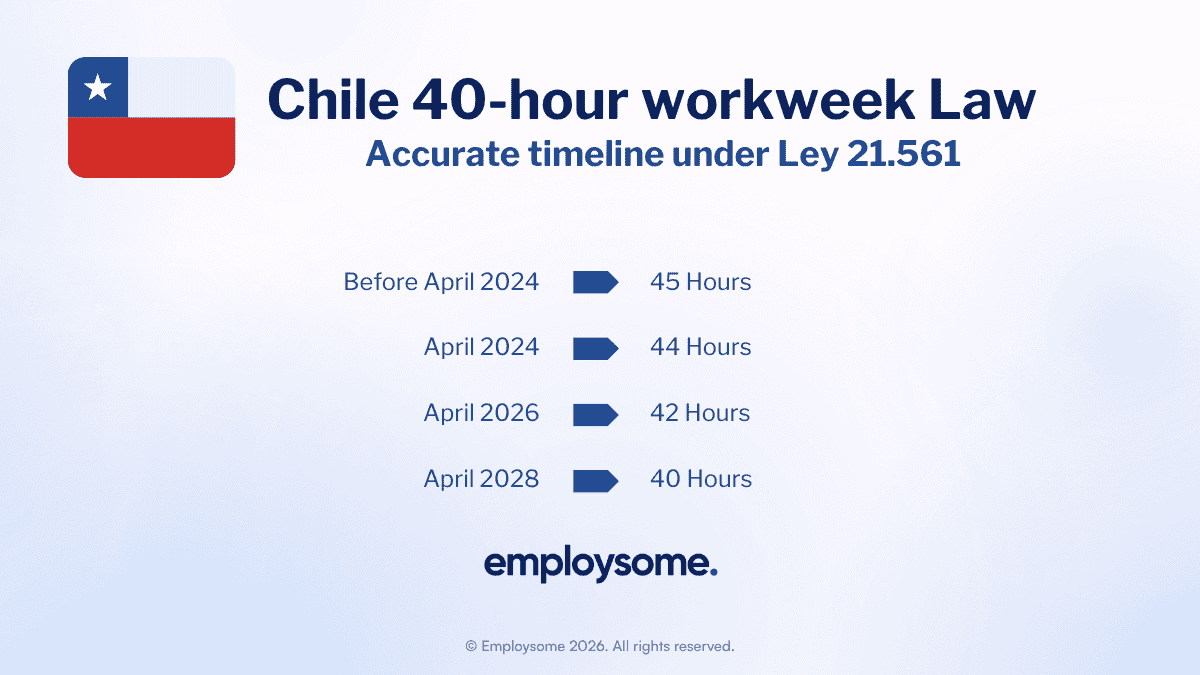
Ley 21.561, enacted in 2023, mandates a phased reduction of the standard workweek: from 45 hours (pre-2024) to 44 hours (2024) to 42 hours (April 2026) to 40 hours (2028). The law explicitly prohibits reducing pay to compensate for the shorter hours.
For employers paying the minimum wage, this means the effective hourly rate increases automatically even without a nominal wage change. At CLP 539,000 per month on a 42-hour week (roughly 182 hours per month), the effective hourly rate is approximately CLP 2,962. On the old 45-hour week, the same monthly salary would have been CLP 2,764 per hour. The workweek reduction is a de facto 7% raise in hourly terms.
Employers can implement the 42-hour week in different ways: reducing daily hours, adding a half-day off, implementing a compressed 4-day week (with employee agreement), or other arrangements, as long as the total does not exceed 42 hours. The daily maximum remains 10 hours.
💡 Employsome Insight: The 42-Hour Workweek Is a Hidden Cost Increase
If you are budgeting for Chilean employees in 2026, do not just look at the CLP 539,000 headline number. The April 2026 workweek reduction means your employees work fewer hours for the same pay, increasing your cost per hour by roughly 7%. If you are comparing Chile against other countries for hiring developers or building operational teams, factor in 42 hours (not 45) when calculating cost per productive hour.
Total Employer Cost in Chile
Chile’s social security system is unusual. Most of the contribution burden falls on the employee, not the employer. Employees contribute roughly 17 to 18% of gross salary (pension, health, unemployment). Employer contributions are historically low, but that is changing with the 2025 pension reform.
|
Cost Component |
Employer Rate |
Employee Rate |
|
Pension (AFP, 10% + commission) |
N/A (employee-funded) |
~11.5% |
|
Health insurance (FONASA/ISAPRE) |
N/A (employee-funded) |
7.0% |
|
Unemployment insurance (indefinite) |
2.4% |
0.6% |
|
Unemployment insurance (fixed-term) |
3.0% |
0% |
|
Disability & survival insurance (SIS) |
~1.5% |
N/A |
|
Work accident insurance |
0.93% base + variable |
N/A |
|
NEW: Pension reform (Aug 2025) |
1.0% (rising to 8.5% by 2035) |
N/A |
Example at minimum wage: An employee earning CLP 539,000 gross on an indefinite contract costs the employer approximately CLP 539,000 + CLP 12,936 (unemployment 2.4%) + CLP 8,085 (SIS 1.5%) + CLP 5,013 (accident 0.93%) + CLP 5,390 (pension reform 1.0%) = approximately CLP 570,424 total (~USD 602). This excludes the legal gratification.
The pension reform is the big change. Employer contributions will rise from 1.0% in August 2025 to 8.5% by August 2035, phased in annually. For multi-year EOR cost planning, this trajectory matters.
💡 Employsome Insight: Budget for the Gratification from Day One
International companies consistently underestimate the legal gratification. It is not optional, and the alternative 25% method applies regardless of profits. When you see a Chilean salary quoted as CLP 539,000, your real base cost before employer contributions is closer to CLP 674,000. If your EOR provider does not include the gratification in their initial quote, ask why.
Working Hours, Overtime, and Leave
|
Rule |
Details |
|
Standard workweek (from April 2026) |
42 hours, distributed over max 5 or 6 days |
|
Daily maximum |
10 hours (including overtime) |
|
Overtime cap |
2 hours per day, only with written agreement |
|
Overtime premium |
50% on top of regular hourly rate |
|
Annual leave |
15 working days (after 1 year). +1 day per 3 years after 10 years. |
|
Public holidays |
16 national holidays per year (2026) |
|
Sick leave |
Employer pays first 3 days. State pays from day 4. |
|
Maternity leave |
6 weeks prenatal + 12 weeks postnatal (state-funded) |
|
Probation period |
No statutory probation period in Chile |
|
Notice period |
30 days (employer) or pay in lieu |
|
Severance |
30 days per year of service, capped at 11 years (330 days) |
Chile has no statutory probation period. Severance applies from day one of employment, which is unusual in Latin America and catches many international employers off guard.
Latin American Comparison
|
Country |
Min (USD) |
Workweek |
Employer SI |
13th Month |
Severance |
|
Chile |
~569 |
42 hrs |
~5-6% (rising) |
No (gratif.) |
30d/yr, cap 11yr |
|
Brazil |
~270 |
44 hrs |
~29% |
Yes |
40% FGTS |
|
Mexico |
~450 |
48 hrs |
~25-35% |
Yes |
3mo + 20d/yr |
|
Colombia |
~330 |
46 hrs |
~22% |
No (prima) |
Varies |
|
Argentina |
~220 |
48 hrs |
~26% |
Yes |
1mo/yr, no cap |
|
Peru |
~280 |
48 hrs |
~11% |
Yes (14 pays) |
1.5mo/yr |
|
Uruguay |
~590 |
44-48 hrs |
~12% |
Yes |
Varies |
Chile has the shortest standard working hours in Latin America. Combined with rising pension reform contributions, total employment cost is trending upward relative to peers. For companies evaluating where to hire in LATAM, the per-hour cost comparison matters more than the monthly headline.
Frequently Asked Questions
CLP 539,000 per month gross (~USD 569) for workers aged 18 to 65. Workers under 18 or over 65 earn CLP 402,082. No regional variation.
Not exactly. Chile requires a legal gratification: either 30% of net profits distributed to employees, or 25% of monthly salary capped at 4.75 minimum wages per year. The 2026 monthly cap is approximately CLP 213,354.
42 hours from April 2026, down from 44. It will further reduce to 40 hours by 2028. No pay reduction is permitted.
Currently ~5-6% (unemployment 2.4%, SIS ~1.5%, accident insurance ~0.93%, pension reform 1.0%). This will reach ~14% by 2035 as pension reform contributions rise to 8.5%.
30 days per year of service, capped at 11 years (330 days). Applies from day one as Chile has no statutory probation period.
Yes. An EOR with a Chilean entity handles employment contracts, AFP/health enrolment, payroll through PreviRed, tax withholding, legal gratification, and compliance with the 42-hour workweek and pension reform.

Written by
Dane Cobain is a Copywriter at Employsome and an accomplished author whose work spans fiction, non-fiction, and professional writing. Over the past decade, he has built a strong track record creating straightforward content for the HR, payroll, and corporate sectors. Dane brings a storyteller’s eye to the evolving world of global employment, with a particular focus on Employer of Record and PEO models. His articles explore industry trends and dedicated Best Of Guides when managing an international workforce.
Our content is created for informational purposes only and is not intended to provide any legal, tax, accounting, or financial advice. Please obtain separate advice from industry-specific professionals who may better understand your business’s needs. Read our Editorial Guidelines for further information on how our content is created.
Other posts
Along with our standard maps we offer highly customizable maps.