Average Salary in Nigeria (2026): What People Actually Earn
The average salary in Nigeria is roughly ₦339,000 per month ($220 USD). That number hides everything. A senior fintech engineer in Lagos earns ₦4,000,000. A teacher in Kano earns ₦65,000. This guide breaks down real salaries by sector, job title, and city, plus the ₦70,000 minimum wage, employer costs (pension, NHIS, NSITF), PAYE tax brackets, how Nigeria compares to India, Philippines, and South Africa as a hiring market, and what international companies need to know about infrastructure, Naira volatility, and paying in USD.

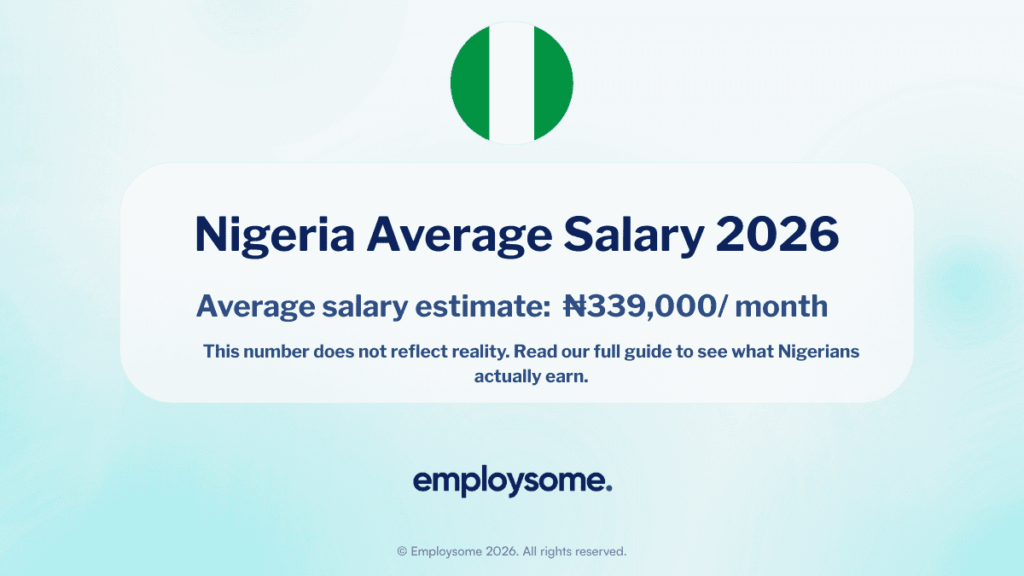
Table of Contents
If you google “average salary in Nigeria,” you will get a number somewhere around ₦339,000 per month. That is roughly $220 USD at current exchange rates. And that number is technically correct in the same way that the average temperature on Earth is 15°C: it is accurate and also completely useless for planning anything.
Nigeria has 220 million people. Africa’s largest economy. The continent’s biggest oil producer. A tech ecosystem in Lagos that is attracting serious international attention. And also one of the most dramatic income inequality gaps you will find anywhere. A junior bank teller in Abuja might earn ₦100,000 a month. A senior software engineer at a fintech in Lagos might earn ₦2,500,000. A petroleum engineer on an offshore platform might earn ₦5,000,000. And a schoolteacher in Kano might take home ₦65,000, if the state government has actually paid this month.
The average does not capture any of this. So instead of repeating the same number every other salary website publishes, this guide breaks down what people in Nigeria actually earn by sector, job title, city, and experience level. It also covers the minimum wage, employer costs (which most salary guides ignore entirely), the tax system, and what international companies need to understand if they are hiring Nigerian talent remotely or through an EOR.

Average Salary Numbers in Nigeria
|
Metric |
Amount (2026) |
|
Average monthly salary |
~₦339,000 (~$220 USD) |
|
Median monthly salary |
~₦407,000 (~$265 USD) |
|
National minimum wage |
₦70,000/month (~$45 USD), effective July 2024 |
|
Previous minimum wage (before July 2024) |
₦30,000/month |
|
Lowest-earning range |
~₦80,000-100,000/month |
|
Highest-earning range |
₦5,000,000-11,500,000/month (oil & gas, C-suite, finance executives) |
|
Average hourly wage |
~₦1,950 (~$1.27 USD) |
|
Currency |
Nigerian Naira (₦ / NGN) |
A note on exchange rates: the Naira has been volatile. In 2023, the government floated the currency and it dropped from roughly ₦460/USD to over ₦1,500/USD by early 2026. Dollar-denominated salary comparisons shift dramatically depending on which month you check. All USD figures in this guide use an approximate rate of ₦1,540/USD, but verify the current rate before making any compensation decisions.
💡 Employsome Insight: The Average Is Misleading Because of Nigeria’s Informal Economy
Nigeria’s formal sector employs a minority of the working population. The National Bureau of Statistics estimates that over 80% of employment is informal: market traders, artisans, smallholder farmers, motorcycle taxi drivers, and self-employed service providers who do not appear in any payroll data. The ₦339,000 average is drawn from formal-sector salaries, which skews the number upward. The actual median income for a working Nigerian is significantly lower. If you are benchmarking salaries to hire in Nigeria, use sector-specific and city-specific data, not the national average.
Average Salaries by Sector
The gap between sectors in Nigeria is enormous. Oil and gas pays four to five times more than education or agriculture for equivalent seniority levels. Here is what the major sectors look like:
|
Sector |
Entry-Level (₦/month) |
Mid-Level (₦/month) |
Senior (₦/month) |
|
Oil & Gas |
500,000-900,000 |
1,500,000-3,500,000 |
4,000,000-11,500,000 |
|
Banking & Finance |
150,000-350,000 |
500,000-1,200,000 |
2,000,000-6,000,000 |
|
Technology / Fintech |
200,000-500,000 |
600,000-2,000,000 |
2,500,000-7,000,000+ |
|
Telecommunications |
200,000-400,000 |
600,000-1,500,000 |
2,000,000-5,000,000 |
|
Manufacturing |
80,000-200,000 |
250,000-600,000 |
800,000-2,000,000 |
|
Healthcare (private) |
150,000-350,000 |
400,000-1,000,000 |
1,200,000-3,500,000 |
|
Education (private) |
50,000-120,000 |
150,000-300,000 |
400,000-800,000 |
|
Retail & FMCG |
70,000-150,000 |
200,000-500,000 |
700,000-1,500,000 |
|
Agriculture |
50,000-100,000 |
120,000-300,000 |
400,000-800,000 |
|
Public Sector (federal) |
80,000-150,000 |
200,000-500,000 |
600,000-1,500,000+ |
The tech sector deserves special attention. Lagos has become West Africa’s startup capital, with companies like Flutterwave, Paystack (acquired by Stripe), Andela, and Interswitch creating a talent ecosystem that commands salaries far above the national average. A senior full-stack developer in Lagos can earn ₦2,000,000 to ₦4,000,000 per month, and the best ones are being poached by international companies paying in dollars, which pushes local rates even higher. If you are hiring Nigerian tech talent remotely, you are competing against this market.
Salaries by Job Title
Here are monthly salary ranges for common roles that international companies hire for in Nigeria:
|
Job Title |
Monthly Range (₦) |
~USD Equivalent |
|
Software Engineer (mid-level) |
600,000-2,000,000 |
$390-$1,300 |
|
Senior Software Engineer |
2,000,000-4,000,000 |
$1,300-$2,600 |
|
Data Analyst |
300,000-800,000 |
$195-$520 |
|
Product Manager |
500,000-2,000,000 |
$325-$1,300 |
|
Customer Support Specialist |
100,000-300,000 |
$65-$195 |
|
Accountant |
150,000-500,000 |
$97-$325 |
|
HR Manager |
300,000-800,000 |
$195-$520 |
|
Marketing Manager |
300,000-1,000,000 |
$195-$650 |
|
Content Writer / Copywriter |
100,000-400,000 |
$65-$260 |
|
Graphic Designer |
100,000-350,000 |
$65-$230 |
|
Administrative Assistant |
70,000-150,000 |
$45-$97 |
|
Sales Executive |
100,000-300,000 + commission |
$65-$195 + commission |
|
Petroleum Engineer |
1,500,000-5,000,000 |
$975-$3,250 |
|
Medical Doctor (private hospital) |
400,000-1,200,000 |
$260-$780 |
The Lagos Premium (and the City-by-City Reality)
Lagos is where the money is. It is Nigeria’s commercial capital, home to most of the country’s banks, tech companies, multinationals, and high-paying industries. Salaries in Lagos are typically 30 to 50% higher than equivalent roles in other Nigerian cities. Abuja (the federal capital) comes second, driven by government institutions and the presence of international organisations. Everything else trails significantly.
|
City |
Salary vs National Average |
Key Industries |
|
Lagos |
30-50% above national average |
Tech, banking, oil & gas HQs, telecoms, FMCG, media |
|
Abuja |
15-30% above national average |
Federal government, international organisations, real estate, professional services |
|
Port Harcourt |
10-25% above (oil & gas roles much higher) |
Oil & gas (Niger Delta), marine services, logistics |
|
Ibadan |
At or slightly below national average |
Agriculture, manufacturing, education, healthcare |
|
Kano |
10-20% below national average |
Agriculture, textiles, commerce, informal trade |
|
Enugu / Calabar / other SE cities |
10-25% below national average |
Agriculture, public sector, SMEs, emerging tech hubs |
For international companies hiring remotely, the practical question is: where does the employee live, and does it matter for your budget? If you are hiring a Nigerian software engineer who lives in Enugu but works remotely for your London company, you can offer less than Lagos market rate and the candidate may still consider it generous relative to their local cost of living. But be aware: the best Nigerian tech talent knows what international companies pay, and they benchmark against Lagos and international rates, not Enugu rates.
Minimum Wage in Nigeria
Nigeria’s national minimum wage was increased to ₦70,000 per month ($45 USD) in July 2024, more than doubling the previous rate of ₦30,000 which had been in place since 2019. The increase was long overdue. Inflation had eroded the purchasing power of the old minimum wage to the point where it was functionally unlivable in any urban area.
That said, ₦70,000 per month is still extremely low by any global standard. It translates to roughly $1.50 per day, well below the World Bank’s poverty line. And enforcement is uneven. Federal government employees receive the new minimum, but several state governments have struggled or delayed implementation, citing budget constraints. Private-sector compliance outside Lagos, Abuja, and the oil-producing states is inconsistent, particularly for small businesses and informal employers.
For international companies, the minimum wage is essentially irrelevant to your hiring decisions. Any role that requires skills, English proficiency, and internet connectivity (the roles you would outsource or hire remotely) pays well above the minimum. The ₦70,000 floor matters for domestic labour policy, not for your compensation planning.
Employer Costs: What You Pay on Top of Salary
This is the section most Nigeria salary guides skip entirely, and it is the one that matters most if you are actually hiring. Nigerian payroll has multiple mandatory contributions that add roughly 11 to 14% on top of gross salary for employers:
|
Contribution |
Employer Rate |
Employee Rate |
Notes |
|
Pension (Contributory Pension Scheme) |
10% of pensionable income |
8% of pensionable income |
Mandatory for employers with 3+ staff. Pensionable income = basic salary + housing + transport allowances. |
|
NHIS (National Health Insurance) |
10% of basic salary |
5% of basic salary |
Applies to employers with 10+ employees. Provides basic healthcare coverage. |
|
NSITF (Social Insurance Trust Fund) |
1% of monthly payroll |
None |
Employer-only contribution. Workplace injury and compensation fund. All employers. |
|
ITF (Industrial Training Fund) |
1% of annual payroll |
None |
Applies to employers with 5+ staff or ₦50M+ turnover. |
|
NHF (National Housing Fund) |
None |
2.5% of basic salary |
Employee deduction. Private sector compliance now voluntary. |
|
EEL (Expatriate Employment Levy) |
$15,000/director or $10,000/other per year |
None |
Only applies if you employ expatriates in Nigeria. |
Total employer burden (excluding EEL) is approximately 12 to 14% of gross salary, which is moderate by global standards. Compare that to 29-32% in Italy, 25-42% in France, or 30-32% in Spain. Nigeria is a relatively low employer-cost jurisdiction, which is one reason it is attractive for outsourcing and remote hiring.
💡 Employsome Insight: The Pension Calculation Catches International Companies Off Guard
Nigerian pension contributions are calculated on “pensionable income,” which is defined as basic salary plus housing allowance plus transport allowance. Most Nigerian salary structures break total compensation into these components (often 40-50% basic, 15-20% housing, 10-15% transport, plus other allowances). The split affects your pension liability. If you structure a package with a high basic salary and no allowances, your pension contribution is higher. A local HR advisor or your EOR provider should structure the compensation correctly.
Employee Income Tax (PAYE)
Nigeria uses a progressive income tax system called PAYE (Pay-As-You-Earn). The employer withholds tax monthly and remits it to the relevant state tax authority (tax residency is based on where the employee lives, not where the company is registered).
Before applying the PAYE rates, the employee receives a Consolidated Relief Allowance (CRA): the higher of ₦200,000 or 1% of gross income, plus 20% of gross income. This significantly reduces the effective tax rate, especially for lower earners.
|
Annual Taxable Income (₦) |
PAYE Rate |
|
First 300,000 |
7% |
|
Next 300,000 |
11% |
|
Next 500,000 |
15% |
|
Next 500,000 |
19% |
|
Next 1,600,000 |
21% |
|
Above 3,200,000 |
24% |
The maximum PAYE rate is 24%, which is low compared to most European countries. Combined with the generous CRA, an employee earning ₦5,000,000 per year ($3,250 USD) has an effective tax rate of roughly 10 to 14%. For international companies, this means that net take-home pay in Nigeria is a higher proportion of gross salary than in most Western markets, which makes Naira-denominated offers go further than the headline number suggests.
How Nigeria Compares to Other Outsourcing Hubs
|
Nigeria |
India |
Philippines |
South Africa |
Kenya |
|
|
Avg monthly salary (USD) |
~$220 |
~$400-500 |
~$300-400 |
~$1,200-1,500 |
~$350-450 |
|
Software engineer (mid, USD) |
$390-1,300 |
$800-2,000 |
$600-1,500 |
$1,500-3,000 |
$500-1,200 |
|
English proficiency |
Official language |
Widely spoken (second language) |
Official language |
Official language |
Official language |
|
Timezone (UTC) |
UTC+1 |
UTC+5:30 |
UTC+8 |
UTC+2 |
UTC+3 |
|
Employer SI costs |
~12-14% |
~12-15% |
~10-12% |
~2-3% (UIF + SDL) |
~5-7% |
|
Top PAYE rate |
24% |
30% |
35% |
45% |
30% |
|
Key advantage |
Cost, English, growing tech talent |
Scale, depth of tech talent |
Service culture, US timezone overlap |
Infrastructure, proximity to Europe |
Cost, East Africa hub |
Nigeria’s main advantage is the combination of very low salary costs, native English proficiency, and a rapidly growing tech talent pool. The main disadvantage is infrastructure: internet connectivity is unreliable outside major cities, power outages are frequent (most professionals use generators or co-working spaces with backup power), and the time zone (UTC+1) offers only moderate overlap with US business hours. For European companies, the timezone alignment is actually excellent.
What International Companies Need to Know About Hiring in Nigeria
If you are considering hiring Nigerian talent, whether for a remote tech role, a customer support team, or a back-office function, here are the things that matter most:
Pay in a stable currency if you can. Naira volatility means that a salary that was competitive six months ago may now be below market. Many international companies pay Nigerian remote workers in USD or peg the Naira salary to a dollar amount with quarterly adjustments. This is not required, but it is increasingly expected by top talent, especially in tech.
The talent pool is deep but concentrated. Lagos is where most of the skilled, internationally competitive talent lives. Abuja has a smaller but growing pool. Other cities have talent but fewer people with international remote work experience. If you are hiring for roles that require consistent internet, a quiet workspace, and real-time collaboration, expect most competitive candidates to be in Lagos.
Infrastructure is a real consideration. Power cuts (“NEPA” in local slang) happen daily in most parts of Nigeria. Professional remote workers have adapted: they use generators, inverters, solar panels, and co-working spaces with reliable power and internet. But you should factor a remote work stipend into your offer to help cover these costs. ₦20,000 to ₦50,000 per month for internet and power backup is common.
The Expatriate Employment Levy is expensive. If you are sending expatriates to Nigeria (not just hiring Nigerians remotely), the EEL is $15,000 per year for directors and $10,000 for other expatriate employees, payable to the Nigeria Immigration Service. This is a significant cost on top of salary and should be factored into your budget.
Use an EOR if you do not have a Nigerian entity. Nigerian employment law requires that employers register with FIRS (tax), PenCom (pension), NSITF (social insurance), and other bodies. Payroll must be run in Naira with correct PAYE withholding to the relevant state authority. An EOR handles all of this. For most international companies hiring 1 to 10 people in Nigeria, it is the practical and cost-effective path.
Hiring in Nigeria?
Nigeria’s growing tech talent pool, English proficiency, and competitive salary levels make it one of Africa’s most attractive hiring markets. Compare the best EOR providers for Nigeria on Employsome. We score each provider on local entity ownership, payroll accuracy, pension compliance, and PAYE handling. Visit our Best EORs in Nigeria Guide to see the full comparison.
Frequently Asked Questions
The average monthly salary in the formal sector is approximately ₦339,000 ($220 USD). However, this varies enormously by sector, city, and role. Tech and oil & gas pay many times more than education or agriculture. Lagos salaries are 30-50% above the national average.
The national minimum wage is ₦70,000 per month ($45 USD), effective since July 2024. It was increased from ₦30,000. Enforcement varies by state, and several state governments have struggled to implement the new rate.
Mid-level: ₦600,000 to ₦2,000,000 per month ($390-$1,300 USD). Senior: ₦2,000,000 to ₦4,000,000+ ($1,300-$2,600+). Top talent working for international companies or major Nigerian fintechs can earn significantly more, especially if paid in USD.
Approximately 12 to 14% of gross salary for pension (10%), NHIS (10% of basic), NSITF (1%), and ITF (1%). This is moderate by global standards. The Expatriate Employment Levy adds $10,000-$15,000/year per foreign employee if applicable.
There is no legal requirement to pay in either. However, top Nigerian talent increasingly expects USD-pegged compensation or direct USD payments due to Naira volatility. Offering a Naira salary without any dollar peg puts you at a disadvantage when competing for the best candidates, especially in tech.
Yes, through an Employer of Record (EOR). The EOR becomes the legal employer in Nigeria, handles tax registration, pension enrolment, PAYE withholding, and payroll compliance. For most international companies, this is the fastest and lowest-risk path to hiring Nigerian talent.

Written by
Courtney Pocock is a Copywriter & EOR/PEO Researcher at Employsome with 15+ years of experience writing for the HR, corporate, and financial sectors. She has a strong interest in global business expansion and Employer of Record / PEO topics, focusing on news that matters to business owners and decision-makers. Courtney covers industry updates, regulatory changes, and practical guides to help leaders navigate international hiring with confidence.
Our content is created for informational purposes only and is not intended to provide any legal, tax, accounting, or financial advice. Please obtain separate advice from industry-specific professionals who may better understand your business’s needs. Read our Editorial Guidelines for further information on how our content is created.
Other posts
Read other blog posts