
Table of Contents
- Why Brazil Needed a Locally Built EOR
- What Is Wide Brazil?
- Biggest Misconceptions About Hiring in Brazil
- Common Mistakes When Hiring in Brazil
- How the Brazilian EOR Market Has Changed
- What Differentiates Wide Brazil From Other EOR Providers
- Brazil's Future as a Global Talent Hub
- Demand for Brazilian Talent: Beyond Tech
- Why EOR Keeps Attracting Founders
- One Piece of Advice
Welcome to Employsome Insiders, a new series where we sit down with EOR founders and operators to dig into the markets, models, and decisions behind the companies shaping global employment. Just honest conversations with the people building this industry from the ground up.
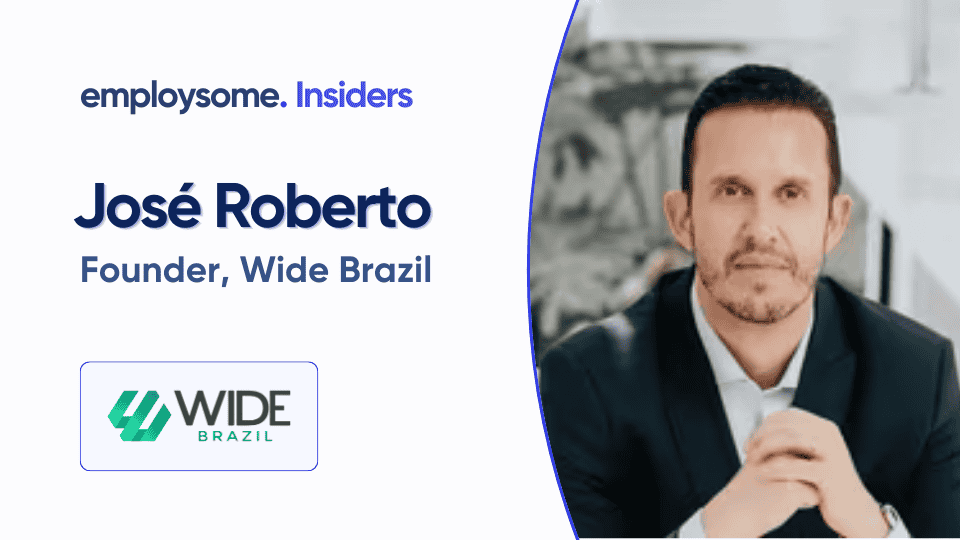
For our very first edition, we spoke with José Roberto Araujo Filho, the founder of Wide Brazil, a locally built, internationally minded Employer of Record (EOR) provider focused entirely on helping foreign companies hire and operate in Brazil.
Wide Brazil supports international companies with EOR, recruitment, payroll outsourcing, and corporate services, all managed directly through their office in Sao Paulo. If you’ve ever considered expanding into Brazil, this conversation is for you.

Why Brazil Needed a Locally Built EOR
Most global EOR providers technically cover Brazil but coverage and depth are two very different things. Many operate through local intermediaries, which adds layers, delays, and communication gaps. José Roberto saw this firsthand before launching Wide Brazil, and it’s what motivated him to build something different.
“When I started Wide Brazil, I noticed that Brazil had a large talent pool and strong economic potential, but the entry barrier for foreign companies was extremely high.
Most international companies didn’t struggle because Brazil lacked opportunity they struggled because they couldn’t easily understand how to operate here.
At the time, many solutions were either very bureaucratic local firms or very large global providers that lacked real local depth. There was a gap for a company that could combine true Brazilian expertise with a service model designed specifically for international clients.
Wide Brazil was built to fill that gap: providing a very transparent, compliant, and practical way for companies to hire and operate in Brazil without unnecessary friction.”
This is a pattern we see across many emerging EOR markets. The global platforms offer breadth, the local specialists offer depth. For a market as complex as Brazil, depth usually wins especially when things go wrong. If you’re evaluating EOR options for Brazil, our comparison tool lets you see exactly which providers operate with their own entity versus through partners.
What Is Wide Brazil?
Brazil is the largest economy in Latin America, with a massive and increasingly global talent pool. Yet for most foreign companies, it remains one of the hardest markets to enter from an employment and compliance perspective. Wide Brazil was built specifically to solve that problem acting as the local infrastructure layer between international companies and the Brazilian labour market.
We asked José to explain what Wide Brazil does and why it exists:
“Wide Brazil is a Brazilian company focused on helping international businesses build teams and operate in Brazil in a compliant and efficient way. We support companies with services such as Employer of Record, recruitment, payroll, and corporate support.
Our focus is very simple: making Brazil easier for foreign companies to navigate. We combine local expertise with a very practical approach, so companies can hire and operate here without needing to immediately establish a legal entity or deal with the complexity of the Brazilian regulatory environment.”
In practice, this means a foreign company can hire a software engineer in São Paulo or a finance analyst in Belo Horizonte without setting up a Brazilian entity, navigating CLT employment contracts, INSS, minimum wage regulations, Decimo Terceiro, or managing the country’s notoriously detailed benefits and tax requirements themselves. Wide Brazil handles all of that as the legal employer on the ground.

Biggest Misconceptions About Hiring in Brazil
If you’ve spent any time researching Brazilian employment law, you’ve probably come away with the impression that it’s a regulatory minefield. And while Brazil’s labour framework is genuinely complex, the CLT alone runs to over 900 articles, the idea that it’s impossible to work within is, according to José Roberto, the single biggest misconception he encounters.
“The biggest misconception is that Brazil is impossible to navigate. Brazil is complex, but it is not unpredictable if you understand the rules and structure things properly from the beginning.
Another misconception is around employment regulations. Many foreign companies assume Brazilian labour laws make hiring inflexible, when in reality there are several compliant ways to structure teams depending on the business model.
The key is local knowledge and compliance discipline. When companies work with partners who understand the system, Brazil becomes far more manageable than many people initially expect.”
The takeaway here is worth underscoring: complexity and impossibility are not the same thing. The companies that succeed in Brazil tend to be the ones that invest in local expertise early whether that’s through an EOR, a local legal advisor, or both rather than trying to apply their home-country playbook to a fundamentally different regulatory environment.
Common Mistakes When Hiring in Brazil
Beyond misconceptions, there are concrete operational mistakes that José Roberto sees international companies make repeatedly. Most of them stem from a single root cause: assuming that what works in Europe or North America will transfer cleanly to Brazil.
“One common mistake is trying to replicate hiring models that work in other countries without adapting them to Brazilian regulations.
Another frequent issue is underestimating the importance of compliance and local payroll structures. Brazil has very specific labour, tax, and benefits requirements, and if these are not handled correctly early on, companies can face unnecessary legal exposure.
We also see companies moving too quickly without understanding the long-term structure they want in the country. Sometimes starting with an EOR model is the most efficient path before establishing a local entity.”
That last point is particularly relevant for scale-ups and mid-market companies exploring Brazil for the first time. The EOR model lets you test the market hire two or three people, validate the talent quality, understand the cost structure before committing to the significant administrative and financial overhead of incorporating locally. It’s the difference between a reversible decision and an irreversible one, and in a market you don’t fully understand yet, reversibility has real value.
How the Brazilian EOR Market Has Changed
The Brazilian employment services market looks fundamentally different than it did five years ago. The shift to remote work, accelerated by the pandemic, changed the calculus for international companies. You no longer need a São Paulo office to access São Paulo talent, and that has made EOR solutions the default entry point for most foreign companies hiring in Brazil for the first time.
“The biggest change has been the acceleration of remote work and global hiring.Five or six years ago, companies entering Brazil were often planning large physical operations. Today, many companies are building distributed teams and hiring talent in multiple countries simultaneously.
This shift has significantly increased the relevance of EOR solutions because companies want speed, flexibility, and compliance without heavy administrative structures.
Another change is the increasing sophistication of clients. Companies today are far more informed about compliance, taxation, and employment structures, which has pushed the industry to become more transparent and professional.”
That growing sophistication is something we’ve observed at Employsome as well. The buyers coming to our platform today aren’t asking “what is an EOR?” — they’re asking “which EOR has its own entity in Brazil, what are the actual monthly costs, and how does the benefits package compare?” The bar has moved, and providers that can’t answer those questions transparently are losing out. It’s a big part of why we built Employsome in the first place.
What Differentiates Wide Brazil From Other EOR Providers
The EOR market in Brazil is getting more competitive. Several global platforms now list Brazil as a covered country, and a handful of local players compete for the same clients. We asked José Roberto what makes Wide Brazil’s approach different.
“Our biggest differentiation is that we are 100% focused on Brazil and built locally, while still operating with an international mindset.
Many global providers operate through intermediaries in Brazil, which often creates additional layers and delays. We operate directly within the country and manage the full process locally.
At the same time, our entire service model was designed for international companies, which means communication, transparency, and responsiveness are core parts of how we work.
We also maintain a very strong focus on compliance and long-term partnerships rather than short-term transactions.”
The own-entity vs. partner model distinction is one of the most important (and least discussed) factors when choosing an EOR. When a provider operates through intermediaries, you’re essentially adding a middleman to every payroll run, every compliance question, and every employee issue. For a straightforward market that might not matter much. For Brazil where employment disputes are common and the regulatory details are dense it can make a meaningful difference in response time and risk management.

Brazil’s Future as a Global Talent Hub
Brazil is already the dominant economy in Latin America, but its role in the global talent market is still evolving. We asked José Roberto where he sees the country heading over the next few years and whether any macro developments could accelerate that trajectory.
“Brazil already represents the largest economy and talent pool in Latin America, and I believe that position will continue to strengthen.
What we are seeing now is increasing interest from international companies looking to diversify their global talent strategy. Brazil offers a combination of high-quality professionals, strong technical education, and a very competitive cost structure compared to many developed markets.
Over the next few years, I expect Brazil to continue becoming an important hub for technology, engineering, and business services supporting global companies.”
One specific catalyst worth watching is the EU–Mercosur trade agreement. If it progresses, it could open a significant new corridor of European investment into Brazil and with it, demand for local employment solutions:
“If the agreement moves forward, it could significantly increase trade and investment between Europe and Mercosur countries, particularly Brazil.
Whenever international investment grows, one of the first operational steps companies need to take is building local teams. Because many companies initially prefer to test markets before establishing a full legal presence, this type of environment tends to increase demand for EOR solutions and flexible employment models.”
Demand for Brazilian Talent: Beyond Tech
There’s a common assumption that hiring in Brazil means hiring developers. And while tech talent is certainly a major draw Brazil produces more computer science graduates annually than most European countries the demand profile is broadening.
“Demand for Brazilian talent has been increasing steadily, particularly in technology and engineering.
Brazil produces a large number of highly qualified professionals every year, and many of them have strong English skills and experience working with international companies.
Beyond tech, we are also seeing growing interest in finance, operations, and back-office functions as companies look to build global teams with strong capabilities and efficient cost structures.
Brazil is becoming a very attractive location for companies building distributed teams.”
This diversification is a sign of market maturity. When companies start hiring operations and finance roles in a new country, not just engineering, it usually means they’ve validated the talent quality and are scaling their commitment. For Brazil, that inflection point appears to be happening right now.
Why EOR Keeps Attracting Founders
We closed our conversation by zooming out. The EOR space has attracted an enormous amount of founder and investor attention over the past five years. We asked José Roberto why he thinks that is.
“The way companies build teams is fundamentally changing.
Businesses are no longer limited by geography when hiring talent, which creates an entirely new layer of complexity around compliance, employment, and payroll.
The EOR space sits right at the intersection of globalization, remote work, and regulatory infrastructure. That combination makes it a very interesting space for founders because it solves a real operational challenge for companies expanding internationally.
At the same time, it is a space where trust and execution matter a lot, which makes long-term relationships very important.”
He’s right that trust is the differentiator in this market. EOR is not a product you evaluate once and forget about, it’s an ongoing relationship where your provider is literally the legal employer of your people. That’s why the comparison process matters so much, and why we believe transparency around pricing, entity ownership, and local capabilities should be the baseline, not the exception.
One Piece of Advice
Every one of our Insiders interview ends with the same question. We asked José Roberto what advice he’d give his younger self.
“I would probably tell myself to focus earlier on building strong partnerships and relationships. In business, opportunities often come through people rather than through strategies or plans.
The other piece of advice would be to stay patient. Building a company takes time, and consistency often matters more than speed.”
This is the first edition of Employsome Insiders. We’ll be publishing new interviews with EOR founders and operators regularly. If you’re building in this space and want to be featured, get in touch.
Want to compare EOR providers for hiring in Brazil or anywhere else? Start comparing on Employsome it’s free.

Written by
Christa is a Copywriter at Employsome with 17 years of professional writing experience across global brands, startups, and online publications. A native English-Finnish writer, she brings strong editorial skills and a versatile background in business, SaaS, and finance. At Employsome, Christa focuses on clear, practical content about HR, payroll, and Employer of Record topics.
Our content is created for informational purposes only and is not intended to provide any legal, tax, accounting, or financial advice. Please obtain separate advice from industry-specific professionals who may better understand your business’s needs. Read our Editorial Guidelines for further information on how our content is created.