Average Salary in Romania: The Complete 2026 Guide
Romania’s average gross salary reached approximately RON 9,500–10,000 per month (~€1,870–1,970) by late 2025, with an average net salary of around RON 5,500–5,700 (~€1,100–1,115). However, averages are heavily skewed by high earners in Bucharest and the IT sector. The median net salary is approximately RON 4,700 (~€940), meaning half of Romanian workers earn below this figure. This guide covers average salaries by sector and region, the gap between gross and net pay, employer costs (including Romania’s uniquely low CAM contribution of 2.25%), the IT sector income tax exemption, salary benchmarks for key roles, and what international companies hiring in Romania need to know about compensation planning.

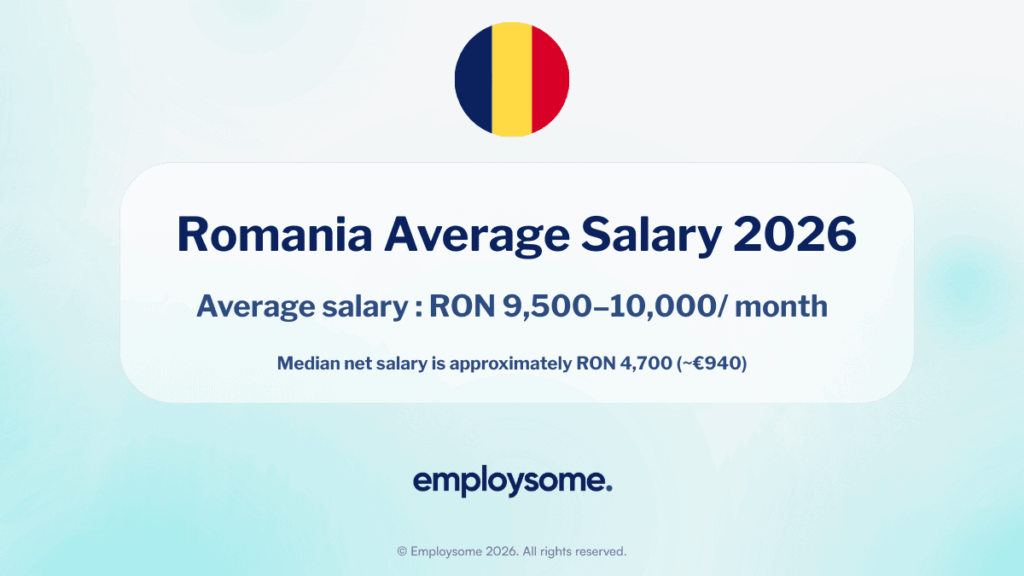
Table of Contents
- Average Salary in Romania: The Numbers
- Average Salary by Sector
- Average Salary by Region
- Understanding Gross to Net: Romania’s Tax Structure
- The IT Sector Income Tax Exemption
- Salary Benchmarks for Key Roles
- Romania vs. Europe: Salary Comparison
- What International Companies Need to Know
- Final Takeaway
Romania is one of Europe’s most attractive markets for hiring skilled professionals, particularly in the technology sector. In the Employsome 2026 Developer Hiring Index, Romania ranked second globally for developer hiring value, reflecting the country’s combination of deep technical talent, EU membership, competitive salary levels, and Europe’s lowest employer payroll burden at just 2.25%. Understanding how salaries are structured across sectors, cities, and seniority levels is essential for international companies looking to build competitive compensation packages that attract top Romanian talent without overpaying relative to the local market.

Average Salary in Romania: The Numbers
Romania’s salary data is published by the National Institute of Statistics (INS/INSSE). The key figures for 2025/2026:
|
Measure |
Amount |
|
Average gross monthly salary |
~RON 9,500–10,000 (~€1,870–1,970) |
|
Average net monthly salary |
~RON 5,500–5,700 (~€1,100–1,115) |
|
Median net monthly salary |
~RON 4,700 (~€940) |
|
Minimum gross monthly salary (2025) |
RON 4,050 (~€815) |
|
Minimum net monthly salary (2025) |
RON 2,574 (~€515) |
The gap between average and median is significant: approximately 15%. This reflects Romania’s pronounced wage inequality, where a small percentage of high earners in IT, finance, and multinational management pull the average upward while the majority of workers earn closer to or below the median. International companies using the average salary as a benchmark for compensation planning risk overpaying for standard roles or underpaying for specialist positions.
💡 Employsome Insight: The Average Salary Is Misleading for Most Roles
Romania’s headline average of ~RON 9,500 gross is heavily inflated by Bucharest and the IT sector. A senior software engineer in Cluj-Napoca can earn RON 18,000–25,000 net, while a retail worker in a rural area earns close to the minimum wage of RON 2,574 net. For compensation planning, international companies should benchmark by sector, city, and seniority level, not against the national average.
Average Salary by Sector
Salaries in Romania vary dramatically by industry. The highest-paying sectors are concentrated in knowledge work, while service and manual labour sectors cluster near the minimum wage.
|
Sector |
Average Net Salary (RON/month) |
|
IT & Telecommunications |
~RON 8,000 (€1,600) |
|
Oil & Gas |
~RON 6,200 (€1,240) |
|
Construction |
~RON 6,000 (€1,200) |
|
Engineering |
~RON 6,000 (€1,200) |
|
Audit & Consulting |
~RON 6,000 (€1,200) |
|
Public Administration |
~RON 7,000 (€1,400) |
|
Education |
~RON 5,500 (€1,100) |
|
Healthcare |
~RON 5,500 (€1,100) |
|
Retail & Hospitality |
~RON 3,500–4,000 (€700–800) |
|
Agriculture |
~RON 3,500 (€700) |
IT salaries increased approximately 15% year-on-year in 2025, driven by continued demand from international companies outsourcing development to Romanian hubs. Senior software engineers and tech leads in Bucharest and Cluj-Napoca command significantly higher salaries than the sector average, with net pay reaching RON 18,000–25,000 (€3,600–5,000) for experienced professionals working on high-demand stacks like cloud infrastructure, machine learning, or cybersecurity.
Average Salary by Region
Romania has significant regional wage disparity. Bucharest and the major tech hubs pay substantially more than rural and post-industrial areas.
|
City / Region |
Average Net Salary (RON/month) |
|
Bucharest |
~RON 5,500 (€1,100) |
|
Cluj-Napoca |
~RON 5,000 (€1,000) |
|
Brașov |
~RON 4,700 (€940) |
|
Timișoara |
~RON 4,600 (€920) |
|
Iași |
~RON 4,400 (€880) |
|
Sibiu |
~RON 4,300 (€860) |
|
Rural / underdeveloped counties (Teleorman, Vaslui, Giurgiu) |
~RON 3,500–4,000 (€700–800) |
Bucharest consistently records the highest average salaries in Romania, driven by the concentration of multinational headquarters, financial services, and IT companies. Cluj-Napoca is Romania’s second-highest paying city and the country’s fastest-growing tech hub, with a strong concentration of software development, shared services, and startup activity. Iași and Timișoara are emerging as competitive alternatives with growing IT sectors and lower living costs.
💡 Employsome Insight: Cluj-Napoca Offers the Best Balance of Talent and Cost
While Bucharest has the highest absolute salaries, Cluj-Napoca offers a strong concentration of IT and engineering talent at salaries approximately 10% lower, with significantly lower office space costs and a vibrant tech ecosystem. For international companies building development teams in Romania, Cluj often provides the best balance of talent availability, salary competitiveness, and operational cost. Iași is increasingly attractive for the same reasons, with salaries approximately 20% below Bucharest levels.
Understanding Gross to Net: Romania’s Tax Structure
Romania’s salary structure involves substantial employee-side deductions that create a large gap between gross and net pay. The employer’s mandatory contribution is unusually low by European standards. The key deductions from gross salary:
|
Contribution |
Rate |
Paid By |
|
Social Insurance (CAS) |
25% |
Employee (deducted from gross) |
|
Health Insurance (CASS) |
10% |
Employee (deducted from gross) |
|
Income Tax |
10% |
Employee (on taxable base after CAS/CASS) |
|
Work Insurance (CAM) |
2.25% |
Employer (on top of gross) |
The effective employee deduction is approximately 41.5% of gross salary (25% CAS + 10% CASS + ~6.5% income tax on the reduced base). This means an employee earning RON 9,500 gross takes home approximately RON 5,560 net. The employer pays only an additional 2.25% CAM on top of gross, making the total employer cost approximately RON 9,714 for a RON 9,500 gross salary.
💡 Employsome Insight: Romania Has the Lowest Employer Payroll Burden in the EU
At just 2.25% CAM under normal working conditions, Romania’s mandatory employer contribution is dramatically lower than almost every other EU country. Compare this to France (~45%), Belgium (~35%), Italy (~30%), Spain (~30–32%), or Germany (~20–21%). For international companies, this means total employer cost in Romania is essentially gross salary plus 2.25%, making salary benchmarking and budgeting straightforward. The trade-off is that employees bear the majority of the social security burden through CAS and CASS deductions, which is why the gross-to-net gap is so large.
The IT Sector Income Tax Exemption
Romania has historically offered an income tax exemption for qualifying IT employees, which eliminated the 10% income tax on their salary, significantly boosting net pay. However, this exemption was substantially modified starting 1 January 2025. Key changes:
- The full income tax exemption for IT employees was reduced or restructured as part of broader fiscal consolidation measures
- The construction sector and agri-food sector tax exemptions were also modified
- Companies hiring IT talent in Romania should verify the current status of the exemption with a Romanian tax advisor, as the regulatory landscape has shifted
Even with the reduced exemption, Romania remains highly competitive for IT hiring costs compared to Western Europe. The combination of lower gross salary levels and the 2.25% employer CAM means total employer cost for a senior developer in Romania is typically 40–50% below equivalent roles in Germany, France, or the UK.
Salary Benchmarks for Key Roles
Indicative monthly salary ranges for roles commonly hired through EOR arrangements in Romania (2026 estimates for major cities):
|
Role |
Gross Monthly (RON) |
Total Employer Cost (RON) |
|
Software Engineer (mid-level) |
12,000–16,000 |
12,270–16,360 |
|
Software Engineer (senior) |
18,000–28,000 |
18,405–28,630 |
|
Marketing Specialist |
7,000–10,000 |
7,158–10,225 |
|
Customer Support (multilingual) |
5,000–7,000 |
5,113–7,158 |
|
HR Manager |
12,000–16,000 |
12,270–16,360 |
|
Finance / Accounting Manager |
14,000–20,000 |
14,315–20,450 |
|
Project Manager |
10,000–15,000 |
10,225–15,338 |
Total employer cost is gross salary plus CAM at 2.25%. Additional costs may include meal vouchers (tichete de masă, typically RON 40–45 per working day), private health insurance, and other benefits that are increasingly necessary to attract talent in competitive sectors.
Romania vs. Europe: Salary Comparison
How does Romania compare to other European hiring destinations?
|
Country |
Avg. Net Monthly |
Employer Burden |
Senior Dev Total Cost |
|
Romania |
~€1,100 |
2.25% CAM |
~€3,800–5,800 |
|
Poland |
~€1,350 |
~20% |
~€5,000–7,500 |
|
Bulgaria |
~€950 |
~18–19% |
~€3,200–5,000 |
|
Portugal |
~€1,200 |
~23.75% |
~€4,500–7,000 |
|
Spain |
~€1,800 |
~30–32% |
~€6,000–9,000 |
|
Germany |
~€2,700 |
~20–21% |
~€8,000–12,000 |
Romania’s combination of moderate salary levels and Europe’s lowest employer payroll burden makes it one of the most cost-effective EU hiring destinations, particularly for IT and engineering roles. A senior software engineer in Romania costs approximately 40–50% less than the equivalent role in Germany and 30–40% less than in Spain, while Romanian developers are consistently rated among the strongest in Eastern Europe for technical skills.
💡 Employsome Insight: Romania Is One of the Most Cost-Effective EU Hiring Markets
The 2.25% employer CAM is Romania’s most underappreciated advantage. In most EU countries, employers budget 20–35% above gross salary for mandatory social contributions. In Romania, the overhead is just 2.25%. This means international companies can offer competitive gross salaries to attract top talent while keeping total employer cost dramatically below Western European levels. Combined with EU membership, a 250,000+ tech talent pool, strong English proficiency, and full GDPR compliance, Romania offers an exceptional value proposition for building distributed teams in Europe.
What International Companies Need to Know
For companies based outside Romania that want to hire Romanian employees, several practical considerations apply:
- Salaries are paid in Romanian Leu (RON). The Employment Act requires payment in local currency, typically via bank transfer. Employers must pay wages no later than the date agreed in the employment contract, typically by the last working day of the month or by the 15th of the following month.
- The gross-to-net gap is approximately 41.5%. When benchmarking Romanian salaries against other countries, always compare net figures. A RON 9,500 gross salary delivers approximately RON 5,560 net. International companies accustomed to countries with lower employee deductions should adjust their offer strategy accordingly.
- Meal vouchers (tichete de masă) are a standard benefit. Most competitive employers in Romania provide meal vouchers worth RON 40–45 per working day. These are tax-advantaged for both employer and employee and have become a baseline expectation in the labour market, particularly for office-based and IT roles.
- The IT tax exemption has changed. Companies planning to hire IT professionals in Romania should consult a Romanian tax advisor to confirm the current status and eligibility criteria of the income tax exemption, which was restructured in January 2025.
- Minimum wage is RON 4,050 gross (2025). This is the floor for all employment contracts. Romania’s minimum wage has increased significantly in recent years and is reviewed annually.
- Using an Employer of Record (EOR) is the most practical route for international companies without a Romanian entity. An EOR becomes the legal employer, handles REVISAL registration, ANAF filings, CAM contributions, payroll processing, and employment contract compliance. For a full breakdown of hiring requirements and EOR options, see our Best Employer of Record in Romania guide.
Final Takeaway: Average Salary in Romania 2026
Romania’s average gross salary of approximately RON 9,500–10,000 per month (~€1,870–1,970) places it in the mid-range for Eastern Europe but well below Western European levels. The median net salary of ~RON 4,700 (~€940) is a more realistic benchmark for most workers. The IT sector leads at ~RON 8,000 net, with senior developers earning two to three times the national average.
For international employers, Romania’s most significant advantage is the 2.25% employer CAM contribution, the lowest in the EU. Total employer cost is essentially gross salary plus 2.25%, making Romania one of the most predictable and cost-effective EU hiring markets. Combined with a 250,000+ tech talent pool, EU membership, strong digital infrastructure, and competitive salary levels, Romania offers an exceptional value proposition for companies building European teams.
Private sector wages are expected to grow by approximately 6% in 2026, though real purchasing power has been eroded by inflation running above 5%. Companies hiring in Romania should benchmark salaries by sector, city, and seniority rather than relying on national averages, and should factor in meal vouchers and private health insurance as standard competitive benefits.
For EOR provider comparisons in Romania, see our Best Employer of Record in Romania guide.

Written by
Dane Cobain is a Copywriter at Employsome and an accomplished author whose work spans fiction, non-fiction, and professional writing. Over the past decade, he has built a strong track record creating straightforward content for the HR, payroll, and corporate sectors. Dane brings a storyteller’s eye to the evolving world of global employment, with a particular focus on Employer of Record and PEO models. His articles explore industry trends and dedicated Best Of Guides when managing an international workforce.
Our content is created for informational purposes only and is not intended to provide any legal, tax, accounting, or financial advice. Please obtain separate advice from industry-specific professionals who may better understand your business’s needs. Read our Editorial Guidelines for further information on how our content is created.
Other posts
Review other blog posts