Minimum Wage in the UK: The Complete 2026 Guide
This guide breaks down the United Kingdom’s minimum wage system for 2026, covering the current statutory hourly rates by age band, the distinction between the National Living Wage and the National Minimum Wage, employer National Insurance obligations, compliance requirements under UK employment law, penalties for underpayment, and how minimum wage compares to living costs across major UK cities.

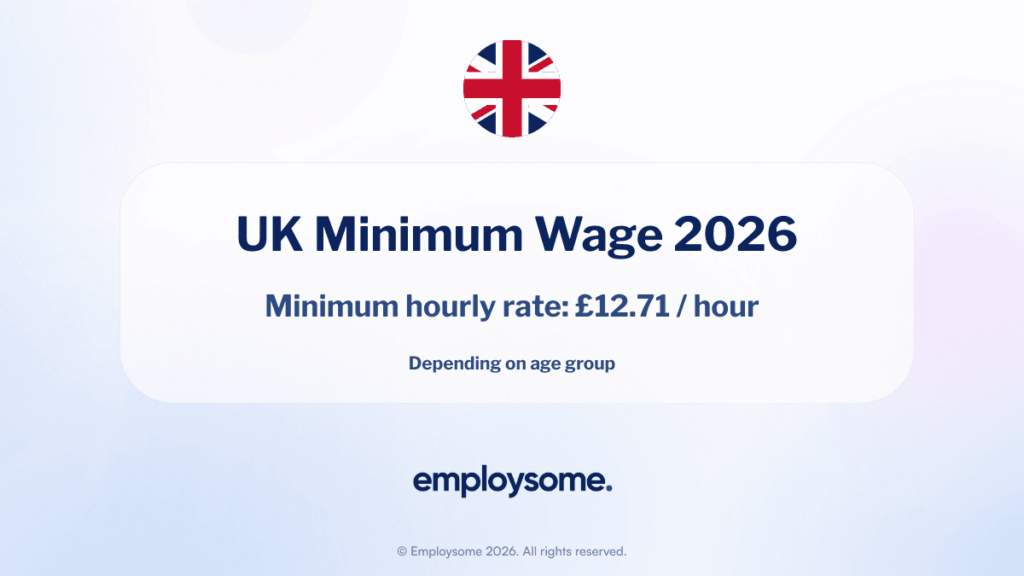
Table of Contents
- How Minimum Wage in the UK Is Regulated
- National Living Wage vs. National Minimum Wage vs. Real Living Wage
- How Minimum Wage in the UK Is Calculated
- Employer National Insurance Contributions
- Legal Framework Governing Minimum Wage in the UK
- Employer Obligations Under UK Law
- Penalties for Violating Minimum Wage in the UK
- Minimum Wage UK vs. Cost of Living
- Minimum Wage UK 2026–2027 Outlook
- Final Takeaway

How Minimum Wage in the UK Is Regulated
The UK’s minimum wage framework is governed by the National Minimum Wage Act 1998, which established a legal floor for hourly pay across the country. The system is reviewed annually by the Low Pay Commission (LPC), an independent advisory body made up of employer representatives, trade union members, and academic experts.
The Low Pay Commission evaluates:
- Median earnings trends and the two-thirds of median earnings target
- Inflation and broader cost of living pressures
- Labour market conditions, including employment levels and vacancies
- The impact on businesses, particularly smaller employers and sectors with high minimum wage coverage
Based on its assessment, the LPC issues formal recommendations to the Government, which then implements the updated rates through statutory regulation. Rates typically take effect on 1 April each year.
Enforcement of minimum wage law is handled by HM Revenue and Customs (HMRC), which investigates complaints, conducts targeted payroll audits, and pursues employers found to have underpaid workers. From April 2026, the newly established Fair Work Agency (FWA) will begin bringing together enforcement of minimum wage, holiday pay, and statutory sick pay under a single body.
The statutory minimum wage applies to almost all workers in the UK, including part-time workers, agency workers, and those on zero-hours contracts. Limited exceptions exist for certain categories, such as volunteers, members of the armed forces, and some apprentices under specific conditions.
UK Minimum Wage 2026: Current Rates
From 1 April 2026, the UK Government has confirmed the following statutory minimum wage rates, accepting in full the recommendations of the Low Pay Commission:
|
Age Band / Category |
April 2025 Rate |
April 2026 Rate |
|
National Living Wage (21 and over) |
£12.21 |
£12.71 |
|
18–20 year olds |
£10.00 |
£10.85 |
|
16–17 year olds |
£7.55 |
£8.00 |
|
Apprentice rate |
£7.55 |
£8.00 |
|
Accommodation offset (daily) |
£10.66 |
£11.10 |
The National Living Wage increase to £12.71 per hour represents a 4.1% rise, following a 6.7% increase in April 2025. The 18-20 rate sees an 8.5% increase, continuing the Government’s stated aim of gradually abolishing age-based rate bands so that a single adult rate eventually applies to all workers aged 18 and over.
The UK does not set a statutory monthly minimum wage. Instead, pay is calculated based on hourly compensation and contracted working hours. For reference:
- 40-hour week: approximately £2,213 gross per month
- 37.5-hour week: approximately £2,075 gross per month
Actual monthly pay depends on contractual working hours and the employer’s payroll structure.
💡 Employsome Insight: The UK’s Minimum Wage Is No Longer “Low Cost”
The UK was historically positioned as a flexible, moderate-cost labour market within Europe. That positioning is changing. With the National Living Wage now anchored to two-thirds of median earnings and employer National Insurance increased to 15%, minimum wage employment in the UK is structurally more expensive than many assume. For labour-intensive sectors such as hospitality, retail, and logistics, the combined impact of wage growth and NIC reform means total employment costs have risen materially faster than inflation.
National Living Wage vs. National Minimum Wage vs. Real Living Wage
The terminology around UK minimum pay rates can be confusing. Here is how the three key rates differ:
National Living Wage (NLW): The statutory minimum hourly rate for workers aged 21 and over. Set by the Government. Legally enforceable. From April 2026: £12.71 per hour.
National Minimum Wage (NMW): The statutory minimum hourly rate for workers under 21 and apprentices. Set by the Government. Legally enforceable. Rates vary by age band (see table above).
Real Living Wage: A voluntary rate calculated independently by the Living Wage Foundation based on the actual cost of essentials such as rent, food, transport, and energy. It is not a legal requirement. From May 2026, the Real Living Wage is set at £13.45 per hour (UK-wide) and £14.80 per hour in London. Over 16,000 UK employers voluntarily pay the Real Living Wage.
The Real Living Wage is currently 5.8% higher than the National Living Wage for workers outside London, and 16.4% higher for London-based workers. This gap highlights the extent to which statutory rates fall short of what the Living Wage Foundation considers necessary to meet basic living costs, particularly in the capital.
How Minimum Wage in the UK Is Calculated
The statutory minimum wage applies to base hourly compensation. Compliance is assessed by calculating the effective hourly rate: total base pay divided by total hours worked within a given pay reference period.
Employers must maintain accurate working time records because underpayment often arises from incorrect time tracking or misclassification of working time rather than from deliberately setting wages below the legal rate.
Key calculation principles:
- Overtime premiums, tips, gratuities, and service charges cannot be counted toward minimum wage compliance
- Deductions for uniforms, tools, or equipment required for the job can reduce effective hourly pay below the minimum wage, creating a compliance breach
- The accommodation offset (£11.10 per day from April 2026) is the only benefit-in-kind that can count toward minimum wage pay
- Salary sacrifice arrangements can reduce an employee’s cash pay below the minimum wage threshold, which is a common cause of inadvertent non-compliance
HMRC assesses compliance on a pay reference period basis, which is typically monthly or weekly depending on the employer’s payroll cycle. A worker must be paid at least the minimum wage in every single pay reference period – not just on average across the year.
💡 Employsome Insight: The Hidden Risk Is Not the Rate; It’s Payroll Structure
Most UK minimum wage breaches are not caused by deliberately setting pay below £12.71. They arise from payroll mechanics: unpaid working time, uniform deductions, salary sacrifice pension schemes, or accommodation offset miscalculations. Because arrears are calculated at current rates rather than historic ones, even minor technical breaches can compound quickly. Employers expanding into the UK should treat time-tracking accuracy as a compliance priority equal to wage level itself.
Employer National Insurance Contributions (NIC)
Beyond minimum wage, employers must budget for mandatory National Insurance contributions (NICs), which significantly increase the true cost of employment.
For the 2025/26 tax year (6 April 2025 to 5 April 2026) and continuing into 2026/27, the key employer NIC rates are:
- Employer Class 1 NIC rate: 15% on employee earnings above the secondary threshold
- Secondary threshold: £5,000 per year (£417 per month)
- Employment Allowance: Up to £10,500 per year, available to most eligible employers to reduce their NIC liability
- Class 1A NIC rate: 15% on benefits in kind (company cars, private health insurance, etc.)
The employer NIC rate was increased from 13.8% to 15% in April 2025, while the secondary threshold was reduced from £9,100 to £5,000 per year. This structural change significantly increased the cost of employment, particularly for businesses with large workforces or many part-time employees.
In addition to NICs, employers must also account for automatic enrolment pension contributions (minimum 3% of qualifying earnings) and the Apprenticeship Levy (0.5% of pay bill for employers with annual pay bills exceeding £3 million). Overall employment costs in the UK typically run 15–20% or more above base salary when all employer-side contributions are included.
💡 Employsome Insight: The 15% Employer NIC Shift Changed the Cost Model
The increase in employer National Insurance from 13.8% to 15%, combined with the reduction of the secondary threshold to £5,000 per year, significantly increased the marginal cost of lower-paid roles. For full-time minimum wage workers, total employer cost now typically exceeds base salary by 18–22% once NICs and pension contributions are included. When modelling UK hiring costs, base wage is only part of the equation.
Legal Framework Governing Minimum Wage in the UK
The principal legislation governing UK minimum wage includes:
- National Minimum Wage Act 1998: Establishes the right to be paid a minimum amount for work performed and defines enforcement mechanisms.
- National Minimum Wage Regulations 2015: Sets out detailed rules for calculating the minimum wage, including how working time is defined and what payments count toward compliance.
- Employment Rights Act 1996 (as amended): Provides protections against detrimental treatment or dismissal for asserting minimum wage rights.
- Employment Rights Bill 2025: Introduces additional reforms including the creation of the Fair Work Agency and expanded enforcement powers.
Minimum wage protections cannot be waived by contract. If an employment agreement specifies pay below the statutory minimum, the legal rate prevails automatically. Workers cannot “opt out” of minimum wage protection, even voluntarily.
Employer Obligations Under UK Law
To remain compliant with UK minimum wage rules, employers must:
- Pay at least the correct minimum wage rate for each worker’s age band or apprentice status, effective from the first pay period on or after 1 April 2026
- Record working hours accurately and retain records for at least six years to demonstrate compliance
- Update payroll systems promptly when annual rate changes take effect and when workers move into a higher age band (e.g., turning 18 or 21)
- Ensure deductions do not reduce pay below the minimum wage: Deductions for uniforms, tools, or accommodation beyond the offset limit can create underpayment
- Issue written employment contracts (or written statements of particulars) that clearly define compensation, working hours, and pay frequency
- Apply the correct rate from the correct date: Arrears are calculated at the current rate, not the rate that applied when the underpayment occurred, which can substantially increase employer liability for historic errors
For companies hiring through an Employer of Record in the UK, these compliance obligations sit with the EOR as the legal employer, including payroll accuracy, statutory rate updates, record retention, and HMRC reporting. However, the commercial risk ultimately remains with the end client, making provider selection and oversight critical. For a detailed breakdown, see our Employer of Record UK guide.
Penalties for Violating Minimum Wage in the UK
Minimum wage enforcement in the UK is among the most active in Europe. HMRC investigates suspected breaches through both complaint-led cases and targeted enforcement campaigns.
If an employer is found to have underpaid workers, the consequences include:
- Arrears at current rates: Back pay must be calculated using the minimum wage rate in force when the payment is made, not the rate when the underpayment occurred. A small error from 2020 could be repaid at the 2026 rate, which is approximately 46% higher.
- Financial penalties of up to 200% of arrears: The penalty is capped at £20,000 per worker and is separate from the obligation to repay arrears.
- Public naming: The Government routinely publishes the names of non-compliant employers. As of October 2025, approximately 4,200 employers had been named publicly, covering over 560,000 affected workers and more than £55 million in arrears.
- Criminal prosecution: In the most serious cases involving deliberate refusal to comply, obstruction, or falsification of records, employers may face criminal charges. Custodial sentences of up to two years are possible for certain labour market offences.
HMRC can pursue underpayments for a period of up to six years for both current and former workers. In the 2024/25 enforcement year, HMRC issued 750 penalties totalling £4.2 million and returned approximately £5.8 million in arrears to over 25,000 workers.
💡 Employsome Insight: Enforcement Is Becoming More Centralised
The launch of the Fair Work Agency marks a structural shift toward consolidated labour market enforcement. By unifying minimum wage, holiday pay, and sick pay enforcement under one body, the UK is signalling stronger regulatory coordination. For employers, this reduces the likelihood that compliance gaps go unnoticed. Audit readiness and payroll documentation will become increasingly important from 2026 onward.
Minimum Wage UK vs. Cost of Living
The UK applies a single nationwide minimum wage with no regional variation. However, the real purchasing power of minimum wage earnings varies significantly depending on where you live, primarily driven by differences in housing costs.
For a full-time worker on the National Living Wage (£12.71 per hour, 40-hour week), gross monthly pay is approximately £2,213. After income tax and employee National Insurance deductions, net take-home pay typically falls between:
£1,850–£1,950 per month (single employee, Tax Code 1257L, standard deductions)
The variation depends primarily on tax code, student loan deductions, and pension contributions rather than geographic location. However, the real difference in purchasing power comes from the cost of living; particularly rent.
|
City |
Region |
Est. Net Pay |
Avg. 1-BR Rent |
Rent ÷ Income |
|
London |
Greater London |
~£1,900 |
~£1,600 |
~84% |
|
Bristol |
South West |
~£1,880 |
~£1,100 |
~59% |
|
Edinburgh |
Scotland |
~£1,870 |
~£1,000 |
~53% |
|
Manchester |
North West |
~£1,880 |
~£900 |
~48% |
|
Birmingham |
West Midlands |
~£1,870 |
~£850 |
~45% |
|
Leeds |
Yorkshire |
~£1,870 |
~£800 |
~43% |
|
Glasgow |
Scotland |
~£1,870 |
~£750 |
~40% |
|
Sheffield |
Yorkshire |
~£1,870 |
~£750 |
~40% |
|
Hull |
Yorkshire |
~£1,860 |
~£550 |
~30% |
In London, a full-time minimum wage worker would spend approximately 84% of their net income on a one-bedroom flat alone, leaving virtually nothing for other essentials. By contrast, in northern cities such as Hull, Glasgow, or Sheffield, the same statutory wage goes considerably further, with rent-to-income ratios of 30–40%.
This highlights a key structural feature of the UK minimum wage system: while the statutory wage floor is uniform across the country, real purchasing power varies dramatically depending on region and local housing market conditions. The absence of any regional weighting or London supplement in the statutory rate is a frequent point of policy debate.
By comparison, the United Kingdom’s nationally uniform minimum wage structure contrasts with both Germany and France, although all three countries now operate centralised statutory wage floors. In 2026, Germany’s federal minimum wage stands at €13.90 per hour, significantly above the UK’s £12.71 rate on a pure currency basis, while France’s SMIC is set at €12.02 per hour. However, direct wage comparisons can be misleading. Germany and France both operate higher employer social contribution systems, meaning total employment cost as a percentage above base wage is typically higher than in the UK. At the same time, housing pressure in London remains materially more extreme than in Berlin or Paris at the minimum wage level. The UK therefore combines relatively high statutory hourly pay with unusually sharp regional housing disparities, creating a purchasing power gap that is structurally wider than in many comparable European economies.
💡 Employsome Insight: National Wage, Regional Reality
The UK’s single nationwide minimum wage masks significant regional cost differences. In London, statutory minimum pay is economically unsustainable without shared housing or supplemental income. In northern England, Scotland, and Wales, the same statutory wage supports a materially higher standard of living. For employers choosing where to base UK operations, regional wage uniformity combined with uneven housing costs creates strategic arbitrage opportunities.
Minimum Wage UK 2026–2027 Outlook
The UK minimum wage has followed a pattern of steady, significant increases in recent years. The National Living Wage has risen from £11.44 in April 2024 to £12.21 in April 2025 and £12.71 in April 2026 – a compound increase of approximately 11% over two years.
Looking ahead, several policy developments will shape minimum wage rates in 2027 and beyond:
- Two-thirds of median earnings target: The Government’s remit to the LPC states that the National Living Wage should not fall below two-thirds of median hourly earnings. This anchoring mechanism ensures steady upward pressure on the rate.
- Age band convergence: The Government has signalled its intention to lower the NLW age threshold to 20 from 2027, and potentially to 18 in later years, subject to economic conditions. This would bring millions of younger workers onto the top statutory rate.
- Fair Work Agency: The FWA will begin operations from April 2026, consolidating enforcement of minimum wage, holiday pay, and statutory sick pay. More rigorous and coordinated enforcement is expected.
For businesses operating in the UK, closely monitoring official LPC recommendations and Government announcements remains essential. Payroll systems must be updated promptly when rate adjustments take effect, as failure to apply the correct statutory rate from the correct date can create significant compliance exposure; particularly given that arrears are calculated at current rates, not historic ones.
Final Takeaway – Minimum Wage Compliance in the UK
The UK minimum wage operates under a nationally uniform statutory framework with robust enforcement mechanisms and clearly defined legal obligations. The National Living Wage and National Minimum Wage apply across England, Scotland, Wales, and Northern Ireland and cover nearly all workers, making compliance a core payroll responsibility for every employer operating in the UK.
To remain compliant in 2026 and beyond, employers must ensure that hourly pay meets or exceeds the correct statutory rate for each worker’s age band from 1 April 2026. Working time must be recorded accurately and retained for at least six years. Deductions, salary sacrifice arrangements, and accommodation offsets must be carefully managed to avoid inadvertently reducing effective hourly pay below the legal floor.
Enforcement is active and financially consequential. HMRC and the incoming Fair Work Agency conduct payroll audits, investigate complaints, and pursue back-payment claims spanning up to six years. Non-compliance can result in arrears at current rates, penalties of up to 200% of underpayments, public naming, and in serious cases criminal prosecution. For international companies hiring in the UK, minimum wage compliance should be treated as a core element of employment risk management – not an administrative detail. Proper wage compliance forms the foundation of lawful hiring, payroll stability, and long-term operational security in the UK market.

Written by
Dane Cobain is a Copywriter at Employsome and an accomplished author whose work spans fiction, non-fiction, and professional writing. Over the past decade, he has built a strong track record creating straightforward content for the HR, payroll, and corporate sectors. Dane brings a storyteller’s eye to the evolving world of global employment, with a particular focus on Employer of Record and PEO models. His articles explore industry trends and dedicated Best Of Guides when managing an international workforce.
Our content is created for informational purposes only and is not intended to provide any legal, tax, accounting, or financial advice. Please obtain separate advice from industry-specific professionals who may better understand your business’s needs. Read our Editorial Guidelines for further information on how our content is created.
Other posts
Along with our standard maps we offer highly customizable maps.