Minimum Wage in France: The Complete 2026 Guide
This guide breaks down France’s minimum wage system for 2026, covering the current statutory hourly rate (SMIC), collective bargaining agreements, employer social security obligations, compliance requirements under the French Labour Code, penalties for underpayment, and how minimum wage compares to living costs across major French cities.

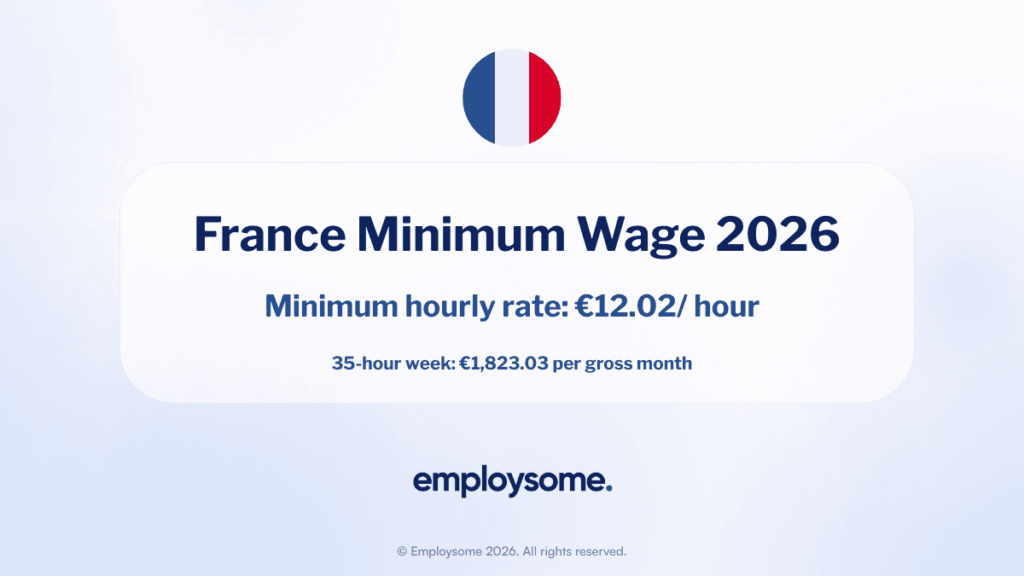
Table of Contents
- Minimum Wage Regulations
- France Minimum Wage 2026: Current Rate
- Sector-Specific Minimum Wages
- Minimum Wage Calculations
- Employer Social Security Contributions in France
- Legal Framework of Minimum Wage
- Employer Obligations Under French Law
- Penalties for Violating Minimum Wage
- Minimum Wage France vs. Cost of Living
- 2026-2027 Outlook
- Final Takeaway
France operates under a nationwide statutory minimum wage known as the SMIC (Salaire Minimum Interprofessionnel de Croissance). Unlike systems where minimum wages vary by region, France applies a single national hourly minimum wage across all of metropolitan France and its overseas departments.
As of 2026, the minimum wage in France is set nationally and applies to nearly all employees (including those hired through an Employer of Record in France), regardless of region. Understanding SMIC rules is essential for compliant hiring, payroll planning, and labour cost forecasting.


How Minimum Wage in France Is Regulated
France’s minimum wage is governed by the Labour Code (Code du Travail), which establishes a single nationwide statutory hourly wage applicable across all regions.
The rate is reviewed annually by the government, informed by two key mechanisms:
- An independent Expert Group (Groupe d’experts sur le SMIC), which evaluates economic data and issues formal recommendations to the government.
- Consultation with the National Commission for Collective Bargaining, Employment and Vocational Training (Commission nationale de la négociation collective, de l’emploi et de la formation professionnelle, or CNNCEFP), a tripartite body composed of employer organisations, trade unions, and government representatives.
The annual review evaluates:
- Consumer price inflation for the lowest 20% of households by income
- Growth in purchasing power of hourly wages for blue-collar and white-collar workers (ouvriers et employés)
- Broader economic performance and labour market conditions
Based on these factors, the government implements the updated rate by decree (décret), typically effective January 1 each year. In addition to the annual adjustment, the SMIC is automatically increased during the year if consumer prices rise by at least 2% compared to the index recorded when the last rate was set.
Official information on France’s minimum wage framework is published by the Ministry of Labour (Ministère du Travail):
Enforcement is overseen by labour inspectors (inspecteurs du travail), who conduct workplace audits, review payroll records, and investigate underpayment complaints. The URSSAF (Unions de Recouvrement des Cotisations de Sécurité Sociale et d’Allocations Familiales) also plays a role in monitoring employer compliance through social security contribution audits.
The statutory minimum wage applies to most employees working in France, including part-time workers, temporary agency staff, and employees on fixed-term contracts (CDD), subject to limited legal exceptions for apprentices and employees under the age of 18.
Employers must ensure that the legally mandated hourly rate is respected in practice, supported by accurate payroll documentation and, where applicable, working time records.
🇩🇪 / 🇫🇷 France vs. Germany: How Minimum Wage Regulation Differs
Both countries apply a single national minimum wage, but the mechanisms differ. Germany’s Minimum Wage Commission reviews the rate every two years and pre-announces increases (€14.60 confirmed for January 2027). France reviews annually, with no pre-commitment to future rates, and includes an automatic mid-year trigger if inflation exceeds 2%. France also allows the government to apply a discretionary bonus increase (coup de pouce) above the formula, a mechanism that does not exist in German law.
France Minimum Wage 2026: Current Rate
As of January 1, 2026, France’s statutory minimum wage (SMIC) is:
€12.02 per hour (gross)
This represents a 1.18% increase from the previous €11.88 rate, which had been in effect since November 1, 2024. The adjustment was confirmed by decree published on December 18, 2025, and applies nationwide across metropolitan France and overseas departments.
The gross monthly SMIC for a standard 35-hour workweek is:
€1,823.03 per month (gross)
For reference:
- 35-hour week = €1,823.03 gross per month
- 39-hour week (with overtime premium) ≈ €2,059 gross per month
(Actual monthly pay depends on contractual working hours, overtime arrangements, and payroll structure.)
The minimum wage applies to full-time, part-time, and most temporary employees working in France. In Mayotte, a separate minimum wage applies, set at 87.5% of the metropolitan net SMIC as of January 1, 2026, with a gross hourly rate of €9.33.
Note: France sets its standard legal workweek at 35 hours, significantly shorter than the 40-hour standard in Germany and many other EU countries. Hours worked beyond 35 per week are classified as overtime and must be compensated at increased rates (typically 25% for hours 36 to 43, and 50% beyond 43 hours), unless a collective bargaining agreement specifies different arrangements.
📌 Employsome Summary: France SMIC 2026
Gross hourly rate: €12.02
Gross monthly (35 hrs/week): €1,823.03
Net monthly (approx., single): €1,400 to €1,480
Legal workweek: 35 hours
Overtime premium: 25% (hours 36-43), 50% (44+)
Effective date: January 1, 2026
Year-on-year increase: +1.18%
Sector-Specific Minimum Wages
In addition to the statutory minimum wage (€12.02 per hour as of January 1, 2026), certain industries in France have higher sector-specific minimum wages negotiated through collective bargaining agreements (conventions collectives) and extended by ministerial decree to become generally binding across the sector.
Where a sector-specific minimum wage exceeds the SMIC, employers must apply the higher amount. If a sector rate falls below €12.02, the statutory minimum wage prevails automatically. The government has introduced reforms in the Social Security Financing Act for 2026 to encourage industries to raise their collectively agreed minimum rates above the SMIC.
Below are representative 2026 sector minimum wage arrangements (subject to periodic updates through collective bargaining):
|
Sector |
Minimum Hourly Wage (2026) |
Notes |
|
Hospitality and Hotels (HCR) |
~€12.26+ |
Convention collective HCR; higher rates for skilled positions |
|
Banking and Financial Services |
Above SMIC |
Typically well above statutory minimum; varies by grade |
|
Construction (Bâtiment) |
~€12.50+ |
Regional and qualification-level variations apply |
|
Metalworking (Métallurgie) |
~€12.10+ |
New unified convention collective effective since 2024 |
|
Retail (Commerce de détail) |
€12.02 (statutory floor applies) |
Some agreements match SMIC; others set marginal premiums |
|
Cleaning Services (Propreté) |
~€12.17+ |
Progressive increases negotiated by sector |
Because the SMIC increased to €12.02 in 2026, any collectively agreed sector wage below this threshold must be adjusted upward to meet the statutory requirement. Employers hiring in regulated industries should verify both the SMIC and any binding collective agreements to ensure full compliance.
💡 Employsome Insight: France has over 700 active collective bargaining agreements (conventions collectives), and identifying the correct one for your industry is not optional. The applicable convention collective is determined by your company’s principal business activity, not the employee’s job title. Misclassifying the applicable agreement is one of the most common compliance errors for international companies hiring in France, particularly when using an Employer of Record. Always confirm the convention collective code (IDCC) before onboarding.
How Minimum Wage in France Is Calculated
The statutory minimum wage (SMIC) applies strictly to base hourly compensation. As of January 1, 2026, employers must ensure that the average hourly wage paid to an employee does not fall below €12.02 per hour.
Compliance is assessed based on the effective hourly rate derived from total base pay divided by actual hours worked. While France does not impose the same universal time-tracking obligation as Germany’s MiLoG, employers are required to maintain records of working hours for employees not subject to a fixed annual working-day arrangement (forfait jours). In practice, payroll documentation must demonstrate that the SMIC is respected in every pay period.
Minimum wage requirements apply independently of additional payments. Overtime compensation, holiday bonuses (prime de vacances), year-end bonuses (13th month), and profit-sharing payments (intéressement, participation) are treated separately and do not count toward satisfying SMIC obligations. Supplementary payments cannot be used to offset or reduce compliance with the statutory minimum wage.
Overtime premiums are governed by statute and collective bargaining agreements. The Labour Code sets the default overtime rate at 125% for hours 36 to 43 and 150% beyond 43 hours per week. Collective agreements can modify the overtime premium, but it cannot fall below 110% of the standard hourly rate.
To avoid compliance risk, employers must implement transparent payroll systems that clearly separate base compensation from supplementary payments, ensuring that the SMIC is met before any additional elements are applied.
Employer Social Security Contributions in France
Beyond minimum wage, employers must budget for mandatory social security contributions, which represent a significant addition to total employment costs in France.
Employer contributions typically range between 40% and 45% of gross salary, making France one of the highest employer-cost environments in the EU. These contributions fund:
- Health, maternity, disability, and death insurance (Assurance maladie): 7% to 13% depending on salary level
- Old-age pension insurance (Assurance vieillesse): approximately 8.55% (capped) plus 1.9% (uncapped)
- Family allowance contributions (Allocations familiales): 3.45% to 5.25% depending on salary level
- Unemployment insurance (Assurance chômage): 4.05% (employer only since 2018; no employee contribution)
- Supplementary pension (AGIRC-ARRCO): approximately 7.87% to 12.95% depending on salary bracket
- Workplace accident and occupational disease insurance (AT/MP): variable by industry risk profile, typically 1% to 3%
- Mandatory complementary health insurance (mutuelle): employer covers at least 50% of the premium
- Mandatory provident insurance (prévoyance): required for managerial employees; may be extended to all staff under collective agreements
The monthly social security ceiling (plafond de la sécurité sociale) increased to €4,005 per month (€48,060 per year) as of January 1, 2026. Several contribution rates are assessed against this ceiling.
2026 Reform Note: The Social Security Financing Act for 2026 introduced several changes affecting employer costs, including an increase in the employer contribution on mutually agreed terminations (rupture conventionnelle) and employer-initiated retirements from 30% to 40%, as well as stricter penalties for undeclared work.
Overall employment costs in France are significantly higher than base salary alone. Employers should expect total labour costs to reach approximately 140% to 145% of the employee’s gross salary when all mandatory contributions are included.
💡 Employsome Insight: France vs. Other Employer Social Costs
France has one of the highest employer social security burdens in the OECD, with contributions typically 40%–45% of gross salary. By comparison, employers pay around 19%–22% in Germany, 13.8% in the UK (above threshold), and 7.65% in the US (FICA only).
When hiring in France, companies should budget total employment cost at roughly 1.4x to 1.45x gross salary to avoid underestimating labour expenses.
Legal Framework Governing Minimum Wage in France
The legal basis for minimum wage in France includes:
- Labour Code (Code du Travail) – Articles L3231-1 to L3231-12 define the SMIC, its calculation methodology, and adjustment mechanisms
- Annual government decrees – Implementing updated SMIC rates (most recently Décret n°2025-951)
- Collective bargaining agreements (Conventions collectives) – Sector-specific agreements that may set higher minimum pay scales
- Social Security Code (Code de la sécurité sociale) – Governing employer and employee contribution obligations
Minimum wage protections cannot be waived by contract. If an employment agreement specifies pay below the statutory minimum, the SMIC prevails automatically. Similarly, if a collective agreement sets a minimum below the SMIC, the higher statutory rate applies.
Foreign employers hiring in France, whether through direct employment, posted worker arrangements, or employer of record structures, must also comply with French minimum wage, working time, and social security obligations for all work performed on French territory.
Employer Obligations Under French Law
To remain compliant with minimum wage rules in France, employers must:
- Pay at least €12.02 per hour (effective January 1, 2026) in accordance with the statutory SMIC framework
- Issue written employment contracts (contrat de travail) that clearly define compensation, job classification, applicable collective agreement, and working time arrangements
- Maintain accurate payroll records (bulletins de paie) with detailed breakdowns of gross salary, all deductions, net salary, and cumulative year-to-date figures
- Register employees with URSSAF and relevant social security bodies
- File the monthly Déclaration Sociale Nominative (DSN), which replaced multiple prior reporting obligations and contains detailed employee information including wages, hours worked, and social contributions
- Provide mandatory complementary health insurance (mutuelle) covering at least 50% of the premium
- Comply with working time regulations, including the 35-hour legal workweek and overtime rules
- Respect notice periods of one to three months (depending on employee classification and collective agreement) in the event of termination
- Pay statutory severance (indemnité de licenciement) to employees with at least eight months of continuous service upon dismissal, calculated as one quarter of a month’s salary per year of service for the first ten years, and one third per year thereafter
Failure to comply with minimum wage documentation, payment, and social security obligations can trigger administrative fines, back-payment orders, and increased scrutiny from enforcement authorities.
Penalties for Violating Minimum Wage in France
Minimum wage enforcement in France is handled by labour inspectors (inspecteurs du travail) and URSSAF auditors, who conduct payroll reviews, investigate employee complaints, and carry out workplace inspections.
If an employer pays below minimum wage, authorities may:
- Order back payment of wage arrears with interest
- Impose fines for underpayment (contraventions under the Labour Code)
- Apply surcharges of up to 35% of social contributions owed in cases of undeclared work (travail dissimulé), increased from 25% under the 2026 Social Security Financing Act
- Initiate criminal proceedings in serious cases, including for undeclared work, which can carry imprisonment of up to three years and fines of up to €45,000
- Exclude the employer from public procurement and government subsidies
Employees can also bring individual claims before the labour courts (conseil de prud’hommes) for unpaid wages and damages.
France is known for active labour enforcement, particularly in sectors such as hospitality, construction, cleaning services, and temporary staffing, where underpayment and undeclared work risks are highest.
🚨 Employsome Compliance Warning: Travail Dissimulé
Undeclared work (travail dissimulé) is treated as a criminal offence in France, not just an administrative violation. It includes failing to register employees, underreporting working hours, or misclassifying employees as independent contractors. Penalties include up to three years of imprisonment, €45,000 in fines per employee, exclusion from public contracts, and a 35% surcharge on all unpaid social contributions (increased from 25% under the 2026 reforms). Labour inspectors actively target sectors with high non-compliance risk.
Minimum Wage France vs. Cost of Living
France applies a single nationwide statutory minimum wage of €12.02 per hour as of January 1, 2026. However, net take-home pay differs depending on:
- Income tax band (barème progressif)
- Household composition and number of dependants (quotient familial)
- Social security contribution rates
- Health insurance provider (régime obligatoire vs. mutuelle)
- Region of residence (for local tax purposes)
Even though the gross hourly SMIC is identical across all of France, net income varies because social security contributions and income tax (collected via withholding since 2019) are deducted before payment.
For a full-time employee (35 hours per week), gross monthly pay is €1,823.03. After statutory deductions, net income typically ranges between:
€1,400 to €1,480 per month (single employee, no dependants)
The variation depends primarily on tax band and contribution profile rather than location. However, the real difference in purchasing power under the SMIC comes from cost of living, which varies significantly by region and city.
|
City |
Region |
Est. Net Pay |
Avg. 1-BR Rent |
Rent / Income |
|
Paris |
Île-de-France |
~€1,450 |
~€1,200 |
~83% |
|
Nice |
Provence-Alpes-Côte d’Azur |
~€1,440 |
~€850 |
~59% |
|
Lyon |
Auvergne-Rhône-Alpes |
~€1,440 |
~€800 |
~56% |
|
Bordeaux |
Nouvelle-Aquitaine |
~€1,440 |
~€800 |
~56% |
|
Nantes |
Pays de la Loire |
~€1,440 |
~€700 |
~49% |
|
Marseille |
Provence-Alpes-Côte d’Azur |
~€1,440 |
~€700 |
~49% |
|
Toulouse |
Occitanie |
~€1,440 |
~€650 |
~45% |
|
Lille |
Hauts-de-France |
~€1,440 |
~€650 |
~45% |
|
Saint-Étienne |
Auvergne-Rhône-Alpes |
~€1,440 |
~€450 |
~31% |
In cities outside Île-de-France and the Côte d’Azur, the rent-to-income ratio remains substantially lower, while the statutory SMIC is identical nationwide. As a result, minimum wage workers in regional cities such as Toulouse, Lille, or Saint-Étienne retain significantly more disposable income compared to employees in Paris or Nice.
This highlights an important structural feature of the SMIC: while the statutory wage floor is uniform across the country, real purchasing power varies materially depending on the region and local housing market conditions. The gap is particularly pronounced in Paris, where a one-bedroom apartment can consume over 80% of net minimum wage income.
💡Employsome Insight: SMIC vs. Market Salaries
For companies hiring through an Employer of Record in France, the SMIC sets the legal floor, but competitive hiring in practice requires paying well above it. In Paris and Lyon, entry-level salaries in tech, finance, and professional services typically start at 1.5x to 2x the SMIC. Regional hiring outside Ile-de-France can offer meaningful cost savings while still attracting qualified talent, particularly in cities like Toulouse, Nantes, and Lille which have growing tech and professional services ecosystems.
Minimum Wage France 2026-2027 Outlook
The future development of minimum wage in France continues to be determined by the annual government review, informed by the independent Expert Group and the CNNCEFP. As of January 1, 2026, the SMIC increased to €12.02 per hour, representing a 1.18% adjustment from the previous rate.
Unlike Germany, which has pre-announced a confirmed increase for 2027, France does not pre-commit to future SMIC rates. The next adjustment will depend on inflation data for the lowest-income households during 2026 and wage growth for blue-collar and white-collar workers. The government also retains the option to apply a discretionary additional increase (coup de pouce) above the automatic formula, although no such increase has been applied in recent years.
If consumer prices rise by at least 2% compared to the index recorded at the time of the last SMIC adjustment, an automatic mid-year increase is triggered regardless of the scheduled annual review.
In recent years, the SMIC has followed a pattern of frequent, relatively modest adjustments rather than large periodic increases. Between 2022 and 2024, the SMIC was adjusted multiple times within the same year due to elevated inflation, including increases in January 2022, May 2022, August 2022, January 2023, May 2023, January 2024, and November 2024.
For companies operating in France, closely monitoring official announcements regarding the SMIC remains essential. Payroll systems must be updated promptly when adjustments take effect, as failure to apply the correct statutory rate can lead to fines, back-payment obligations, and reputational risk. Because the SMIC applies nationwide and across most employment categories, even minor miscalculations can create significant compliance exposure.
📌 Employsome Summary: France SMIC 2026
Gross hourly rate: €12.02 Gross monthly (35 hrs/week): €1,823.03 Net monthly (approx., single): €1,400 to €1,480 Legal workweek: 35 hours Overtime premium: 25% (hours 36-43), 50% (44+) Effective date: January 1, 2026 Year-on-year increase: +1.18%
Final Takeaway: Minimum Wage Compliance in France
Minimum wage in France operates under a single national statutory framework with strong enforcement mechanisms and clearly defined legal obligations. The SMIC applies across all regions and covers most employees, making compliance a central payroll responsibility for any employer hiring in France.
To remain compliant with the SMIC in 2026, employers must ensure that hourly pay meets or exceeds the current statutory rate of €12.02 (effective January 1, 2026). Employers should also monitor official announcements for any mid-year adjustments triggered by inflation and prepare payroll systems accordingly. Working time must be tracked in accordance with Labour Code requirements, and any higher sector-specific minimum wages under applicable collective bargaining agreements must be applied where relevant.
Employer social security contributions, which typically add 40% to 45% to gross salary costs, must be budgeted separately and cannot be used to offset SMIC obligations. The 2026 Social Security Financing Act has introduced additional costs and obligations, including higher contributions on mutually agreed terminations and new requirements for companies with 300 or more employees.
Enforcement of minimum wage rules in France is active and financially consequential. Labour inspectors and URSSAF auditors conduct payroll reviews, investigate complaints, and impose penalties for non-compliance, including back payments, fines, and criminal proceedings in serious cases. For international companies expanding into France, the SMIC should be treated as a core element of employment risk management rather than an administrative detail. Proper wage compliance forms the foundation of lawful hiring, payroll stability, and long-term operational security in the French market.

Written by
Courtney Pocock is a Copywriter & EOR/PEO Researcher at Employsome with 15+ years of experience writing for the HR, corporate, and financial sectors. She has a strong interest in global business expansion and Employer of Record / PEO topics, focusing on news that matters to business owners and decision-makers. Courtney covers industry updates, regulatory changes, and practical guides to help leaders navigate international hiring with confidence.
Our content is created for informational purposes only and is not intended to provide any legal, tax, accounting, or financial advice. Please obtain separate advice from industry-specific professionals who may better understand your business’s needs. Read our Editorial Guidelines for further information on how our content is created.
Other posts
Check out the minimum wage in other countries