

A Managed Service Provider (MSP) is a third-party company that delivers ongoing outsourced services under a structured and recurring service agreement. Rather than building large internal teams, businesses engage a managed service provider to oversee operational functions such as IT infrastructure, workforce management, payroll coordination, vendor governance, and compliance oversight. The MSP model emphasizes proactive monitoring, performance accountability, and clearly defined service-level agreements (SLAs).
The managed services market has expanded rapidly as enterprises seek predictable cost structures and scalable outsourcing frameworks. According to Fortune Business Insights, the global managed services market was valued at over $250 billion in recent years and is projected to grow at a strong compound annual growth rate (CAGR) throughout the decade. This sustained growth reflects rising demand for centralized service governance, risk reduction, and operational efficiency across multinational organizations.
Unlike project-based consulting, a managed service provider operates continuously under long-term agreements, delivering structured oversight and standardized reporting. In global workforce strategies, MSPs often coordinate multiple vendors across jurisdictions, ensuring consistency, compliance alignment, and centralized operational control.

Managed Service Provider Definition
The managed service provider definition refers to a company that proactively manages, monitors, and maintains outsourced business operations on behalf of a client.
Unlike project-based consultants, a managed service provider operates continuously and assumes operational responsibility within an agreed scope.
In workforce and global employment contexts, an MSP may manage:
-
Multi-country staffing programs
-
Vendor coordination
-
Workforce compliance monitoring
-
Contractor oversight
-
Payroll reporting
-
Performance analytics
The MSP meaning centers around structured outsourcing with centralized oversight.
What Does a Managed Service Provider Do?
A managed service provider typically:
-
Oversees multiple vendors
-
Monitors compliance processes
-
Coordinates payroll providers or EORs
-
Delivers reporting dashboards
-
Standardizes workforce governance
In enterprise hiring environments, an MSP may act as a single control layer across multiple Employer of Record providers operating in different countries.
The MSP does not directly employ workers but manages the employment ecosystem.
Managed Service Provider vs Employer of Record (MSP vs EOR)
The difference between a managed service provider and an Employer of Record (EOR) is structural. A Managed Service Provider (MSP) coordinates and oversees workforce vendors but does not become the legal employer of workers. An Employer of Record, by contrast, legally employs staff on behalf of a company and assumes responsibility for payroll, tax withholding, and statutory compliance. In simple terms, an MSP manages the workforce ecosystem, while an EOR executes the legal employment relationship.
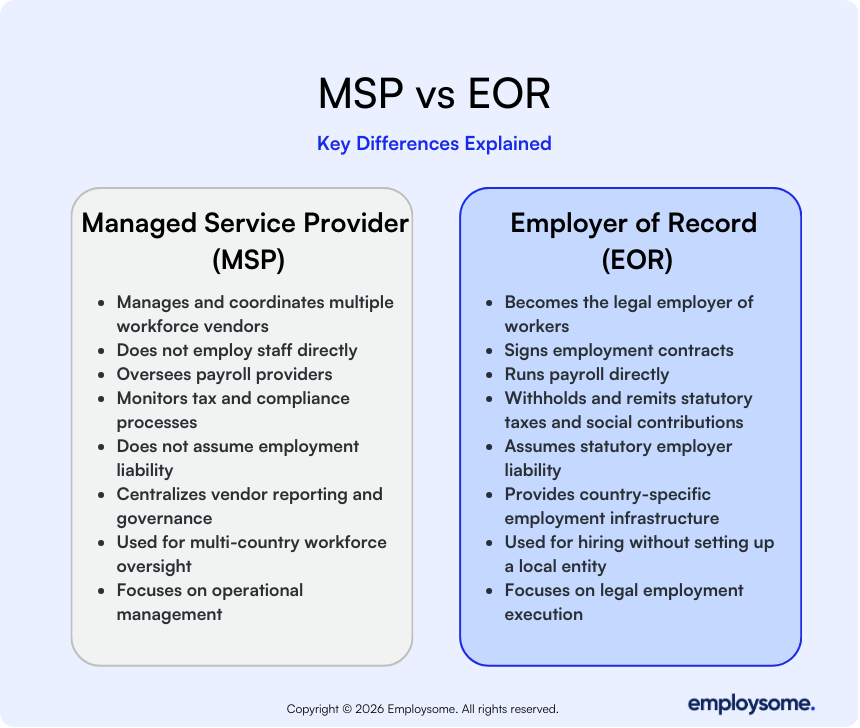
An MSP manages the system.
An EOR executes the employment relationship.
Large multinational companies often combine both models: an MSP manages vendor relationships, while local EORs handle statutory employment.
When Should a Company Use a Managed Service Provider?
Companies typically use a managed service provider when:
-
Expanding into multiple countries
-
Managing complex workforce structures
-
Coordinating multiple EOR providers
-
Requiring centralized governance
-
Lacking internal HR infrastructure
The MSP model is common in enterprise workforce management and global hiring programs.
Pros & Cons of a Managed Service Provider
Centralized workforce control
Standardized vendor management
Improved reporting transparency
Structured compliance oversight
Predictable operational costs
Assume legal employer liability
Replace an Employer of Record
Eliminate statutory compliance obligations
Managed Service Provider in Global Hiring
In global hiring and international workforce strategies, a managed service provider (MSP) often acts as a centralized coordination layer across multiple countries and vendors.
Rather than employing workers directly, the managed service provider oversees and integrates various service providers involved in cross-border employment. This may include:
-
Multiple Employer of Record (EOR) providers operating in different jurisdictions
-
Global and local payroll vendors
-
Staffing and recruitment agencies
-
Immigration and mobility partners
-
Legal and compliance consultants
In this model, the MSP ensures governance, standardization, reporting transparency, and operational consistency across jurisdictions. For multinational organizations managing distributed teams, the managed service provider becomes the control center for workforce oversight.
The MSP meaning in global hiring is therefore not “employer,” but “orchestrator.” It aligns vendors, monitors compliance, tracks performance, and ensures that international employment operations follow a unified framework.
For companies expanding internationally, understanding the difference between a managed service provider and an Employer of Record is essential when designing a scalable and risk-controlled workforce model. An MSP manages the system. An EOR executes employment locally.
Final Takeaway – Managed Service Provider Explained
A Managed Service Provider (MSP) is an outsourced operational partner that manages ongoing business functions under a structured and recurring service agreement. The managed service provider definition centers on continuous oversight, vendor coordination, reporting, and compliance management.
The MSP meaning becomes particularly relevant in global workforce strategies, where companies must coordinate multiple service providers across different legal systems.
Unlike an Employer of Record, a managed service provider does not legally employ workers or assume statutory employer liability. Instead, the MSP oversees the broader workforce ecosystem, ensuring alignment, consistency, and governance across vendors and jurisdictions.
For enterprises building complex international hiring structures, evaluating MSP vs EOR models is critical. Choosing the right structure determines cost efficiency, compliance exposure, and long-term scalability in global employment operation

Written by
Christa is a Copywriter at Employsome with 17 years of professional writing experience across global brands, startups, and online publications. A native English-Finnish writer, she brings strong editorial skills and a versatile background in business, SaaS, and finance. At Employsome, Christa focuses on clear, practical content about HR, payroll, and Employer of Record topics.
Our content is created for informational purposes only and is not intended to provide any legal, tax, accounting, or financial advice. Please obtain separate advice from industry-specific professionals who may better understand your business’s needs. Read our Editorial Guidelines for further information on how our content is created.