Minimum Wage in Germany: The Complete 2026 Guide
This guide breaks down Germany’s minimum wage system for 2026, covering the current statutory hourly rate, sector-specific collective agreements, employer social security obligations, compliance requirements under German labour law, penalties for underpayment, and how minimum wage compares to living costs across major German cities.

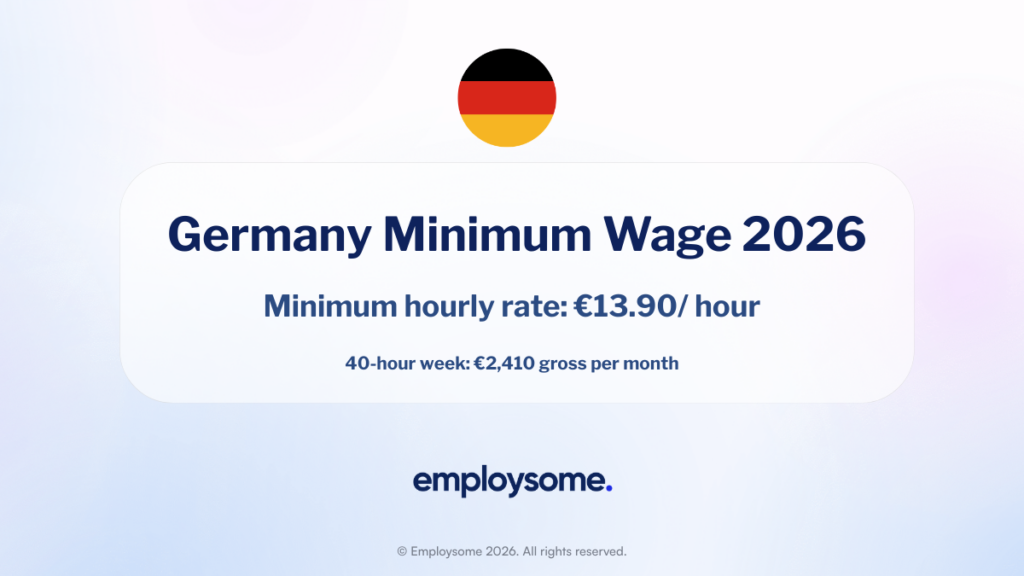
Table of Contents
- How Minimum Wage in Germany Is Regulated
- Germany Minimum Wage 2026: Current Rate
- Sector-Specific Minimum Wages
- How Minimum Wage in Germany Is Calculated
- Employer Social Security Contributions in Germany
- Legal Framework Governing Minimum Wage in Germany
- Employer Obligations Under German Law
- Penalties for Violating Minimum Wage in Germany
- Minimum Wage Germany vs. Cost of Living
- Minimum Wage Germany 2026-2027 Outlook
- Final Takeaway
Germany operates under a nationwide statutory minimum wage (Mindestlohn). Unlike decentralized systems, Germany applies a single federal hourly minimum wage across all states (Bundesländer).
As of 2026, the minimum wage in Germany is set nationally and applies to nearly all employees (including Employer of Record in Germany), regardless of region.
Understanding Germany minimum wage rules is essential for compliant hiring, payroll planning, and labour cost forecasting.

How Minimum Wage in Germany Is Regulated
Germany’s minimum wage is governed by the Minimum Wage Act (Mindestlohngesetz – MiLoG), which establishes a single nationwide statutory hourly wage applicable across all federal states (Bundesländer).
The rate is reviewed regularly by the Minimum Wage Commission (Mindestlohnkommission), an independent body composed of representatives from employers, trade unions, and academic advisors. The Commission evaluates:
-
Collective bargaining developments
-
Inflation and overall price trends
-
Labour market conditions
-
Broader economic performance
Based on its assessment, the Commission issues formal recommendations for adjustments. The Federal Government then implements the updated rate through statutory regulation.
Official information on Germany’s minimum wage framework is published by the Federal Ministry of Labour and Social Affairs (BMAS):
Federal Ministry of Labour and Social Affairs (BMAS)
Enforcement is overseen by the Financial Control of Undeclared Work (Finanzkontrolle Schwarzarbeit – FKS)
, a division of the German customs authority. The FKS conducts payroll inspections, audits working time records, and investigates underpayment complaints.
The statutory minimum wage applies to most employees working in Germany, including part-time workers and temporary agency staff, subject to limited legal exceptions (such as certain trainees and long-term unemployed individuals during initial employment periods).
Employers must ensure that the legally mandated hourly rate is respected in practice, supported by accurate time tracking and payroll documentation.
Germany Minimum Wage 2026: Current Rate
As of January 1, 2026, Germany’s statutory minimum wage is:
€13.90 per hour (gross)
This represents an increase from the previous €12.82 rate and applies nationwide across all federal states (Bundesländer). The statutory minimum wage Germany is scheduled to increase further to €14.60 per hour on January 1, 2027, following the planned two-step adjustment approved by the Minimum Wage Commission.
Germany does not set a statutory monthly minimum wage. Instead, wages are calculated based on hourly compensation and the number of contracted working hours.
For reference:
40-hour week ≈ €2,410 gross per month
38-hour week ≈ €2,290 gross per month
(Actual monthly pay depends on contractual working hours and payroll structure.)
The minimum wage applies to full-time, part-time, and most temporary employees working in Germany.
Sector-Specific Minimum Wages
In addition to the statutory minimum wage (€13.90 per hour as of January 1, 2026), certain industries in Germany have higher sector-specific minimum wages negotiated through collective bargaining agreements (Tarifverträge) and declared generally binding.
Where a sector-specific minimum wage exceeds the statutory minimum wage Germany, employers must apply the higher amount. If a sector rate falls below €13.90, the statutory minimum wage prevails automatically.
Below are representative 2026 sector minimum wage rates (subject to periodic updates):
|
Sector |
Minimum Hourly Wage (2026) |
Notes |
|---|---|---|
|
Construction (West Germany) |
~€15.70 |
Higher rates apply for skilled workers |
|
Construction (East Germany) |
~€15.55 |
Regional differentiation remains in some trades |
|
Electrical Trades |
~€14.41+ |
Varies by qualification level |
|
Care Sector (Nursing Assistants) |
~€15.25 |
Higher rates apply for qualified nursing staff |
|
Cleaning Services (Interior Cleaning) |
€13.90 (statutory floor applies) |
Sector rates below €13.90 are overridden |
|
Temporary Agency Work |
~€14.00+ |
Progressive increases based on tenure |
Because minimum wage Germany increased to €13.90 in 2026, any collectively agreed sector wage below this threshold must be adjusted upward to meet the statutory requirement. Employers hiring in regulated industries should verify both the statutory minimum wage Germany and any binding collective agreements to ensure full compliance.
How Minimum Wage in Germany Is Calculated
The statutory minimum wage Germany applies strictly to base hourly compensation. As of January 1, 2026, employers must ensure that the average hourly wage paid to an employee does not fall below €13.90 per hour.
Compliance is assessed based on the effective hourly rate derived from total base pay divided by actual hours worked. Employers must therefore maintain accurate working time records, as underpayment often results from incorrect time tracking rather than intentional wage reductions.
Minimum wage Germany requirements apply independently of additional payments. Overtime compensation, holiday bonuses, and Christmas bonuses cannot be used to offset or reduce compliance with the statutory minimum wage, unless they are contractually structured and proportionally allocated in a manner consistent with legal requirements. In practice, most supplementary payments are treated separately and do not count toward satisfying minimum wage Germany obligations.
Overtime premiums are not universally mandated by statute but are frequently governed by employment contracts or collective bargaining agreements. Where such agreements apply, employers must comply with the higher contractual standard in addition to meeting the statutory minimum wage Germany threshold.
To avoid compliance risk, employers must implement transparent and reliable time tracking systems, particularly in regulated industries where audits by the Financial Control of Undeclared Work (FKS) are common. Proper documentation is essential to demonstrate that minimum wage Germany requirements are met in every pay period.
Employer Social Security Contributions in Germany
Beyond minimum wage, employers must budget for mandatory social security contributions.
Employer contributions typically range between 19% and 22% of gross salary, including:
-
Pension insurance (Rentenversicherung)
-
Health insurance (Krankenversicherung)
-
Unemployment insurance (Arbeitslosenversicherung)
-
Long-term care insurance (Pflegeversicherung)
-
Accident insurance (Berufsgenossenschaft – varies by industry)
Overall employment costs in Germany are significantly higher than base salary alone.
Legal Framework Governing Minimum Wage in Germany
The legal basis includes:
Minimum wage protections cannot be waived by contract. If an employment agreement specifies pay below the statutory minimum, the legal rate prevails automatically.
Foreign employers hiring in Germany must also comply with wage reporting obligations for posted workers.
Employer Obligations Under German Law
To remain compliant with minimum wage Germany rules, employers must:
- Pay at least €13.90 per hour (effective January 1, 2026) in accordance with the statutory minimum wage Germany framework
- Record working hours accurately to demonstrate compliance with minimum wage Germany requirements
- Issue written employment contracts that clearly define compensation and working time arrangements
- Register employees for mandatory social security contributions under German law
- Withhold income tax (Lohnsteuer) and ensure correct payroll reporting
Failure to comply with minimum wage Germany documentation and payment obligations can trigger administrative fines, back-payment orders, and increased scrutiny from enforcement authorities.
Penalties for Violating Minimum Wage in Germany
Minimum wage enforcement in Germany is handled by the Financial Control of Undeclared Work (FKS), part of German customs authorities.
If an employer pays below minimum wage, authorities may:
-
Order back payment of wage arrears
-
Impose fines of up to €500,000
-
Exclude the employer from public procurement
-
Initiate criminal proceedings in serious cases
Employees can also bring civil claims for unpaid wages.
Germany is known for strict payroll audits, particularly in construction and hospitality sectors.
Minimum Wage Germany vs. Cost of Living
Germany applies a single nationwide statutory minimum wage of €13.90 per hour as of January 1, 2026. However, net take-home pay differs depending on:
Income tax class (Steuerklasse)
Marital status
Church tax liability
Health insurance provider
Federal state (Bundesland)
Public vs. private health insurance
Even though the gross hourly minimum wage Germany is identical across all Bundesländer, net income varies because social security contributions and income tax are deducted before payment.
For a full-time employee (40 hours per week), gross monthly pay is approximately €2,410. After statutory deductions, net income typically ranges between:
€1,650–€1,780 per month (single employee, Tax Class I)
The variation depends primarily on tax class and health insurance contributions rather than location. However, the real difference in purchasing power under minimum wage Germany comes from cost of living, which varies significantly by Bundesland and city.
|
City |
Bundesland |
Est. Net Pay |
Avg. 1-BR Rent |
Rent ÷ Income |
|---|---|---|---|---|
|
Munich |
Bavaria (Bayern) |
~€1,720 |
~€1,600 |
~93% |
|
Frankfurt |
Hesse (Hessen) |
~€1,700 |
~€1,400 |
~82% |
|
Berlin |
Berlin (City-State) |
~€1,680 |
~€1,200 |
~71% |
|
Hamburg |
Hamburg (City-State) |
~€1,690 |
~€1,300 |
~77% |
|
Leipzig |
Saxony (Sachsen) |
~€1,670 |
~€700 |
~42% |
|
Dresden |
Saxony (Sachsen) |
~€1,670 |
~€750 |
~45% |
|
Magdeburg |
Saxony-Anhalt |
~€1,660 |
~€600 |
~36% |
|
Erfurt |
Thuringia (Thüringen) |
~€1,660 |
~€650 |
~39% |
In eastern Bundesländer such as Saxony, Saxony-Anhalt, and Thuringia, the rent-to-income ratio remains substantially lower while the statutory minimum wage Germany is identical nationwide. As a result, minimum wage workers in these regions retain more disposable income compared to employees in higher-cost cities such as Munich or Frankfurt.
This highlights an important structural feature of minimum wage Germany: while the statutory wage floor is uniform across the country, real purchasing power varies materially depending on the Bundesland and local housing market conditions.
Minimum Wage Germany 2026-2027 Outlook
The future development of minimum wage Germany continues to be determined by the independent Minimum Wage Commission, which reviews the statutory rate on a regular two-year cycle. As of January 1, 2026, minimum wage Germany increased to €13.90 per hour, representing a significant step up from the previous €12.82 rate. A further increase to €14.60 per hour is scheduled for January 1, 2027, as part of the Commission’s approved two-stage adjustment.
Adjustments to minimum wage Germany are primarily influenced by inflation trends, collective bargaining outcomes, labour market conditions, and broader economic performance. The structured review mechanism is designed to balance wage growth with economic competitiveness and employment stability.
In recent years, minimum wage Germany has followed a pattern of steady, predictable increases rather than abrupt changes. While political debate can shape public expectations, formal adjustments are implemented through a defined legal process. The confirmed increase to €14.60 in 2027 provides employers with forward visibility for payroll planning.
For companies operating in Germany, closely monitoring official announcements regarding minimum wage Germany remains essential. Payroll systems must be updated promptly when adjustments take effect, as failure to apply the correct statutory rate can lead to fines, back-payment obligations, and reputational risk. Because minimum wage Germany applies nationwide and across most employment categories, even minor miscalculations can create significant compliance exposure.
Final Takeaway – Minimum Wage Compliance in Germany
Minimum wage Germany operates under a single national statutory framework with strong enforcement mechanisms and clearly defined legal obligations. The federal minimum wage applies across all Bundesländer and covers most employees, making compliance a central payroll responsibility for any employer hiring in Germany.
To remain compliant with minimum wage Germany in 2026 and beyond, employers must ensure that hourly pay meets or exceeds the current statutory rate of €13.90 (effective January 1, 2026). Employers should also prepare for the scheduled increase to €14.60 per hour on January 1, 2027, as part of the approved two-step adjustment. Working time must be recorded accurately, and any higher sector-specific minimum wage requirements must be applied where relevant. In addition, employer social security contributions, which typically add more than twenty percent to gross salary costs, must be budgeted separately and cannot be used to offset minimum wage Germany obligations.
Enforcement of minimum wage Germany is active and financially consequential. Authorities conduct payroll audits, review time tracking records, and investigate underpayment complaints. Non-compliance can result in substantial fines, back payments, and exclusion from public procurement contracts. For international companies expanding into Germany, minimum wage Germany should be treated as a core element of employment risk management rather than an administrative detail. Proper wage compliance forms the foundation of lawful hiring, payroll stability, and long-term operational security in the German market.

Written by
Courtney Pocock is a Copywriter & EOR/PEO Researcher at Employsome with 15+ years of experience writing for the HR, corporate, and financial sectors. She has a strong interest in global business expansion and Employer of Record / PEO topics, focusing on news that matters to business owners and decision-makers. Courtney covers industry updates, regulatory changes, and practical guides to help leaders navigate international hiring with confidence.
Our content is created for informational purposes only and is not intended to provide any legal, tax, accounting, or financial advice. Please obtain separate advice from industry-specific professionals who may better understand your business’s needs. Read our Editorial Guidelines for further information on how our content is created.
Other posts
Check out the minimum wage in other countries