
If you’ve spent any time researching how to build a distributed team, you’ve probably come across two acronyms that get thrown around almost interchangeably: MSP and BPO. And honestly, the confusion is understandable. Both involve handing off work to an external partner. Both promise to save you time and money. Both have salespeople who will tell you their model is the obvious choice.
But here’s the thing: MSPs and BPOs solve fundamentally different problems. Choosing the wrong one doesn’t just waste budget. It creates organizational friction that’s surprisingly hard to undo once contracts are signed and teams are onboarded.
We’ve spent years comparing global employment solutions at Employsome, and this is one of those topics where a little clarity up front saves companies months of headaches down the road. So let’s break it down properly.

What Is BPO (Business Process Outsourcing)?
BPO is when you take an entire business function (customer support, payroll processing, data entry, accounting) and hand it off to a third-party provider who runs it on your behalf.
The key word here is process. You’re not hiring individuals. You’re outsourcing a workflow. The BPO provider recruits the people, trains them, manages performance, and delivers results against agreed-upon SLAs. You get the output without managing the machine.
Think of it this way: when a SaaS company outsources its Level 1 customer support to a BPO in the Philippines, they’re not picking which agents answer their tickets. They’re buying a service (X tickets resolved per day at Y quality score) and the BPO figures out the staffing.
The global BPO industry was valued at roughly $350 billion in 2023, with customer service operations making up the largest slice. That number keeps climbing because the economics are hard to argue with: companies report average cost reductions of around 15% when outsourcing routine, high-volume processes, according to ISG research.
What Is an MSP (Managed Service Provider)?
MSP stands for Managed Service Provider. Historically, the term was closely tied to IT: think network monitoring, server management, cybersecurity, cloud infrastructure. A company that didn’t want to build a full in-house IT department could bring in an MSP to handle it.
But the definition has expanded. Today, MSPs also show up in workforce management, where they act as a central layer coordinating your contingent workers, staffing vendors, and technology platforms. In the IT-focused sense, an MSP manages your infrastructure and keeps things running. In the workforce sense, an MSP manages your supplier ecosystem and keeps your external talent pipeline organized.
The managed services market has ballooned past $380 billion in 2025 and is projected to nearly double by 2035. That growth reflects a real shift: businesses are moving away from reactive, break-fix vendor relationships toward ongoing, proactive management partnerships.
Where They Actually Differ
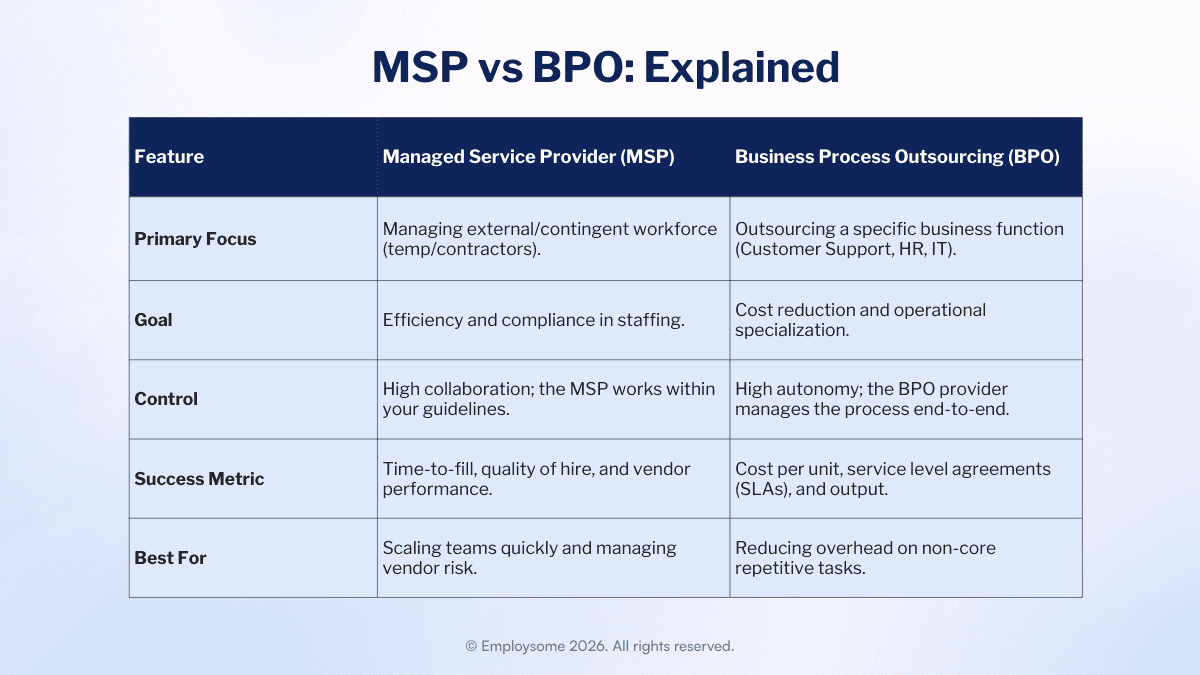
The surface-level distinction (“BPO outsources processes, MSP manages services”) isn’t wrong, but it’s not very helpful when you’re actually trying to make a decision. Here’s where the real differences show up.
Who Owns the People?
This one matters more than most comparison articles let on.
With a BPO, the provider directly employs and manages the workforce. They hire, onboard, train, evaluate performance, and handle terminations. Your involvement in the day-to-day management of those people is minimal by design. You set the goals and KPIs. The BPO figures out the human side.
With an MSP (particularly in the workforce management context), the model is different. The MSP typically doesn’t employ workers directly. Instead, they coordinate a network of staffing agencies and talent suppliers, managing vendor relationships and standardizing processes across multiple sources. The workers might come from three different agencies, but the MSP provides one point of contact and one consistent framework.
In the IT sense, MSPs bring their own technical teams, but those teams are managing your systems, not replacing your workforce.
Why this distinction matters: if you need 50 customer service agents tomorrow and you don’t want to think about hiring any of them, a BPO is your path. If you have a complex mix of contract workers sourced from multiple agencies and you need someone to bring order to the chaos, that’s MSP territory.
This is also where terminology can get confusing. Models like employee leasing and co-employment arrangements through a PEO share some surface-level similarities with BPO (someone else handles employment administration), but the underlying legal structure and degree of control are entirely different. If those terms are new to you, our Global Work Glossary covers them in detail.
How Much Control Do You Keep?
There’s a real tradeoff here, and being honest about what you actually want is important.
BPO arrangements tend toward lower client control over daily operations. That’s the whole point: you’re paying someone else to run the process so you can focus elsewhere. The BPO makes staffing decisions, manages shifts, and handles internal operations. You monitor outcomes through SLA dashboards and regular reviews, but you’re not in the weeds.
MSPs typically give you more visibility and decision-making power. The MSP executes and coordinates, but strategic decisions remain with your team. They support, you decide. This is especially true in workforce MSPs, where you retain control over vendor selection, rate negotiations, and talent criteria. The MSP just makes the whole thing operationally manageable.
Neither approach is inherently better. But if your CEO gets nervous about a critical function being fully managed by a third party with limited oversight, the MSP model offers more built-in checkpoints.
What Kind of Work Gets Outsourced?
BPOs excel at high-volume, process-driven work. Customer support centers. Payroll and benefits administration. Claims processing. Data entry and back-office operations. Recruitment process outsourcing. The common thread is that these are workflows with defined inputs, clear procedures, and measurable outputs.
MSPs in the IT space focus on infrastructure and technology: network monitoring, cloud management, cybersecurity, data backup and disaster recovery, help desk support. In the workforce space, they focus on vendor management, compliance, and talent supply chain optimization.
The overlap between BPO and MSP can get blurry, especially when large providers like Accenture, IBM, or Infosys offer both under different service lines. But the underlying logic is different. BPO replaces your team with their team. MSP supplements your capabilities with their expertise and coordination.
The Cost Question
Let’s be direct: cost comparisons between MSP and BPO are tricky because the pricing models are structurally different. You’re basically comparing apples with pears.
BPO pricing typically works on one of three models: a fixed monthly fee for a defined scope of work, a per-transaction or per-unit rate, or an hourly rate for the outsourced team. The cost savings come primarily from labor arbitrage (hiring in lower-cost markets), economies of scale, and the BPO’s operational efficiency in running the same type of process for multiple clients.
For many companies, BPO is the more cost-effective choice when outsourcing operational, non-strategic tasks, especially at scale. If you’re running a 200-seat contact center, the math on doing it yourself versus a BPO in a tier-2 city in Southeast Asia is pretty stark.
MSP pricing tends to be subscription-based, often structured per-user, per-device, or as a tiered service package. Some MSPs use usage-based models tied to storage, bandwidth, or support hours. The value proposition isn’t primarily about labor cost savings. It’s about avoiding the expense of building specialized capabilities (like a full cybersecurity team) in-house, plus the operational efficiencies of centralized management.
A rough mental model: BPOs save you money on work you already know how to do but don’t want to do. MSPs save you money on work you might not know how to do well.
When to Use Which: A Decision Framework
Rather than giving you the standard “it depends” non-answer, here’s how we’d think about it:
Choose a BPO when:
You have a well-defined, repeatable business process that doesn’t require deep integration with your core product or strategy. Customer support, accounting, HR administration, and data processing are classic examples. You want to reduce costs, and you’re comfortable with less day-to-day control. The work is high-volume enough that a dedicated outsourced team makes economic sense.
Choose an MSP when:
You need ongoing management of IT infrastructure, cybersecurity, or cloud environments, and building that capability in-house would be disproportionately expensive relative to your stage. Or, you’re managing a complex web of contingent workers and staffing vendors and need a coordinating layer to keep everything organized, compliant, and optimized. You want to retain strategic control while delegating operational management.
Consider combining both when:
Larger organizations often use BPOs for specific operational functions and MSPs for IT management simultaneously. They’re not mutually exclusive. A company might outsource its payroll and benefits administration to a BPO while working with an MSP to manage its cloud infrastructure. The important thing is being clear about which model you’re applying to which problem.
Where EOR Fits In (And Why It’s Worth Knowing)
If you’re reading this article because you’re trying to figure out how to hire people in other countries, there’s a third model you should have on your radar: Employer of Record (EOR).
BPOs and MSPs both involve delegating work to external partners. An EOR is different. It’s a legal structure that lets you directly hire full-time employees in countries where you don’t have a legal entity, avoiding the complexity and cost of setting up a foreign subsidiary and the risk of triggering permanent establishment.
The EOR becomes the legal employer on paper (handling payroll, taxes, benefits, and compliance), while the employee works for you day-to-day. You manage them. You direct their work. They’re part of your team in every way except the legal paperwork. If you’re curious about the full picture of tradeoffs, we wrote a deep dive on the pros and cons of using an EOR.
This is a critical distinction for companies building distributed teams. If you want a team of five engineers in Germany who report to your CTO and ship code alongside your existing team, an EOR in Germany is almost certainly what you need, not a BPO or an MSP. If you want to outsource your entire QA process to a team you don’t directly manage, that’s BPO territory.
The global EOR market has exploded in recent years precisely because it fills a gap that neither BPOs nor MSPs address: direct, integrated international hiring without entity setup. It’s also worth noting that EOR is not the same as a Global Employment Organization (GEO), although the terms are sometimes used interchangeably in the market.
At Employsome, we help companies compare EOR providers across 50+ countries using real pricing data and independent scoring. If you’re exploring international hiring, comparing providers before you commit to a BPO or MSP might save you from solving the wrong problem entirely.
The Biggest Providers at a Glance
For reference, here are some of the major players in each space:
Leading MSPs
IBM operates in over 170 countries and remains one of the dominant forces in enterprise IT management and technology consulting. Accenture serves 120+ countries with end-to-end managed services spanning cloud, security, and digital transformation. Infosys, present in 56 countries, has built a strong position in next-generation digital services. Cognizant (37 countries) focuses heavily on infrastructure management and cybersecurity. Wipro (40+ countries) brings a broad portfolio across IT consulting, process services, and business transformation.
Major BPO Providers
Teleperformance is the global leader in customer experience management, with operations in 170 countries and deep multilingual capabilities. Concentrix (70 countries) specializes in customer engagement, including care, sales, and tech support. Genpact (30 countries) leans into automation and AI-driven process optimization. WNS Global Services (13 countries) focuses on finance, accounting, analytics, and customer service. Conduent (24 countries) provides transaction processing, customer care, and analytics at enterprise scale. For reference, here are some of the major players in each space:
Leading MSPs
IBM operates in over 170 countries and remains one of the dominant forces in enterprise IT management and technology consulting. Accenture serves 120+ countries with end-to-end managed services spanning cloud, security, and digital transformation. Infosys, present in 56 countries, has built a strong position in next-generation digital services. Cognizant (37 countries) focuses heavily on infrastructure management and cybersecurity. Wipro (40+ countries) brings a broad portfolio across IT consulting, process services, and business transformation.
Major BPO Providers
Teleperformance is the global leader in customer experience management, with operations in 170 countries and deep multilingual capabilities. Concentrix (70 countries) specializes in customer engagement, including care, sales, and tech support. Genpact (30 countries) leans into automation and AI-driven process optimization. WNS Global Services (13 countries) focuses on finance, accounting, analytics, and customer service. Conduent (24 countries) provides transaction processing, customer care, and analytics at enterprise scale.
MSP vs BPO: Making the Right Call
Here’s what we’ve observed after years of covering this space: the companies that struggle most aren’t the ones who pick BPO over MSP or vice versa. They’re the ones who never clearly defined what problem they were solving before they started shopping for solutions.
Before you talk to a single vendor, get clear on these questions:
Are you trying to reduce the cost of running a specific business function, or are you trying to build capability you don’t currently have? Do you want to hand off operational control, or do you want to keep the steering wheel and just get help managing the complexity? Are the people doing this work fundamentally part of your team, or are they executing a service on your behalf?
The answers to those questions will point you in the right direction faster than any comparison table.
And if the answer is “I just want to hire great people in other countries and have them work as part of my team,” you probably don’t need a BPO or an MSP at all. You need an Employer of Record. Comparing those is kind of our thing.
MSP vs BPO: Frequently Asked Questions
BPO focuses on outsourcing entire non-core business functions like HR, customer support, or accounting to a third party that runs them on your behalf. MSPs focus on managing specific IT services or coordinating your external workforce and vendor ecosystem. The core distinction: BPO replaces your execution of a process, while MSP enhances your management of systems or suppliers.
BPO is generally more cost-effective for operational, high-volume tasks thanks to labor arbitrage and economies of scale. MSP can be more expensive on a per-unit basis but provides value through specialized expertise (like cybersecurity or cloud management) that would cost significantly more to build in-house.
Absolutely. Many mid-to-large companies outsource specific operations (like customer support) to a BPO while partnering with an MSP for IT management. The two models serve different functions and are fully complementary.
If your goal is to hire full-time employees in countries where you don’t have a legal entity, and you want those employees to work as integrated members of your team, an Employer of Record is likely what you need. Unlike BPO and MSP, EOR is about direct employment, not outsourcing. You can compare EOR providers for free on Employsome.
BPO is usually easier to scale for non-IT tasks because providers are built to quickly adjust staff and resources based on workload. MSPs offer strong scalability for IT infrastructure (adding devices, users, or cloud capacity), but scaling workforce-related MSP programs involves coordinating across multiple staffing vendors, which adds complexity.

Written by
Christa is a Copywriter at Employsome with 17 years of professional writing experience across global brands, startups, and online publications. A native English-Finnish writer, she brings strong editorial skills and a versatile background in business, SaaS, and finance. At Employsome, Christa focuses on clear, practical content about HR, payroll, and Employer of Record topics.
Our content is created for informational purposes only and is not intended to provide any legal, tax, accounting, or financial advice. Please obtain separate advice from industry-specific professionals who may better understand your business’s needs. Read our Editorial Guidelines for further information on how our content is created.
Other posts
Read more