Minimum Wage in Kenya: The Complete 2026 Guide
This guide breaks down Kenya’s minimum wage system for 2026, covering current statutory rates by sector and region, housing allowance rules, compliance obligations, penalties for underpayment, and how minimum wages compare to real living costs across the country.

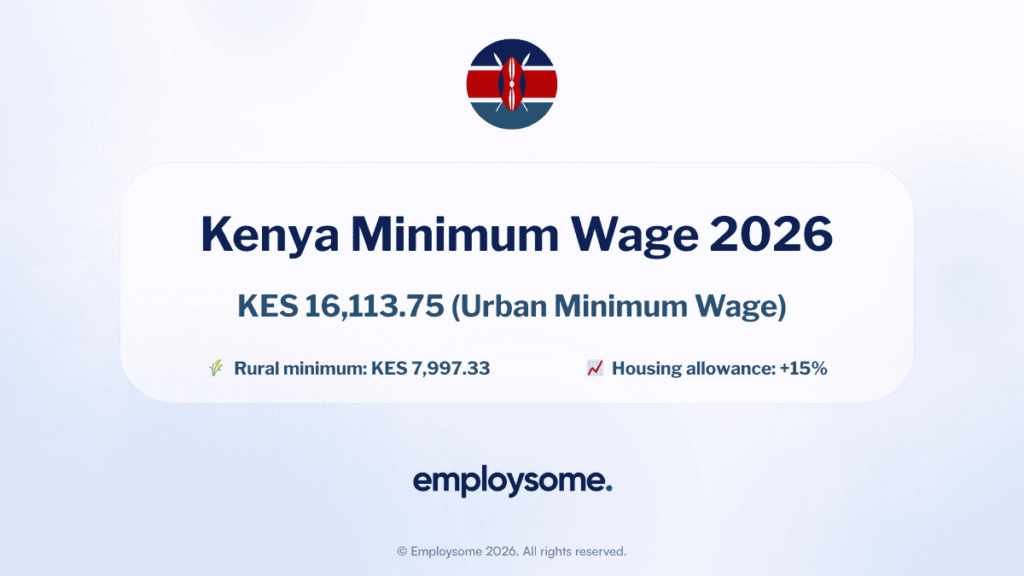
Table of Contents
- The Three-Tier Regional System
- Minimum Wage Rates by Sector and Region
- Housing Allowance Adds 15% to Base Wages
- The Legal Framework
- How Minimum Wage in Kenya is Calculated
- Employer Minimum Wage Obligations
- Employee Rights
- Penalties for Non-Compliance
- Historical Context Shows Steady Wage Growth
- Minimum Wage vs. Living Wage
- Regional Comparison
- Outlook
- FAQ
The minimum wage in Kenya stands at KES 16,113.75 monthly for workers in major cities and KES 7,997.33 for rural areas as of November 2024 rates that remain in effect through 2026 as no new wage order has been gazetted. This comprehensive guide covers everything employers, employees, and HR professionals need to know about navigating Kenya’s complex tiered wage structure, from current rates across all sectors to legal compliance requirements and enforcement mechanisms.
The country’s minimum wage system, governed by The Regulation of Wages (General) (Amendment) Order, 2024 (Legal Notice No. 164), reflects a 6% increase announced by President William Ruto during Labour Day celebrations on May 1, 2024. However, the statutory minimum significantly trails Kenya’s estimated living wage of KES 35,518 monthly creating a persistent gap that shapes labor relations and economic policy debates throughout the nation.


How The Regional System Works for Minimum Wage in Kenya
It’s important to note that Kenya divides minimum wage rates into three geographic zones, recognizing the substantial cost-of-living differences between urban centers and rural areas. This tiered approach affects virtually every aspect of wage calculation and compliance.
Major Cities (highest rates): Nairobi, Mombasa, Kisumu, Nakuru, and Eldoret constitute Kenya’s first tier. Workers in these metropolitan areas receive the highest statutory minimums due to elevated living costs, particularly housing and transportation expenses.
Former Municipalities and Town Councils (mid-tier rates): Mavoko, Ruiru, and Limuru fall into the second tier. These areas command approximately 8-10% lower minimum wages than major cities while remaining above rural rates.
All Other Areas (lowest rates): Rural regions and smaller towns constitute the third tier, where minimum wages can be less than half those in major cities, reflecting lower living costs but also creating incentives for rural-to-urban migration.
Kenya Minimum Wage Rates by Sector and Region
General Workers in Major Cities
The following rates apply to workers in Nairobi, Mombasa, Kisumu, Nakuru, and Eldoret:
| Job Category | Monthly (KES) | Hourly (KES) |
|---|---|---|
| General labourer (cleaner, gardener, house servant, ayah, sweeper, day watchman, messenger) | 16,113.75 | 144.05 |
| Cook, waiter, miner, stone cutter, turn boy | 17,402.94 | 156.68 |
| Night watchman | 17,976.54 | 162.18 |
| Machine attendant, sawmill sawyer, bakery assistant, tailor’s assistant | 18,263.27 | 168.28 |
| Junior clerk, vehicle service worker, light tractor driver | 20,848.40 | 187.09 |
| Car driver, printing machine operator, shop assistant, copy-typist | 21,748.87 | 195.78 |
| Clerk, pattern designer, garment cutter, receptionist, storekeeper | 24,818.31 | 223.55 |
| Tailor, medium-sized vehicle driver | 27,352.40 | 243.48 |
| Crawler tractor driver, salesmen | 30,196.64 | 271.36 |
| Caretaker (buildings), saw doctor | 33,416.82 | 300.62 |
| Cashier, heavy commercial vehicle driver, salesmen-driver | 36,360.92 | 327.65 |
Artisan Grade Wages in Major Cities
| Grade | Monthly (KES) | Daily (KES) |
|---|---|---|
| Artisan – Ungraded | 21,748.92 | 1,045.85 |
| Artisan – Grade III | 27,352.45 | 1,316.36 |
| Artisan – Grade II | 29,542.36 | 1,448.17 |
| Artisan – Grade I | 36,360.92 | 1,750.54 |
Domestic Workers by Region
| Region | Monthly Wage (KES) |
|---|---|
| Major Cities | 16,113.75 |
| Former Municipalities | 14,866.92 |
| All Other Areas | 8,596.49 |
Agricultural Sector Minimum Wages
| Job Category | Monthly (KES) | Daily (KES) |
|---|---|---|
| Unskilled worker | 7,997.33 | 335.86 |
| Stockman, herdsman, watchman | 9,235.78 | 391.14 |
| Cook, house servant | 9,129.41 | 347.63 |
| Senior foreman | 9,339.66 | 397.13 |
| Farm artisan | 9,558.66 | 406.40 |
| Tractor driver | 10,136.30 | 430.52 |
| Combined harvester driver | 11,166.62 | 473.82 |
| Lorry driver, car driver | 11,718.67 | 496.72 |
| Farm foreman / clerk | 14,427.13 | 609.66 |
Security Guards – Special Case
In February 2025, the Employment and Labour Relations Court upheld a Private Security Regulatory Authority (PSRA) directive setting a minimum wage of KES 30,000 for private security guards. This rate is legally enforceable despite ongoing challenges by security firms.
Until full implementation, the previously gazetted rates remain in effect: KES 16,113.75 for day guards and KES 17,976.54 for night guards in major cities.
Housing Allowance Adds 15% to Base Wages
A critical compliance element many employers overlook: when housing is not provided, employers must pay an additional 15% of basic wages as housing allowance. For a domestic worker earning KES 16,113.75 monthly in Nairobi, this means:
- Basic wage: KES 16,113.75
- Housing allowance: KES 2,417.06
- Total guaranteed minimum: KES 18,530.81
This requirement transforms actual minimum compensation significantly higher than the headline figures suggest.
The Legal Framework Governing Minimum Wage in Kenya
Kenya’s minimum wage system rests on multiple legislative pillars that employers must understand for full compliance.
Primary legislation
Employment Act, 2007 (Chapter 226) serves as the principal statute governing employment relationships. Key provisions include:
- Section 17: Regulates payment, disposal, and recovery of wages
- Section 17(10): Specifically criminalizes failure to pay statutory minimum wage
- Section 18: Specifies payment timing requirements
- Section 19: Governs permissible deductions from wages
- Section 20: Mandates itemized pay statements
- Section 74: Establishes employer record-keeping requirements
The Labour Institutions Act, 2007 establishes the Wages Council system through Sections 43-47, creating the tripartite mechanism that recommends minimum wage adjustments.
Wage councils determine rates through tripartite negotiation
Two specialized councils handle wage recommendations:
The General Wages Council (chaired by Wakili Bernard Mung’ata as of September 2024) investigates remuneration and conditions for non-agricultural sectors. Its tripartite composition includes independent members, up to 15 employer representatives, and up to 15 employee representatives serving three-year terms.
The Agricultural Wages Council follows a similar structure for farming sector recommendations, covering stockmen, herdsmen, watchmen, and other agricultural positions.
Both councils must consider: worker and family needs, general wage levels, cost of living, social security benefits, economic factors including productivity, employer sustainability, SME operations, poverty alleviation, minimum subsistence levels, and likely employment impacts.
How Minimum Wage in Kenya is Calculated (and When It Must be Paid)
Kenya uses multiple calculation periods with specific payment requirements under the Employment Act:
Calculation methods:
- Monthly rate: Standard for most contracts
- Daily rate: Calculated inclusive of housing allowance
- Hourly rate: 1/225th of monthly basic wage for monthly-paid workers
Standard working hours:
- Normal week: 45 hours (Monday-Friday: 8 hours each, Saturday: 5 hours)
- Maximum week: 52 hours
- Beyond 52 hours: Constitutes overtime
Payment timing requirements:
- Casual employees: End of each day
- Employees on periods not exceeding one month: End of that period
- Monthly employees: End of each month
Overtime compensation rates:
- Beyond 52 hours weekly: 1.5× normal hourly rate
- Rest day work: 2× normal hourly rate
- Public holiday work: 2× normal hourly rate
- Night work (10pm-6am): 1.2× regular hourly rate
Employer Minimum Wage Obligations
Employers must maintain comprehensive written records including:
- Employee particulars and contracts
- Terms of engagement (annual leave, sick pay, termination procedures, notice periods)
- Where employees perform work
- Wages paid and food ration records (if applicable)
- Disciplinary proceedings records
- Working hours records
Retention period: Minimum 36 months for inspection purposes.
Pay slip requirements
All workers (except casual employees, piece-rate workers, or those employed less than six months) must receive itemized statements showing:
- Gross wages/salary amount
- Variable and statutory deductions with stated purposes
- Payment method for different net amount portions
Permitted and prohibited deductions
Allowed deductions:
- Statutory contributions (PAYE, NSSF, SHIF at 2.75%, Housing Levy at 1.5%)
- Worker-authorized provident/pension fund contributions
- Overpayments made in error
- Written-consent deductions for specific purposes
- Collective agreement deductions
- Day’s wages for unauthorized absences
Critical limit: Total deductions cannot exceed two-thirds (2/3) of wages at any time.
Prohibited: Deducting wages in exchange for job placement.
Employee Rights under Kenya Minimum Wage Law
Workers possess substantial protections that cannot be contracted away:
Fundamental entitlements:
- Minimum wages and conditions apply regardless of contract terms
- Wages Orders constitute minimum terms of employment
- Employees cannot waive minimum wage protections
- Right to itemized pay statement showing all deductions
- Employer must provide contract information within 14 days of request
Filing complaints for violations:
- Report to employer: First step contact supervisor or HR department
- File with Labour Officer: Submit complaint at your County Labour Office using Form LD-64
- Conciliation meeting: Labour Officer convenes mediation within 7 days
- Demand notice: If employer fails to attend, officer issues payment demand
- Employment and Labour Relations Court: For unresolved disputes
Time limit: Complaints must be filed within 3 years of the allegedly unlawful underpayment.
Penalties for Non-Compliance
Criminal penalties
Failure to pay minimum wage (Employment Act, Section 17(10)):
- Fine up to KES 100,000
- Imprisonment up to 2 years
- Or both
False records (Section 75):
- Fine up to KES 100,000
- Imprisonment up to 6 months
- Or both
Civil remedies
Employers must pay workers the difference between:
- Wages specified in the Wages Order, AND
- Amount actually paid
Plus penalties up to 200% of wage arrears, alongside reputational damage and employee litigation exposure.
Recent case example: A watchman was awarded KES 192,158 after his employer paid only KES 7,961 monthly below minimum wage. This aligns with rulings tracked by Kenyan employment law practitioners, confirming that underpayment constitutes an unfair labour practice.
Historical Context Shows Steady Wage Growth
Kenya’s minimum wage system traces back to pre-independence, with formal regulations established in 1972 through guidelines under the Regulation of Wages and Conditions of Employment Act (Cap 229).
Key milestones:
| Year | Minimum Wage (KES/month) | Increase |
|---|---|---|
| 1994 | 1,700 | Baseline |
| 2017 | 12,926 | Major reform |
| May 2022 | 15,120 | 12% increase |
| November 2024 | 16,113.75 (cities) | 6% increase |
The 2022 increase came at President Uhuru Kenyatta’s final Labour Day announcement; the 2024 adjustment followed tripartite negotiations where Regulation of Wages and Conditions of Employment Act (Cap 229), the government proposed 15%, and FKE advocated successfully for 6%.
Minimum Wage in Kenya vs. Living Wage Reveals Significant Gap
Kenya’s statutory minimum falls substantially short of actual living costs, as reflected in independent wage benchmarks from living wage estimates.
| Measure | Amount (KES/month) |
|---|---|
| Urban minimum wage | 16,113.75 |
| Urban living wage (Lake Naivasha estimate) | 35,518 |
| Rural living wage (Kericho/Mt. Kenya) | 30,531 |
| Urban living income (family of 5) | 52,251 |
The minimum wage covers only 45-53% of estimated living wage requirements. With Nairobi rent alone ranging KES 15,000-25,000 monthly—potentially exceeding the entire minimum wage, workers face substantial economic pressure.
December 2024 context:
- Food inflation: 7.8% year-on-year
- Major increases: Tomatoes (+30.3%), sukuma wiki (+23.4%), maize flour (+13.2%)
- The 6% wage increase failed to keep pace with food price inflation
Regional Comparison Puts Kenya in Perspective
Kenya maintains East Africa’s most comprehensive minimum wage system, as tracked by WageIndicator, offering more structured worker protection than neighboring countries despite ongoing competitiveness concerns.
| Country | Monthly Minimum (USD equivalent) |
|---|---|
| Kenya | $117-125 (urban), $62 (rural) |
| Tanzania | $54-228 (sector-dependent) |
| Uganda | $31 (unchanged since 1984) |
| Rwanda | ~$2-3 (reviewing 1978 guidelines) |
| Ethiopia | $46 (public sector only) |
Kenya’s tiered system across 17 wage orders represents significantly more worker protection than regional neighbours, though FKE argues this makes Kenya less competitive for investment.
An Outlook on Minimum Wage in Kenya
No gazette notice for 2026 minimum wages had been published as of early 2026. COTU Secretary-General Francis Atwoli continues urging the government to begin planning wage improvements before the next Labour Day announcement. Future adjustments will likely consider inflation rates, cost of living changes, labor market conditions, and ongoing debates about the gap between statutory minimums and actual living costs.
The February 2025 court ruling upholding KES 30,000 minimum wages for private security guards signals potential sector-specific increases ahead, particularly for vulnerable worker categories. Employers should monitor official announcements from the Ministry of Labour and Social Protection (labour.go.ke) and prepare for potential mid-year adjustments.
For workers, the path forward requires active engagement with trade unions, awareness of complaint procedures, and documentation of wage payments. For employers, maintaining rigorous compliance records, staying current with gazette notices, and budgeting for potential increases represents prudent practice in Kenya’s evolving labor landscape.
Frequently Asked Questions
As of November 2024, minimum wage ranges from KES 16,113.75 monthly in major cities (Nairobi, Mombasa, Kisumu, Nakuru, Eldoret) to KES 7,997.33 in rural areas. These rates remain in effect through 2026 absent a new gazette notice.
Yes. Kenya operates 17 different wage orders covering general workers, agricultural workers, domestic workers, and specific occupations. Rates differ by job category, skill level, and geographic location.
Annually, with announcements typically on May 1st (Labour Day). Reviews involve tripartite negotiations between the government, COTU (workers), and FKE (employers).
File a complaint at your County Labour Office within 3 years of underpayment. The Labour Officer will call a conciliation meeting within 7 days. Unresolved cases proceed to the Employment and Labour Relations Court.
Yes. Part-time employees receive pro-rated wages based on hours worked relative to the standard 52-hour workweek, calculated at KES 73.08-144.05 per hour depending on category.
Unpaid interns in formal training programs, self-employed workers, and the informal sector (over 80% of Kenya’s workforce) may have limited or no coverage.
Standard overtime (beyond 52 hours weekly): 1.5× regular rate. Rest days and public holidays: 2× regular rate. Night work (10pm-6am): minimum 1.2× regular rate.
Statutory deductions (PAYE, NSSF, SHIF, Housing Levy), worker-authorized contributions, overpayment corrections, and collective agreement deductions never exceeding two-thirds of wages total.
No. The minimum wage is basic cash wage only. If housing isn’t provided, employers must pay an additional 15% housing allowance.
Fines up to KES 100,000, imprisonment up to 2 years, or both plus back pay requirements and potential civil claims reaching 200% of wage arrears.

Written by
Courtney Pocock is a Copywriter & EOR/PEO Researcher at Employsome with 15+ years of experience writing for the HR, corporate, and financial sectors. She has a strong interest in global business expansion and Employer of Record / PEO topics, focusing on news that matters to business owners and decision-makers. Courtney covers industry updates, regulatory changes, and practical guides to help leaders navigate international hiring with confidence.
Our content is created for informational purposes only and is not intended to provide any legal, tax, accounting, or financial advice. Please obtain separate advice from industry-specific professionals who may better understand your business’s needs. Read our Editorial Guidelines for further information on how our content is created.
Other posts
Read More