

As the way people hire globally becomes more flexible, new employment and compliance terms continue to emerge. Alongside Employer of Record (EOR) and Contractor of Record (COR), many companies now encounter the term Agent of Record (AOR).
For founders, HR teams, and finance leaders, these terms can quickly become confusing. In this article, we clearly explain what an Agent of Record is, when it’s used, and how it compares to a Contractor of Record, so you can choose the right model for your business.

What Is an Agent of Record (AOR)?
An Agent of Record (AOR) is a third-party service provider that acts as a legal and administrative intermediary between a company and a contractor or freelancer, without becoming the legal employer. To put it very simple: Its a normal freelancer without any legal relation between contractor and provider – you only use their tech platform and payment rails.
In an Agent of Record model, the worker remains an independent contractor, while the AOR (e.g. Deel or Remote) supports the client company by managing contracts, compliance checks, invoicing, and payments. The client continues to direct the work, but the AOR helps reduce administrative burden and misclassification risk, particularly when engaging contractors across borders.
This model is commonly used by companies that want to hire international freelancers quickly at low costs and avoid setting up local legal entities or employment relationships. The only downside: you bear the entire misclassification risk.
💡 Employsome Tip: AOR means you carry the entire misclassification risk
Many providers offer contractor misclassification checks – but keep in mind they’re often biased toward upselling COR or EOR. In an AOR setup, the legal risk almost always stays with you, not the provider. Use their tools as guidance, not as a safety net.
When Should You Use an Agent of Record (AOR)?
For the company that wants to hire a contractor through AOR, the AOR support the following
- Generation of contractor agreement and signature process
- Local compliance checks (misclassification risk, no guarantee though!)
- Generate invoice in the correct format and not dependant on invoicing skills of contractor
- Paying the contractor in the local currency through platform (often credit card payment, direct debit available and not just bank transfer)
- Consolidated invoicing in case you want to pay multiple contractors in multiple countries in multiple currencies but want to receive only one invoice
- Tax documentation support, often available via pdf download
- Ongoing contractor compliance monitoring
- Time tracking using the providers platform for hourly paid contractors
- Milestone tracking for milestone payments
- Some additional IP protection through provider’s platforms
This makes AOR particularly attractive for companies working with independent contractors in multiple countries.
Agent of Record (AOR) Vs. Contractor of Record (COR) – Key Differences Explained
Although often confused, Agent of Record and Contractor of Record are not the same.
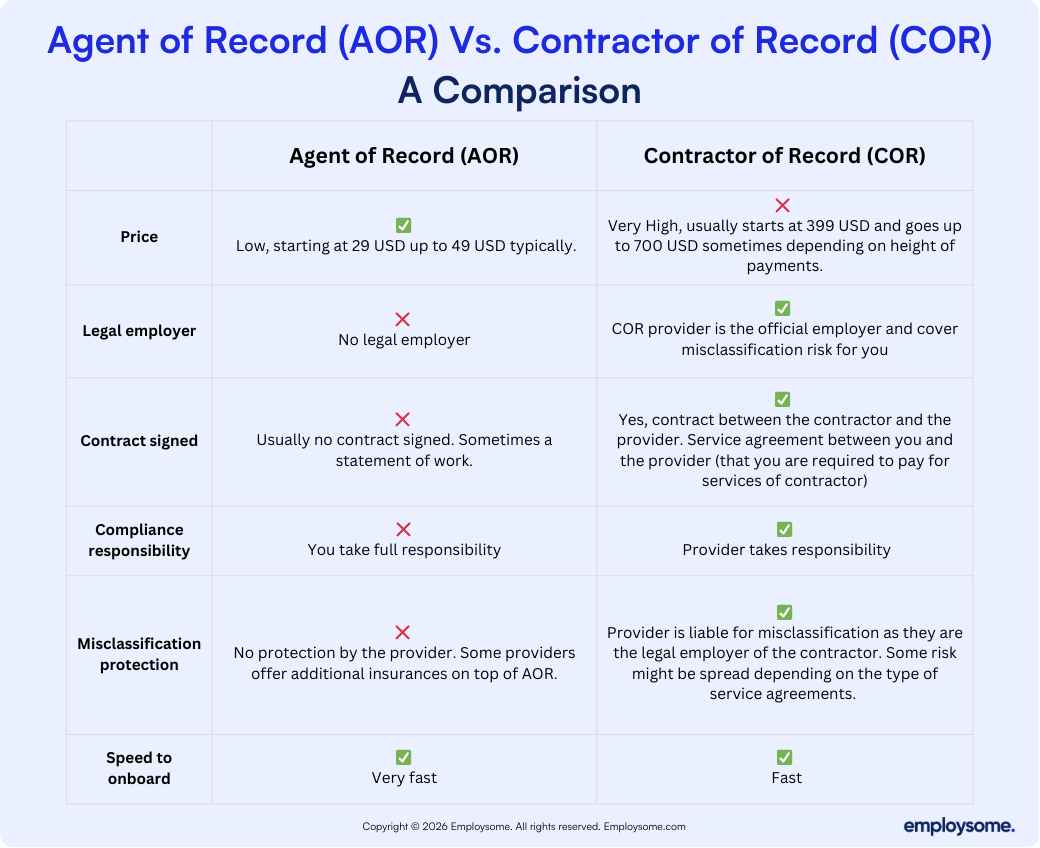
A COR is fundamentally different from an AOR because the COR provider becomes the legal employer of the contractor, taking over responsibility for contracts, tax handling, and misclassification risk. While COR is more expensive than AOR, it significantly reduces legal exposure by shifting compliance and employment liability away from the client company.
In short, COR trades higher cost for stronger protection, making it the safer choice when contractor classification risk is high or regulations are unclear.
💡 Employsome Tip: Consider case by case misclassification risk
If your misclassification risk is low, an AOR setup can be the most cost-efficient option.
If the risk is medium to high, move to Contractor of Record – but keep in mind it’s significantly more expensive. At that point, it often makes sense to consider EOR instead – the price is usually similar to COR, but you eliminate misclassification risk entirely (with the trade-off of standard employer costs).
Agent of Record (AOR) Pros and Cons
Lower cost than EOR or COR: Low service feees and no employer social contributions, benefits, or statutory employer taxes – you only pay the low fee.
Fast to set up: Ideal for quick contractor engagements without entity setup or long onboarding cycles.
High flexibility: Easy to scale contractors up or down with minimal legal friction.
Good for low-risk markets: Works well where contractor classification rules are clear and enforcement is light (e.g. across Africa, South East Asia).
Misclassification risk: Legal responsibility still sits with you, not the AOR; audits and penalties are your problem (e.g. high risk across Central Europe).
Not suitable for long-term hires: Extended contractor use can trigger red flags with tax and labor authorities.
Few employee-style benefits: No access to statutory benefits, pensions, or social security coverage.
Agent of Record (AOR) – Final Verdict & Hiring Recommendation
An AOR is a smart, cost-efficient option for companies working with international contractors when speed, flexibility matters and you do not want to spend hundrets of dollars for extra legal protection. It works best for short-term or project-based engagements in countries where contractor rules are clear and misclassification risk is relatively low.
For example, hiring a contractor in Thailand can work well under an AOR setup as the country has low misclassification risk. In Germany, on the other hand, the same approach carries much higher risk and should only be considered very carefully for project based work, if at all.
That’s why AOR decisions should always be made case by case, based on a proper misclassification risk assessment. One important reality to be aware of: many EOR providers have little financial incentive to recommend AOR. It’s a low-margin service, and sales teams often push clients toward COR or EOR instead, because that’s where providers make most of their money.
Still, AOR is not a compliance shield. As soon as a contractor becomes long-term, business-critical, or operates in a tightly regulated labor market, the risk can quickly outweigh the savings. In those situations, moving to COR – or even directly to EOR – often makes more sense. The price difference is usually smaller than expected, while the legal protection is significantly stronger. Some providers offer misclassification insurance, but this should be seen as a last line of defense, not a substitute for choosing the right employment model from the start.

Written by
Christa is a Copywriter at Employsome with 17 years of professional writing experience across global brands, startups, and online publications. A native English-Finnish writer, she brings strong editorial skills and a versatile background in business, SaaS, and finance. At Employsome, Christa focuses on clear, practical content about HR, payroll, and Employer of Record topics.
Our content is created for informational purposes only and is not intended to provide any legal, tax, accounting, or financial advice. Please obtain separate advice from industry-specific professionals who may better understand your business’ needs. Read our Editorial Guidelines for further information on how our content is created.