Insiders #3 with SOS: Why the Philippines Wins in Global Hiring
Martin English of Smart Outsourcing Solution breaks down the Philippines EOR market, pricing transparency, AI offshore staffing, and why specialist providers keep winning against global platforms.

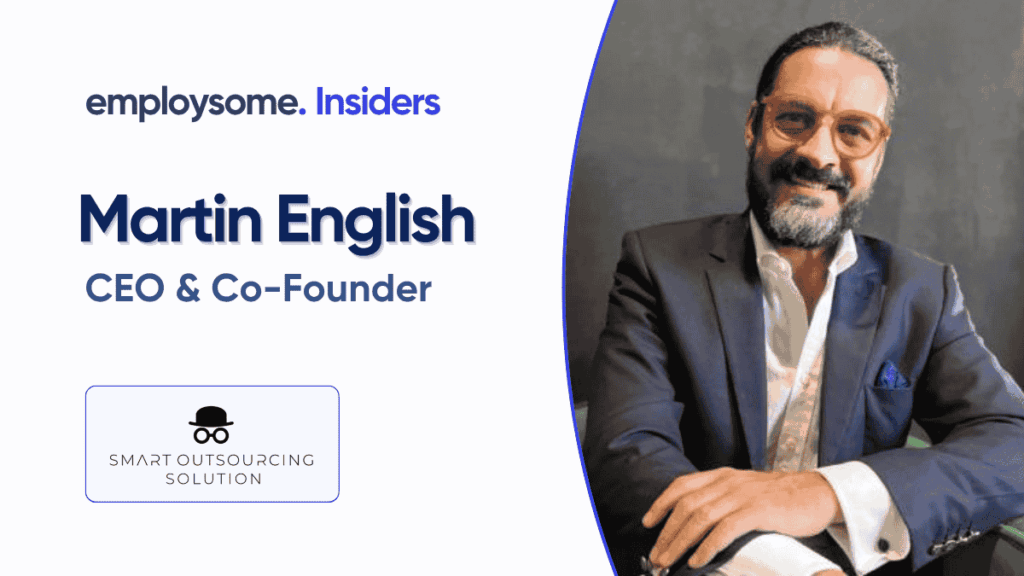
Table of Contents
- How SOS Started
- Philippines as a Top Destination for EOR
- Common Mistakes Foreign Companies Make
- How SOS Competes Against Global EORs
- SOS' $190 Per Employee Model
- When Companies Graduate from EOR to Their Own Entity
- How AI Is Reshaping Philippine Outsourcing and EOR Operations
- Running Bootstrapped
- Where the Philippine EOR Market Is Heading
- About the Series
The Employer of Record market has exploded over the past five years, but the Philippines has been an outsourcing powerhouse for decades. The country produces over 500,000 college graduates annually, has near-native English proficiency across professional roles, and sits in a time zone that overlaps with both APAC and late US hours. For companies looking to hire employees internationally, the Philippines consistently ranks among the most cost-effective and operationally mature destinations in the world.
Smart Outsourcing Solution (SOS) launched in 2017, before most companies had heard the term Employer of Record. Founded by Martin English, a strategy consultant with twenty years of international experience, and Philip, a BPO veteran who has managed teams of up to 10,000 in the Philippines, SOS is a specialist provider that focuses exclusively on one market. No global platform play. No 180-country coverage map. Just the Philippines, done properly.
We sat down with Martin to discuss how SOS operates, why regional specialists keep outperforming global platforms on the ground, and where AI fits into the Philippine outsourcing picture.

How Smart Outsourcing Solution Started in the Philippine EOR Market
Martin spent two decades advising companies across Europe, Southeast Asia, Australia and the US on operations, performance improvement and outsourcing strategy. He saw the same pattern repeat: companies wanted to build teams in the Philippines but found the mechanics of hiring there unnecessarily complex. The market at the time offered two extremes, large BPO providers requiring substantial contracts, or recruitment firms that could source candidates but could not provide compliant employment structures.
“There was a clear gap for a more flexible model. One that allowed companies to hire talent quickly while remaining fully compliant with Philippine labour law. When we launched SOS in 2017, the Employer of Record category was not widely recognised. The remote work boom after COVID accelerated adoption dramatically, but the underlying need for flexible global hiring had already been building for years.”
Martin English, Co-founder, Smart Outsourcing Solution
His co-founder Philip brings complementary depth. Three decades running large-scale BPO operations, including senior leadership roles supporting Qantas and Telstra, give SOS the kind of operational muscle that pure-play EOR platforms struggle to replicate.
“I tend to focus on the strategic needs of international clients, how offshore teams fit into their business model and growth plans, while Phil brings deep operational expertise in building and managing high-performing teams locally. That balance allows us to remain very hands-on with clients while maintaining strong operational discipline.”
Martin English, Co-founder, Smart Outsourcing Solution
What Makes the Philippines a Top Destination for EOR
The Philippines has long been associated with customer experience and BPO roles, but the talent mix is shifting fast. Companies are now sourcing software development, digital marketing, finance operations, executive support and data analysis talent from the country. For businesses evaluating the best countries to hire developers, the Philippines increasingly appears alongside Vietnam and India as a top-tier option.
“The Philippines has long been associated with customer experience roles, but the talent mix is evolving rapidly. We are seeing increasing demand for software development, digital marketing, finance operations, executive support, data analysis and other knowledge-based roles. As remote work becomes normalised, companies are less focused on geography and more focused on accessing talent wherever it exists.”
Martin English, Co-founder, Smart Outsourcing Solution
Philippine labour law is structured and employee-protective, which is precisely why working with a specialist EOR provider matters. The country mandates 13th-month pay, minimum wage compliance at regional level, SSS, PhilHealth and Pag-IBIG contributions, and specific termination protections. Getting any of this wrong exposes companies to employee misclassification risk.
💡 Employsome Insight
The Philippines uses a regional minimum wage system. Daily rates vary significantly across 17 regions. For example, the NCR (Metro Manila) rate is substantially higher than rates in the Visayas or Mindanao. Any EOR operating in the Philippines must track and apply the correct regional rate for each employee. Compare Philippines EOR providers on Employsome to see which ones handle regional compliance properly.

Common Mistakes Foreign Companies Make When Hiring in the Philippines
Martin is blunt about where companies go wrong. The most common issue is treating Philippine hiring like domestic hiring. Companies try to use contractor arrangements or informal setups that violate local labour law. The second mistake is treating offshore teams as peripheral to the organisation. And the third is underestimating the quality of available talent.
“The most common mistake is assuming international hiring works the same as hiring domestically. Philippine labour law is structured and employee-protective, and companies that try to use contractor models or informal arrangements often run into compliance issues.”
Martin English, Co-founder, Smart Outsourcing Solution
“Another mistake is treating offshore teams as peripheral to the organisation. The companies that succeed are those that integrate their Philippine teams fully into their operations.”
Martin English, Co-founder, Smart Outsourcing Solution
This integration point is worth underlining. Companies that treat EOR-employed staff as fully embedded team members, with the same access to tools, communication channels and career development as onshore staff, consistently get better retention and output. The EOR handles the employment infrastructure. The client company handles the work relationship. When those two sides operate well together, the model works. For a deeper look at how this works structurally, see our guide on how Employer of Record is changing the hiring market.
How SOS Competes Against Global EOR Platforms Like Deel and Remote
The global EOR market is increasingly dominated by well-funded platforms like Deel, Remote and Multiplier. These companies have raised hundreds of millions in venture capital and compete on breadth: 150+ countries, slick dashboards, fast onboarding. So how does a bootstrapped, single-country specialist compete?
Martin’s answer is straightforward: depth beats breadth in the markets that matter most.
“The biggest difference is that SOS is a specialist rather than a platform designed to cover the entire world. We focus deeply on the Philippines and operate as a founder-led organisation where clients have direct access to experienced operators.”
Martin English, Co-founder, Smart Outsourcing Solution
This is a pattern we see across the EOR provider landscape. Global platforms often rely on in-country partners to deliver services in specific markets. The client signs with the platform, but the actual employment, payroll and compliance execution is handled by a local third party. Specialist providers like SOS cut out that middleman layer. The result is typically faster response times, deeper compliance knowledge and more competitive pricing.
“What we have seen is that once companies decide to hire in the Philippines, they often prefer working with a specialist provider that understands the local market in depth rather than a platform designed to cover dozens of countries.”
Martin English, Co-founder, Smart Outsourcing Solution
💡 Employsome Insight
Many global EOR providers use third-party partners for Philippine operations. This adds a markup layer and can slow down issue resolution. When comparing providers, always ask whether the EOR operates through its own entity or a local partner. Our owned entity vs. in-country partner guide explains the trade-offs in detail.
EOR Pricing Transparency & the $190 Per Employee Model
EOR pricing is notoriously intransparent. Most global providers quote anywhere from $299 to $799 per employee per month, with additional costs for onboarding, offboarding, benefits administration and currency conversion markups often buried in the fine print. For a full breakdown, see our EOR cost guide. SOS takes a different approach.
“Our pricing model is intentionally transparent. At around $190 per employee per month, clients receive employment infrastructure, payroll, statutory compliance, HR support and recruitment assistance. Because we operate efficiently and focus on one market, we can maintain a very competitive price point without compromising compliance or service quality.”
Martin English, Co-founder, Smart Outsourcing Solution
$190 per employee per month is well below the industry average. For context, the median EOR cost across global providers typically falls between $400 and $700 per employee per month. Single-country specialists can operate leaner because they do not carry the overhead of maintaining legal entities, compliance teams and partner networks across 100+ countries.
When Companies Graduate from EOR to Their Own Entity
One question that comes up in every EOR evaluation: at what point does it make sense to stop using an EOR and set up your own legal entity? Martin sees this as a natural and positive progression rather than a threat to SOS’s business.
“Many companies initially use EOR as a fast way to enter the market. As their teams grow, they may decide to establish their own local entity. When that happens, we support the transition through a Build-Operate-Transfer model. From our perspective, that is a positive outcome because it means the client’s operations have grown successfully.”
Martin English, Co-founder, Smart Outsourcing Solution
The Build-Operate-Transfer (BOT) model is increasingly common in the Philippine outsourcing market. The EOR handles the initial setup, hiring and operations. Once the client reaches a certain scale, typically 20 to 50 employees, the EOR helps transfer the team to the client’s own entity. For companies weighing the pros and cons of EOR, the BOT option offers a clear exit path that reduces long-term dependency on a third party.
How AI Is Reshaping Philippine Outsourcing and EOR Operations
SOS recently expanded into AI offshore resources, data annotation and schema services. This is not a pivot away from EOR. It is an extension of the same thesis: the Philippines has disciplined, English-proficient teams that can support complex operational work at scale. AI just creates a new category of that work.
“AI is creating entirely new operational roles. Tasks such as data annotation, training datasets, AI workflow management and structured data optimisation require disciplined teams operating at scale. The Philippines has a long history of supporting digital operations for global companies, so it is well positioned to support AI-related work as well.”
Martin English, Co-founder, Smart Outsourcing Solution
This is worth paying attention to. As AI adoption accelerates, the demand for human-in-the-loop operations, model training, data labelling and quality assurance is growing fast. These roles require the same qualities that made the Philippines a BPO leader: attention to detail, strong English communication, process discipline and the ability to operate in global team structures. Companies hiring for these roles through an EOR get the speed and compliance benefits of the EOR model without the overhead of building local infrastructure from scratch.
“Historically, the Philippines has adapted well to shifts in the outsourcing industry, and we expect it to remain a major hub for global digital operations.”
Martin English, Co-founder, Smart Outsourcing Solution
Running a Bootstrapped EOR Without Venture Capital
In a market where Deel has raised over $680 million, Remote over $490 million and Multiplier over $130 million, SOS stands out as a founder-funded operation. Martin is candid about the trade-offs.
“Operating without venture capital allows us to focus on long-term relationships rather than short-term growth metrics. It means we can prioritise service quality and sustainable growth rather than scaling aggressively at any cost. The trade-off is that growth tends to be more measured, but it also means we maintain independence in how we run the business.”
Martin English, Co-founder, Smart Outsourcing Solution
This is a meaningful distinction in the EOR space. VC-backed providers are under pressure to grow headcount, expand country coverage and drive top-line revenue. That pressure can lead to over-promising on compliance capabilities, rushing into new markets through partners, or pushing pricing models that are not sustainable. Bootstrapped providers like SOS do not face those incentives. The result is typically slower growth but higher client retention and more consistent service delivery.
💡 Employsome Insight
When evaluating EOR providers, it is worth understanding their funding model. VC-backed providers may offer aggressive pricing to win market share, but watch for hidden costs, FX markups and partner-layer quality issues. Bootstrapped specialists often deliver better per-employee economics over time. Our real-time EOR comparison tool lets you compare pricing transparently across 125+ providers.
Where the Philippine EOR Market Is Heading
Martin sees continued growth in EOR demand for the Philippines, driven by three tailwinds: the normalisation of distributed workforces, the expansion of AI-related roles, and the maturity of the Philippine talent pool in knowledge-based functions beyond traditional BPO.
“Our focus is on strengthening our position as a specialist partner for companies building teams in the Philippines. We expect continued growth in Employer of Record services while expanding into knowledge-based roles and AI-related operational support.”
Martin English, Co-founder, Smart Outsourcing Solution
SOS’s ideal client has also become more defined over time: companies that want to build long-term teams rather than engage in transactional outsourcing. That includes startups scaling globally, tech companies building distributed teams, and established organisations expanding their operational footprint into Southeast Asia.
“Focus on building trust and relationships early. In the outsourcing industry, reputation matters enormously. If you consistently deliver value to clients and support your teams well, sustainable growth tends to follow.”
Martin English, Co-founder, Smart Outsourcing Solution
—
Employsome Insiders is an interview series featuring the founders and leaders behind the EOR providers, PEO companies and global hiring platforms shaping the future of international employment. Each edition goes behind the product page to explore how these businesses actually operate, how they compete, and where the industry is heading. Read the full series on the Employsome blog.
About the Employsome Insiders Series
Employsome Insiders is an interview series featuring the founders and leaders behind the EOR providers, PEO companies and global hiring platforms shaping the future of international employment. Each edition goes behind the product page to explore how these businesses actually operate, how they compete, and where the industry is heading. Read the full series on the Employsome blog.

Written by
Christa is a Copywriter at Employsome with 17 years of professional writing experience across global brands, startups, and online publications. A native English-Finnish writer, she brings strong editorial skills and a versatile background in business, SaaS, and finance. At Employsome, Christa focuses on clear, practical content about HR, payroll, and Employer of Record topics.
Our content is created for informational purposes only and is not intended to provide any legal, tax, accounting, or financial advice. Please obtain separate advice from industry-specific professionals who may better understand your business’s needs. Read our Editorial Guidelines for further information on how our content is created.
Other posts
Read More Insiders