Minimum Wage in Thailand: The Complete 2026 Guide
Thailand’s 2026 minimum wage ranges from THB 337 to THB 400 per day depending on province, with Bangkok at the top. Combined with a social security ceiling increase and a new Employee Welfare Fund, total employer costs are rising. This guide breaks down the provincial wage grid, social security reform, total cost, overtime, income tax, and regional comparisons.

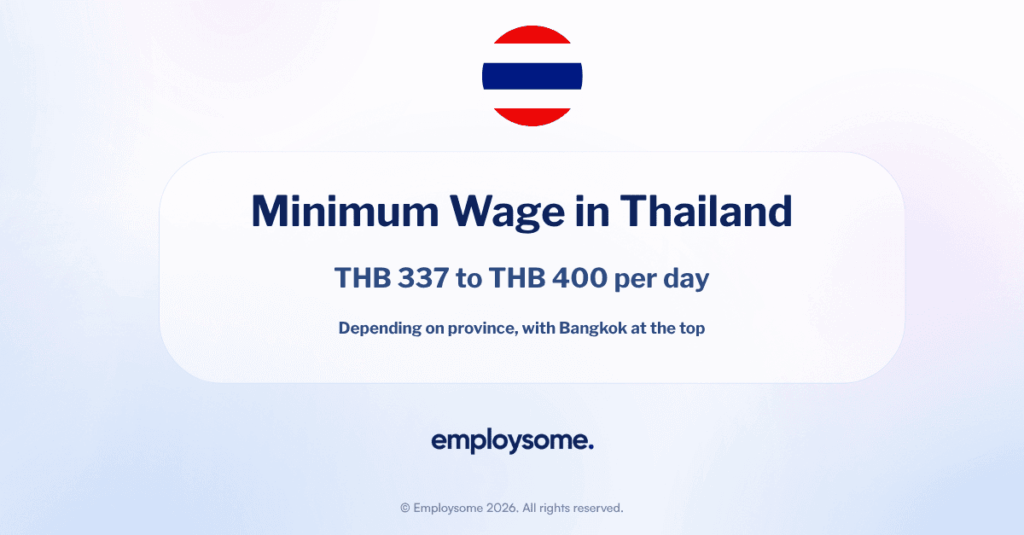
Thailand’s minimum wage is not a single number. It is a grid. The National Wage Committee sets different daily rates for different provinces, reviewed periodically and adjusted based on local cost of living, labour demand, and economic activity. As of 2026, daily rates range from THB 337 to THB 400 (~USD 9.70 to $11.55), with Bangkok, Phuket, Chonburi, Rayong, Chachoengsao, and Koh Samui at the top of the scale.
The headline wage changes are only part of the 2026 story. Starting 1 January, the social security wage ceiling increased from THB 15,000 to THB 17,500, raising the maximum monthly employer contribution from THB 750 to THB 875. This is phase one of a three-phase reform that will push the ceiling to THB 23,000 by 2032. On top of that, a new Employee Welfare Fund (EWF) is scheduled to launch in October 2026, adding another mandatory contribution layer. For international employers, the cost of hiring in Thailand is going up, and the compliance requirements are getting more complex.
This guide covers the provincial wage grid, the social security reform, total employer costs, overtime rules, income tax, and how an Employer of Record handles Thai payroll compliance.

Minimum Wage by Province: The 2026 Grid
Thailand’s minimum wage is set per day, not per hour or per month. The Labour Protection Act requires a minimum of 8 hours per day and a maximum of 48 hours per week. Monthly equivalents depend on the number of working days (typically 26 per month).
|
Province / Area |
Daily Rate (THB) |
Monthly (~26 days) |
Approx USD/mo |
|
Bangkok |
400 |
~10,400 |
~$300 |
|
Phuket |
400 |
~10,400 |
~$300 |
|
Chonburi |
400 |
~10,400 |
~$300 |
|
Rayong |
400 |
~10,400 |
~$300 |
|
Chachoengsao |
400 |
~10,400 |
~$300 |
|
Koh Samui (Surat Thani) |
400 |
~10,400 |
~$300 |
|
Nonthaburi, Pathum Thani, Samut Prakan |
370 to 380 |
~9,620 to 9,880 |
~$277 to 285 |
|
Chiang Mai, Nakhon Ratchasima |
365 to 370 |
~9,490 to 9,620 |
~$274 to 277 |
|
Khon Kaen, Udon Thani |
355 to 365 |
~9,230 to 9,490 |
~$266 to 274 |
|
Narathiwat, Pattani, Yala (Deep South) |
337 |
~8,762 |
~$253 |
The THB 400 rate also applies nationally to hotels (type 2, 3, and 4 under the Hotel Act) and entertainment establishments, regardless of province. A hotel in Chiang Mai with a general provincial rate of THB 370 must still pay THB 400 if it falls under the Hotel Act classification. This sector-specific rule catches many employers off guard.
The government’s stated policy target is THB 600 per day by 2027, but the current trajectory suggests a more modest path. The jump from THB 370 to 400 for Bangkok in July 2025 was the most significant recent increase. Whether the 600 target materialises will depend on economic conditions and political dynamics.
💡 Employsome Insight: The Provincial Rate Sets a Floor, Not a Ceiling
In practice, the minimum wage matters most for manufacturing, agriculture, hospitality, and unskilled service roles. Professional roles in Bangkok (tech, finance, consulting) typically pay THB 20,000 to 50,000+ per month, well above the minimum. But the minimum wage still affects employer costs indirectly because social security contributions, overtime calculations, and holiday pay premiums are all calculated relative to the daily wage. A minimum wage increase ripples through the entire payroll.
The 2026 Social Security Reform: Higher Ceiling, Higher Costs
This is the change that matters most for international employers. Thailand’s social security contribution rate stays at 5% for employers and 5% for employees, but the wage ceiling used to calculate those contributions increased on 1 January 2026:
|
Phase |
Period |
Max Wage Ceiling |
Max Monthly Contribution (per party) |
|
Previous |
Until Dec 2025 |
THB 15,000 |
THB 750 |
|
Phase 1 |
Jan 2026 to Dec 2028 |
THB 17,500 |
THB 875 |
|
Phase 2 |
Jan 2029 to Dec 2031 |
THB 20,000 |
THB 1,000 |
|
Phase 3 |
Jan 2032 onwards |
THB 23,000 |
THB 1,150 |
For an employee earning THB 20,000/month, the employer’s monthly social security contribution increased from THB 750 to THB 875 in January 2026, an increase of THB 125/month or THB 1,500/year per employee. For a team of 50, that is THB 75,000/year in additional cost, just from the ceiling change.
The reform also increased benefit entitlements: sickness and disability compensation rose from THB 7,500 to THB 8,750/month, maternity benefits from THB 22,500 to THB 26,250 per birth, and the death benefit from THB 90,000 to THB 105,000. Pension benefits also increased for long-term contributors.
Total Employer Cost in Thailand
|
Contribution (2026) |
Employer |
Employee |
|
Social Security Fund (SSF) |
5% (max THB 875/mo) |
5% (max THB 875/mo) |
|
Provident Fund (voluntary) |
2 to 15% (if offered) |
2 to 15% (matched) |
|
Employee Welfare Fund (from Oct 2026) |
TBD (expected ~0.2 to 0.5%) |
TBD |
|
Workmen’s Compensation Fund |
0.2 to 1.0% (industry-dependent) |
0% |
|
Total mandatory employer cost |
~5.2 to 6% |
~5% |
Thailand’s mandatory employer social security contributions are among the lowest in Asia at roughly 5 to 6%. For comparison, South Korea is 10 to 11%, China is 30 to 40%, and Vietnam is 21 to 22%. This makes Thailand attractive on total cost, even though the minimum wage itself is not the cheapest in the region.
The Employee Welfare Fund (EWF), originally planned for October 2025 but postponed to October 2026, will add another mandatory contribution for both employers and employees. Details are still being finalised, but early indications suggest rates in the 0.2 to 0.5% range. Combined with the SSF ceiling increase, 2026 is a double-hit year for employer cost planning.
💡 Employsome Insight: The Provident Fund Is Where Competitiveness Lives
The mandatory SSF contribution is a baseline, not a differentiator. What separates competitive employers in Thailand is the voluntary Provident Fund (similar to a 401k or company pension). Most multinationals and large Thai companies offer 5 to 10% employer matching. If your EOR offers only the statutory minimum with no Provident Fund option, your employees will notice. Ask your EOR whether they can set up a Provident Fund through their entity, and what the administrative cost is.
Working Hours, Overtime, and Leave
|
Rule |
Details |
|
Standard workday |
8 hours/day maximum. 7 hours for hazardous work. |
|
Standard workweek |
48 hours/week maximum. 42 hours for hazardous work. |
|
Overtime premium |
1.5x hourly rate for regular overtime. |
|
Holiday work |
1x additional daily wage (2x total). |
|
Holiday overtime |
3x hourly rate. |
|
Maximum overtime |
36 hours per week. Employee must consent in writing. |
|
Annual leave |
Minimum 6 days after 1 year of service. Most employers offer 10 to 15 days. |
|
Sick leave |
Up to 30 days paid per year (employer pays). Medical certificate required for 3+ consecutive days. |
|
Public holidays |
13 mandatory paid holidays per year (minimum). |
|
Maternity leave |
98 days (45 days employer-paid, remainder through SSF). Increased from 90 days under 2025 Labour Protection Act amendment. |
|
Paternity leave |
15 days paid (newly introduced under 2025 amendment). |
|
Severance |
30 days to 400 days of wages depending on tenure (120 days for 1 to 3 years, up to 400 days for 20+ years). |
|
Notice period |
One full pay period (typically 30 days). Can be waived with payment in lieu. |
Thailand’s 98-day maternity leave and newly introduced 15-day paid paternity leave (effective 2025) are both recent changes under the amended Labour Protection Act. The maternity benefit is split: the employer pays for 45 days, and the Social Security Fund covers the remaining 53 days at a capped rate. For companies hiring employees internationally, the severance schedule is the most important table to internalise. Thailand’s severance obligations are uncapped and escalate steeply with tenure.
Employee Income Tax
|
Annual Taxable Income (THB) |
Tax Rate |
|
Up to 150,000 |
Exempt |
|
150,001 to 300,000 |
5% |
|
300,001 to 500,000 |
10% |
|
500,001 to 750,000 |
15% |
|
750,001 to 1,000,000 |
20% |
|
1,000,001 to 2,000,000 |
25% |
|
2,000,001 to 5,000,000 |
30% |
|
Over 5,000,000 |
35% |
A minimum-wage worker in Bangkok earning THB 10,400/month (THB 124,800/year) falls below the THB 150,000 exemption threshold and pays no income tax. A professional earning THB 30,000/month pays an effective rate of roughly 3 to 5% after personal deductions and the SSF deduction. Thailand’s income tax burden is low by international standards, which makes gross salary comparisons more favourable than they appear.
How Thailand Compares in Southeast Asia
|
Country |
Min Wage (USD/mo) |
Workweek |
Employer SI |
Severance |
Key 2026 Change |
|
Thailand (Bangkok) |
~$300 |
48 hrs |
~5 to 6% |
30 to 400 days |
SSF ceiling to THB 17,500 |
|
Vietnam (Region I) |
~$206 |
48 hrs |
~21 to 22% |
None (insurance) |
Decree 219 work permits |
|
Philippines (NCR) |
~$225 |
48 hrs |
~10 to 12% |
15 to 30 days/yr |
SSS rate increase |
|
Malaysia |
~$340 |
45 hrs |
~13% (EPF) |
10 to 20 days/yr |
EPF rate review |
|
Indonesia (Jakarta) |
~$310 |
40 hrs |
~11 to 12% |
Complex formula |
BPJS adjustment |
|
Singapore |
No statutory |
44 hrs |
~17% (CPF) |
None |
Retirement age to 64 |
Thailand’s total employer cost (5 to 6% social security + no mandatory pension beyond SSF) is the lowest in this comparison. Malaysia’s EPF at 13%, Vietnam’s combined social insurance at 21 to 22%, and Singapore’s CPF at 17% all exceed Thailand’s mandatory burden significantly. This makes Thailand one of the most cost-effective hiring markets in Asia for companies that do not need to offer supplementary benefits. The trade-off is that the statutory safety net is thinner, and competitive employers fill the gap with voluntary Provident Funds and private health insurance.
How an EOR Handles Thailand Payroll Compliance
An Employer of Record in Thailand operates as the legal employer on behalf of your company. The EOR holds the Thai entity, registers with the Social Security Office, files monthly contributions, calculates withholding tax, manages the Workmen’s Compensation Fund, and handles statutory leave entitlements. Your company retains day-to-day management of the employee while the EOR owns the compliance stack.
For the 2026 changes specifically, your EOR should have updated the SSF ceiling from THB 15,000 to 17,500 in January payroll, adjusted all contribution calculations accordingly, and flagged the upcoming EWF obligation in October. If your EOR hasn’t communicated these changes proactively, that is a signal. The pros and cons of using an EOR come down to whether the provider actually stays ahead of regulatory changes or simply processes payroll on autopilot.
Thailand does not require a permanent establishment exemption for EOR arrangements, but the legal structure matters. Some EOR providers use their own Thai entity, while others rely on in-country partners. Own-entity EORs give you more control over compliance and data. Partner-model EORs can be faster to set up but introduce a third party into the employment relationship. Either way, the EOR is liable for all statutory obligations including the new SSF ceiling and the forthcoming EWF.
If you are evaluating providers, the best global EOR rankings on Employsome rate each provider on pricing transparency, local entity ownership, and onboarding speed across 100+ countries including Thailand.
Frequently Asked Questions
Thailand’s minimum wage ranges from THB 337 to THB 400 per day depending on the province. Bangkok, Phuket, Chonburi, Rayong, Chachoengsao, and Koh Samui all sit at the THB 400 rate. The lowest rate (THB 337) applies in Narathiwat, Pattani, and Yala in the Deep South.
It is set per day, not per hour or per month. Monthly equivalents are calculated by multiplying the daily rate by the number of working days (typically 26). A THB 400 daily rate translates to roughly THB 10,400 per month.
The wage ceiling for social security contributions increased from THB 15,000 to THB 17,500 on 1 January 2026. The contribution rate stays at 5% for both employer and employee, but the maximum monthly contribution per party rose from THB 750 to THB 875.
On total employer cost, yes. Thailand’s mandatory social insurance burden is roughly 5 to 6%, compared to 21 to 22% in Vietnam and 10 to 12% in the Philippines. The minimum wage itself is higher than both, but the lower contribution rates make total cost competitive.
Some can, some cannot. EORs with their own Thai entity are more likely to offer Provident Fund administration. Ask specifically whether the Provident Fund is offered through their entity or requires a separate arrangement. You can switch EOR providers if your current one does not support it.
Severance in Thailand is tenure-based and ranges from 30 days of wages (under 120 days of service) to 400 days of wages (20+ years of service). There is no statutory cap. This makes long-tenured terminations expensive and is one of the key compliance risks for international employers.

Written by
Christa is a Copywriter at Employsome with 17 years of professional writing experience across global brands, startups, and online publications. A native English-Finnish writer, she brings strong editorial skills and a versatile background in business, SaaS, and finance. At Employsome, Christa focuses on clear, practical content about HR, payroll, and Employer of Record topics.
Our content is created for informational purposes only and is not intended to provide any legal, tax, accounting, or financial advice. Please obtain separate advice from industry-specific professionals who may better understand your business’s needs. Read our Editorial Guidelines for further information on how our content is created.
Other posts
Along with our standard maps we offer highly customizable maps.