Average Salary in Turkey 2026: What Employers Pay
The average salary in Turkey in 2026 sits around TRY 30,000 to 45,000 per month gross, depending on industry, city, and experience. With a minimum wage of TRY 33,030 gross and employer social security costs of roughly 22.5%, understanding the full cost picture matters for any company hiring in Turkey. This guide covers salaries by role, city, and sector, plus income tax, employer costs, and how Turkey compares regionally.

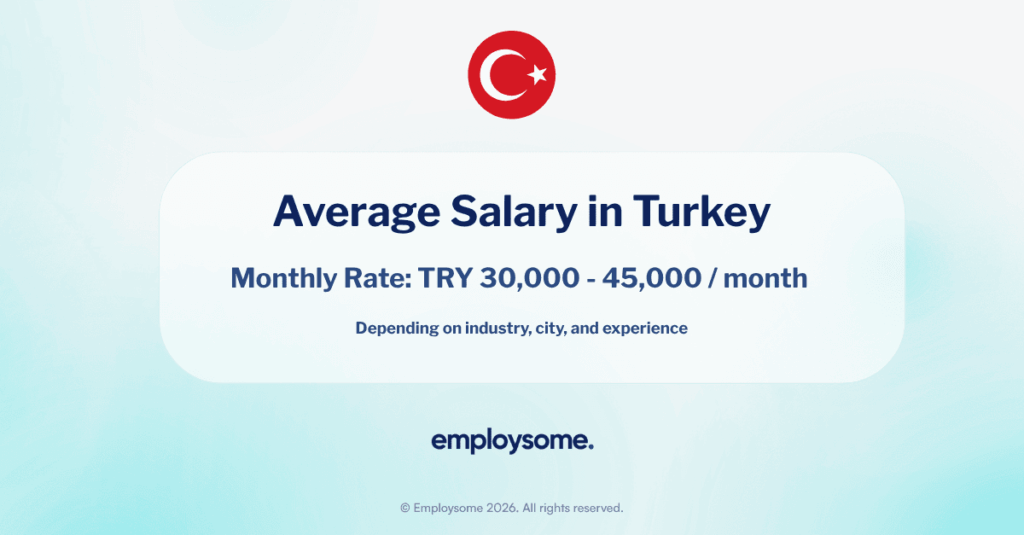
The average salary in Turkey is one of those numbers that looks straightforward until you actually try to use it. Depending on the source, you will find figures ranging from TRY 20,000 to TRY 45,000 per month gross. The spread exists because Turkey’s labour market is split between a minimum-wage-heavy base (more than a third of the 30 million workforce earns the minimum) and a fast-growing professional class in Istanbul, Ankara, and Izmir where tech, finance, and engineering salaries have climbed sharply.
As of January 2026, the gross minimum wage is TRY 33,030 per month. That number matters beyond entry-level roles because it sets the floor for social security contributions, shapes employer cost calculations, and determines eligibility thresholds for foreign work permits. On the employer side, mandatory contributions add roughly 22.5% on top of gross salary, pushing the true cost of a TRY 50,000/month hire to over TRY 61,000.
This guide breaks down the average salary in Turkey by role, industry, city, and experience level. It also covers income tax brackets, total employer cost, and how Turkish salaries compare to neighbouring markets. If you are hiring employees internationally and considering Turkey, the numbers here will help you benchmark compensation and budget accurately.

Average Salary in Turkey by Role (2026)
The table below shows gross monthly salaries for common professional roles. These are mid-career figures for candidates with 3 to 7 years of experience, based on market data from Istanbul and Ankara. Salaries in smaller cities run 20 to 40% lower.
|
Role |
Gross Monthly (TRY) |
Approx USD |
Market Demand |
|
Software Engineer |
TRY 55,000 to 85,000 |
~$1,550 to 2,400 |
High demand |
|
Data Analyst |
TRY 40,000 to 60,000 |
~$1,130 to 1,700 |
Growing |
|
Product Manager |
TRY 70,000 to 110,000 |
~$1,980 to 3,100 |
High demand |
|
Marketing Specialist |
TRY 35,000 to 55,000 |
~$990 to 1,550 |
Moderate |
|
HR Manager |
TRY 60,000 to 95,000 |
~$1,700 to 2,700 |
Moderate |
|
Accountant |
TRY 35,000 to 50,000 |
~$990 to 1,400 |
Stable |
|
Customer Support |
TRY 33,000 to 45,000 |
~$930 to 1,270 |
High volume |
|
Sales Manager |
TRY 55,000 to 90,000 |
~$1,550 to 2,540 |
Performance-based |
|
Mechanical Engineer |
TRY 45,000 to 70,000 |
~$1,270 to 1,980 |
Moderate |
|
Graphic Designer |
TRY 30,000 to 45,000 |
~$850 to 1,270 |
Competitive |
USD conversions use a rate of approximately TRY 35.5 to $1, which reflects early 2026 market rates. Turkey’s currency has been volatile, so dollar equivalents shift. For compensation planning, anchor to the TRY figure and treat USD as directional.
💡 Employsome Insight: The Minimum Wage Is the Market for a Third of the Workforce
Over 10 million workers in Turkey earn the minimum wage. That is not a rounding error. It means the TRY 33,030 gross figure shapes entire sectors: retail, hospitality, agriculture, and much of manufacturing. Professional salaries in Istanbul may be three to four times the minimum, but the median Turkish worker is much closer to the floor than the average suggests. When benchmarking for roles that compete with this pool, keep in mind that even small premiums above the minimum attract strong candidate pipelines.
Average Salary by City
Istanbul dominates Turkish salary data because it generates roughly a third of the country’s GDP and hosts the headquarters of most multinationals and tech companies. Ankara runs second as the administrative capital with a concentration of government, defence, and consulting roles. Izmir, Bursa, and Antalya follow, each with distinct sector strengths.
|
City |
Avg Gross Monthly (TRY) |
Typical Rent (1-bed) |
Key Sectors |
|
Istanbul |
TRY 40,000 to 55,000 |
TRY 15,000 to 22,000 |
Tech, finance, trade |
|
Ankara |
TRY 35,000 to 48,000 |
TRY 12,000 to 17,000 |
Government, defence, IT |
|
Izmir |
TRY 33,000 to 42,000 |
TRY 10,000 to 15,000 |
Petrochemicals, export |
|
Bursa |
TRY 33,000 to 40,000 |
TRY 9,000 to 13,000 |
Automotive, manufacturing |
|
Antalya |
TRY 33,000 to 38,000 |
TRY 8,000 to 12,000 |
Tourism, hospitality |
The cost-of-living gap between Istanbul and secondary cities is significant. A software engineer earning TRY 70,000 in Istanbul may have less disposable income than one earning TRY 50,000 in Ankara, simply because rent in central Istanbul has risen sharply. For remote-friendly roles, this opens an arbitrage: companies can offer competitive salaries in lower-cost cities and still save relative to Istanbul benchmarks.
Average Salary by Industry
|
Industry |
Gross Monthly Range (TRY) |
Market Notes |
|
Information Technology |
TRY 50,000 to 90,000 |
Strong, especially AI and cloud |
|
Finance & Banking |
TRY 45,000 to 85,000 |
Stable, regulated |
|
Automotive & Manufacturing |
TRY 35,000 to 60,000 |
Export-driven, cyclical |
|
Healthcare & Pharma |
TRY 40,000 to 70,000 |
Growing, medical tourism |
|
Tourism & Hospitality |
TRY 33,000 to 42,000 |
Seasonal, high volume |
|
Construction & Real Estate |
TRY 35,000 to 55,000 |
Project-based |
|
Education |
TRY 33,000 to 45,000 |
Public vs. private gap |
|
E-commerce & Retail |
TRY 35,000 to 55,000 |
Fast growth, competitive |
IT is the clear outlier. Senior software engineers, AI specialists, and cloud architects in Istanbul regularly exceed TRY 100,000/month gross, particularly at companies with international revenue streams or venture-backed startups that benchmark against European salaries. If you are building a distributed engineering team, Turkey offers a strong talent-to-cost ratio compared to Western Europe. Our best countries to hire developers index ranks Turkey highly on this metric.
Minimum Wage in Turkey (2026)
As of 1 January 2026, the gross minimum wage is TRY 33,030 per month. The net take-home is approximately TRY 27,001 after employee social security (14%) and unemployment insurance (1%) deductions. Minimum wage earners are fully exempt from income tax and stamp tax in 2026, which is a continuation of the policy introduced in 2022.
The minimum wage is revised annually (sometimes semi-annually during high inflation periods) by the Minimum Wage Determination Commission, a tripartite body with government, employer, and union representatives. The TRY 33,030 figure represents a 27% increase over the 2025 level of TRY 26,005.50. This is lower than the 49% increase from 2024 to 2025, reflecting moderating (though still elevated) inflation.
The standard workweek is 45 hours, spread across six days in most sectors. There is no separate hourly minimum wage statute; the daily minimum is TRY 33,030 divided by 30, which is TRY 1,101 per day. Overtime beyond 45 hours per week must be paid at 1.5x the standard hourly rate. Annual overtime is capped at 270 hours.
Total Employer Cost in Turkey
Gross salary is only part of the cost. Mandatory employer contributions in Turkey add roughly 22.5% on top, broken down as follows:
|
Contribution |
Standard Rate |
With Incentives |
|
Social security (SGK) employer share |
20.75% |
12% (with 2-point incentive for services) or 15.75% (with 5-point incentive for manufacturing) |
|
Unemployment insurance (employer) |
2% |
2% |
|
Total employer contributions |
~22.75% |
~14 to 17.75% (with incentives) |
|
Social security (SGK) employee share |
14% |
14% |
|
Unemployment insurance (employee) |
1% |
1% |
The social security ceiling for 2026 is TRY 297,270 per month (9x the minimum wage). Contributions are only calculated up to this ceiling. For most employees, the ceiling is irrelevant because salaries fall well below it, but for highly compensated executives and senior engineers, it caps the employer’s SGK exposure.
Manufacturing employers receive a 5-point SGK discount through the end of 2026, while service-sector employers receive a reduced 2-point discount under the 2026 restructuring of Treasury incentives (Law No. 7566). There is also a TRY 1,270/month minimum wage support credit per eligible employee, deducted from accrued SGK debt. For a full breakdown of how EOR pricing works and what these costs mean in practice, see our cost guide.
💡 Employsome Insight: Severance Is the Hidden Line Item
Turkey’s severance system is uniquely expensive. For every full year of service, an employee who is terminated without cause (or who resigns under qualifying conditions) is entitled to one month’s gross salary as severance, capped at TRY 44,536.34 per year of service in the first half of 2026. For a 10-year employee at the cap, that is TRY 445,363 in severance alone. There is no statutory provident fund or employer pension contribution yet (a mandatory supplementary pension system is planned for late 2026), so severance functions as the de facto retirement benefit. If you are hiring through an Employer of Record, confirm how severance accruals are handled and whether they are reflected in your monthly invoices.
Employee Income Tax Brackets (2026)
Turkey uses a progressive, cumulative income tax system. Tax is calculated on year-to-date earnings, which means an employee’s effective rate increases through the year as their cumulative income crosses into higher brackets. The brackets for wage income in 2026 (per Income Tax Communique No. 332):
|
Annual Cumulative Wage Income (TRY) |
Tax Rate |
|
Up to TRY 190,000 |
15% |
|
TRY 190,001 to 400,000 |
20% |
|
TRY 400,001 to 1,500,000 |
27% |
|
TRY 1,500,001 to 5,300,000 |
35% |
|
Over TRY 5,300,000 |
40% |
A minimum-wage earner (TRY 33,030/month gross, TRY 396,360/year) is fully exempt from income tax and stamp tax in 2026. For a professional earning TRY 60,000/month gross, the cumulative system means they start the year at 15%, move into the 20% bracket around month four, and hit 27% around month seven. The practical impact: net pay decreases month over month through the year as the marginal tax rate climbs. This is normal in Turkey and should be communicated clearly to employees during onboarding.
Stamp tax of 0.759% also applies to gross salary, though the minimum wage portion is exempt. For salaries above the minimum, the stamp tax applies only to the excess.
How Turkey Compares Regionally
|
Country |
Avg Gross Monthly (USD) |
Min Wage (USD) |
Employer SI |
Key Factor |
|
Turkey |
~$850 to 1,270 |
~$930 |
~22.5% |
Large talent pool, high inflation |
|
~$1,800 to 2,500 |
~$1,200 |
~20% |
EU access, stable currency |
|
|
~$1,200 to 1,800 |
~$830 |
~2.25% |
Low employer SI, IT hub |
|
|
~$2,200 to 3,000 |
~$1,400 |
~30% |
EU labour law, high SI |
|
|
Egypt |
~$300 to 600 |
~$130 |
~24% |
Low cost, large workforce |
|
Greece |
~$1,400 to 2,000 |
~$1,050 |
~22% |
EU, tourism-driven |
Turkey’s positioning is interesting. Nominal salaries in USD are lower than Central/Southern Europe, but employer social security costs are comparable (22.5% vs. 20 to 30% in the EU). Where Turkey wins is on the absolute numbers: a senior developer at $2,400/month fully loaded costs roughly $2,940, compared to $4,500+ for the same role in Spain. The trade-off is currency risk. The lira has depreciated consistently against the dollar, which can create retention pressure if employees benchmark their purchasing power in foreign currency.
Hiring in Turkey Through an Employer of Record
An Employer of Record in Turkey acts as the legal employer, handling SGK registration, monthly payroll declarations, income tax withholding, stamp tax, and severance accrual. You retain day-to-day management of the employee. The EOR carries the compliance liability.
For the salary data in this guide, the EOR implications are straightforward: the EOR should be able to tell you the exact total monthly cost for any given gross salary, including all mandatory contributions and its own fee. If a provider quotes you a flat fee without specifying how SGK, unemployment insurance, and severance provisions are handled, that is a red flag. The pros and cons of using an EOR often come down to this kind of transparency.
Turkey’s planned mandatory supplementary pension system (TES), expected in the second half of 2026, will add another employer contribution layer. Not all EOR providers are tracking this. If you are evaluating providers, the best EORs ranking on Employsome rate providers on exactly this kind of regulatory readiness.
Hiring in Turkey?
If you are looking to hire employees in Turkey without setting up a local entity, an Employer of Record handles SGK registration, payroll, income tax withholding, and severance compliance on your behalf. We have independently reviewed and ranked the top providers operating in the Turkish market. See our Best Employer of Record in Turkey ranking for pricing, entity ownership, onboarding speed, and compliance depth across 10+ providers.
Frequently Asked Questions
The average gross salary ranges from TRY 30,000 to 45,000 per month depending on industry, city, and experience. In Istanbul, professional roles average TRY 40,000 to 55,000. The national median is closer to TRY 35,000, pulled down by the large share of workers earning the minimum wage.
The gross minimum wage is TRY 33,030 per month as of January 2026. The net take-home is approximately TRY 27,001 after social security and unemployment insurance deductions. Minimum wage earners are exempt from income tax and stamp tax.
Total employer cost is the gross salary plus approximately 22.5% in mandatory contributions (SGK at 20.75% and unemployment insurance at 2%). Eligible employers in manufacturing can reduce this to roughly 17.75% through Treasury incentives. Severance provisions (one month per year of service, capped) should also be budgeted.
Yes, particularly for tech, customer support, and design roles. Turkey offers a large, educated, multilingual workforce at salary levels well below Western Europe. The time zone (GMT+3) overlaps well with both European and Middle Eastern business hours. Currency depreciation can create retention challenges, so building in regular salary reviews is important. You can compare EOR providers on Employsome to find the right partner for Turkish hiring.
Turkey uses a progressive cumulative system with rates from 15% to 40%. Tax is calculated on year-to-date earnings, so the effective rate increases through the calendar year. Minimum wage income is fully exempt from income tax and stamp tax in 2026.

Written by
Christa is a Copywriter at Employsome with 17 years of professional writing experience across global brands, startups, and online publications. A native English-Finnish writer, she brings strong editorial skills and a versatile background in business, SaaS, and finance. At Employsome, Christa focuses on clear, practical content about HR, payroll, and Employer of Record topics.
Our content is created for informational purposes only and is not intended to provide any legal, tax, accounting, or financial advice. Please obtain separate advice from industry-specific professionals who may better understand your business’s needs. Read our Editorial Guidelines for further information on how our content is created.
Other posts
Along with our standard maps we offer highly customizable maps.