Average Salary in Costa Rica 2026: By Sector, City & Costs
Costa Rica’s average salary is approximately ₡785,000 per month (~$1,500 USD) in 2026, with a median closer to ₡630,000 to ₡670,000. The country has Latin America’s highest minimum wage for unskilled workers (~$710 USD) and a tiered system that sets different minimums by occupational category. Employer costs are steep at ~26.67% in mandatory CCSS and social fund contributions, rising to 39 to 50% above gross when aguinaldo and vacation are included. This guide covers salaries by sector, city, and experience level, plus a full employer cost breakdown with worked example.

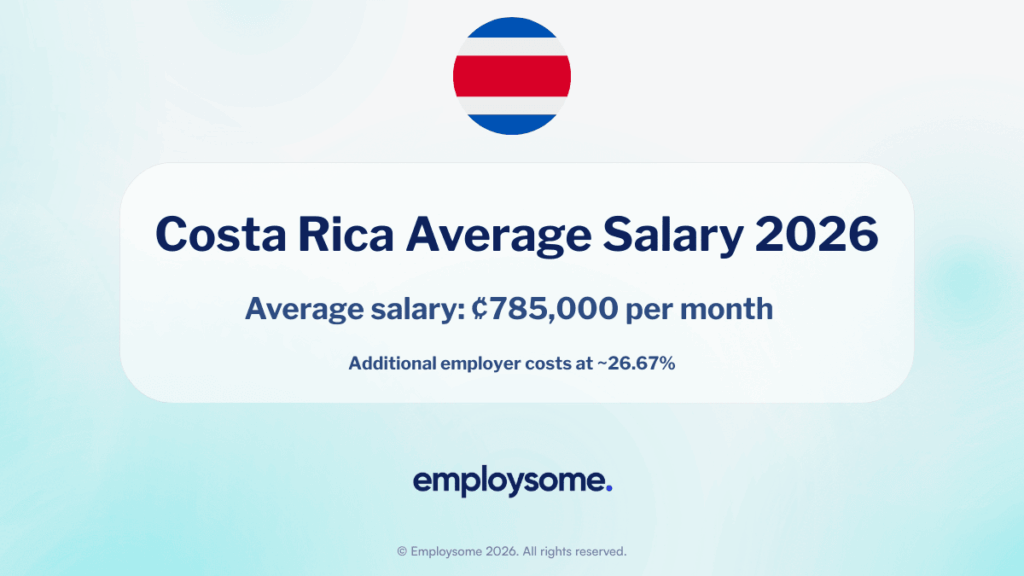
Table of Contents
- National Average Salary in Costa Rica (2026)
- Average Salary by City and Region
- Average Salary by Sector
- Average Salary by Experience Level
- Employer Social Security and Mandatory Contributions
- Aguinaldo (13th Month Salary) and Vacation
- Personal Income Tax
- Central American and Latin American Comparison
- FAQs
Costa Rica is the most stable and developed economy in Central America, with the highest minimum wage in Latin America (measured in USD for unskilled workers), a well-educated bilingual workforce, and a growing reputation as a nearshoring hub for US companies. Major tech firms including Microsoft, Amazon, and Intel have established operations in the country, and over 800 international technology companies operate from San José.
The average salary in Costa Rica is approximately ₡785,000 per month (~$1,500 USD) as of 2026, though this figure is pulled up by high earners in finance and technology. The median sits closer to ₡630,000 to ₡670,000 (~$1,210 to $1,290 USD). Unlike most Latin American countries, Costa Rica does not have a single national minimum wage. Instead, the National Salary Council (Consejo Nacional de Salarios) sets different minimum rates by occupational category, ranging from ₡373,092 for unskilled labour to ₡765,852 for university-degree holders.
For employers hiring in Costa Rica, whether through a local entity or an Employer of Record, the key financial consideration is the high employer social security burden. Employers contribute approximately 26.67% of gross salary to the CCSS (Caja Costarricense de Seguro Social) and other mandatory funds, making Costa Rica’s employer costs comparable to Brazil despite lower headline salaries.
💡 Employsome Insight: Costa Rica’s Employer Costs Are Higher Than You Expect
At approximately 26.67% in mandatory employer contributions (CCSS, INS, INA, IMAS, Banco Popular, and others), Costa Rica has one of the highest employer social security burdens in Latin America. When you add the mandatory aguinaldo (13th month salary), vacation pay, and severance provisions, total employment costs can reach 40 to 50% above gross salary. Many employers are surprised by this when comparing Costa Rica to lower-cost neighbours like Nicaragua or Guatemala.

National Average Salary in Costa Rica (2026)
|
Metric |
Value (2026) |
|
Average monthly salary |
~₡785,000 (~$1,500 USD) |
|
Median monthly salary |
~₡630,000 to ₡670,000 (~$1,210 to $1,290 USD) |
|
Salary range (all sectors) |
₡373,000 to ₡10,500,000+/month |
|
Minimum wage (unskilled labour) |
₡373,092/month (~$710 USD) |
|
Minimum wage (specialised worker) |
~₡452,000/month (~$860 USD) |
|
Minimum wage (university bachelor’s degree) |
~₡626,000/month (~$1,195 USD) |
|
Minimum wage (licenciatura / master’s level) |
~₡765,852/month (~$1,460 USD) |
|
General wage increase (Jan 2026) |
+1.63% (private sector) |
|
Average annual salary increment |
~9% every 17 months (~6% annualised) |
Costa Rica’s tiered minimum wage system is unique in Latin America. Rather than a single floor, minimum wages are set by occupational category based on skill level and education. This means two employees in the same company can have different legal minimum wages depending on their job classification.
Average Salary by City and Region
Costa Rica’s economy is heavily concentrated in the Greater Metropolitan Area (GAM) surrounding San José, which accounts for the majority of formal professional employment. Salaries outside the Central Valley are significantly lower.
|
City / Region |
Avg. Monthly Salary |
Notes |
|
San José (Greater Metropolitan Area) |
₡900,000 to ₡1,200,000+ |
Capital. Finance, tech, shared services. Highest salaries. ~40% of population. |
|
Heredia / Alajuela (Central Valley) |
₡750,000 to ₡1,000,000 |
Free Trade Zones. Intel, P&G, Amazon operations nearby. |
|
Cartago |
₡650,000 to ₡850,000 |
University town. Manufacturing and tech. |
|
Guanacaste / Puntarenas (Pacific coast) |
₡450,000 to ₡700,000 |
Tourism-dominated. Seasonal employment. Lower professional salaries. |
|
Limón (Caribbean coast) |
₡400,000 to ₡600,000 |
Port city. Agriculture (bananas, pineapples). Lower income region. |
|
Rural / agricultural regions |
₡373,000 to ₡500,000 |
Many workers near minimum wage. Agriculture and informal economy. |
Urban households in the GAM earn an average of approximately ₡1,173,000/month, while rural households average ₡720,000. This 40%+ gap reflects the concentration of professional and multinational employment in the Central Valley.
💡 Employsome Insight: Free Trade Zones Drive Salary Premiums
Costa Rica’s Free Trade Zones (zonas francas) in Heredia, Alajuela, and parts of San José host most of the country’s multinational operations and offer tax incentives that allow companies to pay above-market salaries. If you are hiring for a shared services, BPO, or tech role, benchmark against Free Trade Zone salaries, not the national average. Workers in these zones typically earn 30 to 50% more than the national median.
Average Salary by Sector
|
Sector |
Avg. Monthly Salary (₡) |
Senior / Manager Level (₡) |
|
IT / Software Development |
800,000 to 1,800,000 |
2,000,000 to 5,000,000+ |
|
Finance / Banking |
900,000 to 2,000,000 |
2,500,000 to 6,000,000+ |
|
Medical / Healthcare |
700,000 to 2,500,000 |
3,000,000 to 8,000,000+ (specialists) |
|
Engineering / Manufacturing |
700,000 to 1,500,000 |
1,800,000 to 4,000,000 |
|
Shared Services / BPO |
600,000 to 1,200,000 |
1,500,000 to 3,000,000 |
|
Legal / Professional Services |
800,000 to 1,800,000 |
2,000,000 to 5,000,000+ |
|
Education |
500,000 to 1,000,000 |
1,200,000 to 2,500,000 |
|
Tourism / Hospitality |
400,000 to 800,000 |
1,000,000 to 2,000,000 |
|
Retail / Services |
373,000 to 700,000 |
900,000 to 1,500,000 |
|
Agriculture |
373,000 to 550,000 |
700,000 to 1,200,000 |
Tech workers in Costa Rica earn between $20,000 and $45,000 per year, compared to the median salary of $124,200 for American tech workers. This 60 to 80% cost saving, combined with timezone alignment (GMT-6, just 1 to 2 hours behind US East Coast), makes Costa Rica one of the most attractive nearshoring destinations in the Americas for tech roles.
💡 Employsome Insight: Costa Rica’s Nearshoring Advantage Is Timezone + Talent + English
Costa Rica’s IT workforce is strong in software development, mobile apps, AI, and cloud computing. The country ranks high on English proficiency in Latin America, and most tech professionals in San José are bilingual. Combined with just 1 to 2 hours of timezone difference from the US East Coast and strong IP protection, Costa Rica offers a nearshoring package that is hard to match in the region. The main trade-off compared to Colombia or Mexico is that Costa Rican salaries are 15 to 25% higher for equivalent roles.
Average Salary by Experience Level
|
Experience Level |
Typical Monthly Salary Range (₡) |
|
Entry-level (0 to 2 years) |
373,000 to 600,000 |
|
Junior (2 to 5 years) |
600,000 to 1,000,000 |
|
Mid-level (5 to 10 years) |
1,000,000 to 1,800,000 |
|
Senior (10+ years) |
1,500,000 to 3,500,000 |
|
Director / Senior Management |
3,000,000 to 10,000,000+ |
Employees with 2 to 5 years of experience earn approximately 32% more than entry-level workers. Those with 10+ years earn about 21% more than those in the 5 to 10 year bracket. University education has a strong impact: a Bachelor’s degree adds approximately 24% to earning potential, and a Master’s or Licenciatura adds a further 29%.
Employer Social Security and Mandatory Contributions
Costa Rica’s employer contribution burden is among the highest in Latin America. The employer pays approximately 26.67% of gross salary to multiple mandatory funds, while the employee contributes approximately 10.67% (increasing to ~10.83% from January 2026 with the IVM adjustment).
|
Contribution |
Employer Rate |
Employee Rate |
|
CCSS: Health Insurance (SEM) |
9.25% |
5.50% |
|
CCSS: Pension (IVM) (from Jan 2026) |
5.58% |
4.33% |
|
Banco Popular (worker savings fund) |
0.25% |
1.00% |
|
INA (vocational training) |
1.50% |
0% |
|
IMAS (social development) |
0.50% |
0% |
|
Family Allowances (FODESAF) |
5.00% |
0% |
|
Labour Capitalisation Fund (FCL) |
3.00% |
0% |
|
Mandatory Supplementary Pension (ROP) |
1.50% |
0% |
|
INS (labour risk insurance, varies by industry) |
~1% to 3% |
0% |
|
Total (approx.) |
~26.67% to 28.67% |
~10.83% |
The IVM pension component increased by 0.16 percentage points for both employers and employees from 1 January 2026, as part of a gradual reform to strengthen the pension fund’s sustainability. Further increases are scheduled through 2029.
Worked Example: Professional Employee in San José
|
Cost Component |
Monthly Amount (₡) |
|
Gross salary |
1,200,000 |
|
Employer CCSS + funds (~26.67%) |
320,040 |
|
INS labour risk (~1.5%) |
18,000 |
|
Monthly employer cost |
1,538,040 (~$2,940 USD) |
|
Aguinaldo / 13th month (amortised: ₡1,200,000/12) |
100,000 |
|
Vacation provision (amortised) |
~33,333 |
|
Total annualised monthly cost |
~1,671,373 (~$3,190 USD) |
For a ₡1,200,000 gross salary, total annualised employer cost is approximately ₡1,671,000 per month, which is about 39% above the gross salary.
Aguinaldo (13th Month Salary) and Vacation
Costa Rica mandates an aguinaldo (Christmas bonus) equal to one month’s salary, calculated as one twelfth of all ordinary and extraordinary wages earned between 1 December of the previous year and 30 November of the current year. It must be paid during the first 20 days of December. This is mandatory for all employees, including those who are dismissed or resign during the year (pro-rated).
Employees are entitled to two weeks (12 working days) of paid vacation per year after 50 weeks of continuous service. Unused vacation must be compensated upon termination. Vacation pay is calculated at the employee’s regular salary rate.
Sick leave is managed through the CCSS. The employer pays the first 3 days at 50% of salary. From day 4 onwards, the CCSS pays 60% of the employee’s salary directly. Medical certification is required.
💡 Employsome Insight: The Aguinaldo Is Calculated on Total Earnings, Not Just Base Salary
A common payroll error in Costa Rica is calculating the aguinaldo based on base salary only. The legal requirement is that it covers all ordinary and extraordinary wages earned during the calculation period, including overtime, commissions, and regular bonuses. If your EOR or payroll provider calculates aguinaldo on base salary alone, the employee may have a valid claim for the difference.
Personal Income Tax
Costa Rica applies a progressive income tax (Impuesto Único sobre las Rentas del Trabajo) on employment income. The employer withholds tax monthly after deducting CCSS contributions. The 2026 brackets (subject to annual adjustment) are:
|
Monthly Taxable Income (₡) |
Tax Rate |
|
Up to ~₡929,000 |
0% (exempt) |
|
~₡929,001 to ~₡1,363,000 |
10% |
|
~₡1,363,001 to ~₡2,392,000 |
15% |
|
~₡2,392,001 to ~₡4,783,000 |
20% |
|
Over ~₡4,783,000 |
25% |
The generous tax-free threshold of approximately ₡929,000/month means that minimum wage earners and many mid-level workers pay zero income tax. Effective tax rates for most professionals are modest (5 to 10%), making Costa Rica’s personal tax burden relatively light compared to the heavy employer-side social security costs.
Central American and Latin American Comparison
|
Country |
Avg. Monthly (USD) |
Min. Wage (USD) |
Employer SI Rate |
Workweek |
|
Costa Rica |
~$1,500 |
~$710 (unskilled) |
~26.67% |
48 hrs |
|
Panama |
~$1,200 |
~$400 to $600 |
~13.25% |
48 hrs |
|
Colombia |
~$1,240 (professional) |
~$550 (incl. transport) |
~20 to 30% |
42 hrs (Jul 2026) |
|
Chile |
~$1,100 |
~$575 |
~5 to 8% (rising) |
42 hrs (Apr 2026) |
|
Mexico |
~$600 to $700 |
~$450 |
~25 to 30% |
48 hrs |
|
Guatemala |
~$400 to $500 |
~$380 |
~12.67% |
48 hrs |
|
Nicaragua |
~$300 to $400 |
~$200 to $300 |
~22.5% |
48 hrs |
Costa Rica has the highest average salaries and minimum wages in Central America. Its employer contribution rate is also among the highest in the region. However, the combination of political stability, strong education, bilingual workforce, and timezone alignment with the US makes it a premium nearshoring destination that justifies the higher cost for many employers.
💡 Hiring in Costa Rica?
Compare the best EOR providers for Costa Rica on Employsome. We score each provider on entity ownership, local compliance expertise, payroll accuracy, and CCSS handling so you can hire compliantly without setting up a Costa Rican entity. Visit our Costa Rica EOR Guide to see the full comparison.
Frequently Asked Questions
Approximately ₡785,000 per month (~$1,500 USD). The median is lower at ₡630,000 to ₡670,000 (~$1,210 to $1,290 USD). Professional salaries in San José typically range from ₡900,000 to ₡1,200,000+.
Costa Rica uses a tiered minimum wage system by occupational category. Unskilled labour: ₡373,092/month (~$710 USD). Specialised workers: ~₡452,000. University bachelor’s: ~₡626,000. Licenciatura/master’s: ~₡765,852. A general 1.63% increase was applied from 1 January 2026.
Approximately 26.67% of gross salary for CCSS (health + pension), INA, IMAS, FODESAF, Banco Popular, FCL, ROP, and INS. When aguinaldo (13th month) and vacation provisions are included, total annualised cost is approximately 39 to 50% above gross salary.
Yes. The aguinaldo (Christmas bonus) equals one month’s salary based on total earnings and must be paid in the first 20 days of December. It applies to all employees, including those who resign or are dismissed during the year (pro-rated).
Finance/banking, IT/software development, and medical specialists command the highest salaries. Senior management in multinational Free Trade Zone companies can earn over ₡5,000,000 per month ($10,000+ USD).
Yes. An Employer of Record becomes the legal employer under Costa Rican labour law and handles employment contracts, payroll, CCSS registration and contributions, INS labour risk insurance, aguinaldo, vacation pay, income tax withholding, and statutory compliance. This allows foreign companies to hire in Costa Rica without setting up a local entity.

Written by
Courtney Pocock is a Copywriter & EOR/PEO Researcher at Employsome with 15+ years of experience writing for the HR, corporate, and financial sectors. She has a strong interest in global business expansion and Employer of Record / PEO topics, focusing on news that matters to business owners and decision-makers. Courtney covers industry updates, regulatory changes, and practical guides to help leaders navigate international hiring with confidence.
Our content is created for informational purposes only and is not intended to provide any legal, tax, accounting, or financial advice. Please obtain separate advice from industry-specific professionals who may better understand your business’s needs. Read our Editorial Guidelines for further information on how our content is created
Other posts
Review other blog posts