Average Salary in Colombia 2026: Sector & Regional Breakdown
Colombia’s average professional salary is approximately COP 4.5 million per month (~$1,240 USD), with Bogota and Medellin both averaging above COP 5.3 million. The 2026 minimum wage jumped 23% to COP 1,750,905 plus a COP 249,095 transport subsidy, bringing the effective floor to COP 2,000,000 (~$550 USD). Employer contributions add 20 to 30% on top of gross salary, and when mandatory prima de servicios, cesantias, and vacation provisions are included, total annualised cost is approximately 35 to 40% above base salary. The standard workweek drops to 42 hours from July 2026 under Ley 2101 with no reduction in pay.

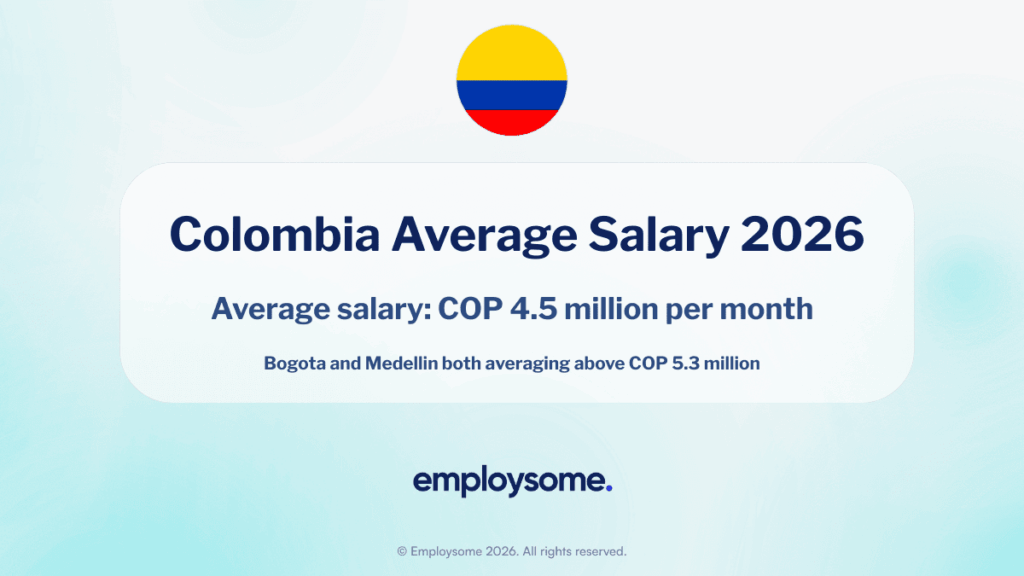
Table of Contents
- National Average Salary in Colombia (2026)
- Average Salary by City
- Average Salary by Sector
- Average Salary by Experience Level
- Employer Costs and Social Security Contributions
- Employer Costs and Social Security Contributions
- The 42-Hour Workweek (July 2026)
- Personal Income Tax
- Latin American Comparison
- FAQs
Colombia is rapidly emerging as one of Latin America’s most attractive hiring markets. With a population of over 52 million, a growing tech sector (24.5% growth since 2010), strong English proficiency in major cities, and timezone alignment with the US (GMT-5), the country has become a top nearshoring destination for IT, customer service, and professional services.
The average salary in Colombia for professional roles is approximately COP 4.5 million per month (~$1,240 USD) as of 2026. However, the headline story for 2026 is the historic 23% minimum wage increase that pushed the statutory floor to COP 1,750,905 plus a COP 249,095 transport subsidy, bringing the effective minimum to COP 2,000,000 per month (~$550 USD). This is the largest single increase in modern Colombian history.
For employers hiring in Colombia, whether through a local entity or an Employer of Record, understanding real salary levels, mandatory employer contributions, and the evolving labour reforms is critical for accurate budgeting and competitive compensation.
💡 Employsome Insight: The 23% Minimum Wage Hike Changes Everything for 2026 Budgets
Colombia’s 2026 minimum wage increase of 23% (from COP 1,423,500 to COP 1,750,905) is far above inflation (~5.3%) and was a politically driven decision by President Petro. This doesn’t just affect minimum wage workers. Many salaries, fines, visa thresholds, and statutory calculations in Colombia are expressed as multiples of the SMMLV (salario mínimo mensual legal vigente). If you have existing employees in Colombia, review all compensation packages against the new baseline. If you are using an EOR, confirm they have updated all contracts and statutory calculations for 2026.

National Average Salary in Colombia (2026)
|
Metric |
Value (2026) |
|
Average monthly salary (professional roles) |
~COP 4,500,000 (~$1,240 USD) |
|
Median monthly salary |
~COP 1,100,000 to 4,040,000 (varies widely by source and methodology) |
|
Salary range (all sectors) |
COP 900,000 to 20,900,000+/month |
|
Minimum wage (SMMLV) |
COP 1,750,905/month (~$485 USD) |
|
Transport subsidy |
COP 249,095/month |
|
Effective minimum (salary + transport) |
COP 2,000,000/month (~$550 USD) |
|
Minimum wage increase (2025 to 2026) |
+23% (largest increase in modern history) |
|
Average annual salary increment |
~7% every 19 months (~4% annualised) |
The wide range between average and median salary reflects Colombia’s significant income inequality and the large informal economy, which employs nearly half of the workforce. For employers hiring skilled professionals in Bogotá or Medellín, expect salaries well above the national median.
Average Salary by City
Colombia’s salary landscape is dominated by Bogotá and Medellín, which together account for the majority of formal professional employment. Cali, Barranquilla, and Cartagena offer lower salaries but are growing as secondary hubs.
|
City |
Avg. Monthly Salary |
Notes |
|
Bogotá |
COP 5,450,000 (~$1,500 USD) |
Capital. Financial, government, and corporate hub. Highest salaries nationally. 8+ million residents. |
|
Medellín |
COP 5,390,000 (~$1,490 USD) |
Innovation hub. Strong tech scene. Lower cost of living than Bogotá. |
|
Cali |
COP 3,800,000 to 4,500,000 |
Third-largest city. Manufacturing, agriculture, and services. |
|
Barranquilla |
COP 3,500,000 to 4,200,000 |
Caribbean port city. Industrial and logistics hub. |
|
Cartagena |
COP 3,200,000 to 4,000,000 |
Tourism and port. Lower professional salaries but growing. |
|
Bucaramanga |
COP 3,000,000 to 3,800,000 |
Emerging tech hub. Growing startup ecosystem. |
|
Smaller cities / rural |
COP 1,750,000 to 2,500,000 |
Many workers near minimum wage. Agriculture-dominated. |
💡 Employsome Insight: Medellín Is Closing the Gap with Bogotá
Medellín’s tech and innovation ecosystem has grown significantly, and professional salaries are now nearly equal to Bogotá for IT and digital roles. The city’s lower cost of living, better climate, and growing reputation as a nearshoring hub make it increasingly attractive for both employers and employees. If you are hiring remote workers in Colombia, Medellín often offers the best balance of talent quality, salary expectations, and employee satisfaction.
Average Salary by Sector
|
Sector |
Avg. Monthly Salary (COP) |
Senior / Manager Level (COP) |
|
Oil & Gas / Mining |
5,000,000 to 10,000,000 |
12,000,000 to 20,000,000+ |
|
Finance / Banking |
4,000,000 to 8,000,000 |
10,000,000 to 18,000,000+ |
|
IT / Software Development |
4,000,000 to 7,000,000 |
8,000,000 to 15,000,000 |
|
Telecommunications |
3,500,000 to 6,500,000 |
7,000,000 to 13,000,000 |
|
Engineering / Construction |
3,500,000 to 6,000,000 |
7,000,000 to 12,000,000 |
|
Healthcare / Medical |
3,000,000 to 7,000,000 |
10,000,000 to 20,000,000+ (surgeons/specialists) |
|
Marketing / Sales |
2,500,000 to 5,000,000 |
6,500,000 to 10,000,000+ |
|
Customer Service / BPO |
2,000,000 to 3,500,000 |
4,000,000 to 6,000,000 |
|
Education |
2,000,000 to 4,000,000 |
5,000,000 to 8,000,000 |
|
Retail / Hospitality |
1,750,000 to 3,000,000 |
3,500,000 to 6,000,000 |
|
Agriculture |
1,750,000 to 2,500,000 |
3,000,000 to 5,000,000 |
Colombia’s tech sector has grown by 24.5% since 2010, with the government positioning the country as Latin America’s Silicon Valley. Software developers earn between $18,000 and $45,000 annually (COP 75 million+ for senior roles), making Colombia 40 to 70% cheaper than the US for equivalent tech talent while offering strong timezone overlap.
💡 Employsome Insight: Colombia Is Latin America’s Fastest-Growing Nearshoring Destination
Colombia’s combination of timezone alignment with the US East Coast (GMT-5), growing bilingual workforce, competitive salaries (40 to 70% below US rates), and government support for the tech sector makes it arguably the strongest nearshoring market in Latin America for 2026. The 23% minimum wage hike increases costs at the lower end but has minimal impact on professional and tech salaries, which were already well above the minimum.
Average Salary by Experience Level
|
Experience Level |
Typical Monthly Salary Range (COP) |
|
Entry-level (0 to 2 years) |
1,750,000 to 2,500,000 |
|
Junior (2 to 5 years) |
2,500,000 to 4,500,000 |
|
Mid-level (5 to 10 years) |
4,000,000 to 7,000,000 |
|
Senior (10+ years) |
6,000,000 to 12,000,000 |
|
Director / C-suite |
10,000,000 to 20,000,000+ |
Employees with 5+ years of experience earn approximately 36% more than those with less experience. A Master’s degree adds roughly 29% to earning potential compared to a Bachelor’s degree. The average salary increment in Colombia is approximately 7% every 19 months, which annualises to about 4%.
Employer Costs and Social Security Contributions
|
Experience Level |
Typical Monthly Salary Range (COP) |
|
Entry-level (0 to 2 years) |
1,750,000 to 2,500,000 |
|
Junior (2 to 5 years) |
2,500,000 to 4,500,000 |
|
Mid-level (5 to 10 years) |
4,000,000 to 7,000,000 |
|
Senior (10+ years) |
6,000,000 to 12,000,000 |
|
Director / C-suite |
10,000,000 to 20,000,000+ |
Employees with 5+ years of experience earn approximately 36% more than those with less experience. A Master’s degree adds roughly 29% to earning potential compared to a Bachelor’s degree. The average salary increment in Colombia is approximately 7% every 19 months, which annualises to about 4%.
Employer Costs and Social Security Contributions
Colombia has a significant employer contribution burden, typically adding 20 to 30% on top of gross salary. The exact rate depends on whether the employer qualifies for the payroll tax exemption under Article 114-1 of the Colombian Tax Code.
|
Contribution |
Employer Rate |
Employee Rate |
|
Pension |
12% |
4% |
|
Health Insurance (EPS) |
8.5% |
4% |
|
Labour Risks Insurance (ARL) |
0.522% to 6.96% (risk-dependent) |
0% |
|
Family Welfare Fund (Caja de Compensación) |
4% |
0% |
|
SENA (vocational training) |
2%* |
0% |
|
ICBF (family welfare institute) |
3%* |
0% |
|
Total employer contributions |
~20 to 30% |
8% |
*Employers subject to income tax are exempt from Health (8.5%), SENA (2%), and ICBF (3%) contributions for employees earning under 10 SMMLV (COP 17,509,050/month in 2026) under Article 114-1 of the Tax Code. This exemption significantly reduces total employer costs for most employees.
Worked Example: Professional Employee in Bogotá (With Payroll Tax Exemption)
|
Cost Component |
Monthly Amount (COP) |
|
Gross salary |
5,000,000 |
|
Pension (12%) |
600,000 |
|
Labour Risks Insurance (~1%) |
50,000 |
|
Family Welfare Fund (4%) |
200,000 |
|
Total monthly employer cost |
5,850,000 (~$1,610 USD) |
|
Prima de servicios / 13th month (amortised monthly) |
~417,000 |
|
Cesantías / severance fund (amortised monthly) |
~417,000 |
|
Interest on cesantías (12% annual, amortised) |
~50,000 |
|
Vacation provision (amortised monthly) |
~208,000 |
|
Total annualised monthly cost |
~6,942,000 (~$1,910 USD) |
💡 Employsome Insight: Colombia’s “Hidden” Labour Costs Add Up Fast
Beyond the monthly employer contributions, Colombia mandates prima de servicios (a 13th month salary paid in two instalments in June and December), cesantías (a severance fund equal to one month’s salary per year, deposited annually), interest on cesantías (12% per year), and 15 days of paid vacation per year. When you add these to the base employer contributions, the true total cost of a COP 5,000,000 employee is closer to COP 6,900,000 per month, approximately 38% above gross salary.
The 42-Hour Workweek (July 2026)
Colombia is implementing a phased reduction of the standard workweek from 48 hours to 42 hours under Ley 2101. The workweek dropped from 48 to 47 hours in July 2023, to 46 hours in July 2024, and will reach 42 hours by July 2026. The final target is 42 hours, making Colombia one of the most progressive labour markets in Latin America alongside Chile.
As with Chile’s reduction, the law prohibits any reduction in pay as a result of the shorter workweek. Overtime kicks in after the weekly threshold: 125% for daytime overtime and 175% for nighttime or holiday overtime.
Personal Income Tax
Colombia applies a progressive income tax on employment income, calculated in Tax Value Units (UVT). The employer withholds tax (retención en la fuente) from the employee’s salary each month. The 2026 rates are:
|
Annual Taxable Income (UVT) |
Tax Rate |
|
0 to 1,090 UVT |
0% |
|
1,090 to 1,700 UVT |
19% |
|
1,700 to 4,100 UVT |
28% |
|
4,100 to 8,670 UVT |
33% |
|
8,670 to 18,970 UVT |
35% |
|
18,970 to 31,000 UVT |
37% |
|
Over 31,000 UVT |
39% |
For a minimum wage earner, the entire salary falls within the 0% bracket. For a professional earning COP 5,000,000/month, the effective tax rate is typically low (under 10%) after social security deductions and personal allowances.
Latin American Comparison
|
Country |
Avg. Monthly (USD) |
Min. Wage (USD) |
Employer SI Rate |
Workweek |
|
Colombia |
~$1,240 (professional) |
~$550 (incl. transport) |
~20 to 30% |
42 hrs (Jul 2026) |
|
Chile |
~$1,100 |
~$575 |
~5 to 8% (rising) |
42 hrs (Apr 2026) |
|
Brazil |
~$340 (national avg) |
~$300 |
~28 to 36% |
44 hrs |
|
Mexico |
~$600 to $700 |
~$450 |
~25 to 30% |
48 hrs |
|
Argentina |
~$400 to $600 (volatile) |
~$200 to $300 |
~25 to 30% |
48 hrs |
|
Peru |
~$400 to $500 |
~$280 |
~9 to 11% |
48 hrs |
Colombia’s 2026 minimum wage increase has pushed it above Chile’s minimum wage in dollar terms for the first time. However, average professional salaries remain below Chile’s due to Chile’s higher per-capita income. Colombia’s combination of competitive professional salaries, US timezone alignment, and growing bilingual workforce makes it the strongest nearshoring alternative to Mexico in the region.
💡 Hiring in Colombia?
Compare the best EOR providers for Colombia on Employsome. We score each provider on entity ownership, local compliance expertise, payroll accuracy, and pricing transparency so you can hire compliantly without setting up a Colombian entity. Visit our EOR in Chile Guide to see the full comparison.
Frequently Asked Questions
The average salary for professional roles is approximately COP 4.5 million per month (~$1,240 USD). In Bogotá and Medellín, professional salaries average COP 5.4 to 5.5 million. The national average including all sectors and the informal economy is significantly lower.
COP 1,750,905 per month (~$485 USD) plus a mandatory transport subsidy of COP 249,095, bringing the effective minimum to COP 2,000,000 (~$550 USD). This is a 23% increase over 2025, the largest in modern Colombian history.
Approximately 20 to 30% of gross salary for pension (12%), health (8.5%, often exempt), labour risks (0.5 to 7%), family welfare (4%), SENA (2%, often exempt), and ICBF (3%, often exempt). When you add mandatory prima, cesantías, interest, and vacation, total annualised cost is approximately 35 to 40% above gross salary.
Oil and gas/mining, finance/banking, and IT/software development command the highest salaries. Senior medical specialists (surgeons) can earn COP 10 to 20+ million per month. IT professionals earn COP 4 to 15 million depending on seniority.
Yes. Under Ley 2101, the standard workweek is being reduced from 48 hours to 42 hours in phases. It reaches 42 hours in July 2026. Pay cannot be reduced as a result of the shorter workweek.
Yes. An Employer of Record becomes the legal employer under Colombian labour law and handles employment contracts, payroll, pension and health contributions, prima de servicios, cesantías, income tax withholding, and statutory compliance. This allows foreign companies to hire in Colombia without setting up a local entity.

Written by
Dane Cobain is a Copywriter at Employsome and an accomplished author whose work spans fiction, non-fiction, and professional writing. Over the past decade, he has built a strong track record creating straightforward content for the HR, payroll, and corporate sectors. Dane brings a storyteller’s eye to the evolving world of global employment, with a particular focus on Employer of Record and PEO models. His articles explore industry trends and dedicated Best Of Guides when managing an international workforce.
Our content is created for informational purposes only and is not intended to provide any legal, tax, accounting, or financial advice. Please obtain separate advice from industry-specific professionals who may better understand your business’s needs. Read our Editorial Guidelines for further information on how our content is created.
Other posts
Review other blog posts